
Discover Peterborough
The History of Peterborough: An Interactive Timeline
Journey through the history of Peterborough, from Jurassic sea monsters and prehistoric communities to Roman industry, a Norman cathedral, two queens, the railway revolution and the growth of the modern city. Explore more than 165 million years of remarkable stories through our interactive Peterborough timeline.
Explore Peterborough’s history by period
Jurassic Peterborough

Long before human history, Peterborough lay beneath warm Jurassic seas. The rocks they left behind — golden limestone and grey, fossil-rich clay — would one day build the cathedral and much of modern Britain.
A tropical sea leaves its stone
In the Middle Jurassic, shallow, sunlit tropical seas cover the region, and shelly lime sediments settle on the sea floor — hardening over millions of years into the famous Barnack stone, the creamy limestone that medieval masons would one day use to build Peterborough Cathedral.
Barnack "rag" was quarried from Roman times onwards and prized across eastern England — by around 1500 the best beds were essentially worked out. The abandoned medieval quarry pits at Barnack, known as the Hills and Holes, are now a National Nature Reserve whose limestone-loving wildflowers grow, quite literally, on the leftovers of the cathedral.
Sea monsters of the Oxford Clay
The seas deepen, and fine muds settle to form the Oxford Clay — waters patrolled by dolphin-like ichthyosaurs, long-necked plesiosaurs, huge predatory pliosaurs and vast shoals of fish, whose remains sink into the sea floor and are preserved for 165 million years.
The brick pits dug into the clay around Fletton from Victorian times turned out to be a fossil treasure house. Local collector Alfred Leeds of Eyebury amassed world-famous finds — including the colossal filter-feeding fish Leedsichthys, named in his honour — and in 2008 a fossil shark from near the city was named Planohybodus peterboroughensis after Peterborough itself. The internationally important Jurassic marine reptile collection at Peterborough Museum & Art Gallery is the star of its galleries today. And in a neat twist of deep time, it is the oily, organic-rich character of this ancient sea-floor clay that later made Fletton bricks so cheap to fire.
Prehistoric Peterborough
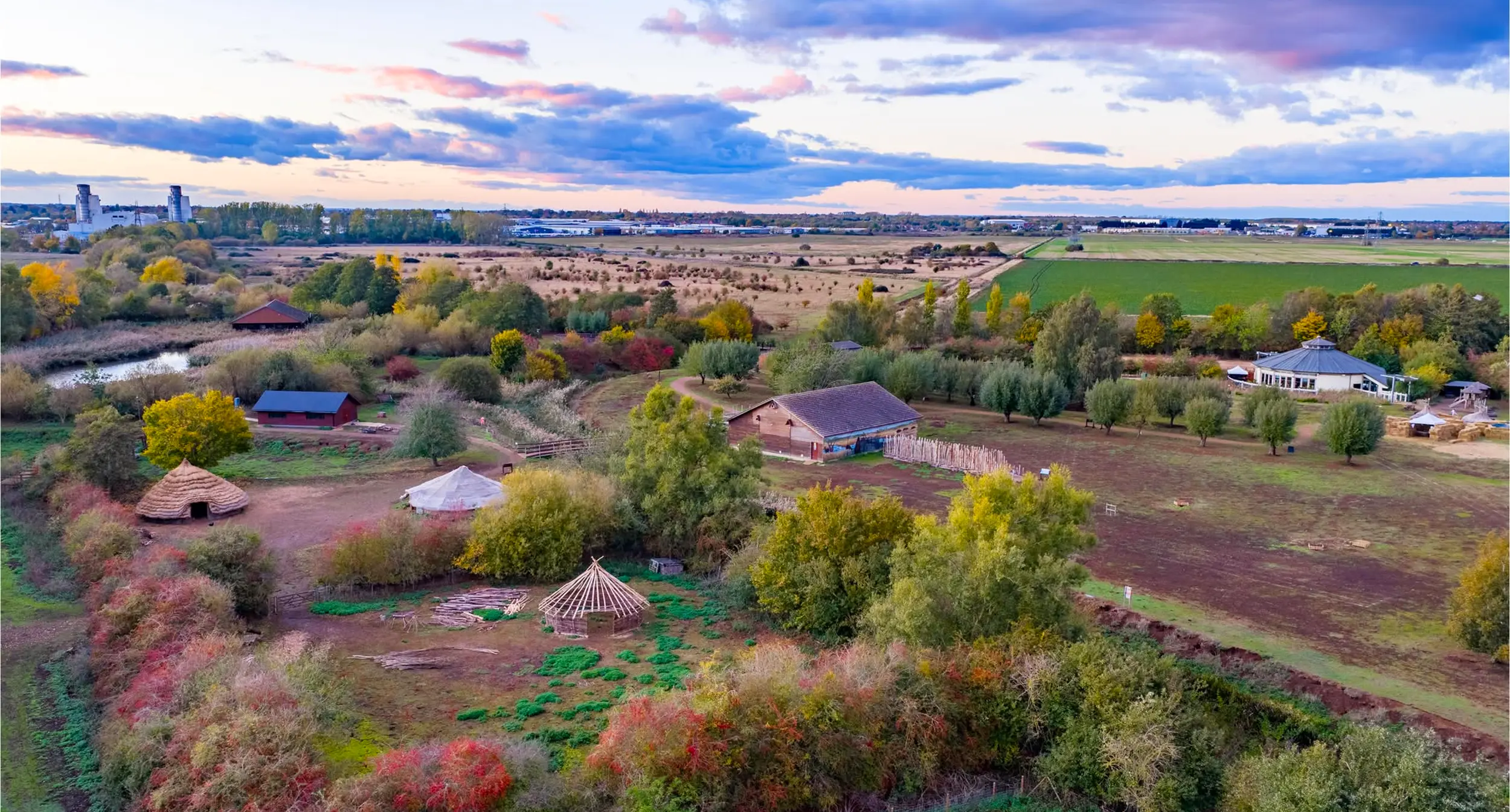
Woodland, fertile farmland and wetland met here on the edge of the fens, making this one of the most intensively settled landscapes in prehistoric Britain — much of it preserved for millennia beneath the peat.
Mammoths on the tundra
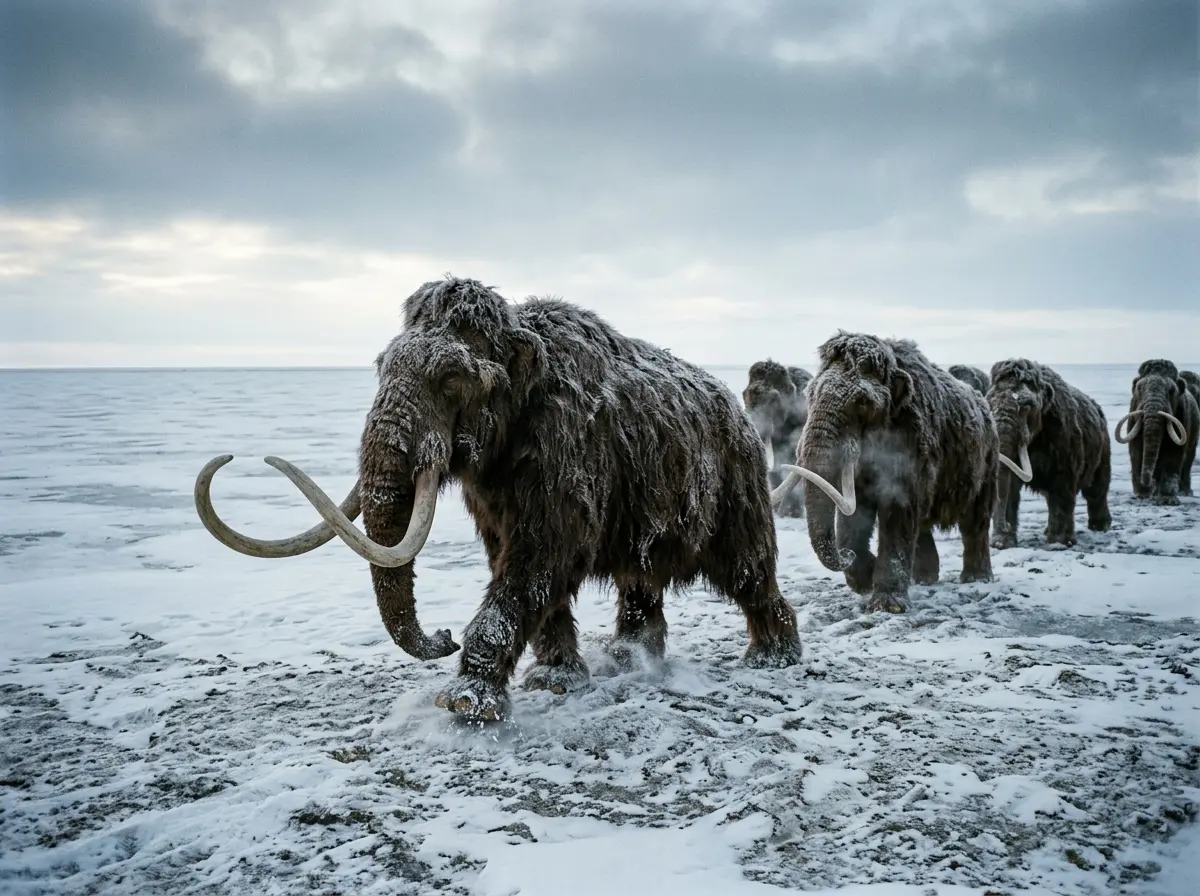
As the last Ice Age loosens its grip, the Peterborough area is a freezing wilderness roamed by mammoth, woolly rhinoceros, bears and reindeer — their bones still turn up in the gravels of the river valleys.
Bands of hunters probably ranged north in the brief summers, but there were no settled communities yet. As the climate warmed, rising seas drowned the land bridge to the continent by around 6500 BC, and Britain became an island. Hunter-gatherers left behind delicate flint tools, some now displayed at Peterborough Museum & Art Gallery.
The first farmers: Maxey and Etton
Well-organised Neolithic communities raise monumental earthworks in the Welland valley just north of the city — a great ditched cursus near Maxey and a causewayed enclosure at Etton, a gathering place for feasting, trade and ceremony.
Etton's waterlogged ditches preserved wooden tools, pottery and carefully placed offerings — one of the clearest pictures anywhere of Neolithic ritual life. The area even gave its name to a national style of decorated Stone Age pottery: archaeologists still call it "Peterborough Ware", pitted with patterns made from cord, bone, sticks and fingernails.
The Fengate field systems
Bronze Age farmers lay out ditched fields and droveways at Fengate, on the eastern edge of the modern city — among the earliest planned farming landscapes yet found in Britain.
Pioneering excavations led by archaeologist Francis Pryor from the 1970s revealed a highly organised world of livestock farming on the fen margin, overturning old ideas of a "primitive" prehistoric Britain. His work at Fengate led directly to the discovery of Flag Fen in 1982.
Flag Fen: a causeway across the waters
Over four centuries, communities drive some 60,000 upright timbers and lay a quarter of a million horizontal planks to build a kilometre-long causeway and platform across the marsh between Fengate and Whittlesey — a place of crossing, ceremony and offering.
Discovered in 1982 during a survey of local dykes, Flag Fen is one of Europe's most important Bronze Age sites. Swords, daggers, jewellery and tools were deliberately broken and cast into the water as offerings, and the museum displays what is thought to be Britain's oldest wheel. Today, visitors can visit Flag Fen Archaeology Park to see the preserved 3,000-year-old timbers lying where they were placed.
Must Farm — "Britain's Pompeii"
A settlement of nearly new roundhouses built on stilts above a river channel near Whittlesey catches fire and collapses into the mud below, freezing a single day of Bronze Age life in astonishing detail for 3,000 years.
Excavated in 2015–16, Must Farm yielded complete pots with food still inside, exquisite textiles, thread still wound on its bobbins, wooden wheels and log boats carved from single trees — the best-preserved Bronze Age dwellings ever found in Britain. Many finds are displayed at Peterborough Museum & Art Gallery and Flag Fen.
The Iron Age fen edge
Iron replaces bronze from around 700 BC, coins appear by the late second century BC, and thatched roundhouse settlements dot the fen edge — including a fort out at Borough Fen, between today's Peakirk and Newborough.
Life here shows remarkable continuity: sites such as Fane Road in Walton were farmed straight through from the Iron Age into Roman times. Even before the legions landed, Roman goods, technology and fashions were already filtering into the fenland world they would soon transform.
Roman Peterborough
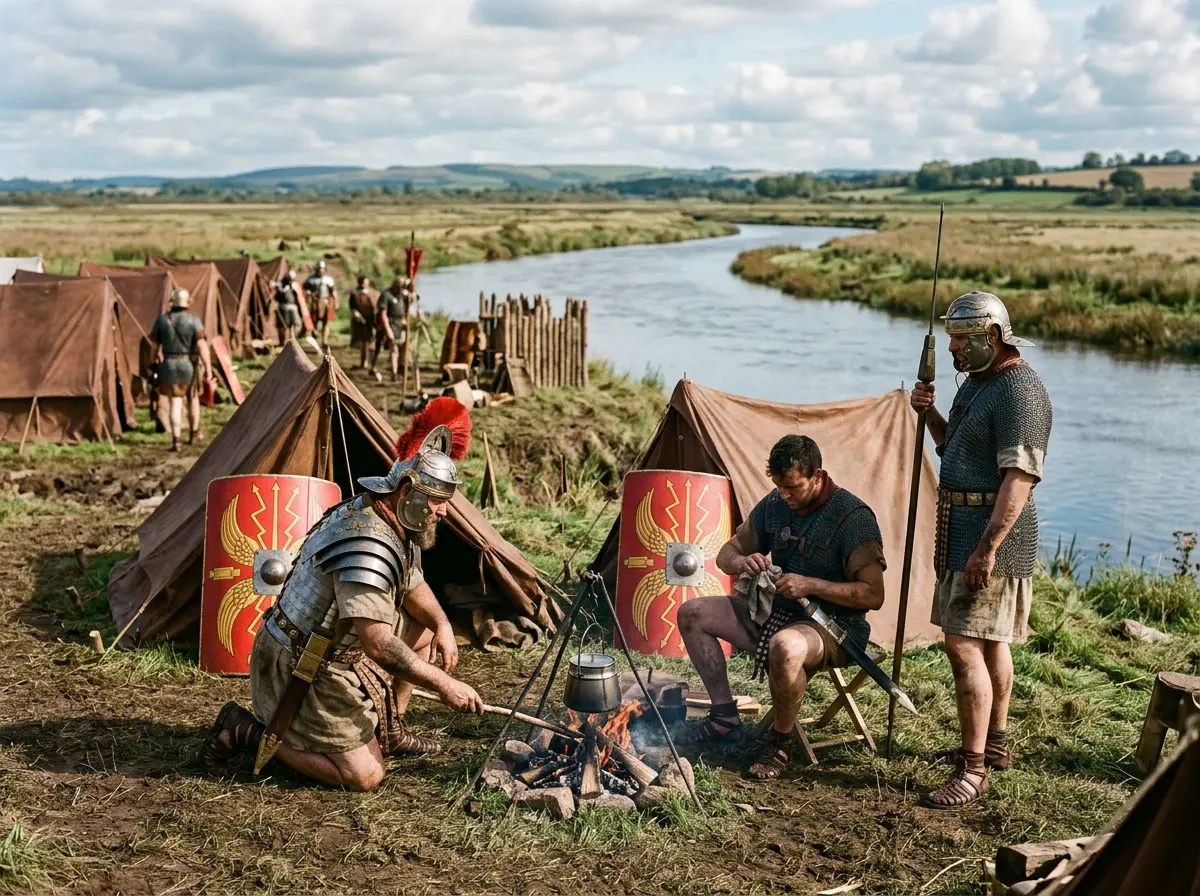
The legions arrive, Ermine Street marches north, a canal skirts the fens — and the Nene valley becomes one of Roman Britain's industrial powerhouses.
The legions at Longthorpe
Within a few years of the invasion of AD 43, the Romans build a fortress at Longthorpe beside the Nene — big enough for around 3,000 men — on ground now occupied by a golf course.
It was from Longthorpe that soldiers of the Ninth Legion marched out against Boudica's revolt in AD 60–61 — and back to Longthorpe that the survivors fled after a devastating ambush in which most of the force was destroyed. The Fen Causeway, a Roman road striking east across the wetlands towards Norfolk, passed over the older ritual landscape at Flag Fen, where an exposed section can still be seen.
Durobrivae and the pottery boom
Where Ermine Street bridges the Nene at Water Newton, a fort grows into the walled town of Durobrivae — officially a Roman "small town", but in reality one of the most prosperous in Britain, ringed by industrial suburbs.
Kilns between the town and Castor mass-produced pottery and worked iron on an industrial scale. The famous Nene Valley colour-coated wares — fine cups and beakers, some decorated with lively hunting scenes — were traded as far as Cornwall and the Antonine Wall in Scotland. Durobrivae first appears in surviving records in the Antonine Itinerary, a late 2nd-century Roman route book.
Car Dyke and the Castor Praetorium
Roman engineers cut Car Dyke, a 122-kilometre waterway along the fen edge — skirting Eye, Dogsthorpe and Werrington on its way towards Lincoln — while at Castor rises one of the largest and most elaborate Roman buildings in the whole country.
Whether Car Dyke was for transport, drainage or both is still debated; stretches of it survive at Werrington. The vast complex at Castor, known as the Praetorium, stood where the parish church now sits and is thought to have handled regional administration and tax collection. Wealthy villas dotted the surrounding countryside — including one excavated by the community at Itter Crescent, off Fane Road, in the north of the modern city.
The Water Newton Treasure
A hoard of silver vessels and plaques buried near Durobrivae — rediscovered in 1975 — reveals a strong, wealthy Christian community in the town, and ranks as the earliest group of Christian liturgical silver yet found anywhere in the Roman Empire.
The treasure, now in the British Museum, includes cups, bowls and votive plaques marked with the Chi-Rho symbol of Christ — a remarkable prologue to Peterborough's later story as a great centre of Christianity. Within decades, Roman control faded: the field army was withdrawn in the early 400s and Britain's towns were told to look to their own defence.
Anglo-Saxon and Viking Peterborough
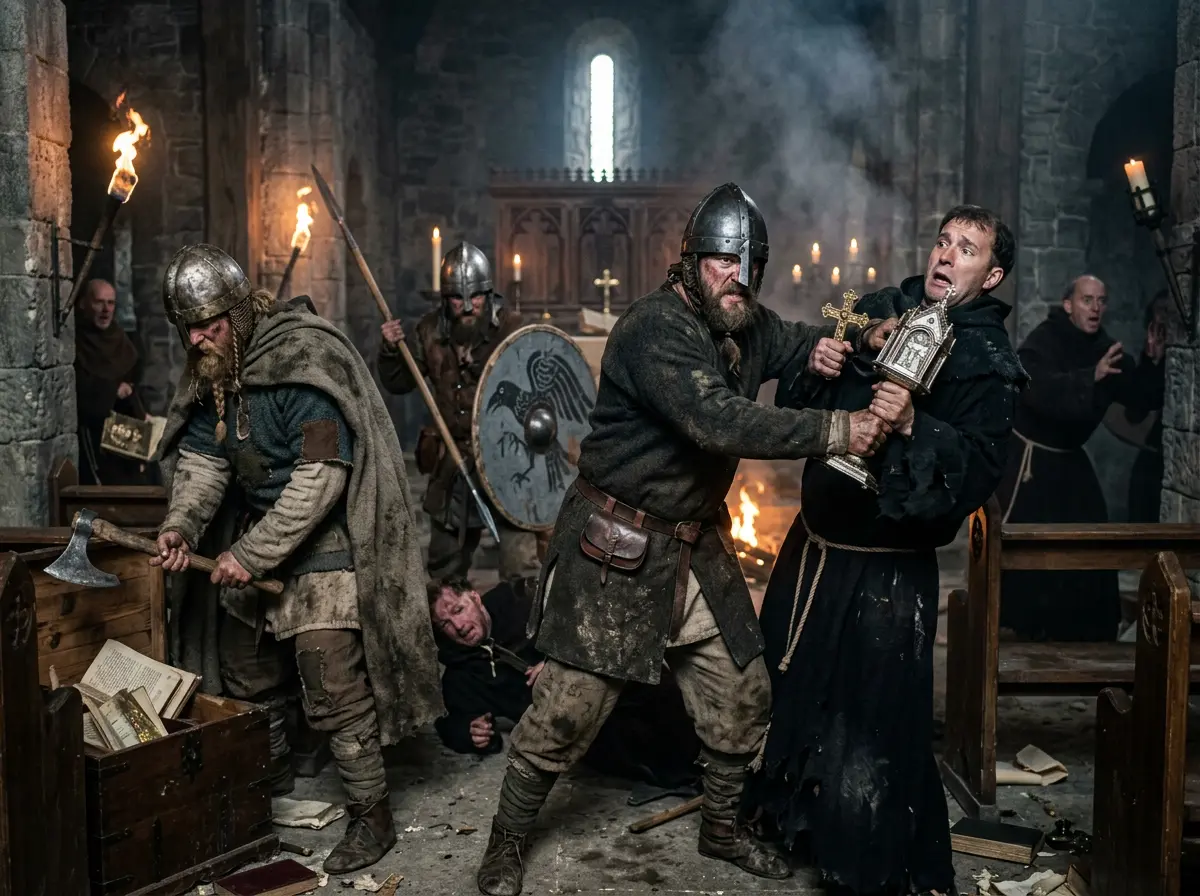
A monastery rises at Medeshamstede, is destroyed by Viking raiders, and rises again as the "Golden Borough" — the town that becomes Peterborough.
Medeshamstede is founded
Peada, son of the pagan king Penda of Mercia, embraces Christianity and founds a monastery at the Saxon village of Medeshamstede — "the homestead in the meadows" — on the very site where the cathedral stands today. Saxulf is its first abbot.
Peada's brother Wulfhere completed the monastery, and Saxulf went on to become bishop of Mercia in 673. Medeshamstede grew into one of the great monastic centres of Middle Anglia, while hermit-saints such as Guthlac at Crowland and Pega at Peakirk sought out the watery wilderness of the fens. The beautifully carved Hedda Stone, still kept in the cathedral, survives from this early monastery.
Viking raiders destroy the monastery
The Danish Great Army, which had landed in 865 and toppled kingdoms across eastern England, plunders the abbey at Medeshamstede. Later monastic tradition held that every monk was killed, and the site is abandoned for a century.
The carved Hedda Stone appears to mark the shrine of the monks remembered as martyrs of the raid. The region passed into the Danelaw — and it was under Danish law that the idea of the "Soke", a district answerable to its lord's court, first took root here. The Soke of Peterborough would keep a separate identity for the next thousand years.
Rebirth as the "Golden Borough"
Guided — so the abbey's chronicler Hugh Candidus tells it — by a vision, Bishop Æthelwold of Winchester finds the ruined monastery being used to stall cattle and sheep, and with King Edgar's backing refounds it as a Benedictine abbey dedicated to St Peter.
Around the year 1000 a defensive wall or "burgh" was raised against Danish raids, and the abbey became known as Burgh — eventually Peterborough, "St Peter's borough". Its wealth earned it another name too: Gildenburgh, the Golden Borough. The abbot allowed the villagers a market, and a small town began to grow at the abbey gates.
Hereward the Wake sacks the abbey
Locally born resistance leader Hereward the Wake, allied with a Danish fleet occupying Ely, attacks Peterborough — sacking the abbey and burning the town just as William the Conqueror's newly appointed Norman abbot, Turold, approaches from Stamford.
The abbey's treasures were carried off and mostly never recovered. Turold's response was to raise a castle mound between monastery and town — still visible today as Tout Hill in the Deanery garden — and William punished the town's doubtful loyalty by demanding it supply sixty knights. Hereward's fenland rebellion made him one of England's most enduring folk heroes, and his name lives on across the modern city.
Medieval Peterborough
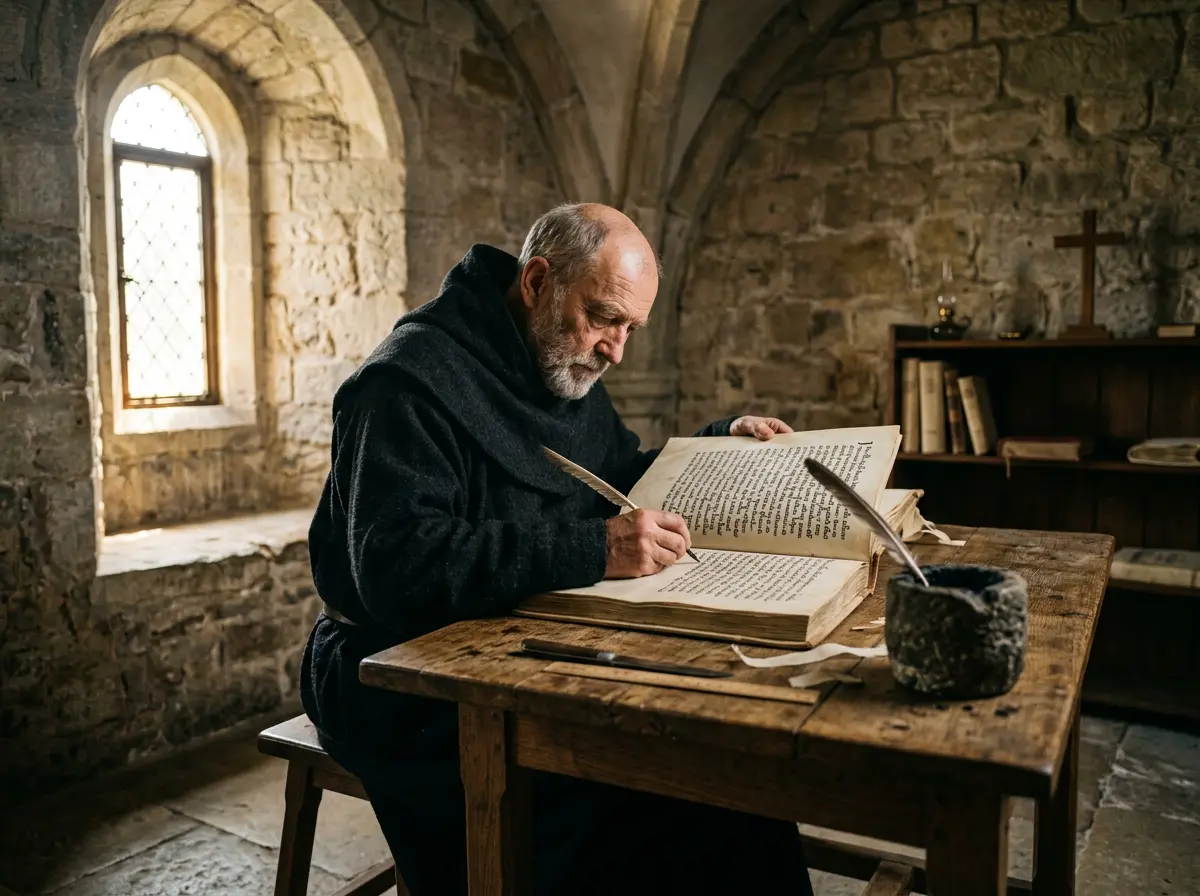
Fire, rebirth and glory: the age that gives Peterborough its cathedral, its chronicle, its bestiary, its market place — and its painted ceiling.
Fire — and the birth of the cathedral
A blaze breaks out in the abbey bakehouse and destroys both the monastery and the town. In 1118, under Abbot John de Séez, work begins on a magnificent new Norman church — the very building that stands at the heart of the city today.
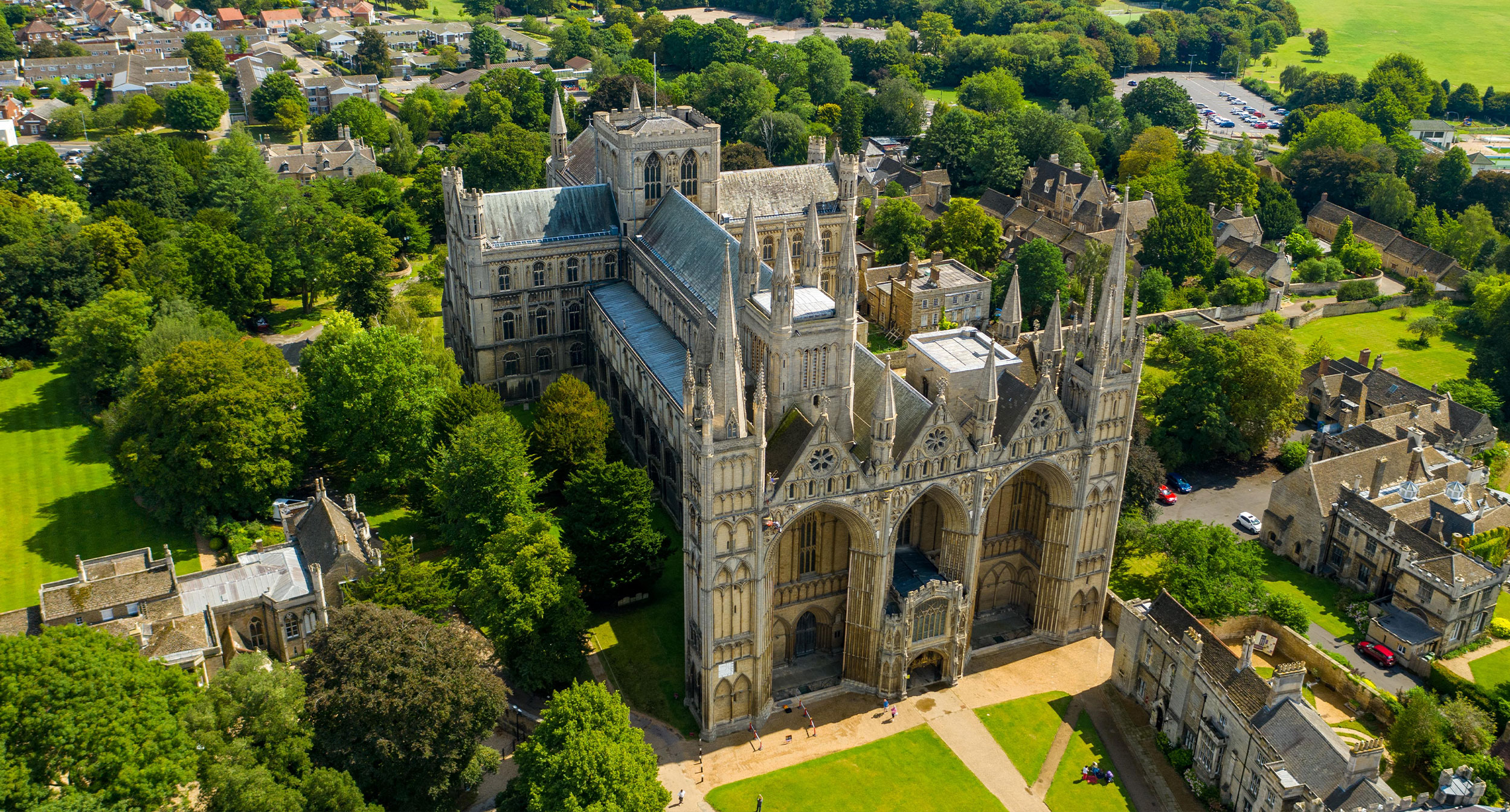
Built of creamy Barnack limestone quarried nearby, the new abbey church rose over the following 120 years. Its triple-arched Gothic West Front, with the statues of St Peter, St Paul and St Andrew looking down from its gables, has no architectural precedent and no direct successor — one of the most dramatic façades in Europe. A stained-glass window in the cathedral still depicts the great fire.
The Peterborough Chronicle
Monks at Peterborough copy and continue the Anglo-Saxon Chronicle, carrying it on decades after every other version had fallen silent — the only known prose history written in English between the Norman Conquest and the later 1300s.
The Chronicle's final entries include an unforgettable eyewitness account of the anarchy of King Stephen's reign, when — as the Peterborough monk despairingly wrote — it seemed that Christ and his saints slept. A foundation stone of English literature, written here.
Abbot Martin lays out the town
Abbot Martin de Vecti rebuilds the settlement on dry limestone to the west of the monastery — away from the flood-prone marshland to the east — laying out the market place and a wharf beside the river. The shape of Peterborough's city centre is set for the next 900 years.
The "Marketstede" — today's Cathedral Square — grew up beyond the abbey's west gate, and street names that still survive appeared: Cowgate, and Cumbergate, named for the wool-combers whose trade became the town's main medieval industry. In 1189 Richard I granted the abbey an annual fair, a mark of Peterborough's growing importance as an agricultural and trading centre.
The great church is consecrated
After 120 years of building, the abbey church is consecrated — a statement in stone of the abbey's immense wealth and prestige, and a structure that has remained little changed ever since.
The abbots held total power over the townspeople, running law and order, building projects and the town's growth. It wasn't always peaceful: during the war between King John and his barons, refugees sheltered in the monastery until the king's soldiers forced the sanctuaries and carried off great treasures. A 13th-century wooden windlass used by the original builders still survives in the cathedral roof.
The painted nave ceiling
Artists complete a vast painted wooden ceiling over the nave — a dazzling lozenge pattern of kings, saints, musicians and monsters. It is the only one of its kind in Britain, and one of just a handful in Europe.
Remarkably, the ceiling still survives, nearly 800 years on — overpainted twice but never replaced. Lying back to gaze up at it remains one of the great experiences of any visit to Peterborough Cathedral.
The painted chamber at Longthorpe Tower
The de Thorpe family add a three-storey tower to their manor house at Longthorpe around 1290–1300, then cover its walls with an extraordinary scheme of paintings — today considered the finest domestic medieval murals in northern Europe.
Hidden under whitewash for centuries and rediscovered in 1945, the paintings cover almost every surface with religious, secular and mythical scenes, heraldry, birds and beasts — including the famous Wheel of the Five Senses. Longthorpe Tower, now in the care of English Heritage, offers a rare window into how a wealthy medieval household saw its world.
The Peterborough Bestiary
Scribes and illuminators create the Peterborough Bestiary — a gorgeously painted encyclopaedia of beasts real and imagined, from lions and elephants to dragons and unicorns, shimmering with gold leaf.
Each creature carried a moral lesson for its medieval readers. The manuscript, now held at Corpus Christi College, Cambridge, is one of the finest bestiaries ever made and a testament to the artistry of Peterborough's monastic scriptorium.
Bridges, fairs and a parish church
The town's first bridge over the Nene — built of wood in 1308 to replace a ford — will serve for over 560 years. The parish church of St John the Baptist is completed beside the market place in 1407, and in 1439 Henry VI grants the abbot the fair still known today as the Bridge Fair.
The Bridge Fair, held on both banks of the river, survives to this day — complete with a civic proclamation and a traditional sausage lunch at the Town Hall. The Black Death of 1349 cast a long shadow over the same century, killing townspeople and monks alike; in the same year the Soke of Peterborough gained its own court sessions, separate from the rest of Northamptonshire.
Fan vaults: the New Building
In the last flowering of the medieval abbey, the "New Building" is added behind the high altar, crowned with exquisite fan vaulting attributed to John Wastell — the master mason of King's College Chapel, Cambridge.
It was the abbey's final great architectural project. Within a generation, the world that built it would be swept away by the Reformation.
Tudor and Stuart Peterborough
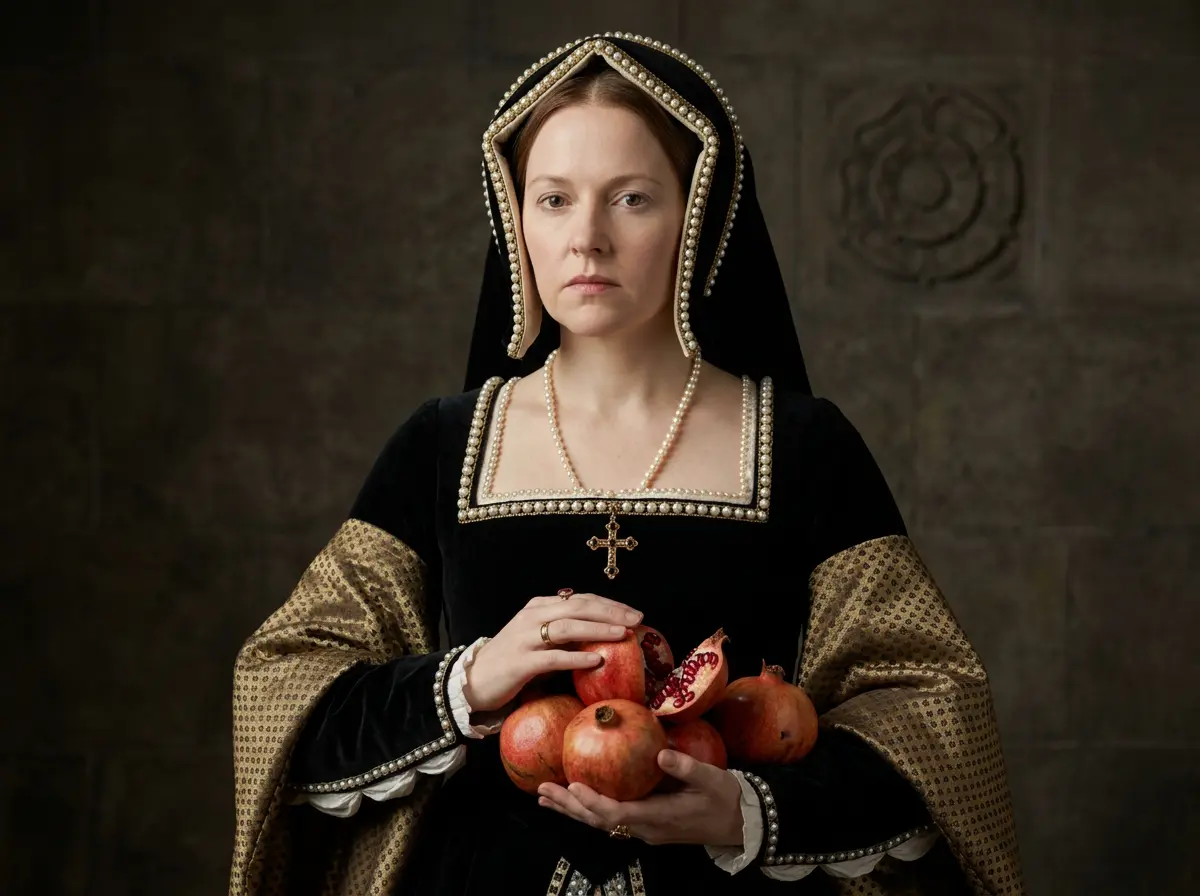
Two queens are buried here, an abbey becomes a cathedral, a city is born — and civil war and fen drainage remake the world around it.
Katharine of Aragon is laid to rest
Henry VIII's first queen, Katharine of Aragon, dies at Kimbolton and is buried with honour in Peterborough Abbey. Her tomb remains in the cathedral, still visited and still decked with pomegranates — her personal emblem.
Every January the city marks the Katharine of Aragon Festival in her memory, and Peterborough is twinned with Alcalá de Henares in Spain, the town of her birth. Tradition holds that her grave helped save the abbey: when the monasteries fell, Peterborough was spared destruction.
Dissolution — and a city is born
The great abbey — assessed at the enormous annual income of nearly £2,000 — surrenders to Henry VIII's commissioners in 1539. But instead of demolition, transformation: in 1541 the abbey church becomes the cathedral of a brand-new diocese, and Peterborough is declared a city.
The last abbot, John Chambers, deftly became the first Bishop of Peterborough, and the abbot's house became the bishop's palace. Henry also founded The King's School, which thrives to this day. Because the precincts passed intact to the new Dean and Chapter, an exceptional amount of the medieval abbey — gateways, cloister buildings and precinct walls — still survives around Cathedral Square.
Mary, Queen of Scots is buried here
After her trial and execution at nearby Fotheringhay Castle, Mary, Queen of Scots is buried in Peterborough Cathedral — making it the resting place of two queens.
Both royal graves were dug by the same remarkable man: Robert Scarlett, "Old Scarlett", the cathedral sexton who died in 1594 aged 98, whose portrait still watches over the west door — and who has even been suggested as the inspiration for the gravedigger in Shakespeare's Hamlet. In 1612 Mary's son, King James, moved her body to Westminster Abbey, but her original burial place is still marked in the cathedral. This was also the great age of the local dynasties: Burghley House rose near Stamford for Sir William Cecil, Elizabeth I's Lord Treasurer, and Milton Hall for the Fitzwilliams.
Draining the fens
A company of wealthy "Gentleman Adventurers" led by the Earl of Bedford hires the Dutch engineer Cornelius Vermuyden to drain the fens — beginning, against fierce local opposition, the transformation of the watery wilderness into some of England's richest farmland.
New cuts and windmill-driven pumps carried water more swiftly to the Wash, and by the end of the 17th century much of the great scheme was complete. The work would continue for two more centuries — and its final act, the draining of Whittlesey Mere, still lay ahead.
Civil war comes to the cathedral
Peterborough is divided between Cavalier and Roundhead when war breaks out. In 1643 Parliamentarian soldiers, passing through to attack Royalist strongholds at Stamford and Crowland, ransack the cathedral — destroying the Lady Chapel, chapter house, cloister, high altar, choir stalls and medieval records.
The damage was among the worst suffered by any English cathedral in the war — yet the painted nave ceiling, high above the soldiers' reach, survived. Their beer bottles, clay pipes and musket balls were found in abundance during a 2016 excavation in the Dean's garden. Nearby, Parliament built the Horsey Hill gun fort to guard the Nene crossing; its earthworks survive between Stanground and Whittlesey.
Thorpe Hall and the Guildhall
Oliver St John, Cromwell's Lord Chief Justice, builds Thorpe Hall — one of the very few grand mansions raised during the Commonwealth — and after the Restoration, John Lovin builds the Guildhall (1669–71) that still presides over Cathedral Square.
The Guildhall's open, columned ground floor sheltered the butter and poultry markets, and it later served as Peterborough's town hall from 1874 until 1933. Thorpe Hall, after later lives as a maternity hospital, is today a Sue Ryder hospice — still one of the city's architectural treasures.
Georgian and Railway Peterborough
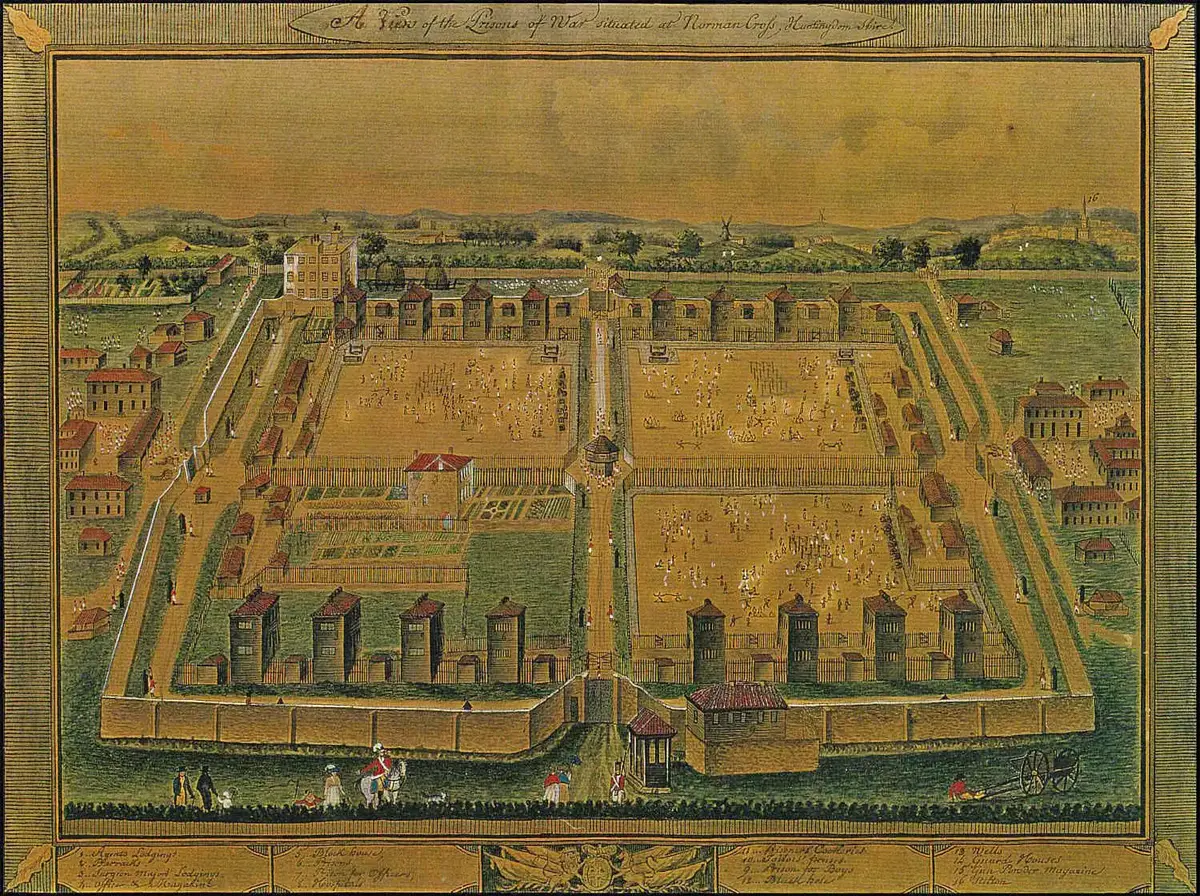
A quiet market town of a few thousand souls is transformed, within a single generation, into one of England's great railway crossroads.
A Georgian market town
Mid-18th-century Peterborough is a river port and market town of around 3,000 people. The Nene is made fully navigable to Northampton by 1761, the first theatre opens in 1774, and in 1790 Improvement Commissioners are appointed to pave, clean and light the streets.
The handsome Custom House beside the Town Bridge — built in the early 1700s — still recalls the city's days as an inland port, when goods moved by water between the Midlands and the Wash.
John Clare, the peasant poet, is born
In the village of Helpston, just outside Peterborough, John Clare is born into a farm labourer's family. He becomes one of England's greatest poets of nature and the countryside.
Clare wrote with unmatched intimacy about the fields, birds and seasons of the landscape around Peterborough — and about the pain of seeing it enclosed and changed. His manuscripts are held at Peterborough Museum, he is buried in Helpston churchyard, and John Clare Cottage — his home from birth until 1832 — now celebrates his life and work.
Norman Cross: the world's first POW camp
On the city's outskirts, the Admiralty builds the Norman Cross Depot to hold prisoners from the wars with France — believed to be the world's first purpose-built prisoner-of-war camp, housing up to 6,300 men guarded by 500 soldiers.
The French prisoners, held here until 1814, passed their years crafting astonishingly intricate models and trinkets from bone, straw and wood. Peterborough Museum holds the celebrated Norman Cross collection of their work, and the site — recently taken into the care of the Nene Park Trust — can still be visited.
Cowgate’s lost burial ground opens
With the old parish burial ground beside the Cathedral full, St John the Baptist buys three acres of farmland at the western end of Cowgate. Elizabeth Money becomes the first person buried there in March 1805.
For the next half century this was Peterborough’s parish cemetery. It later became the scene of the city’s first recorded body-snatching case in 1828, before railways, roads, the Queensgate development and pedestrian subways transformed the site almost beyond recognition. The story resurfaced dramatically during City Link works in 2026, when human remains were found within the roundabout.
The railways arrive — and everything changes
Peterborough's first trains steam in on lines from Northampton and Ely in 1845. In 1850 the Great Northern Railway opens direct services to London, with the line north to Doncaster following in 1853 — and the market town finds itself on the spine of Britain's railway network.
Peterborough owed some of its luck to Stamford: Lord Exeter's opposition to the railway there pushed the main line through Peterborough instead. The 1847 Nene Viaduct, built by William and Joseph Cubitt, still carries trains today and is the oldest surviving cast-iron railway bridge in the UK. Whole new neighbourhoods — most famously New England, built by the Great Northern for its workers — grew up around the sheds and yards, and the town's population soared. Today's East Coast Main Line follows the same route, while the Nene Valley Railway keeps the steam age alive.
Whittlesea Mere is drained
The largest lake in lowland England — Whittlesea Mere, a place of regattas, eel fisheries and winter skating just south of Peterborough — is pumped dry by a new steam engine, the final dramatic act of the great fen drainage.
An iron post sunk at nearby Holme Fen in 1852 to measure the shrinking peat now stands roughly four metres proud of the ground — dramatic proof of how drainage lowered the land. Holme Fen today lies about 2.75 metres below sea level, the lowest point in Great Britain, and nearby nature reserves are slowly rewetting the ancient fen.
Victorian and Industrial Peterborough
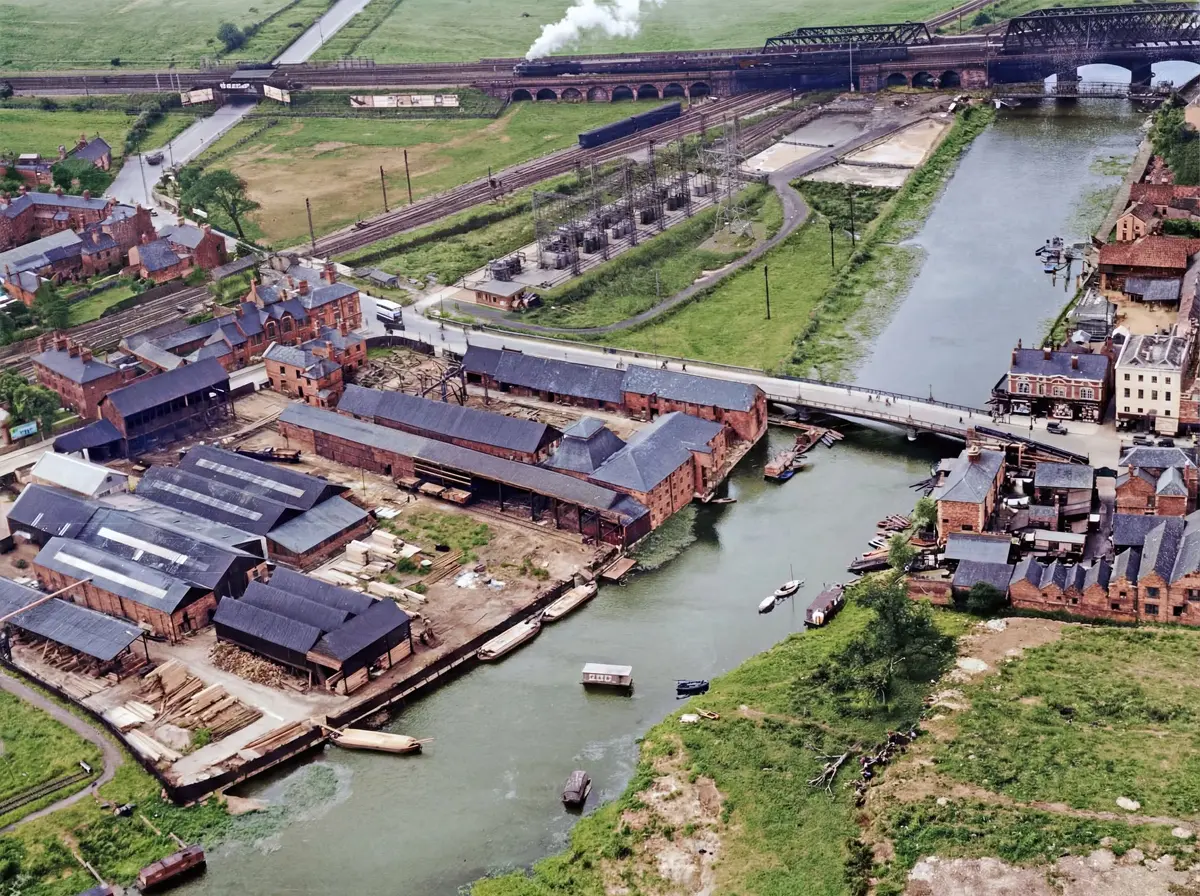
Bricks, engines and civic pride: over two centuries the population grows from 3,000 to 160,000 — and Peterborough builds much of modern Britain, quite literally.
A proud Victorian borough
Fast-growing Peterborough is incorporated as a municipal borough in 1874, with its first elected mayor and council. Piped water and sewers arrive by 1880, electric trams start running in 1903, and in 1906 a public library opens on Broadway, funded by Andrew Carnegie.
Carnegie was made the first freeman of the city on the library's opening day. The era's famous names run deep: Edith Cavell, the heroic wartime nurse, was educated at Laurel Court in the cathedral precincts, while Henry Royce — engineer and co-founder of Rolls-Royce — was born at Alwalton, on the city's edge, in 1863.
Fletton bricks build Britain
Experiments at Fletton show that the harder, deeper Lower Oxford Clay contains enough oil to almost fire itself. The cheap, tough "Fletton" brick is born — and, combined with the railways, it makes the Peterborough area the UK's leading brick producer for most of the 20th century.
The London Brick Company, founded by builder-architect John Cathles Hill, came to dominate the industry, and some of the country's best-known buildings rose in Peterborough brick. The towering works chimneys defined the southern skyline for generations. In the 1950s the company recruited thousands of workers from Apulia and Campania in southern Italy — by 1960 around 3,000 Italian men worked at the brickworks, founding one of the largest Italian communities in Britain, still a vibrant part of city life today.
An engineering powerhouse
Baker Perkins' precursor brings its bakery-machinery works from London to Westwood in 1903, Peter Brotherhood follows to Walton in 1906, sugar production begins at Woodston in 1926 — and in 1932 Frank Perkins founds Perkins Engines, making Peterborough a world centre of diesel power.
Peterborough-built machines baked the nation's bread and powered ships, generators, tractors and trucks across the globe. Within thirty years Perkins alone employed more than a tenth of the city's population, and it remains one of Peterborough's largest employers to this day.
Up the Posh — and into the water
Peterborough United Football Club — "The Posh" — plays its first season in 1934–35, the city's elegant art-deco Lido opens in 1936, and 1937 brings both the Odeon cinema and the Embassy Theatre to Broadway.
The Posh entered the Football League in 1960 and promptly scored a record 134 league goals in the 1960–61 season — 52 of them by Terry Bly — winning the Fourth Division at the first attempt. The Lido, with its sun terraces and fountains, remains one of the finest open-air pools still in use in England, a beloved summer institution in the city's River & Rail Quarter.
Peterborough at war
The city endures around fifty air raids during the Second World War. Bombs fall near Walpole Street and Priestgate in 1941, the Town Hall area is hit in 1942 — and the cathedral survives with only minor damage, thanks in part to its devoted fire watchers.
Compared with many English cities Peterborough escaped lightly — seven houses were destroyed across the war — but its factories worked flat out for the war effort, and its airfields trained the crews who flew from the surrounding flatlands of bomber country.
Modern Peterborough
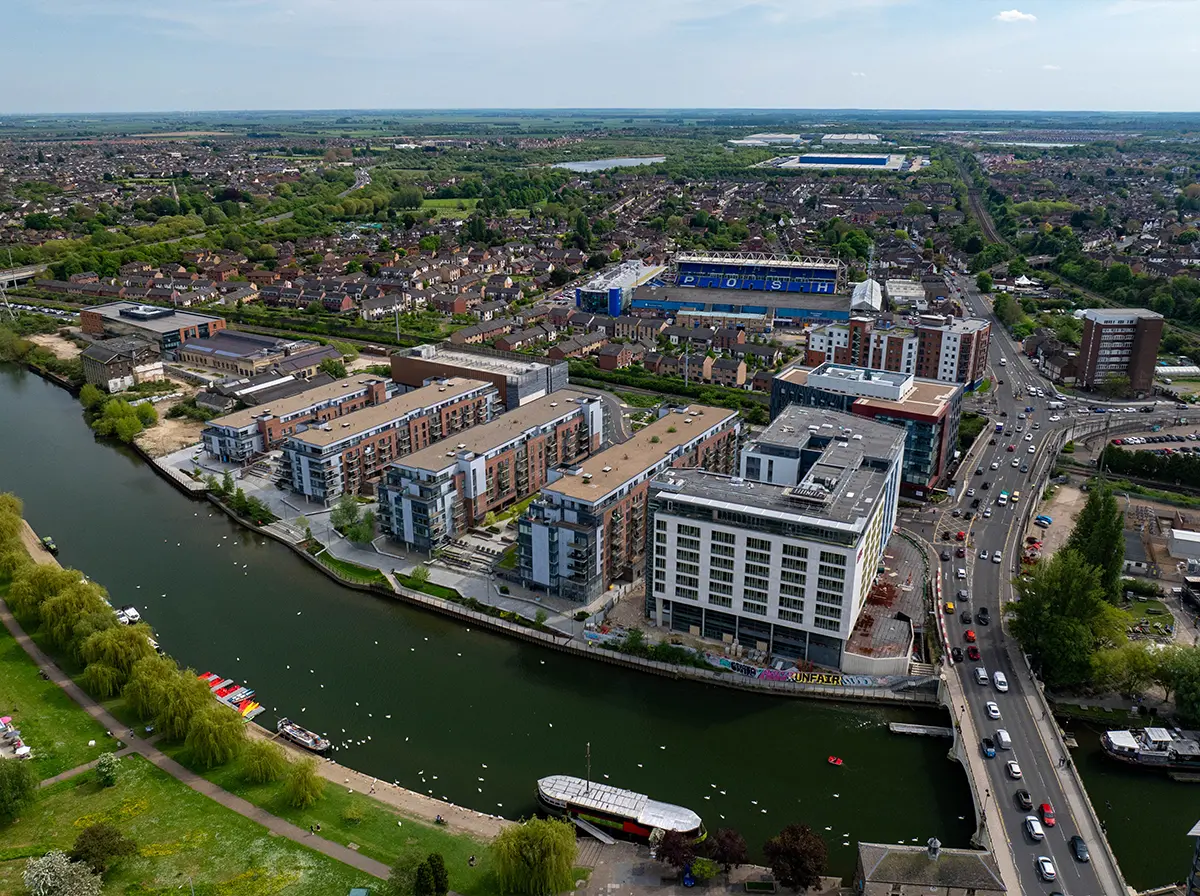
A New Town, a new university, and a city rediscovering just how much history lies beneath its feet.
The Great Fire of Peterborough
On 22 August 1956 a blaze breaks out in the Robert Sayle shop on the corner of Cowgate and King Street and tears through much of the old city centre — even engulfing the fire station itself.
The fire spread to a shoe shop and a furniture store, caused over £250,000 of damage — a vast sum at the time — and was only extinguished with the help of American airmen from the USAF base at Alconbury. It reshaped a corner of the city centre and lives on in local memory.
George Alcock looks up — and finds two comets
From Farcet, schoolteacher and visual astronomer George Alcock trains himself to know the night sky so intimately that an unfamiliar point of light stands out. On 25 August 1959 he discovers a comet, then finds another just five days later.
Alcock went on to discover five comets and five novae, largely through patient visual observation with binoculars and an extraordinary memory for star fields. His achievements made a fenland village part of the international story of twentieth-century astronomy and continued a striking Peterborough tradition of close observation shared by figures such as John Clare and Alfred Nicholson Leeds.
New Town: the city doubles
Peterborough is designated a New Town in 1967, and the Peterborough Development Corporation sets out to double the population towards 160,000 — building whole new townships at Bretton, Orton and Paston–Werrington, largely for families moving from London.
A fourth planned township at Castor was never built, but Hampton later rose to the south. The expansion brought the distinctive parkway road network — which still gives Peterborough some of the fastest urban journey times of any UK city its size — along with new industries and service-sector giants such as Thomas Cook and Pearl Assurance. The population grew by over 45% between 1971 and 1991, yet planners protected the historic core and commissioned the country park that became Nene Park.
Peterborough becomes a film set
The city and its surroundings begin appearing repeatedly on screen. The Nene Valley Railway, Peterborough Cathedral, the historic centre, the Fens and RAF Wittering prove capable of standing in for places and periods far beyond Peterborough.
From the BBC’s Secret Army in the late 1970s and The Barchester Chronicles in 1982 to Bond films, period dramas and major action productions, Peterborough develops an unusually varied screen history. Its railways, architecture and landscapes become part of the city’s modern cultural identity as well as working locations for the film and television industries.
Ferry Meadows and Queensgate
Nene Park opens in 1978, stretching five and a half kilometres along the river with lakes, meadows and the much-loved Ferry Meadows at its heart. In 1982 the Queensgate shopping centre, with over 90 stores, is opened — by Queen Beatrix of the Netherlands, no less.
Between them, the two projects captured the New Town ideal: a modern city where lakes, woodland and countryside sit minutes from the shops. The Nene Park Trust, created in 1988, still cares for the park today, while Queensgate remains the retail heart of the city — and hidden historic rooms above Cathedral Square survive within it.
Peterborough goes it alone
Peterborough becomes a unitary authority, taking full control of its own affairs while remaining part of ceremonial Cambridgeshire — a modern echo of the proud independence of the old Soke of Peterborough.
For centuries the Soke — with roots in the Danelaw and its own courts from 1349 — ran its affairs separately from the rest of Northamptonshire, surviving as a county in its own right until 1965. After a spell in the short-lived county of Huntingdon and Peterborough, the city joined Cambridgeshire in 1974. Self-government runs deep in Peterborough's story.
Fire and renewal at the cathedral
A fire breaks out in the cathedral's south transept, prompting a major restoration project — the latest chapter in a long story of care that has kept the great church alive for nearly nine centuries.
It was far from the first rescue: Dean James Henry Monk led a major restoration in the 1820s to repair the lingering damage of the Civil War, and Victorian engineers rebuilt the central tower stone by stone. Each generation has handed the building on to the next.
Deep time makes headlines
The Must Farm excavation of 2015–16 stuns the archaeological world, and in 2018 Peterborough Cathedral celebrates 900 years since the first stones of the present building were laid.
The anniversary year filled the cathedral with events and exhibitions, while Must Farm's discoveries confirmed what Flag Fen had long suggested: few places in Europe can match the Peterborough fens for prehistoric preservation.
A university city
ARU Peterborough opens its doors on Bishops Road — the city's first purpose-built university campus, opening a new chapter for education, skills and opportunity.
Fittingly, higher learning returns to a city whose monastic school and scriptorium were centres of scholarship a thousand years earlier. The campus continues to grow alongside the regeneration of the riverside and Fletton Quays.
Telling the city's story: Discover Peterborough
An independent Peterborough Tourist Board is launched, uniting the city's cultural, commercial and community partners — and Discover Peterborough goes live as the digital home for the city's stories, past and present.
Over the following year the platform grows far beyond visitor listings, connecting Peterborough’s history with dedicated stories about its people, archaeology, folklore, objects, railways, engineering, brickmaking, screen heritage and New Town transformation. The result is a living digital record that lets each part of the city’s story lead naturally into another.