

One of the most famous queens in British history never ruled Peterborough and may never have seen the city alive. Yet for twenty-five years, Peterborough Cathedral was her resting place.
Life in dates
- 1542 Born at Linlithgow Palace on 8 December; becomes Queen of Scots six days later
- 1548 Sent to France as a child
- 1558 Marries Francis, heir to the French throne
- 1559 Becomes Queen consort of France
- 1561 Returns to Scotland after Francis II's death
- 1565 Marries Henry Stuart, Lord Darnley
- 1566 Her son, the future James VI and I, is born
- 1567 Darnley is murdered; Mary marries Bothwell and is forced to abdicate
- 1568 Flees to England and enters the custody of Elizabeth I
- 1587 Executed at Fotheringhay Castle on 8 February
- 1587 Buried at Peterborough Cathedral on 1 August
- 1612 Removed from Peterborough and reburied in Westminster Abbey
A queen at six days old
Mary Stuart was born at Linlithgow Palace on 8 December 1542, the daughter of James V of Scotland and Mary of Guise. Six days later her father died, leaving the infant Mary as Queen of Scots.
Few lives in British history began with greater expectations. Mary belonged to the royal House of Stuart, but through her grandmother Margaret Tudor she was also a great-granddaughter of Henry VII of England.
That family connection would eventually place her dangerously close to the English throne.
As Scotland's political relationship with England deteriorated, the young queen was sent to France. There she was raised within one of Europe's most sophisticated royal courts and prepared for marriage to Francis, heir to the French crown.
France, Scotland and England
Mary married Francis in 1558. When his father died the following year, the teenage couple became King and Queen of France.
It was a spectacular rise, but a brief one. Francis II died in December 1560 and the widowed Mary returned to Scotland in 1561.
She returned to a Scotland transformed by religious and political change. Mary was a Catholic monarch ruling a country in which Protestantism had become increasingly powerful.
Her personal life soon became inseparable from the struggle around her throne. In 1565 she married her cousin Henry Stuart, Lord Darnley. Their son James was born the following year.
The marriage was disastrous. Darnley became implicated in the murder of Mary's secretary David Rizzio and was himself murdered near Edinburgh in February 1567.
Mary's subsequent marriage to James Hepburn, Earl of Bothwell, who was widely suspected of involvement in Darnley's death, intensified the crisis. Scottish nobles rebelled. Mary surrendered and was imprisoned at Loch Leven Castle, where she was forced to abdicate in favour of her infant son.
Nineteen years in captivity
Mary escaped from Loch Leven in 1568 and attempted to regain her throne, but her forces were defeated at the Battle of Langside.
She crossed into England expecting assistance from her cousin Elizabeth I.
Instead of receiving an ally, Elizabeth received a political problem that would dominate almost two decades of her reign.
Mary's blood relationship to the Tudor dynasty gave her a substantial claim to the English succession. For Catholics who regarded Elizabeth as illegitimate, Mary could be presented as the rightful Catholic heir.
She consequently became the focus of successive plots against Elizabeth, whether or not Mary herself controlled them. Rather than being allowed to leave England, she was kept under increasingly close supervision for nineteen years.
The road to Fotheringhay
The final crisis came with the Babington Plot of 1586, a conspiracy that included a plan to assassinate Elizabeth and place Mary on the English throne.
Mary's intercepted correspondence was used against her. She was brought to trial at Fotheringhay Castle and found guilty.
Elizabeth signed the death warrant.
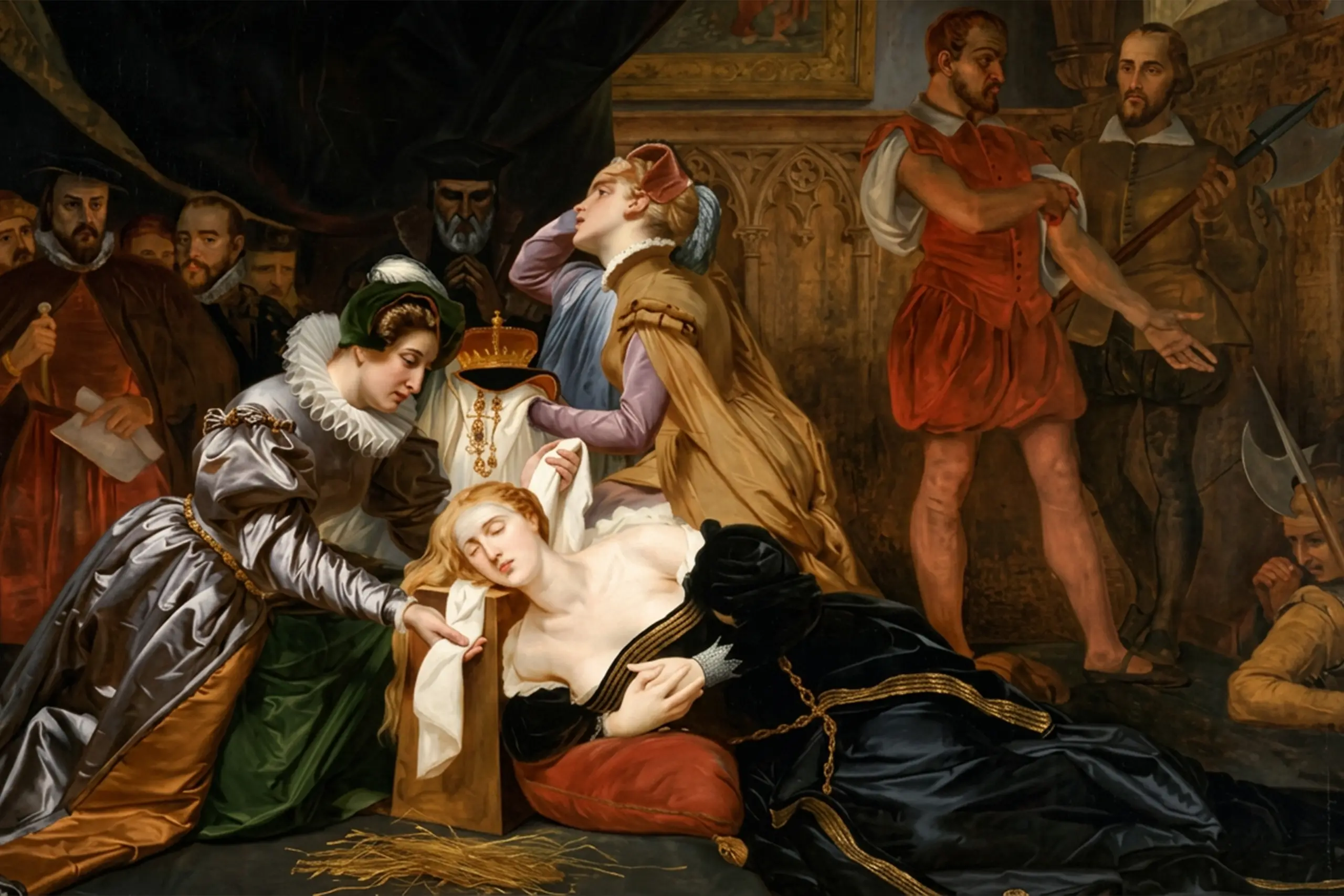
On 8 February 1587, Mary Stuart walked into the Great Hall at Fotheringhay as a captive queen and left it as one of the most famous royal martyrs in European history.
Mary was forty-four years old when she was executed.
But her story was not finished at Fotheringhay.
A queen comes to Peterborough
Mary's body remained at Fotheringhay for several months.
Then, on the night of Sunday 30 July 1587, the dead Queen of Scots was brought to Peterborough.
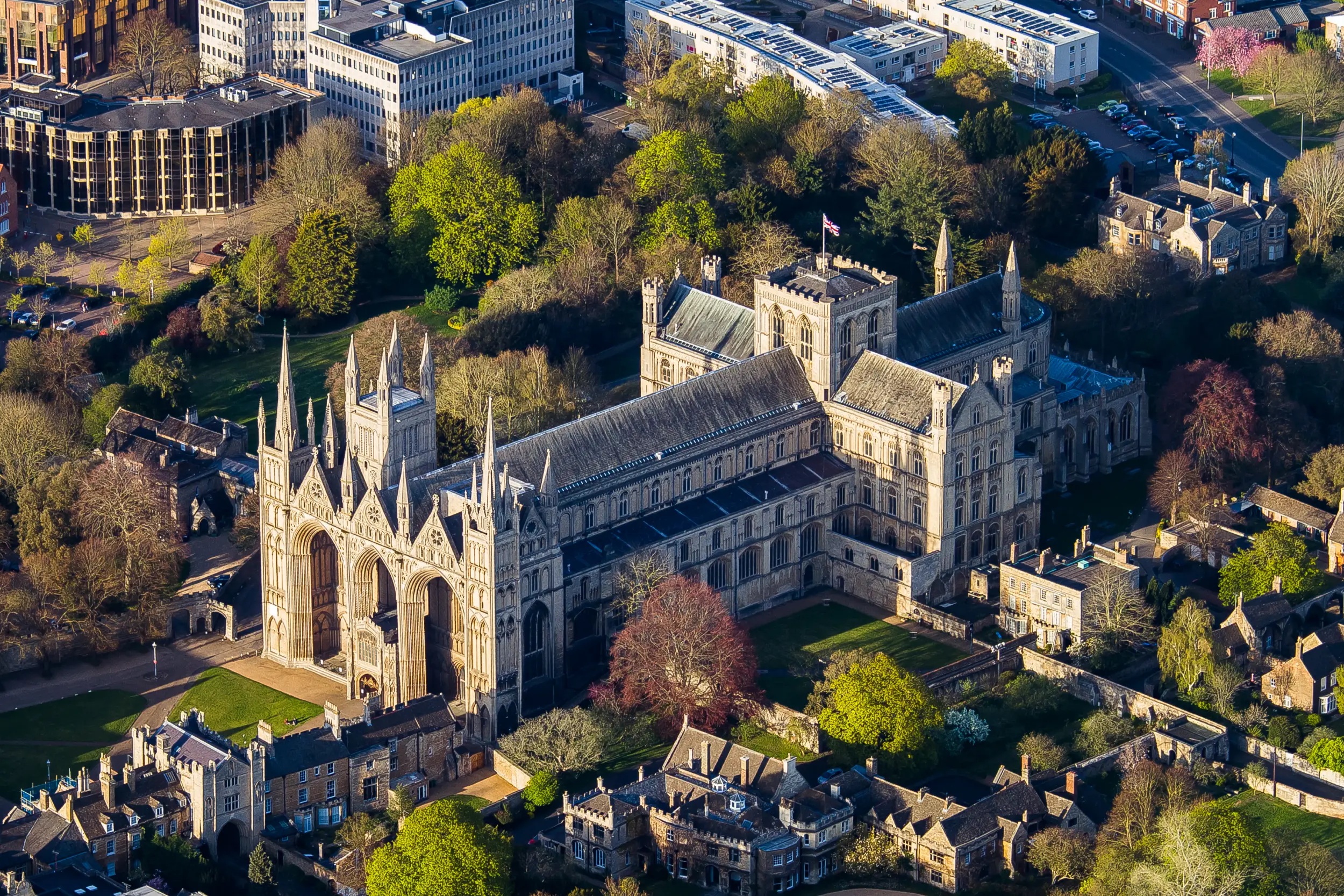
Her coffin was taken into the Cathedral precincts and placed in the Bishop's Palace. The city was about to become the stage for one of the most extraordinary royal funerals in its history.
Peterborough · Summer 1587
Five months after the axe fell at Fotheringhay, a queen arrived at Peterborough by night.
She would remain here for the next quarter of a century.
The great funeral
Mary's funeral was held at Peterborough Cathedral on 1 August 1587.
The building was transformed for the occasion. The Cathedral was hung with black and Mary's royal identity was displayed through heraldry associated with both Francis II of France and Lord Darnley.
An effigy representing the dead queen was carried with the symbols of monarchy. The cortege included bishops, heralds, nobles, officers of state and members of Mary's household.
One hundred poor widows dressed in black took part in the procession. The Bishop of Lincoln preached the sermon, while Richard Fletcher, Dean of Peterborough, presided over the burial.
Fletcher had also been present at Mary's execution.
After the service, officers broke their ceremonial staves and cast them into the grave. A lavish funeral banquet followed in the Bishop's Palace.
The funeral cost £321, an enormous sum in 1587, with around a third of the expenditure reportedly devoted to food and drink.
A cathedral of two queens
Mary was buried on the south side of the Cathedral choir.
Across from her lay another queen whose fate had also been shaped by the Tudor succession: Katharine of Aragon, first wife of Henry VIII.
Fifty-one years separated their funerals.
The remarkable human link between them was Peterborough's elderly sexton Robert "Old Scarlett".
Scarlett had been associated with Katharine's burial in 1536. By the time Mary's grave was prepared he was around ninety years old and still serving the Cathedral community.
For twenty-five years, Peterborough Cathedral held two queens beneath its roof: one cast aside by Henry VIII, the other executed by his daughter.
Their presence places Peterborough directly inside the story of the Tudor monarchy, the English Reformation and the struggle over the succession to the English crown.
The queen who left Peterborough
Mary remained at Peterborough for twenty-five years.
History had changed dramatically by then.
Elizabeth I died in 1603 and Mary's son, James VI of Scotland, inherited the English crown as James I. The child from whom Mary had been separated after her fall was now king of both Scotland and England.
In 1612 James ordered his mother's remains to be removed from Peterborough and transferred to Westminster Abbey.
His royal warrant was dated 28 September. Mary was reburied at Westminster on 11 October beneath the magnificent monument commissioned for her by her son.
Westminster Abbey records an intriguing final Peterborough detail: Mary's funeral hearse was left behind when her remains were taken to London.
Her grave in Peterborough was now empty.
Her connection to the city was not.
Her place in Peterborough's story
Mary, Queen of Scots cannot be described as a Peterborough woman in the conventional sense. She was born in Scotland, raised partly in France and spent her final nineteen years moving between places of captivity in England.
But Peterborough became part of what happened to her after death.
Her funeral brought the politics, symbolism and spectacle of European monarchy directly into the Cathedral precincts. Her grave made Peterborough a royal burial place of extraordinary significance, and for twenty-five years her body lay within the city's great church.
Visitors can still see the site of Mary's original burial inside Peterborough Cathedral.
One queen remained.
One queen was moved.
Both made Peterborough part of the national story.