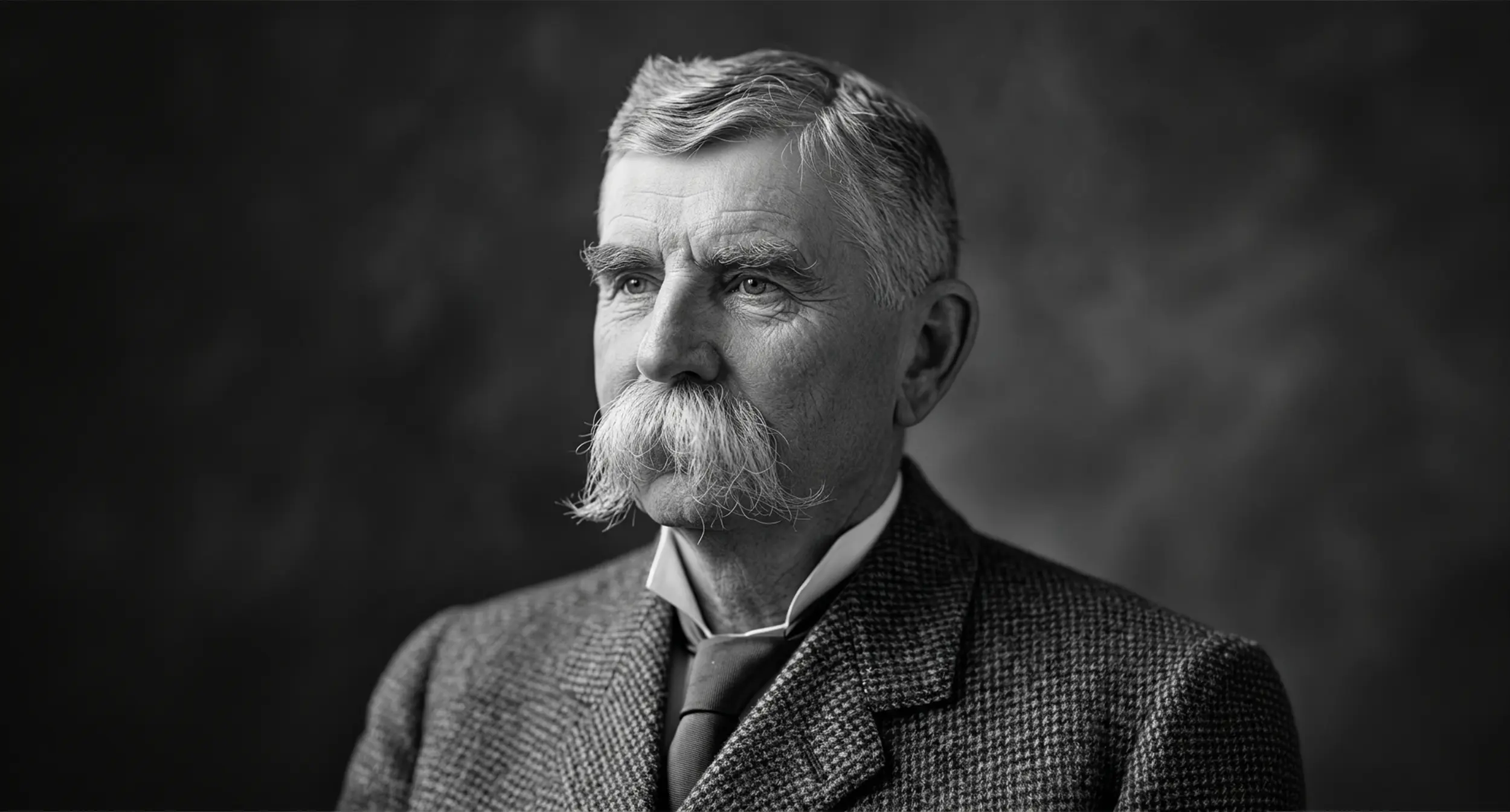
Alfred Nicholson Leeds (1847–1917) was a pioneering British fossil collector whose work transformed our understanding of Jurassic marine life.
Digging the Oxford Clay
Based near Peterborough, he excavated thousands of fossils from the Oxford Clay during the late 19th century, uncovering remarkable specimens of ichthyosaurs, plesiosaurs and the giant fish Leedsichthys, named in his honour.
Building the collection
Working alongside his brother Charles, Leeds developed one of the most important fossil collections of its kind, many of which are now held in museums around the world.
What he pulled from the clay
The Oxford Clay around Peterborough preserves the animals of a warm Jurassic sea. Among the creatures represented in the Leeds Collection are these.
Leedsichthys
Giant bony fish
Named in Leeds’s honour, and thought to be among the largest fish ever to have lived.
Ophthalmosaurus
Ichthyosaur
A dolphin-shaped marine reptile, named for its extraordinarily large eyes.
Cryptoclidus
Plesiosaur
Long-necked and paddle-limbed, one of the more completely known plesiosaurs.
Liopleurodon
Pliosaur
A short-necked, large-headed predator near the top of the Jurassic marine food chain.
Metriorhynchus
Marine crocodile
A fully seagoing crocodilian, with paddle-like limbs and a finned tail.
Legacy
His discoveries placed Peterborough firmly on the global map for Jurassic palaeontology and continue to shape scientific research and public understanding today.