

Hereward the Wake was one of the most celebrated English rebels of the 11th century. From the waterways and marshes of the Fens, he resisted the rule of William the Conqueror during the unsettled years following the Norman Conquest.
His story belongs particularly to the landscapes around Peterborough, Ely and southern Lincolnshire. In June 1070, Hereward and his allies attacked Peterborough Abbey, burned much of the surrounding town and carried the monastery’s treasures into the Fens. The following year, he escaped from William’s forces during the fall of the rebel stronghold on the Isle of Ely.
These events are recorded in medieval chronicles. Almost everything else, from Hereward’s childhood adventures to his disguises, battles and mysterious death, lies somewhere between history, oral tradition and heroic legend.
Modern historians therefore describe him more cautiously as Hereward, active in 1070–71. His birth, parentage and ultimate fate remain unknown. Nevertheless, the historical Hereward was real, his resistance was significant and his connection with Peterborough was direct.
The story in dates
- 1066William defeats Harold II at Hastings
- 1069Abbot Brand dies; William appoints the Norman Turold
- 1069–70A Danish fleet reaches England and bases itself at Ely
- 10702 June: Hereward’s force attacks Peterborough Abbey
- 1070The treasure leaves England with the departing Danes
- 1071Ely surrenders; Hereward escapes into the Fens
- c.1109–31The Gesta Herewardi is composed
- 1118Building begins on the present cathedral
- 1866Kingsley’s novel makes him a national figure
Rebel, outlaw and legend of the Fens
Hereward belongs to a particular kind of history: one where a handful of hard facts sit surrounded by centuries of storytelling. Two events are securely recorded. He led the raid on Peterborough Abbey in June 1070, and he escaped from the Isle of Ely when it fell the following year. Everything before and after is contested.
That does not make him a legend rather than a person. It makes him a person we can see only in glimpses, at the two moments when chroniclers had reason to write him down.
Who was the historical Hereward?
Hereward probably came from southern Lincolnshire and may have belonged to the substantial landholding class of late Anglo-Saxon England. He is traditionally associated with Bourne, although there is no decisive evidence that he was born there or possessed the manor.
Domesday Book records land associated with men named Hereward, including holdings at Laughton, Rippingale, Witham on the Hill, Barholm and Stowe. Some of these properties were connected with the abbeys of Peterborough and Crowland. It is not certain that every entry refers to the same person, but the evidence supports a strong connection between the historical rebel, southern Lincolnshire and Peterborough Abbey. Open Domesday itself cautions that identical names do not necessarily identify the same individual.
Historian David Roffe argues that Hereward may have been more important than a simple monastic tenant. His landholding relationships suggest that he could have been a king’s thegn or a powerful local protector employed by religious houses to defend their interests.
Hereward is also connected in later accounts with Brand, the last English abbot of Peterborough before the arrival of the Norman abbot Turold. Brand is frequently described as Hereward’s uncle, but no contemporary record proves that relationship.
Hereward before the Norman Conquest
The most detailed account of Hereward’s early life is the Gesta Herewardi, or Deeds of Hereward. It was probably composed during the first quarter of the 12th century, perhaps while men who had known or fought alongside Hereward were still alive.
According to the Gesta, Hereward was the son of a man named Leofric of Bourne and a woman named Eadgyth. It describes him as a strong but troublesome youth who was outlawed at the age of eighteen during the reign of Edward the Confessor.
The young exile then supposedly travelled through Northumberland, Cornwall and Ireland, fought an enormous bear, rescued a Cornish princess, defeated powerful warriors and entered military service in Flanders. He is said to have married a Flemish woman named Turfrida before returning to England.
These are wonderful stories, but they should not be read as straightforward biography. The scholarly introduction to the Gesta describes much of its account of Hereward’s youth as deliberately heroic fiction, constructed from the familiar ingredients of medieval romance. See the Middle English Texts Series introduction.
There may, however, be a historical foundation beneath parts of the story. Historian Elisabeth van Houts has shown that the Gesta’s descriptions of political and military activity in Flanders correspond in several respects with continental evidence. Hereward may genuinely have spent part of his exile there and acquired the military experience that later made him an effective rebel leader. See “Hereward and Flanders”.
England after 1066
William, Duke of Normandy, defeated King Harold II at the Battle of Hastings in October 1066, but the conquest of England was not completed in a single battle. Rebellions continued across the country as English landholders lost estates, Norman castles appeared and French or Norman clergy were placed in charge of important churches and monasteries.
Resistance was especially persistent in northern and eastern England. The Fens offered rebels a natural refuge. Before modern drainage, the area was a complex landscape of wetlands, rivers, meres, reed beds and islands of higher ground. Local knowledge of navigable channels and safe routes gave Fenland fighters a considerable advantage over heavily armed forces unfamiliar with the terrain.
The Isle of Ely was particularly defensible. It could be reached by boat through the rivers and waterways connected with the Wash, while an invading army approaching overland had to negotiate marshes and a small number of difficult causeways.
A Danish expedition sent by King Sweyn II arrived in England during the rebellions of 1069–70. A section of the force, commanded by Earl Osbern and Bishop Christian, established itself at Ely. The Anglo-Saxon Chronicle records that people from across the Fenland joined the Danes in the hope that they could overturn Norman control.
Hereward was among them.
Hereward and the attack on Peterborough
Peterborough’s place in Hereward’s story begins with the death of Abbot Brand in 1069. William appointed Turold, a Norman, to replace him as abbot of Peterborough. Turold had a reputation as a severe and forceful man and approached the town accompanied by armed followers.
The monks learned that Hereward and his companions intended to take the abbey’s treasures before the new abbot arrived. The Peterborough version of the Anglo-Saxon Chronicle describes Hereward’s group as the monastery’s own men. The Oxford Dictionary of National Biography consequently identifies Hereward as the leader of Peterborough Abbey’s tenants, who resented the imposition of Turold.
On 2 June 1070, Hereward’s force arrived at Peterborough in numerous ships. The monks attempted to prevent them from entering the monastery, so the attackers set fire to the monastic buildings and the town. According to the Chronicle, almost the entire settlement was burned.
The attackers forced their way through the burning precinct at the gate known as Bull-hithe or Bolhithe Gate. The monks met them and pleaded for peace, but the appeal was ignored.
Hereward’s allies entered the abbey church and stripped it of an extraordinary collection of precious objects. They took the golden crown from the great figure of Christ above the altar, gold and silver crosses, reliquaries, vestments, money and valuable books.
They carried away more treasure than one person could describe to another.
The Peterborough chronicler, on the raid of 1070
The treasure was transported by water to Ely. After King William reached an agreement with the Danish leadership, much of it was taken out of England by the departing Danish fleet. The detailed account survives in the 1070 entry of the Anglo-Saxon Chronicle.
Was Hereward protecting the abbey?
Later stories attempted to present the attack as an act of protection rather than plunder. Hereward and his followers were said to have feared that Peterborough’s sacred objects would fall into Norman hands. The Gesta Herewardi even claims that Hereward later returned the treasure after receiving a vision of St Peter.
That version is difficult to reconcile with the Peterborough Chronicle. Its account says that the treasures were taken to Ely and subsequently carried away by the Danes. It also records the burning of the monastic buildings and almost all the town, despite the monks’ attempts to resist the attackers.
The most reasonable interpretation is that resistance to the incoming Norman abbot formed part of Hereward’s motivation, but the operation became a violent and destructive raid. His men may have believed that they were denying wealth to the Norman regime, yet the immediate victims included the monks and people of Peterborough.
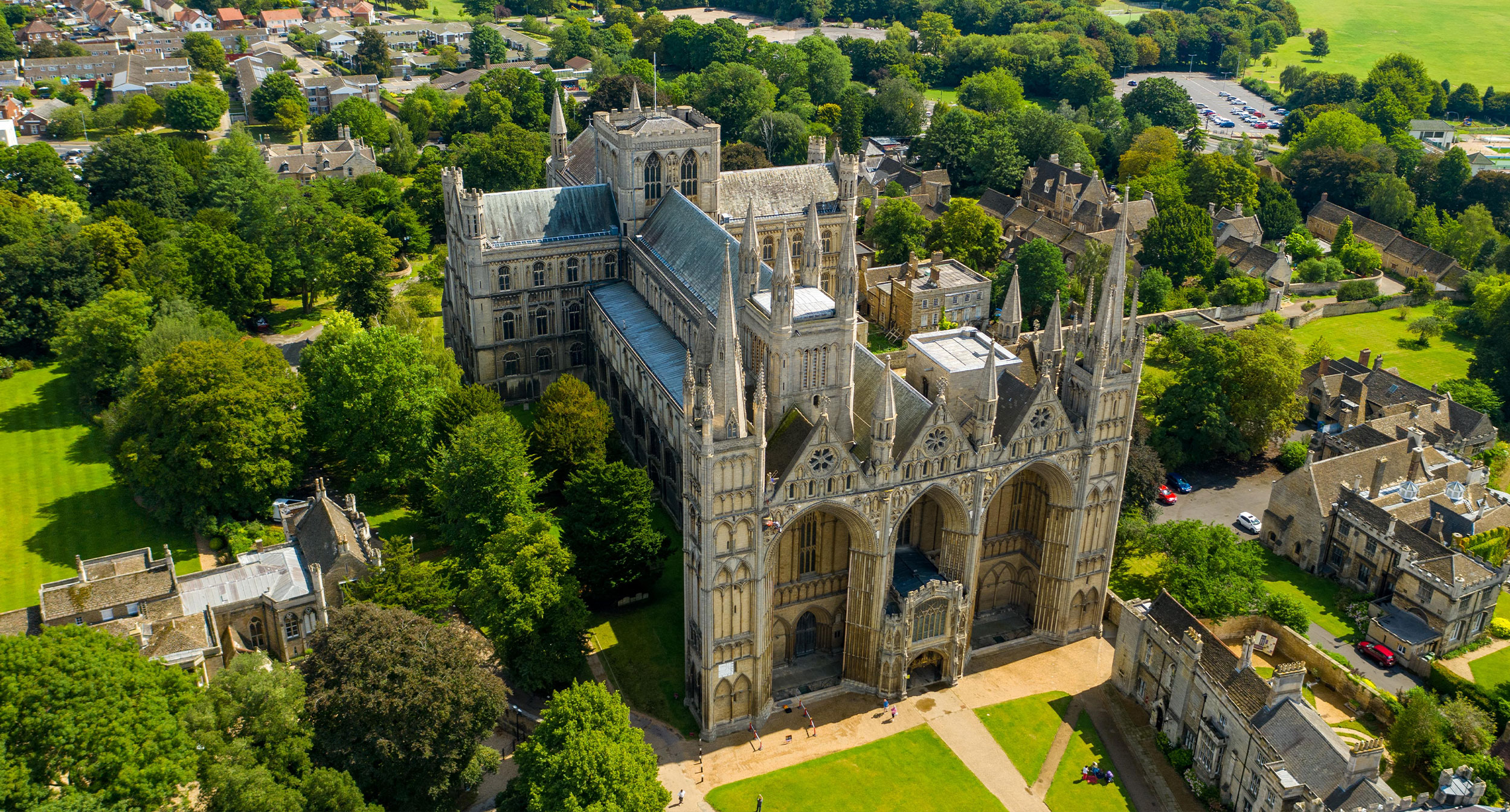
The present Peterborough Cathedral was begun in 1118, after a separate fire destroyed the earlier abbey church in 1116. It occupies the same sacred site at the heart of the city, while the mound known as Tout Hill or Mount Turold survives in the Cathedral Precincts as a reminder of the fortified Norman presence established after the rebellion. See the Cathedral’s historical timeline.
The last stand at Ely
After the Danish fleet departed, Ely continued to attract opponents of William’s rule. In 1071, Hereward was joined by several prominent English rebels, including Morcar, the former Earl of Northumbria; Æthelwine, Bishop of Durham; and the landholder Siward Barn.
William responded with both land and naval forces. The rebels were surrounded and the king’s army constructed a route across the difficult wetland terrain. The precise course of the siege is uncertain, but Ely eventually surrendered.
The Anglo-Saxon Chronicle records that William captured the rebels, their ships, weapons and treasures. Hereward, however, refused to surrender. He escaped from the island with those willing and able to follow him. The Chronicle says that he led them out successfully, but provides no further account of where they went.
This escape is the last event in Hereward’s life supported by an early historical record.
The warrior of legend
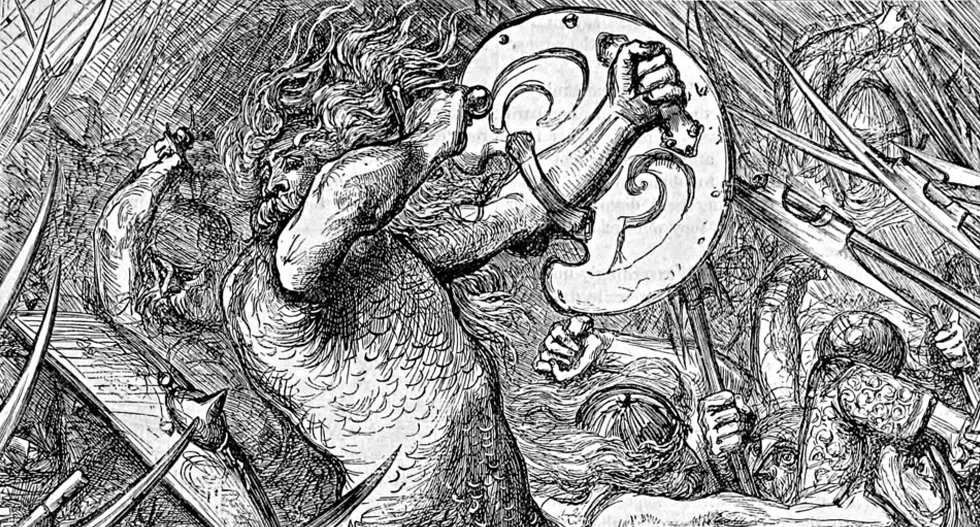
Later storytellers transformed the siege into an epic contest between Hereward’s intelligence and William’s overwhelming military power. Four episodes recur.
The causeway
A vast Norman causeway is built out across the marsh, only to collapse beneath the weight of the soldiers and horses crossing it.
The witch
William employs a witch to curse the rebels from a wooden tower, and Hereward’s men set the tower alight.
The potter
Hereward enters the Norman camp disguised as a potter, overhears the king’s plans and escapes undetected.
The fisherman
He poses as a fisherman, then burns the very equipment he has been ordered to carry for the Normans.
These episodes cannot be treated as established history. They belong to the development of Hereward as a medieval outlaw hero, celebrated for cunning, disguise and knowledge of the landscape. English Heritage describes the Gesta as one of the earliest surviving examples of this kind of outlaw story, anticipating some of the qualities later associated with Robin Hood.
What happened to Hereward?
There is no contemporary evidence for Hereward’s fate after his escape from Ely.
The Gesta Herewardi claims that he eventually reached an agreement with William, received a royal pardon and recovered some of his property. Other medieval traditions say that he was attacked and killed by a group of Norman knights. Another possibility is that he went into exile and disappeared from the written record.
No reliable date, place or cause of death is known. There is also no authenticated grave.
That unresolved ending helped the legend to grow. Hereward could be imagined as the warrior who never truly surrendered: a figure who escaped from Ely into the waterways, woods and stories of the Fens.
Why was he called “the Wake”?
Hereward was not known as “the Wake” during the rebellion. Early sources describe him simply as Hereward, Hereward the Exile or Hereward the Outlaw.
The epithet appears in a Peterborough chronicle produced considerably later. It has traditionally been interpreted as meaning “the wakeful” or “the watchful”, an appropriate title for a guerrilla leader who repeatedly avoided capture.
An alternative explanation connects the name with the Anglo-Norman Wake family, later lords of Bourne. Members of that family claimed descent from Hereward and may have attached their own name to his story. The exact origin remains uncertain.
From Fenland rebel to national hero
Stories about Hereward circulated soon after his lifetime. The author of the Gesta claimed to have drawn upon the memories of former companions, while other medieval writers referred to songs celebrating his deeds.
For much of the Middle Ages, Hereward’s fame was concentrated in the East Midlands and East Anglia. He became a national figure largely through Charles Kingsley’s historical novel Hereward, the Last of the English, published in 1866.
Kingsley presented Hereward as the heroic final defender of Anglo-Saxon England. His novel popularised many now-familiar elements of the legend, including the unsupported claim that Hereward was the son of Lady Godiva. The book is an important part of Hereward’s cultural legacy, but it is historical fiction rather than a reliable biography. You can read Kingsley’s novel through Project Gutenberg.
The Victorian image of Hereward as “the last Englishman” has remained powerful. Yet the real history is more complicated. His forces included English Fenlanders and Danish warriors, his motives combined local loyalty with political resistance, and his best-recorded action brought devastation to Peterborough.
Hereward and Peterborough today
Hereward’s story connects Peterborough’s urban history with the wider Fenland landscape. It links the former abbey, the waterways of the Nene, the villages and estates of southern Lincolnshire, and the great wetland refuge around Ely.
Peterborough Cathedral Precincts
The same sacred site as the abbey Hereward raided, with the mound of Tout Hill, or Mount Turold, surviving from the Norman fortification that followed.
The Isle of Ely
The rebel stronghold of 1071, and the last place Hereward appears in an early historical record.
Bourne, Lincolnshire
Traditionally associated with Hereward, and later the seat of the Wake family who claimed descent from him.
The Hereward Way
A 110-mile route from Oakham towards the Peddars Way, passing through both Peterborough and Ely. See the Long Distance Walkers Association for the full route.
For Peterborough, Hereward should be remembered neither as an uncomplicated local hero nor simply as a destructive outlaw. He was a real leader of resistance during one of the most violent transformations in English history. He opposed the replacement of established English authority, understood how to use the Fenland landscape and escaped from one of William the Conqueror’s final campaigns against organised resistance.
But he was also responsible for an attack that burned Peterborough and stripped its great abbey of treasures accumulated over generations.
It is precisely this tension between heroism and destruction, historical evidence and medieval legend, that makes Hereward the Wake one of the most compelling figures in Peterborough’s story.
What do we know for certain?
- Hereward was a real 11th-century English landholder, outlaw and rebel.
- He had connections with southern Lincolnshire and Peterborough Abbey.
- He participated in the attack on Peterborough on 2 June 1070.
- His force burned much of the monastic settlement and removed the abbey’s treasures.
- He joined the resistance based on the Isle of Ely.
- He escaped when Ely surrendered to William in 1071.
- His birth, parentage, later life and death cannot be established with certainty.
- Many of his most famous adventures come from later heroic literature rather than contemporary records.
Principal sources
- The Anglo-Saxon Chronicle, entries for 1070 and 1071
- Oxford Dictionary of National Biography: Hereward
- Elisabeth van Houts, “Hereward and Flanders”, Anglo-Saxon England
- David Roffe, “Hereward ‘the Wake’ and the Barony of Bourne”
- Middle English Texts Series: Hereward the Wake
- Peterborough Cathedral historical timeline
- Historic England: Abbot’s Gate and Peterborough Abbey