
Longthorpe Tower at a glance
- What
- Medieval manor tower containing exceptional 14th-century wall paintings
- Where
- Thorpe Road, Peterborough, PE3 6LU
- Built
- Around 1290–1300 by Robert Thorpe
- Paintings
- Created in the early 14th century
- Look out for
- Kings, saints, musicians, animals, mythical creatures and the Wheel of the Five Senses
- Best for
- Medieval history, art, unusual architecture and visitors who enjoy discovering hidden places
Climb a medieval tower in suburban Peterborough and enter a room where almost the entire medieval universe is still painted across the walls.
Longthorpe Tower is easy to underestimate from the outside. The compact stone building looks like an intriguing fragment of a lost medieval house. Step upstairs, however, and the scale of what survives becomes apparent.
The main first-floor chamber contains one of the most remarkable schemes of medieval domestic wall painting in England. Religious stories sit beside scenes of work and ageing. Kings confront death. Angels play musical instruments. Animals, birds and extraordinary symbolic creatures populate the painted room.
These were not paintings made for a church. They belonged to the private home of a wealthy and highly educated family. That makes Longthorpe extraordinary: visitors can stand inside the thought-world of fourteenth-century Peterborough.
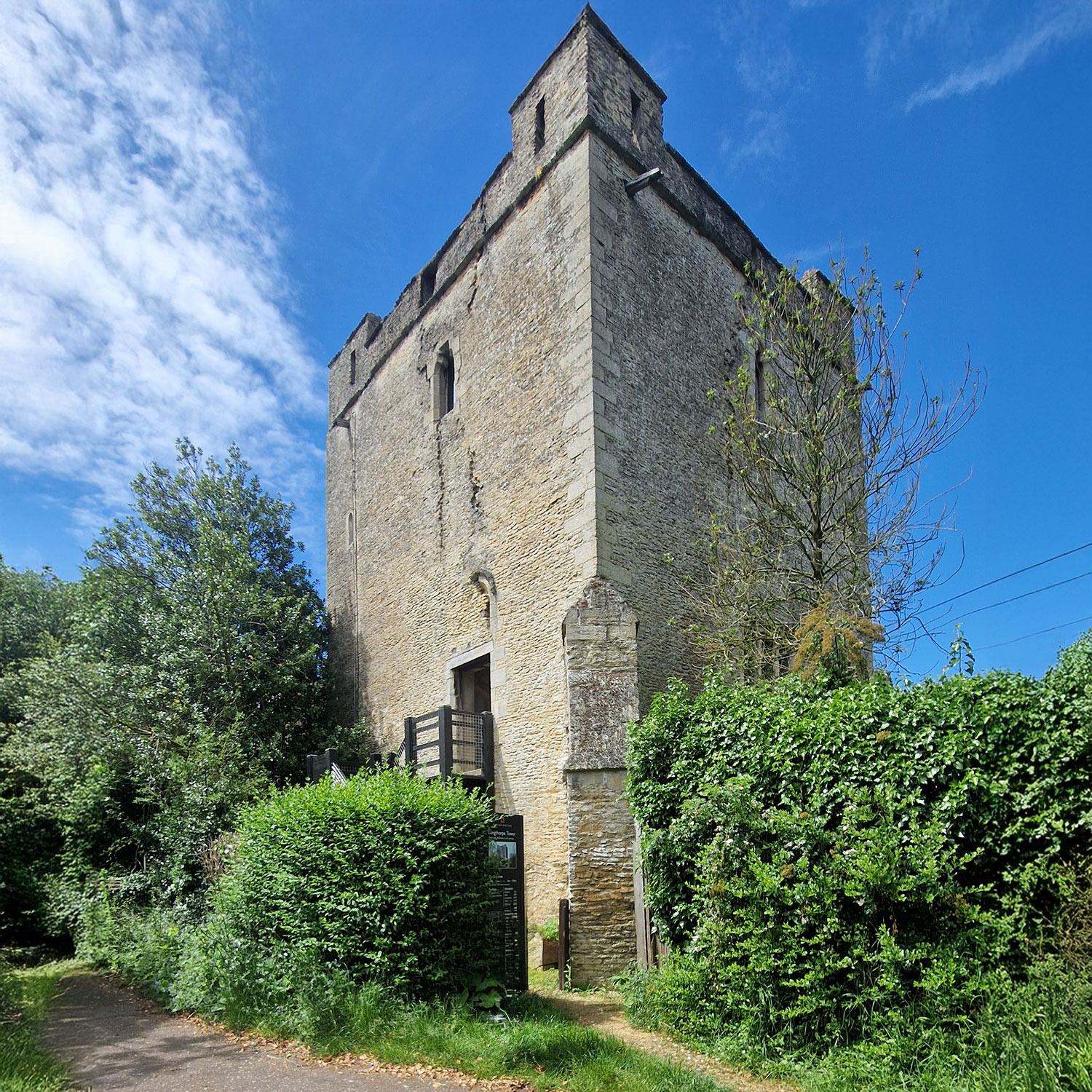
Walk into the medieval world beyond the Abbey walls
Longthorpe Tower opens a very different window onto medieval Peterborough: not kings and abbots, but the home of an educated lay family whose fortunes were closely connected with Peterborough Abbey.
What to look for inside
The paintings are dense with detail. Knowing some of the stories beforehand makes the chamber much easier, and much more rewarding, to read.
The Seven Ages of Man
Figures trace the human journey through different stages of life, turning part of the painted chamber into a meditation on ageing and mortality.
The Wheel of the Five Senses
One of Longthorpe’s rarest images uses five animals to represent sight, hearing, smell, taste and touch, gathered around a great wheel.
The Three Living and the Three Dead
Living kings encounter their dead counterparts in a striking reminder that rank, wealth and worldly success offer no escape from mortality.
The Nativity
The birth of Christ appears within the larger scheme, placing biblical history within the same visual world as morality, work and everyday life.
Labours of the Months
Seasonal activities bring farming, work and the rhythm of the medieval year into the chamber.
Musician angels
Angels play carefully depicted musical instruments, adding a heavenly soundtrack to the scenes unfolding below.
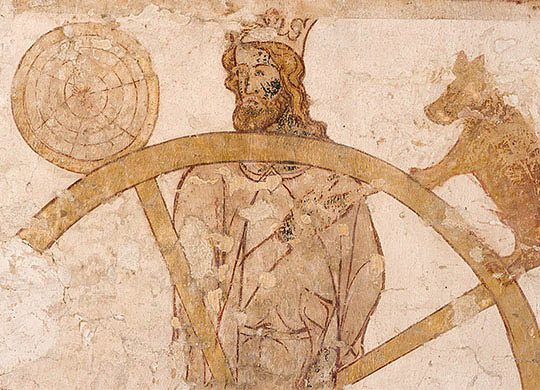 Wheel of the Five Senses, Longthorpe Tower. Image © English Heritage.
The Wheel of the Five Senses
Look closely at this extraordinary image and medieval ideas about human perception begin to emerge.
Five creatures around the wheel represent the five senses, each selected because medieval writers believed it possessed an exceptional sensory ability.
Behind the wheel stands a crowned figure. His exact interpretation has been debated, but he may represent Reason or the human mind receiving information through the senses and exercising judgement over them.
The image is extraordinarily rare. English Heritage identifies only two known medieval parallels, one in Rome and another in Constance in Germany.
Explore the Wheel of the SensesA medieval encyclopaedia painted on plaster
The extraordinary thing about Longthorpe is not simply the survival of individual medieval pictures. It is the way they work together.
Life, work, death, learning, religion, perception, nature and salvation all appear within one room. Biblical figures occupy the same visual world as birds, animals, teachers, workers and musicians.
The room is almost an encyclopaedia of medieval thought painted directly onto architecture.
The paintings would originally have appeared much stronger and more colourful than they do today. In a chamber lit by medieval daylight, lamps and candles, the effect must have been extraordinary.
Meet Robert Thorpe, lawyer, landholder and Abbey man.
The tower was built around the end of the thirteenth century by Robert Thorpe, a lawyer from a family with longstanding connections to the local manor.
Thorpe was closely connected with Peterborough Abbey and served at a high level within its secular administration.
That relationship matters because the intellectual resources surrounding the Abbey may help explain the extraordinary range of texts, symbols and ideas reflected in Longthorpe’s painted chamber.
The room therefore becomes a fascinating meeting point between elite domestic life and the intellectual world of medieval Peterborough.
Explore the Abbey and Cathedral storyThe tower was about status as well as security.
Its substantial masonry and elevated private rooms offered protection, but the architecture also made a very deliberate statement about the people who owned it.
The surviving structure once formed part of a larger medieval domestic complex.
Anyone entering the painted chamber would have understood immediately that this was the home of a wealthy, educated and ambitious family.
The strange medieval world hiding on the walls
Longthorpe rewards visitors who stop scanning the large scenes and start hunting for the smaller details.
Animals with meanings
Birds and animals appear throughout the scheme, reflecting a medieval culture in which characteristics of the natural world could carry moral, intellectual and religious meanings.
Angels playing music
The musicians are detailed enough to interest historians of medieval music, giving the paintings value far beyond art history alone.
Kings meet the dead
The Three Living and the Three Dead confronts wealthy viewers with a stark message: earthly status is temporary.
Work beside the supernatural
Ordinary labour and seasonal activities appear alongside saints, angels and biblical imagery, placing everyday life inside a much larger moral universe.
Work, learn, pray
Several scenes reveal just how closely medieval ideas about work, learning and religion could overlap.
One remarkable image relates to the story of St Anthony asking how he might achieve salvation. The response is represented through a figure alternating between prayer and practical work, including basket-making.
Elsewhere, teaching and scholarship appear within the wider scheme.
For an educated lawyer such as Robert Thorpe, this combination of knowledge, useful labour, faith and moral behaviour would have carried particular significance.
The Seven Ages of Man
Another wall turns the human lifespan itself into a visual story.
The Seven Ages of Man follows the progression of life from youth through maturity towards old age. Rather than presenting time as an abstract idea, the painters show human beings changing as they move through it.
Placed alongside images warning powerful kings about death, the message becomes difficult to miss. Everything changes. Youth disappears. Wealth passes. Status ends.
Longthorpe’s paintings may be beautiful, but many of their messages are deliberately uncomfortable.
The paintings almost disappeared from view.
For centuries, the medieval scheme lay concealed beneath later coverings and surface treatments.
The paintings were rediscovered during the twentieth century, revealing an extraordinary survival that had effectively been hiding inside the building.
Specialists then began the difficult process of uncovering, recording, understanding and conserving what remained.
Seven centuries on, the room is still fragile.
Medieval wall paintings are particularly vulnerable because pigment and plaster are part of the historic building itself.
Moisture, temperature, previous treatments and the condition of the underlying wall can all affect their survival.
Longthorpe continues to be studied by specialists, with conservation research helping protect a painted scheme that has somehow survived for almost seven centuries.
Read the English Heritage historyPeterborough beyond kings and abbots
Longthorpe Tower is particularly valuable because it broadens the medieval Peterborough story.
The Cathedral preserves the world of the great Abbey, bishops, queens and national religious history. Longthorpe preserves something much rarer: the private intellectual and domestic world of a prosperous lay household closely connected with that institution.
Put the two together and medieval Peterborough becomes richer.
The Abbey was not an isolated religious island. It controlled estates, employed officials, conducted legal business and interacted constantly with the families and communities living around it.
A hidden treasure in plain sight
Modern Peterborough has grown around Longthorpe Tower, making its survival feel even more surprising.
A building once standing within a medieval manor landscape now sits only a short distance from busy roads and suburban homes. Yet climb the stairs and the visual world of medieval England is still waiting inside.
That contrast is one of the pleasures of visiting. Longthorpe Tower does not announce itself with the monumental scale of a castle or cathedral.
It rewards people who know where to look.
Planning your visit
- Where to find the Tower
- Longthorpe Tower is on Thorpe Road, Peterborough, PE3 6LU, west of the city centre.
- Before you travel
- Check the official Longthorpe Tower visitor information for current access and tour arrangements before making a special journey.
- Historic stairs
- This is a genuine medieval tower with steep historic stairs, narrow spaces and changes of level. Check current accessibility guidance if you have particular mobility requirements.
- Guided experience
- Guided visits are particularly valuable here because the paintings become much easier to understand once their stories and symbols are decoded.
- English Heritage
- Longthorpe Tower is an English Heritage property, with extensive research available on the building, paintings and their conservation.
- Take your time upstairs
- Look beyond the major compositions. Search for animals, musical instruments, surviving inscriptions and smaller figures hidden within the scheme.
Discover Peterborough tip: spend some time with the Wheel of the Five Senses. Once you have found the creatures representing sight, hearing, smell, taste and touch, the room suddenly feels less like a collection of old pictures and more like an attempt to explain how a human being experiences the world.
Continue exploring Peterborough
Longthorpe Tower connects directly into the wider medieval, artistic and historical story of Peterborough.
Wheel of the Senses
Take a closer look at one of Longthorpe’s rarest medieval paintings and discover what its five extraordinary creatures represent.
Explore the artworkPeterborough Cathedral
Explore the great medieval Abbey that shaped the world in which Robert Thorpe and his family lived.
Explore the CathedralThe Cathedral’s 1,350-Year Story
Follow Peterborough Abbey from its Anglo-Saxon foundation through medieval power, dissolution and the modern Cathedral.
Read the full historyPeterborough Timeline
Place Longthorpe Tower within the wider story of medieval Peterborough and everything that came before and after it.
Travel through timePeterborough History
Explore the people, buildings, archaeological discoveries and turning points that shaped the city.
Explore the historyPeterborough Museum & Art Gallery
Continue the historical journey through archaeology, art and objects connected with Peterborough’s long past.
Explore the MuseumPeterborough Art
Move from a fourteenth-century painted chamber to sculpture, paintings, murals and public art across the modern city.
Explore Peterborough artNene Park
Continue west into lakes, woodland, meadows and riverside routes across one of Peterborough’s great outdoor landscapes.
Explore Nene ParkMore things to do
Find more heritage, culture, family attractions and memorable places across Peterborough.
Find more experiencesStep inside Longthorpe Tower
Check current visitor and guided-tour information before travelling, then come prepared to look closely. The smallest details are often the most memorable.