

Peterborough History
Peterborough A city of its own
Northamptonshire. The Soke of Peterborough. Huntingdon and Peterborough. Cambridgeshire. Governments have redrawn the lines around the city again and again. Peterborough’s own identity has proved much harder to move.
A surprisingly difficult question
So, which county is Peterborough actually in?
Ask somebody from Peterborough where they are from and the answer is usually straightforward: Peterborough.
Ask which county the city belongs to and things become much less simple.
Modern maps usually place Peterborough within Cambridgeshire. That is correct for ceremonial purposes, and the city shares a number of wider institutions with neighbouring Cambridgeshire.
But Peterborough’s relationship with Cambridgeshire is much newer than many people realise.
For centuries the city was associated principally with Northamptonshire. Around it sat the extraordinary Soke of Peterborough, a territory with its own courts and jurisdiction which eventually became a separate administrative county.
In 1965 Peterborough became one half of a newly created county called Huntingdon and Peterborough. Nine years later that disappeared too.
Cambridgeshire arrived in 1974.
Then, in 1998, Peterborough stepped outside Cambridgeshire County Council government again and became a unitary authority in its own right.
The history is therefore not a story of Peterborough slowly becoming part of Cambridgeshire.
It is a story of a city whose administrative surroundings have repeatedly changed.
Before Cambridgeshire
Peterborough was chiefly Northamptonshire
For much of its history, Peterborough’s county relationship was with Northamptonshire.
That never meant the geography was perfectly tidy. Peterborough sits in a genuine borderland, close to Lincolnshire, Huntingdonshire and the Fens. The growing Victorian town even crossed historic county boundaries, particularly south of the River Nene.
But the ancient city, cathedral and much of the territory surrounding them belonged to Northamptonshire.
Victorian gazetteers still described Peterborough in those terms, even while acknowledging that parts of the borough extended into neighbouring Huntingdonshire.
“Partly in Huntingdonshire, but chiefly in Northamptonshire.”John Bartholomew’s Gazetteer of the British Isles, 1887
The Soke of Peterborough
Within a county, but never quite of it
Peterborough’s distinctive administrative identity goes back far beyond modern local government.
The Soke of Peterborough, also known historically as the Liberty of Peterborough, grew from the special jurisdiction associated with Peterborough Abbey.
The abbots exercised legal rights over the surrounding territory. Courts, justices and local institutions developed separately from those operating across the rest of Northamptonshire.
In other words, Peterborough became accustomed centuries ago to a position that still feels strangely familiar: geographically connected to a larger county, but possessing a powerful identity and administrative life of its own.
The modern transformation came with the Local Government Act of 1888.
On 1 April 1889 the Soke of Peterborough became a separate administrative county, distinct from the rest of Northamptonshire, with its own county council.
Peterborough county government
For generations, the Soke was everyday life
The Soke was not simply a romantic medieval title. It became a functioning unit of modern local government.
Soke of Peterborough County Council gradually assumed many of the responsibilities familiar to county councils across England, including education, public health, planning and other public services.
Its existence also reinforced the distinction between Peterborough and Northamptonshire.
The city could have centuries of historical connection with Northamptonshire while simultaneously operating within its own county-level administrative structure.
That duality matters because it helps explain why Peterborough’s identity does not fit comfortably into a simple modern county label.
Another map, another identity
1965: Huntingdon and Peterborough
Then, almost overnight, the Soke disappeared from the administrative map.
On 1 April 1965, the Soke of Peterborough and neighbouring Huntingdonshire were brought together in a new county commonly known as Huntingdon and Peterborough.
Peterborough’s name was not hidden within a larger county identity. It appeared directly in the title.
The arrangement was significant, but remarkably short-lived.
Peterborough New Town was designated during this period, bringing extraordinary population growth and physical expansion to the city just as the wider administrative map was about to be rewritten once again.
Huntingdon and Peterborough existed for just nine years, a reminder that administrative geography can feel permanent right up until the moment somebody redraws it.
A newer chapter
1974: Cambridgeshire arrives
The association that modern maps make look timeless actually dates from the nationwide local government reorganisation of 1974.
Huntingdon and Peterborough was abolished and its territory became part of an enlarged Cambridgeshire.
That change matters, but so does the timescale.
By 1974, Peterborough had already existed for centuries within the Northamptonshire world, developed the distinctive institutions of the Soke, operated a Soke county council for 76 years and spent nine years as part of Huntingdon and Peterborough.
Peterborough’s relationship with Cambridgeshire is therefore real, but historically it is one of the newest layers of the city’s administrative identity.
Cambridgeshire is part of Peterborough’s story. It is not the origin of Peterborough’s identity, and it is not the whole of it.
Peterborough steps out again
1998: a unitary city
The 1974 arrangement did not remain untouched for long.
On 1 April 1998, Peterborough City Council became a unitary authority.
That meant Peterborough once again stopped being governed by Cambridgeshire County Council.
Instead of the two-tier arrangement used across most of Cambridgeshire, Peterborough City Council took on the powers of both a county council and a district council.
Roads, education, social care, planning, waste services and the many other responsibilities divided between two councils elsewhere could once again be administered through Peterborough’s own local authority.
Peterborough remained within ceremonial Cambridgeshire, but in everyday local government it was once again a distinct entity.
Where that leaves us today
Cambridgeshire matters, but the picture is nuanced
Peterborough is connected to Cambridgeshire in several important ways, but those connections should not be confused with Peterborough simply being another district of the county.
Peterborough City Council
Peterborough is a unitary authority with county and district-level local government responsibilities.
Ceremonial Cambridgeshire
Peterborough sits within the ceremonial county, including arrangements connected with the Lord Lieutenancy.
Shared institutions
Policing and several wider regional structures operate across Cambridgeshire and Peterborough.
Not the County Council
Cambridgeshire County Council does not provide Peterborough residents with their county-level local government services.
Why the identity feels different
A county line is not the same thing as a sense of place
Perhaps this history helps explain something that is obvious to many people who live here.
Peterborough does not always experience its Cambridgeshire identity in the same everyday way that Cambridge does.
That is not surprising.
County identity becomes powerful when geography, institutions, history and culture reinforce one another over generations. Peterborough’s administrative geography has done almost the opposite.
The city has been shifted between structures while remaining a regional centre in its own right.
Its historic landscape reaches west towards Northamptonshire, north towards Lincolnshire and east into the Fens. Its railway connections have always pulled the city along a different axis again.
Governments have repeatedly decided which larger geography should contain Peterborough.
Peterborough people have generally carried on calling the place Peterborough.
Historical sources and image credits
Soke of Peterborough County Council: Cambridgeshire Archives . The archive confirms that the Soke became a separate administrative county on 1 April 1889 and existed until 31 March 1965.
Historical Peterborough and Northamptonshire: A Vision of Britain Through Time . The 1887 Gazetteer describes Peterborough as partly in Huntingdonshire but chiefly in Northamptonshire.
Soke administrative boundaries: GB Historical GIS / University of Portsmouth .
Huntingdon and Peterborough: A Vision of Britain Through Time . The administrative county was created in 1965 and abolished in 1974.
Peterborough’s current local government status: Peterborough City Council . Peterborough became a unitary authority in 1998 and exercises both county and district council powers.
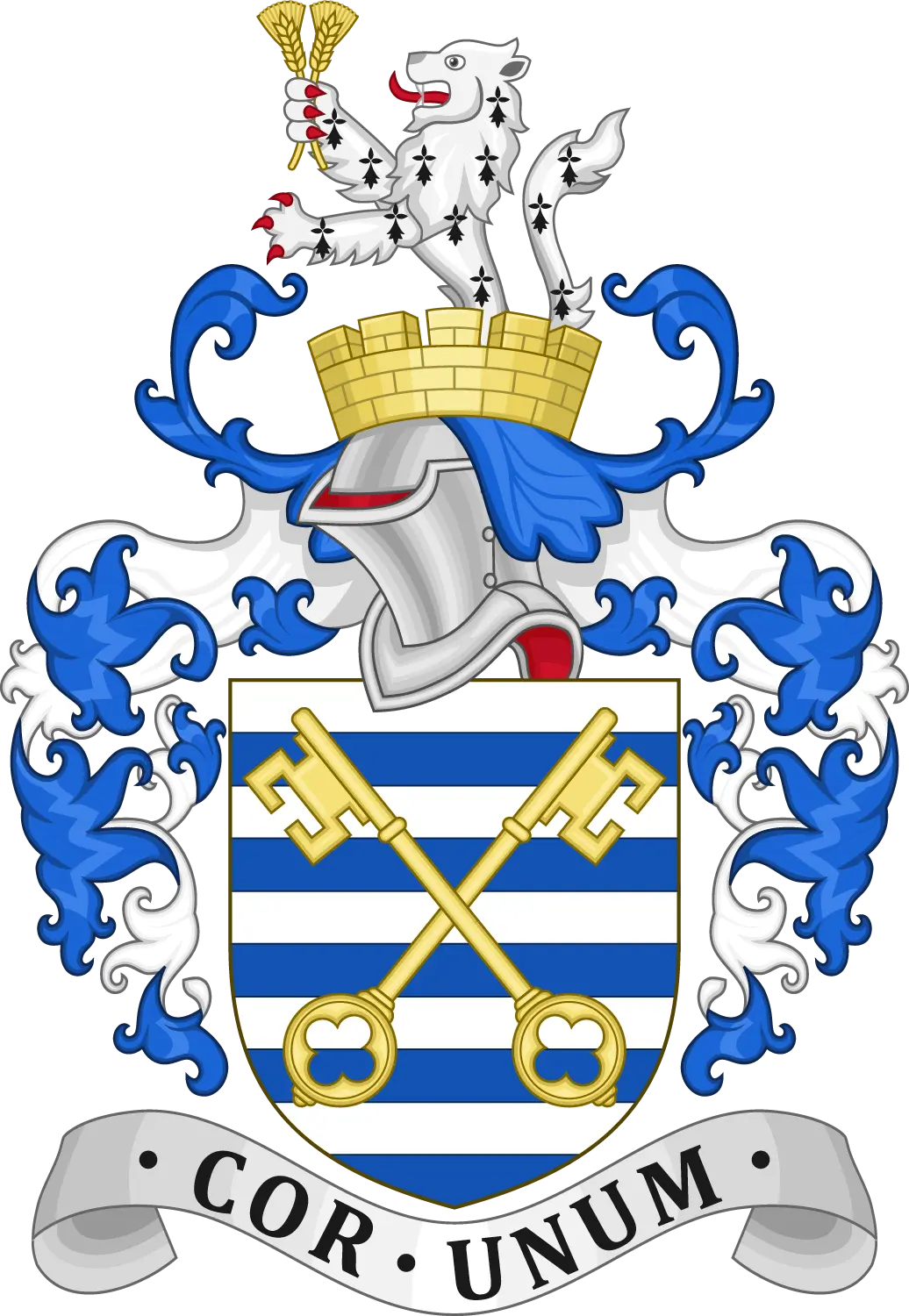
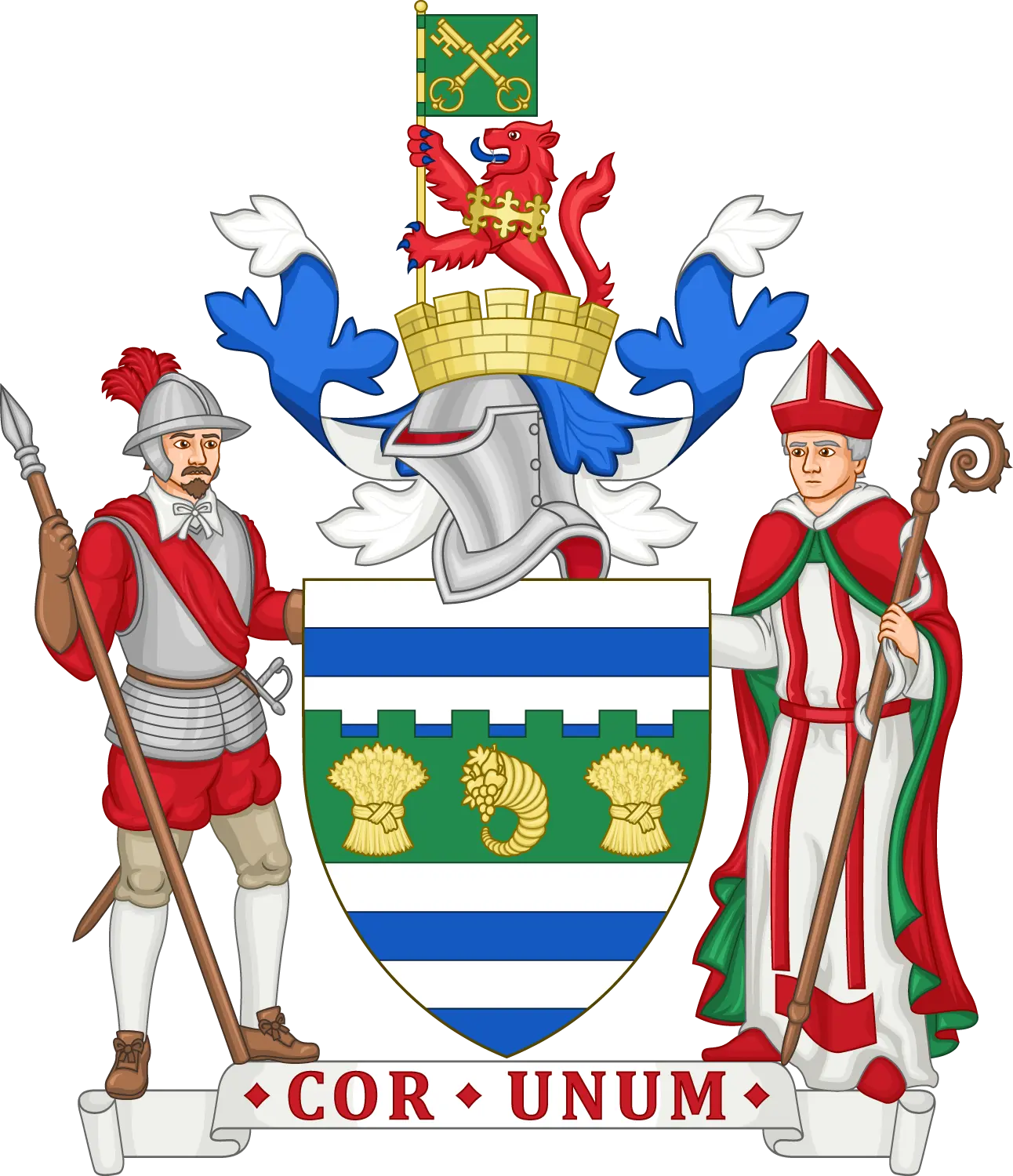
The Soke of Peterborough County Council arms and the Huntingdon and Peterborough County Council arms are now hosted within the Discover Peterborough image collection. The underlying historical images were sourced from Wikimedia Commons.
The historical administrative boundaries graphic is now hosted within the Discover Peterborough image collection. The original graphic is by Fenn-O-maniC using Ordnance Survey OpenData and is licensed CC BY-SA 3.0.
The North Prospect of the Cathedral Church of Peterborough is hosted in the Discover Peterborough image collection. It is a later historic view and is used atmospherically, rather than as a depiction of any particular administrative period.