


Peterborough’s first named writer was a monk who spent almost his entire life inside the abbey, and who left us nearly everything we know about the city’s earliest centuries.
A life in dates
- c.1095Born
- 1107–14His brother Reginald serves as sacrist under Abbot Ernulf
- 1116The abbey church burns
- 1139At the reconsecration, he handles the arm of St Oswald
- 1155Abbot Martin dies; Hugh helps elect his successor and rides to Oxford
- c.1160Dies, probably not long after 1155
The boy and the name
Hugh Candidus entered the Benedictine monastery at Peterborough as a small boy, brought into the community by his elder brother Reginald, who served as sacrist under Abbot Ernulf between 1107 and 1114. He was a sickly child and never strong, though he lived to a considerable age.
The name by which history knows him was not a surname but a description: he was called Hugo Albus, Hugh the White, for the paleness of his face, and later writers rendered this as Candidus. The Tudor antiquary John Leland, missing the point, listed him as “Hugh Whyte”.
A life inside the abbey
He rose steadily. Taught by Abbot Ernulf and by his own brother, both of whom he wrote about with real warmth decades later, he served under a succession of abbots and was employed in every corner of the monastery’s business, inside and out. Under Abbot Martin he was elected sub-prior.
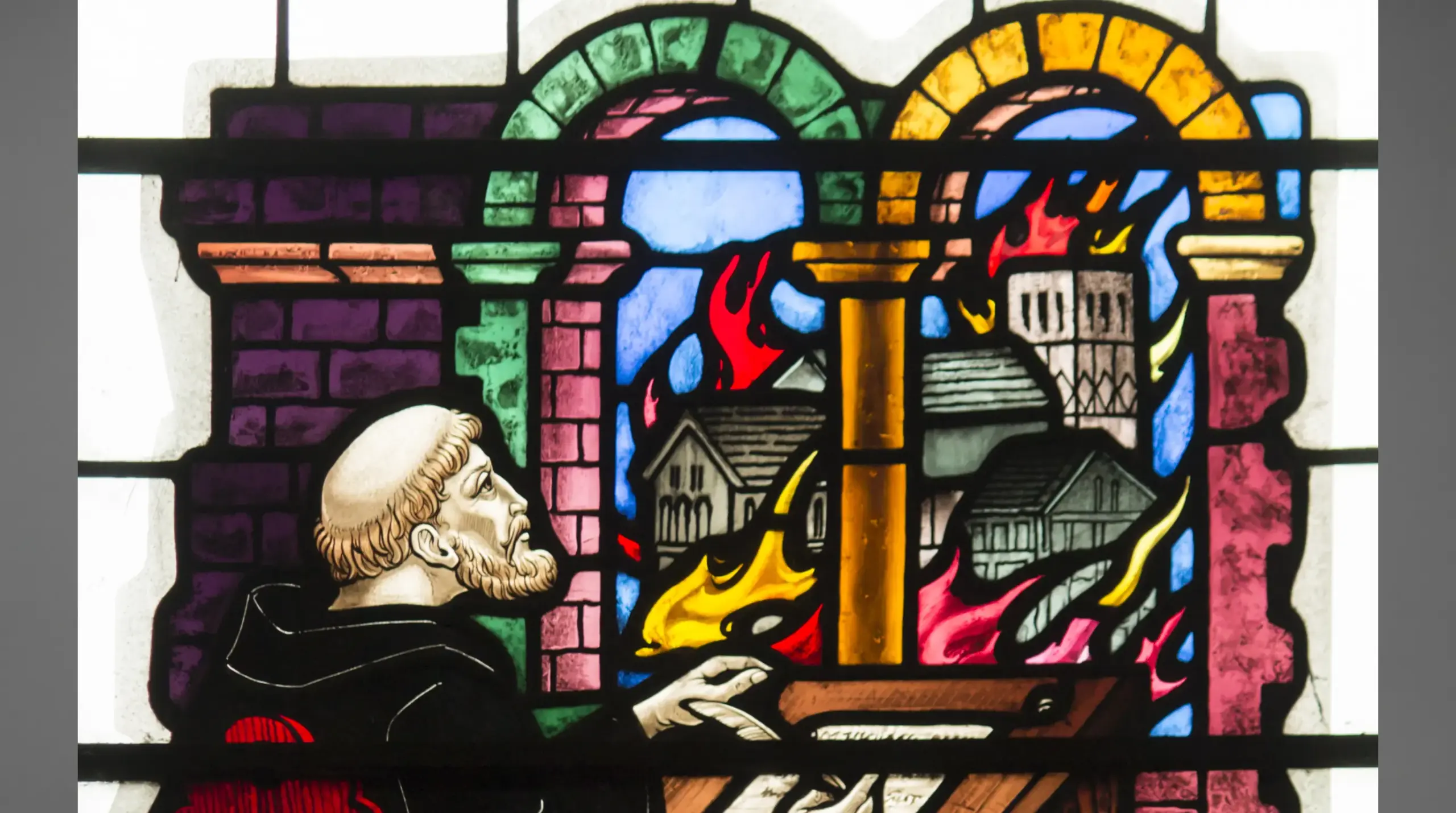
He was there when the abbey church burned in 1116, and at its reconsecration in Lent 1139 he washed and kissed the right arm of St Oswald, the most precious relic Peterborough possessed, afterwards testifying that flesh and skin remained whole.
When Abbot Martin died in January 1155, Hugh sat on the committee of twelve senior monks that elected William of Waterville, and rode the next day with the prior to Oxford to bring the news to Henry II.
The chronicle
His achievement is a history of the abbey written in Latin, running from its seventh-century foundation as Medeshamstede, through its refounding by Bishop Æthelwold in the tenth century and the change of name to Burh (the borough) to his own lifetime.
The golden borough
Hugh’s description of pre-Conquest Peterborough
It is from Hugh that we get that phrase, and it has attached itself to the place ever since. As his modern editor observes, his attention rarely wanders far from the monastery, its buildings, its lands and the saints who watched over it.
That narrowness is also the source of his value: nobody else was writing this down.
How the text survived
The manuscript history is its own drama.
- c.1155 The original Lost.
- 1600s A transcript is made Copied from the Cotton manuscript before the fire. This is the earliest text we have.
- 1723 First printed edition By the Peterborough antiquary Joseph Sparke.
- 1731 The Cotton library burns The copy in Sir Robert Cotton’s library is destroyed.
- 1949 The modern scholarly edition Edited by W. T. Mellows.
- 1980 The revised English translation Published by the Peterborough Museum Society.
Other versions survive in two great Peterborough books named for the men who compiled them, Walter of Whittlesey and Robert of Swaffham.
The end
He probably died shortly after 1155. Later hands added to his manuscript, including the note recording his own death: a fitting end for a man whose life’s work was making sure Peterborough remembered itself.