


Discover Peterborough
Peterborough History
Norman Cross
Prison Depot
Just south of Peterborough, a quiet field preserves the footprint of an extraordinary lost town: the world’s first purpose-built prisoner-of-war camp. Between 1797 and 1814, thousands of captured servicemen lived, worked, traded, endured illness and dreamed of home behind its walls.
An International Story
The lost town beside Peterborough
The world’s first purpose-built POW camp.
Norman Cross was not a converted castle, prison ship or borrowed barracks. It was designed from the ground up for one purpose: holding prisoners of war.
Built in 1796 and 1797 beside the Great North Road, around five miles south of Peterborough, the Depot became a huge enclosed settlement during the French Revolutionary and Napoleonic Wars.
At its busiest it could hold around 7,000 prisoners, watched over by soldiers and a complex system of palisades, roads, gates, barracks and guard positions. Across its working life, around 30,000 servicemen passed through the camp.
Today almost every prison building has vanished, yet the plan of this extraordinary place survives in earthworks beneath and across the fields. Its history also survives in one of Peterborough Museum’s most remarkable collections.
A field south of Peterborough once held a population larger than many towns.
Why Here?
Location was part of the design
Connected enough to supply. Remote enough to contain.
Norman Cross was selected with unusual care.
The site stood where the road from Peterborough met the Great North Road. It could be reached from east-coast ports including Great Yarmouth and King’s Lynn, with prisoners moved by sea, river and road before marching the final miles to the Depot.
Yet it was deliberately inland and away from a large city. The flat, exposed landscape made concealment difficult for escapees, while the road network allowed troops, food and supplies to arrive quickly.
The rural location also offered space, access to local produce and a site then regarded as healthier than the crowded prison hulks and improvised prisons it was intended to replace.
Great North Road
A major national route linked the Depot towards London and the north.
East-coast access
Prisoners and supplies could move inland from ports and navigable waterways.
Open country
The surrounding landscape reduced the chances of escapees disappearing into a city.
Peterborough nearby
A growing market town lay close enough to provide goods, labour, services and connections.
War arrives in the landscape
Britain’s wars with Revolutionary and Napoleonic France produced thousands of prisoners. Existing prisons, forts and hulks could no longer cope.
Follow the timeline →A purpose-built prison town
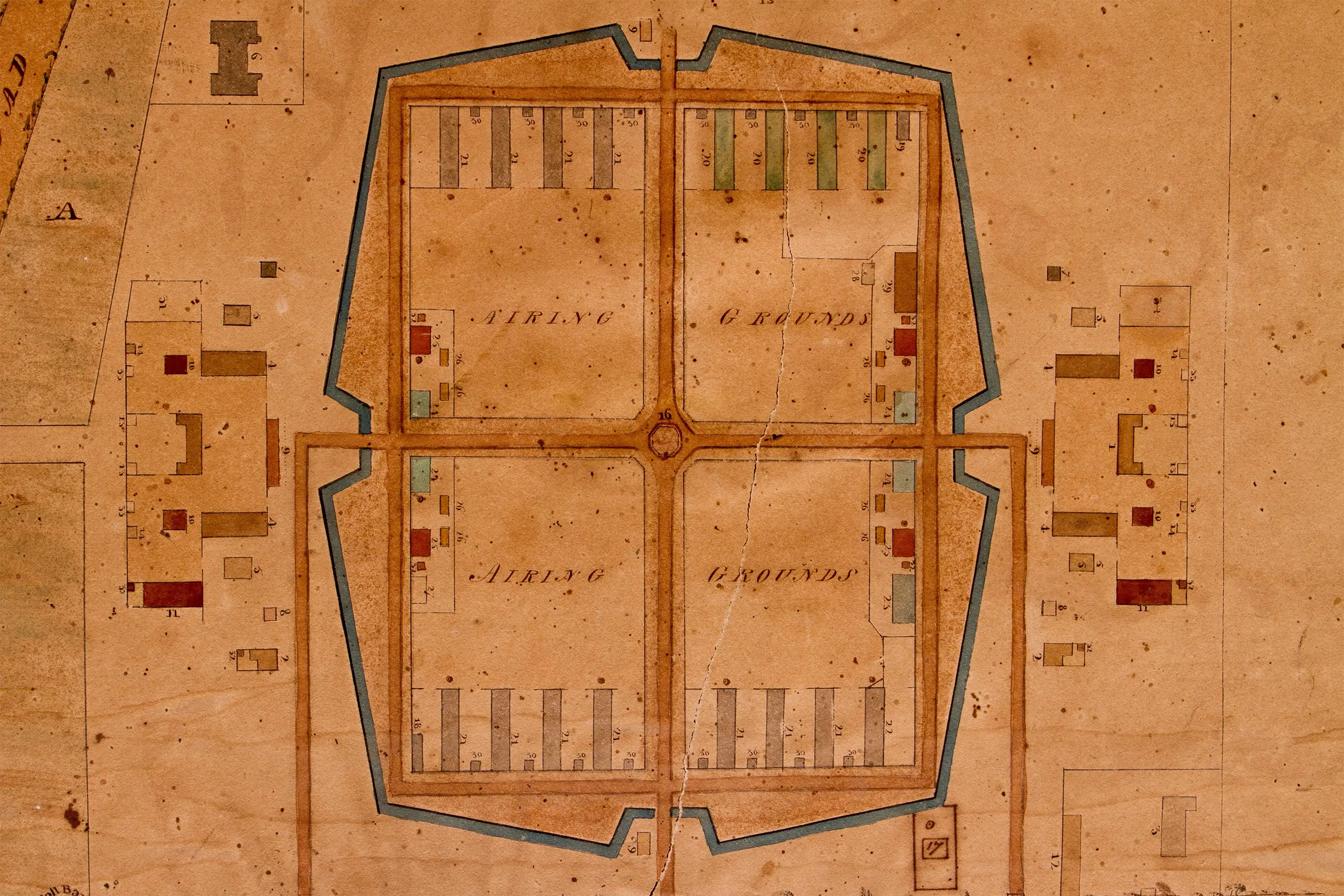
Four great prisoner compounds, barrack blocks, guard barracks, hospitals, offices and a central blockhouse formed a deliberately planned landscape.
Explore the layout →Captivity became an economy
Prisoners transformed bone, straw, wood and other materials into intricate objects which were sold to local people and traders at the camp market.
See the prisoner craft story →A lost town that still survives
Archaeology, museum collections, surviving houses, the memorial and the earthworks allow the camp to be reconstructed more than two centuries later.
Discover Norman Cross today →Inside the Walls
A prison designed as a system
Four compounds. One watchful centre.
The geometry of Norman Cross was part of its security.
The whole Depot covered roughly 15 hectares. At its heart was the prisoners’ enclosure, divided into four large quadrangles. Each contained four timber barrack blocks and an airing ground.
Cross roads met at an octagonal space in the centre, dominated by a blockhouse from which guards could overlook the compounds. Guard barracks and military buildings stood outside the prisoners’ enclosure.
The original timber palisade was later strengthened, and the site developed a substantial perimeter system. Archaeology has revealed traces of ditches, walls, roads and the structures that organised daily life.
The Blockhouse
The eye at the centre
Every road led to the watchtower.
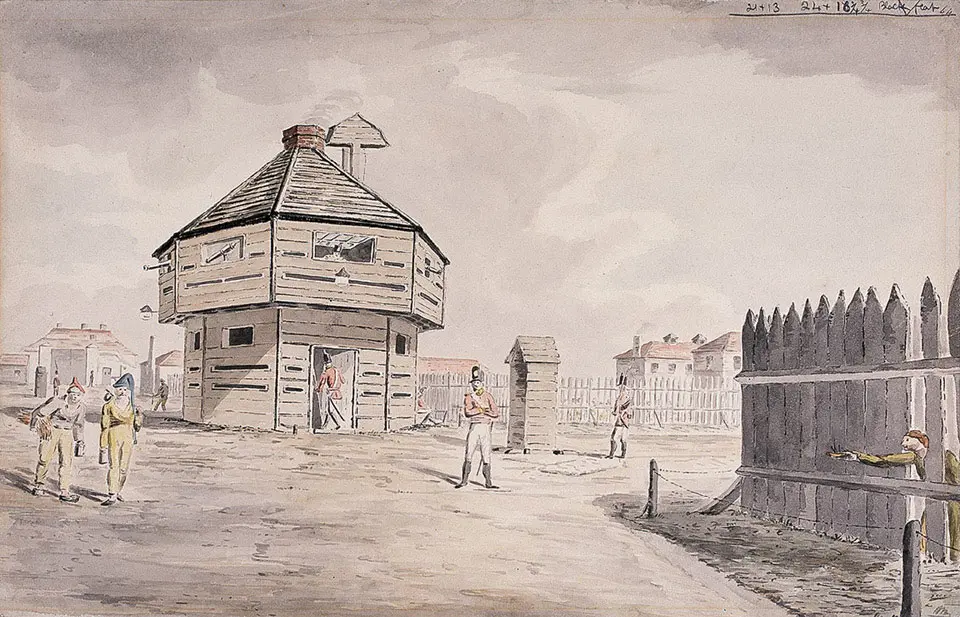
The octagonal blockhouse made the prison’s architecture unmistakably military.
Positioned at the intersection of the four compounds, it gave guards a commanding view into the prison. Contemporary images show a timber upper structure and armed sentries, with the surrounding palisades channeling movement through controlled routes.
Norman Cross was therefore more than a collection of barracks. It was an early experiment in designing a whole landscape around surveillance, separation and control.
The Norman Cross Years
From emergency construction to disappearance
Seventeen years behind the walls.
The Depot existed for only a short period, but its story spans war, temporary peace, epidemic, mass captivity and eventual demolition.
A purpose-built solution is ordered
Land at Norman Cross is acquired and construction begins late in the year, using timber structures designed for rapid assembly.
The first prisoners arrive
Norman Cross becomes operational as the first specially constructed prisoner-of-war camp of its kind.
A devastating epidemic
An epidemic causes 1,020 deaths. Across the whole life of the Depot, around 1,770 prisoners are recorded as having died.
Peace empties the prison
Following the Treaty of Amiens, prisoners leave in detachments and the Depot is empty by the end of April.
War returns
Hostilities resume. Norman Cross reopens and prisoners begin arriving again in August.
Trafalgar prisoners come inland
Peterborough Museum records that one third of the sailors captured at the Battle of Trafalgar were imprisoned at Norman Cross.
The Depot closes
With the war entering its final phase, the last prisoners leave and the camp closes.
The lost town is dismantled
Buildings and materials are sold. Most of the timber complex disappears, with some structures or materials reused elsewhere.
The memorial is unveiled
The Entente Cordiale Society erects a memorial beside the Great North Road to those who died at the Depot.
Archaeology returns to the camp
Wessex Archaeology and Channel 4’s Time Team excavate nine trenches, confirming elements of the plan and uncovering graves and craft-working evidence.
The site is secured for the future
Nene Park Trust acquires the main scheduled monument with support from Historic England and The National Lottery Heritage Fund.
More of the monument is brought together
Further Historic England funding supports Nene Park Trust’s purchase of an additional 2.4 hectares, bringing most of the Scheduled Monument into unified charitable ownership.
The story becomes visible again
A public viewing area, interpretation, digital reconstruction and guided walks are helping a new generation discover the site.
Life Inside
Thousands of individual stories
Prisoners, guards, traders and neighbours.
Norman Cross was a prison, but it was also a place of work, exchange, routine, boredom, ingenuity, fear and human contact.
The prisoners were predominantly sailors and soldiers. Peterborough Museum records men and boys from more than 35 countries and islands, including people from France, Holland and Italy. Some were very young.
At peak periods as many as 7,000 prisoners were guarded by up to 1,000 soldiers and militiamen. The Depot was administered by the Transport Office, with an Agent or Governor usually drawn from the Royal Navy.
Officers and some civilians could live outside the camp on parole, staying in Peterborough and surrounding towns and villages under agreed restrictions. That created another layer of contact between the wars of Europe and local life.
Soldiers and sailors captured across a conflict that stretched far beyond France.
Soldiers and militiamen lived in barracks outside the prisoner compounds.
Residents, dealers and suppliers became part of the camp’s wider economy.
The Prisoners’ Craft
Art made in captivity
Bone, straw and wood became extraordinary.
One of the most remarkable things about Norman Cross is what the prisoners made.
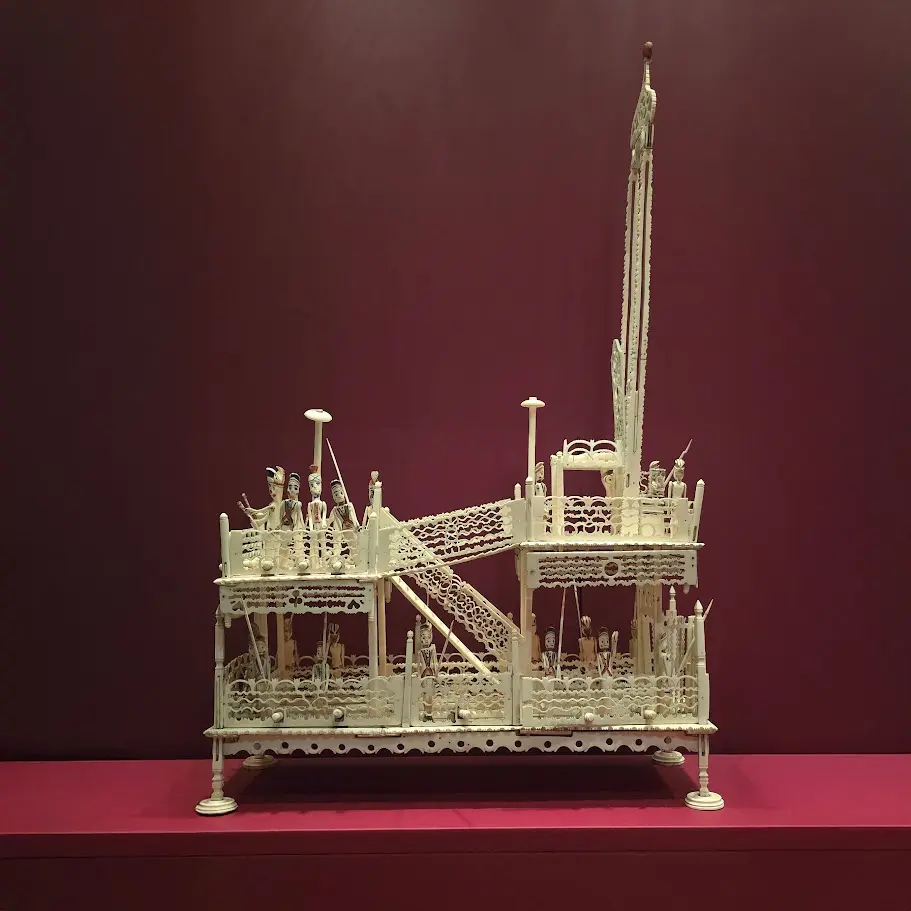
Using readily available or discarded materials, including animal bone, straw and wood, prisoners created model ships, miniature guillotines, boxes, games, automata, decorative objects and elaborate straw marquetry.
These were not simply ways of passing time. Finished pieces were sold at the market near the east gate to local residents and dealers. Prices and trading were supervised, and prisoners could use their earnings for food, warm clothing and other comforts.
The result was a distinctive prison economy and a body of craftwork whose survival now makes Norman Cross internationally significant.
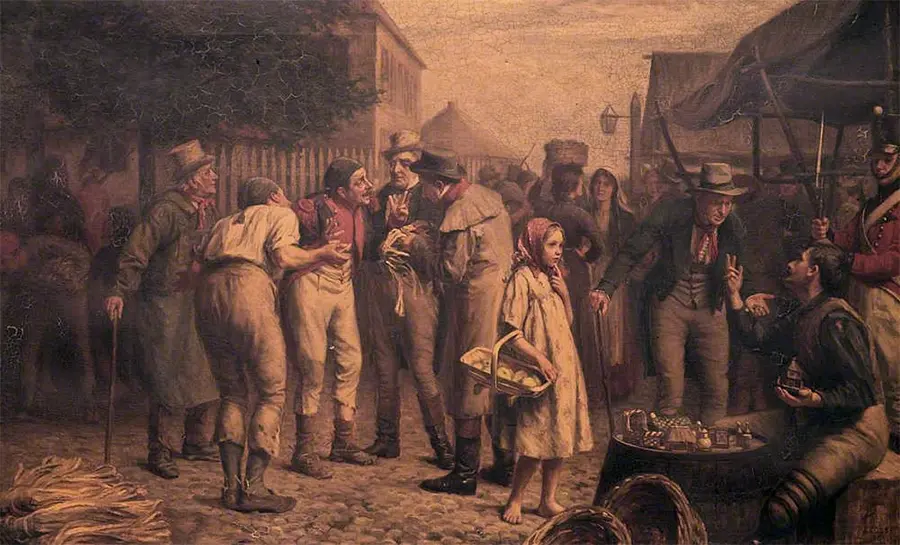
Peterborough Museum
The largest and finest collection of its kind.
Peterborough Museum holds more than 800 Norman Cross objects, including model ships, guillotines, needlework boxes, playing cards and straw marquetry. A substantial selection is displayed in a dedicated gallery.
Explore the Norman Cross Collection ↗Escape
The walls were not the end of the story
Some ran. Some nearly made it.
The Depot’s security was formidable, but prisoners continued to test it.
Peterborough Museum records repeated escape attempts. Sixteen prisoners escaped in 1804, while in 1805 around 500 men charged and broke down an inner fence.
Other attempts were more individual: disguises, improvised uniforms and even hiding in the cart used to remove waste from the camp. Recapture could mean confinement in a dark punishment cell and reduced rations until the cost of pursuit had been repaid.
These stories give the vast geometry of Norman Cross a human scale. Behind every wall and regulation were people measuring distance, opportunity and the possibility of going home.
Disease & Memory
The human cost of captivity
1,770 lives remembered.
Norman Cross was designed with health and hygiene in mind, but confinement on this scale remained dangerous.
Around 1,770 prisoners are recorded as having died during the Depot’s working life. A major epidemic in 1800 and 1801 accounted for 1,020 deaths.
Archaeological investigation in 2009 found graves immediately outside the camp’s northern and eastern defences, including burials containing more than one individual.
In 1914 the Entente Cordiale Society unveiled a memorial column topped by a bronze eagle. The original eagle was stolen in 1990. Following a long campaign, a replacement by sculptor John Doubleday was dedicated in 2005.

Beneath the Field
Archaeology of a vanished place
The prison is still there.
Not as buildings, but as ditches, foundations, buried surfaces, graves and the fragments of daily life.
The perimeter
Earthworks still trace the form of the camp, including the great boundary ditch and recessed entrances.
The barracks
Excavation confirmed elements of the camp’s layout and evidence for structures that had been systematically dismantled.
The craft workers
Hundreds of pieces of worked bone waste and unfinished objects reveal the manufacture taking place inside the compounds.
The graves
Archaeology confirmed burial areas on the north and east sides, adding physical evidence to the documentary record of those who died.
After 1816
When the prison became materials
The camp vanished. Not everything did.
After closure, the Depot was dismantled and its materials sold. Timber and buildings were reused around the area, while the site returned to agriculture.
Two important buildings associated with the camp survive above ground: the former Barrack Master’s accommodation and the Agent or Superintendent’s house. Historic England also protects the main site as a Scheduled Monument.
The disappearance of the prison is part of what makes Norman Cross so compelling. A place once crowded with thousands of people can now appear almost empty, while its buried plan remains unusually legible.
Norman Cross Today
A heritage landscape returning to public life
From hidden field to place of discovery.
In 2025, the future of the main Norman Cross site changed.
Nene Park Trust acquired the main scheduled monument with grant support from Historic England and The National Lottery Heritage Fund, securing the archaeology and opening a new chapter in how the story is shared. Further funding in 2026 enabled the Trust to acquire an additional 2.4 hectares, bringing most of the Scheduled Monument into unified charitable ownership.
A public viewing area off London Road now provides interpretation panels, a film and access to a digital 3D reconstruction. The viewing area can be accessed at all times.
The wider field is not generally open for unrestricted access. Nene Park Trust runs guided walks and talks which allow visitors to explore the site while protecting archaeology, livestock and the dignity of the burial areas.
Visit the Site
Norman Cross, London Road
- Postcode: PE7 3TB
- Viewing area: accessible from London Road at all times
- Whole field: access normally through organised guided events
- Parking: very limited parking by the memorial; additional paid parking nearby
- Facilities: no public toilets or café on the site
Continue the Story
Peterborough Museum & Art Gallery
See what the prisoners left behind.
The landscape at Norman Cross shows where the prison stood. Peterborough Museum reveals how people lived inside it.
Its dedicated Norman Cross Gallery brings together more than two centuries of collecting, with extraordinary prisoner-made craftwork, interpretation, maps and a recreated sense of the camp.
Discover the museum collection ↗The Legacy
A global story hidden in Peterborough’s landscape.
Norman Cross matters because it changed the architecture of captivity.
It was the prototype for later purpose-built military prisons, but its importance reaches beyond institutional history. It is a story of ordinary people caught up in international war, of local communities connected to distant battlefields, of creativity inside confinement and of the difficult work of remembering those who never returned home.
The buildings disappeared more than two centuries ago. The place did not.
Go Deeper
Explore the story from different angles
Follow Norman Cross further.
Peterborough Museum
Explore more than 800 objects connected with the prisoners and their craft.
Discover the collection ↗ 02 VisitNene Park Trust
Find current visitor information, interpretation and guided-walk details.
Explore Norman Cross ↗ 03 ProtectionHistoric England
Read the official Scheduled Monument record and detailed history of the site.
Read the listing ↗ 04 Historic bookT. J. Walker, 1913
Read the landmark early history of the Depot and its surviving documentary evidence.
Read the book ↗Sources & Further Reading
Research behind this story.
This page draws on official heritage records, museum interpretation, archaeological reporting and published historical research.
- Historic England, Site of the Norman Cross Depot for Prisoners of War, National Heritage List for England, List Entry 1006782.
- Historic England, Norman Cross Memorial, National Heritage List for England, List Entry 1222028.
- Peterborough Museum & Art Gallery, Norman Cross Gallery Large Print Guide.
- Peterborough Museum & Art Gallery, Norman Cross Collection.
- Historic England, Napoleonic Norman Cross Site in Cambridgeshire Saved for the Nation, 12 June 2025.
- Wessex Archaeology, Norman Cross Camp, Cambridgeshire: Archaeological Evaluation and Assessment of Results, 2010.
- Wessex Archaeology, Death and Dominoes: The First POW Camp, summary of the Time Team investigation.
- National Army Museum, The Blockhouse, Norman Cross Barracks, 1809, watercolour by Captain George Lloyd.
- Thomas James Walker, The Depot for Prisoners of War at Norman Cross, Huntingdonshire, 1796 to 1816, Constable & Company, 1913.
- Paul Chamberlain, The Napoleonic Prison of Norman Cross: The Lost Town of Huntingdonshire, 2018.
Historical numbers vary slightly between sources depending on date, definition and whether figures refer to capacity, people present at one time or the total passing through the Depot. This page uses figures supported by the current Historic England and Peterborough Museum records.
Discover Peterborough
One field. One extraordinary chapter in a much bigger story.
From prehistoric landscapes and Roman roads to medieval power, railways, engineering and the making of the modern city, Peterborough’s history is written across the places around us.
Explore Peterborough History →