

Two Stones · Two Arrows · One Impossible Shot
Robin Hood and
Little John
Stand in Alwalton churchyard and look north towards the Nene. According to an old local story, Robin Hood and Little John once stood here, drew their bows and fired into the distance. Their arrows landed more than a mile away.
At least, that is what the stones said.
Two low stones stand in a field above Milton Ferry Bridge, west of Peterborough.
They do not look like much.
They are weathered, squat and easy to overlook in a landscape already full of old stone.
Yet for centuries the villages around Castor and Alwalton gave them two of the biggest names in English folklore.
One stone was Robin Hood.
The other was Little John.
Their explanation was wonderfully simple.
The two outlaws had stood in Alwalton churchyard and shot an arrow each across the countryside.
The stones marked where the arrows landed.
It would have been a magnificent shot.
Magnificent to the point of impossibility.
The tradition begins at the medieval Church of St Andrew in Alwalton.
From there, Robin Hood and Little John were said to have released their arrows towards the rising ground north of the River Nene.
The stones stand roughly a mile and a half from the churchyard.
No ordinary longbow shot was going to cover that distance.
But this is Robin Hood.
Folk heroes are not restricted by sensible draw weights, practical ranges or inconvenient geography.
Little John shot the other.
The field remembered where they fell.
That was the story.
The stones themselves had another one.
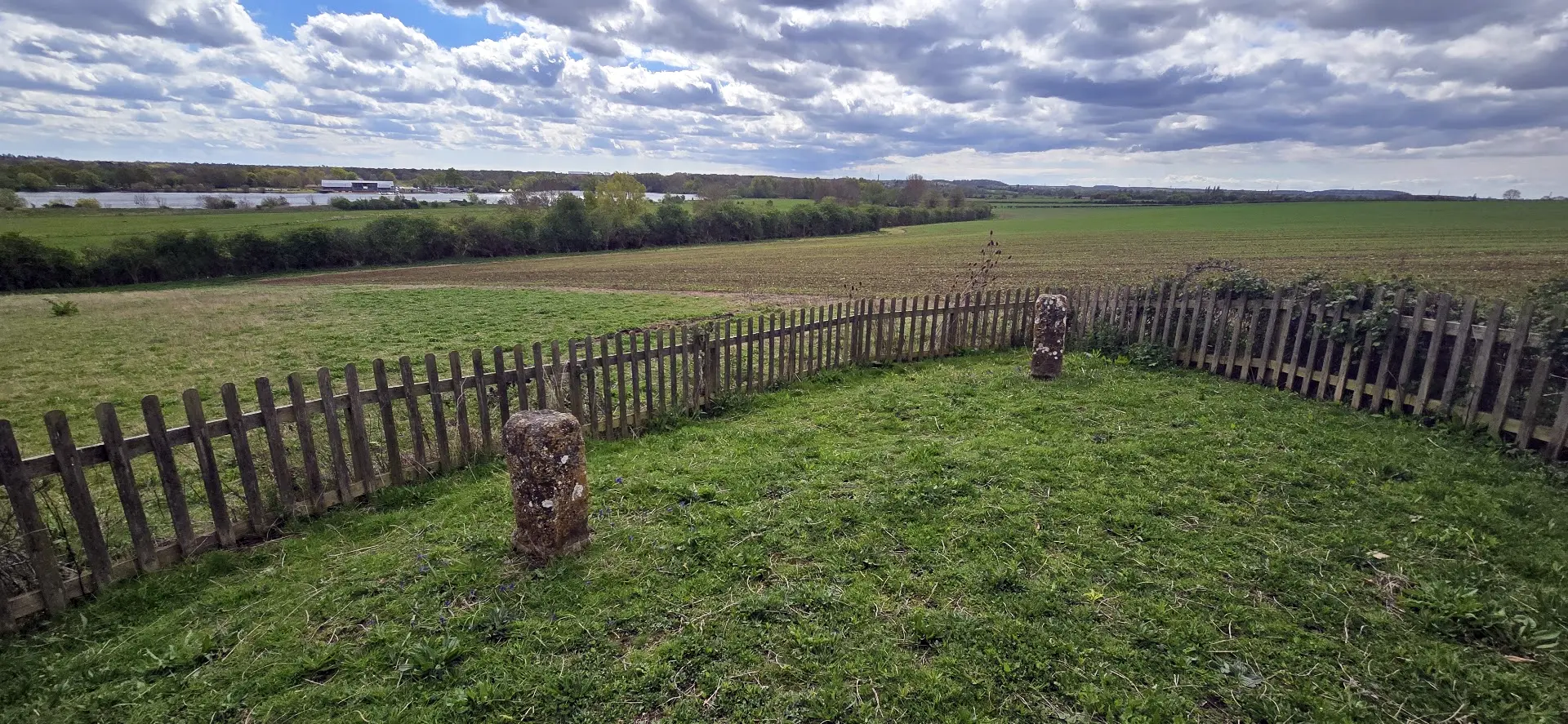
The stones are real.
They are not modern props placed in the landscape to illustrate the legend.
They have stood here for centuries.
Today Historic England lists them as the Robin Hood and Little John Stones.
They stand at Ferry Hill in the parish of Castor, overlooking the Nene corridor.
Their current national heritage designation preserves the folklore name.
But the official listing also preserves the older explanation.
These were probably not monuments to outlaws at all.
They belonged to the medieval stone trade.
They were St Edmund's Stones.
The historical explanation is less romantic than two impossible arrows, but much more revealing about medieval Peterborough.
Long before the stones acquired their outlaw names, the surrounding route was connected with the transport of limestone from the great quarries at Barnack.
Bury St Edmunds Abbey needed stone.
Barnack had it.
The problem was getting enormous quantities of heavy limestone from one to the other.
The two stones appear to have marked a privileged route across the land.
Carts carrying Barnack stone towards the river could pass along it without paying the usual toll.
Old records knew the markers as St Edmund's Stones.
The route itself was remembered as St Edmund's Balk.
Heavy stone needed water.
Medieval builders could move astonishing quantities of material, but hauling stone over land was slow and expensive.
The River Nene solved part of the problem.
Barnack stone intended for Bury St Edmunds could be carted south through the landscape towards the river.
The privileged route associated with the stones led towards Gunwade Ferry.
From there the stone could enter the Nene transport system.
They were marking where carts could pass.
Suddenly these two modest objects tell a much larger story.
They connect Barnack quarrymen, medieval abbots, roads, tolls, river transport and one of England's great monastic building programmes.
They also sit in a landscape where routes have mattered for far longer than the Middle Ages.
The clue was carved into the stones.
According to older descriptions, the tops of the stones carried marks shaped like arrowheads.
That might sound like perfect evidence for Robin Hood.
It was probably evidence for somebody else.
St Edmund was the ninth-century King of East Anglia whose shrine made Bury St Edmunds one of medieval England's great pilgrimage centres.
His martyrdom was inseparable from arrows.
Medieval imagery repeatedly showed Edmund bound and pierced by them, and the arrow became one of the visual symbols by which he could be recognised.
Two arrow marks.
A route carrying stone towards his abbey.
Historic England notes the traditional explanation that the arrow-shaped nicks commemorated St Edmund.
It also records something important.
No clear trace of those arrow marks can now be identified.
The marks disappeared.
Their story did not.
St Edmund faded. Robin Hood took his place.
This is where the story becomes a perfect example of how landscape folklore is made.
Medieval people knew why the road existed.
They knew why Bury St Edmunds needed Barnack stone.
They knew who St Edmund was and why arrows mattered to him.
Over time, those connections weakened.
The monasteries were dissolved.
The medieval transport arrangement ceased to matter.
The stones stayed exactly where they were.
And local people still had two old stones that everyone said had once carried arrow marks.
So the landscape found a new explanation.
Who was the most famous archer in England?
Robin Hood.
Who belonged beside him?
Little John.
Two stones.
Two archers.
Problem solved.
The story is older than we can precisely date.
What we can say is that Robin Hood had already claimed the stones by the seventeenth century.
Simon Gunton's history of Peterborough church, published in 1686, discusses the stones while describing the old Barnack quarries.
Gunton knew the practical explanation.
He says old records called them St Edmund's Stones and connects them with toll-free transport of stone to the ferry.
He also knew what local people were saying.
Gunton dismissed that as an “erroneous tradition”.
But his irritation is useful to us.
It proves the folklore was already established enough in 1686 to require correcting.
By then, the stones already had two histories.
Almost every field here has another story underneath it.
The stones stand in one of the richest historic landscapes around Peterborough.
To the west and north lie the villages and limestone country associated with Barnack.
Nearby Castor occupies part of an extraordinary Roman and Anglo-Saxon landscape.
Across the Nene was Durobrivae, the Roman town that grew around one of Britain's great road and river crossings.
Ermine Street passed through it.
The Nene moved goods through it.
Centuries later, medieval carts carrying Barnack stone were still exploiting the same basic advantage.
Roads and rivers continued to decide how this landscape worked.
Folklore noticed the old features too.
Only a short distance away, Castor remembered another mysterious old route as Lady Conyburrow's Way.
Robin Hood did not need to be here for the story to belong here.
There are Robin Hood wells, hills, caves, trees and stones scattered across England.
That does not mean the outlaw visited all of them.
It means Robin Hood became one of the figures people used to explain remarkable things in the landscape.
An enormous tree?
Robin hid in it.
A strange well?
Robin drank there.
Two stones once marked with arrows?
Robin Hood and Little John must have shot them.
In Peterborough, however, the folklore has preserved something else underneath it.
A memory of the medieval stone industry.
A memory of a road.
A memory of the River Nene as a transport artery.
A memory of St Edmund.
And two small monuments that outlived the reason they were put there.
The medieval road gave them a purpose.
Peterborough gave them Robin Hood.
The stones connect to much more of Peterborough.
Trace the quarry, river, Roman road and neighbouring folklore that sit behind the Robin Hood story.
Barnack Hills & Holes
Walk through the former limestone quarries that supplied stone for some of medieval England's greatest buildings and are now a National Nature Reserve.
Explore the reserve → 02 · MEDIEVAL PETERBOROUGHPeterborough Cathedral
See Barnack limestone transformed from quarried rock into one of England's great Norman churches.
Explore 1,350 years → 03 · ROAD & RIVERRoman Peterborough
Discover Durobrivae, Ermine Street and the Nene crossing that made this landscape an important transport corridor long before Robin Hood entered the story.
Enter Roman Peterborough → 04 · CASTOR FOLKLORELady Conyburrow's Way
Another old route in the Castor landscape acquired another explanation, this time involving a Mercian princess, a saint and a path the earth refused to forget.
Follow the old road →More Peterborough Folklore
Old roads, impossible animals, witches, rebels and stories fixed to real places across the Peterborough landscape.
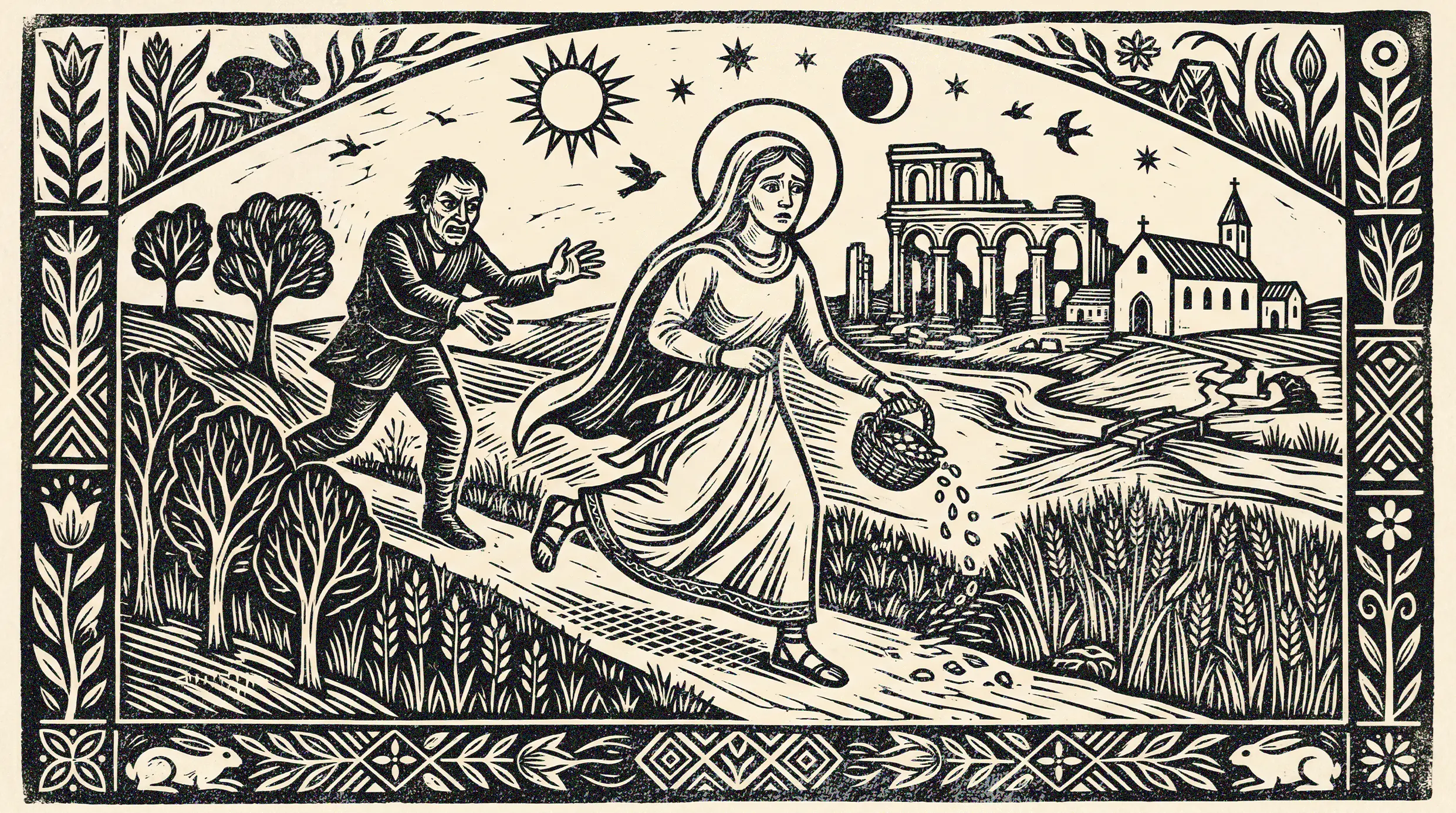
Lady Conyburrow's Way
A mysterious route through the fields became the road of St Kyneburgha, princess, abbess and saint.
Hereward & the White Wolf
A rebel army loses its road in darkness until a huge pale animal appears and walks ahead.
The Witch of Ailsworth
Iron pins, an accusation of sorcery and a story preserved because an Anglo-Saxon land charter needed to explain what had happened.
The Shag Foal
A huge shaggy creature waited on country roads after dark in the villages around Barnack and Helpston.
The Wild Hunt
Black riders, monstrous hounds and hunting horns were heard through the countryside outside Peterborough.
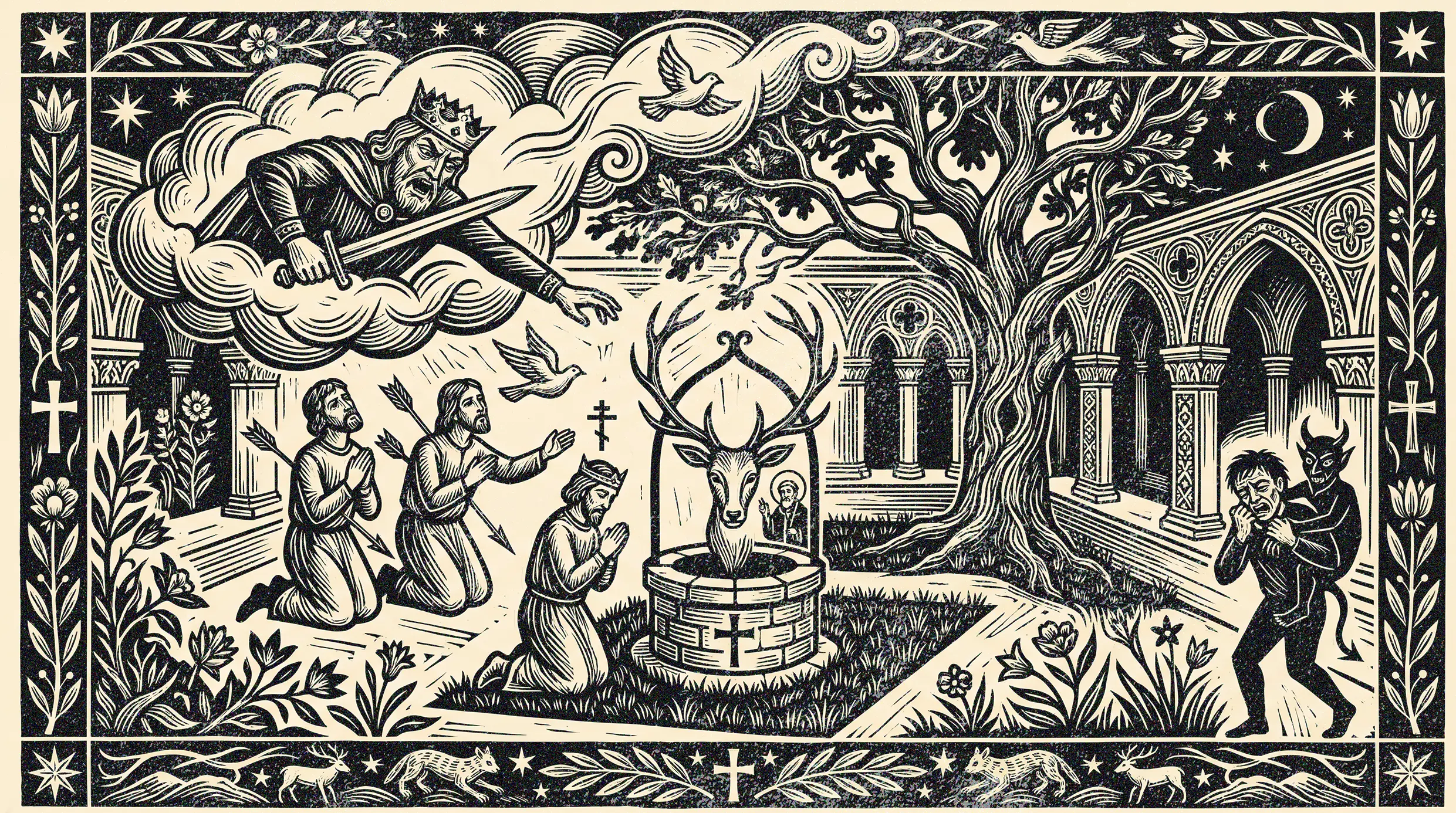
The Princes & the Hart
A royal hunt, a hidden hart and the extraordinary legend once told in Peterborough's medieval cloister windows.
Behind the folklore
The Robin Hood tradition is unusually useful because the stones survive, their probable medieval function is known, and the competing explanations were already being discussed in the seventeenth century.
-
Historic England · Robin Hood and Little John Stones
Official listing for the stones at Ferry Hill. Historic England identifies them as probable markers for a privileged toll-free roadway used to carry Barnack stone to Gunwade Ferry for shipment towards Bury St Edmunds Abbey. -
Simon Gunton · The History of the Church of Peterburgh, 1686
Records both explanations: the popular claim that the stones marked arrows shot from Alwalton churchyard and the older documentary identification of them as St Edmund's Stones associated with the transport of Barnack stone. -
Legends and Traditions of Huntingdonshire
Preserves the wider local tradition that residents of Alwalton, Chesterton and neighbouring villages associated the two stones with Robin Hood and Little John. -
Discover Peterborough · Barnack Hills & Holes NNR
The surviving quarry landscape from which Barnack's famous limestone was extracted. The old workings are now protected for their exceptional limestone grassland and wildlife. -
Discover Peterborough · Peterborough Cathedral
The wider story of Peterborough's monastery and Cathedral, including the enormous medieval building campaigns that transformed Barnack limestone into one of England's great churches.