

Iron stakes · lost land · an unnamed widow
The Witch
of Ailsworth
A widow and her son lost their estate after being accused of harming a powerful man with iron stakes. She was drowned. Her son escaped into outlawry. The man they were accused of attacking received their land. More than a thousand years later, we still do not even know the widow's name.
The most important person in this story is the one whose name nobody bothered to record.
She is usually called the Witch of Ailsworth. The surviving medieval text calls her something much simpler: a widow.
Around the middle of the tenth century she controlled an estate at Ailsworth, west of modern Peterborough, with her son. That alone tells us something important. This was not necessarily a destitute woman living at the edge of the settlement. She was associated with valuable land significant enough to become the subject of royal documents.
Then something happened involving a man named Ælfsige. The widow and her son were accused of driving iron stakes or pins into him. Something described as a deadly object was found in the widow's private chamber. Their land was forfeited.
The widow was drowned. Her son escaped and became an outlaw. The estate eventually passed to Ælfsige.
Those facts survive not because a medieval writer decided the widow's life was worth preserving, but because somebody later needed to explain who legally owned Ailsworth.
That difference changes the entire story.
The surviving account never actually calls her a witch.
The title has become so familiar that it is easy to assume the original record accuses the widow explicitly of witchcraft. It does not.
The late tenth-century document known to historians as S1377 describes the widow and her son causing harm to Ælfsige with iron stakes. It then says that evidence connected with the offence was taken from her inner chamber.
For generations, historians have interpreted this as image magic: an effigy representing Ælfsige was pierced with iron pins in the belief that injuries inflicted on the image would also injure the person.
That interpretation is entirely plausible and remains widely used. If correct, the Ailsworth case is an exceptionally early English record of a form of sympathetic or imitative magic.
But the word “effigy” is an interpretation. It is not unambiguously present in the surviving Old English.
Later history: the Witch of Ailsworth.
Modern scholarship therefore encourages us to treat Ailsworth Widow as the safer historical description. That does not dismiss the possibility of magic. It simply avoids turning an accusation and a later interpretation into her identity.
On this page we retain “The Witch of Ailsworth” because that is how the story has entered local folklore, but the distinction matters.
Something was found in the widow's room.
The later document tells the story backwards. It begins with land being exchanged, then reaches into the past to explain how one particular estate had entered the chain of ownership.
According to that account, the widow and her son had forfeited Ailsworth because they had driven iron stakes into Ælfsige, father of a man named Wulfstan Uccea.
The offence was discovered. The text says a morð was pulled from the widow's inner chamber. That difficult Old English word can refer to death, murder or something used to cause death. It is one reason translations of the passage vary.
Then the narrative becomes brutally concise. The woman was taken and drowned. Her son escaped and was outlawed.
Their estate went to the king.
Her land does not.
A separate royal diploma gives us the crucial date. In 948 King Eadred granted three hides at Ailsworth to Ælfsige.
The widow's forfeiture and death therefore had to have happened by that year.
This point matters later in the story. The king responsible for the 948 grant was Eadred, not Edgar.
This is a land transaction with a death hidden inside it.
S1377 was produced later in the tenth century to record an exchange of estates between Bishop Æthelwold and Wulfstan Uccea.
Most of the document is concerned with property. Washington in Sussex. Yaxley. Ailsworth. Who gives what to whom.
Then the text pauses to explain the history of Ailsworth.
The widow and her son forfeited Ailsworth after the offence against Ælfsige was discovered. The woman was drowned, her son escaped into outlawry, and the estate passed into royal hands.
Modern translations differ over whether the object involved should be understood as an effigy, a murderous instrument or evidence of a physical attack.The detail is chilling precisely because the document does not linger over it. A woman's death, a son's flight and the destruction of a household appear as the backstory to a transfer of land.
Without that later property transaction, neither of them might appear anywhere in written history.
The most famous part of the story is also the least certain.
The traditional reconstruction is powerful. Somewhere inside a house in Ailsworth stands an image of Ælfsige. The widow and her son drive iron pins into it. The magical attack is discovered. The incriminating object is dragged from her room.
This kind of sympathetic magic is known from many periods and cultures. Damage the representation, and you hope to damage the person represented.
But the original language does not explicitly mention an image. The iron stacan could be stakes, pins or rods, and the mysterious morð found in the chamber does not force us to translate it as an effigy.
An alternative reading is therefore much less supernatural: perhaps the widow and her son were accused of physically attacking Ælfsige with iron implements.
Other scholars remain unconvinced by that interpretation. The wider context still makes image magic plausible.
Physical assault?
A later story shaped to justify confiscation?
The honest answer is that the Old English leaves room for argument.
That uncertainty should be part of the story rather than edited out of it.
If the traditional interpretation is correct, Ailsworth gives us an exceptionally early documentary example of harmful image magic in England. If the alternative interpretation is correct, the case becomes an equally fascinating example of how a violent property dispute was later transformed into a story modern historians came to describe as witchcraft.
The land explains why the story survived.
The safest way through this extraordinary case is to follow Ailsworth itself. The documentary sequence is much firmer than any attempt to reconstruct the widow's motives.
The later account says they held the Ailsworth estate before losing it following the accusation involving Ælfsige.
After the widow's drowning and her son's outlawry, their property entered royal hands.
Charter S533 independently records the king granting three hides at Ailsworth to the very man the widow and her son were accused of harming.
The estate descended into the hands of Wulfstan, who later transferred Ailsworth as part of an exchange with Bishop Æthelwold.
S1377 belongs to the later tenth century. The exchange brought Ailsworth into Æthelwold's great programme of monastic restoration.
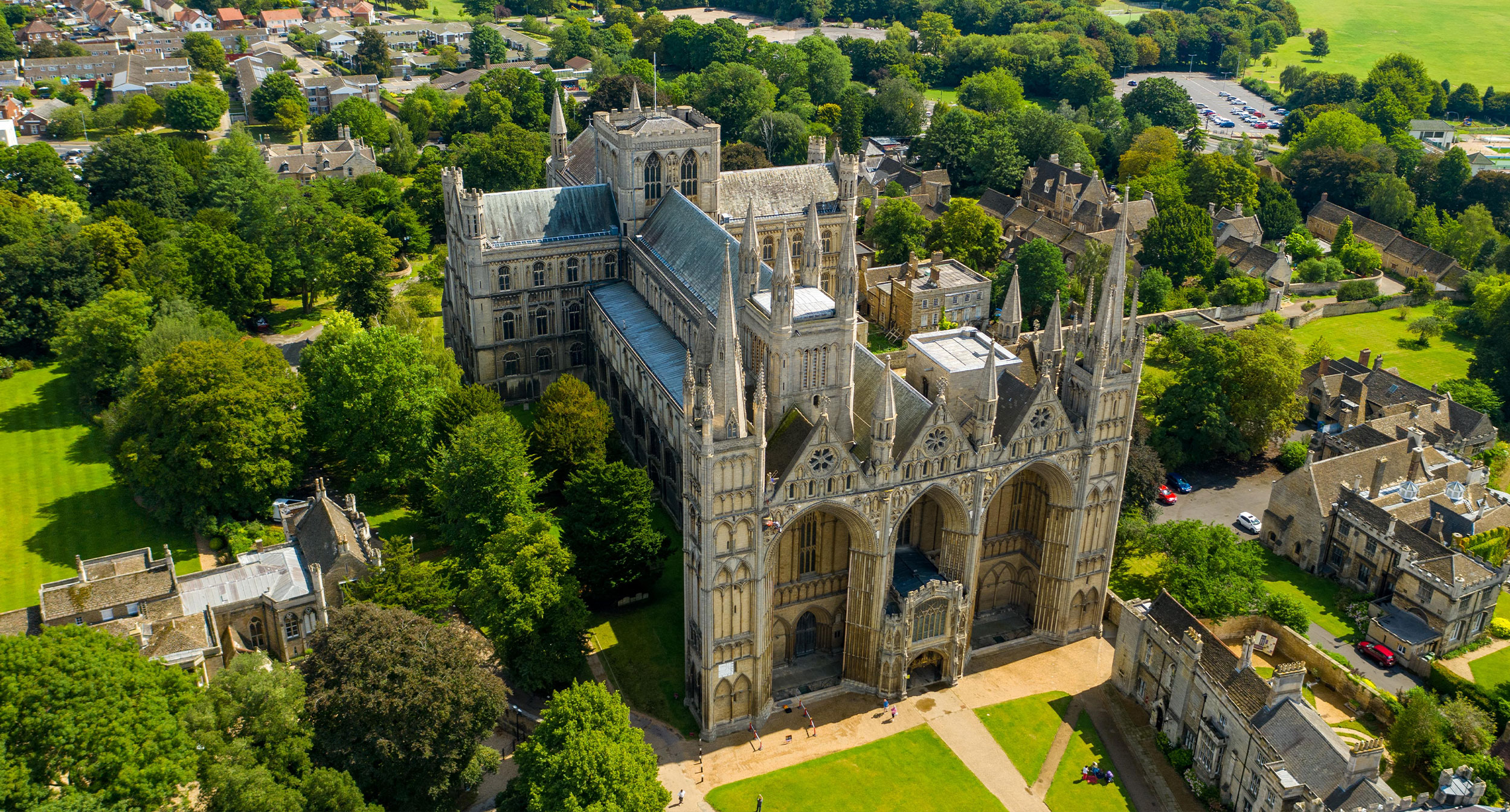
The estate was given to the refounded monastic community at Burh, the Peterborough that grew from the ancient monastery of Medeshamstede.
The chain matters because it prevents two different kings from being merged into one story.
Eadred made the documented grant to Ælfsige in 948. Edgar belongs to the later stage, when Æthelwold was rebuilding and endowing monasteries and Ailsworth ultimately entered Peterborough's landed estate.
Edgar enters the story later.
King Edgar did not confiscate the widow's land and he did not grant it to Ælfsige. By the time Edgar became king, that part of the story had already happened.
His importance comes through what happened next.
Edgar ruled England from 959 to 975 and became a major royal supporter of the tenth-century Benedictine reform. Among its leading figures was Bishop Æthelwold of Winchester, who established and restored monastic communities across eastern England.
Peterborough was one of them.
During Edgar's reign, Æthelwold acquired Ailsworth from Wulfstan Uccea. The estate was then assigned to Burh, the refounded Peterborough monastery. A property once held by an unnamed widow had become part of the economic foundation of a major religious house.
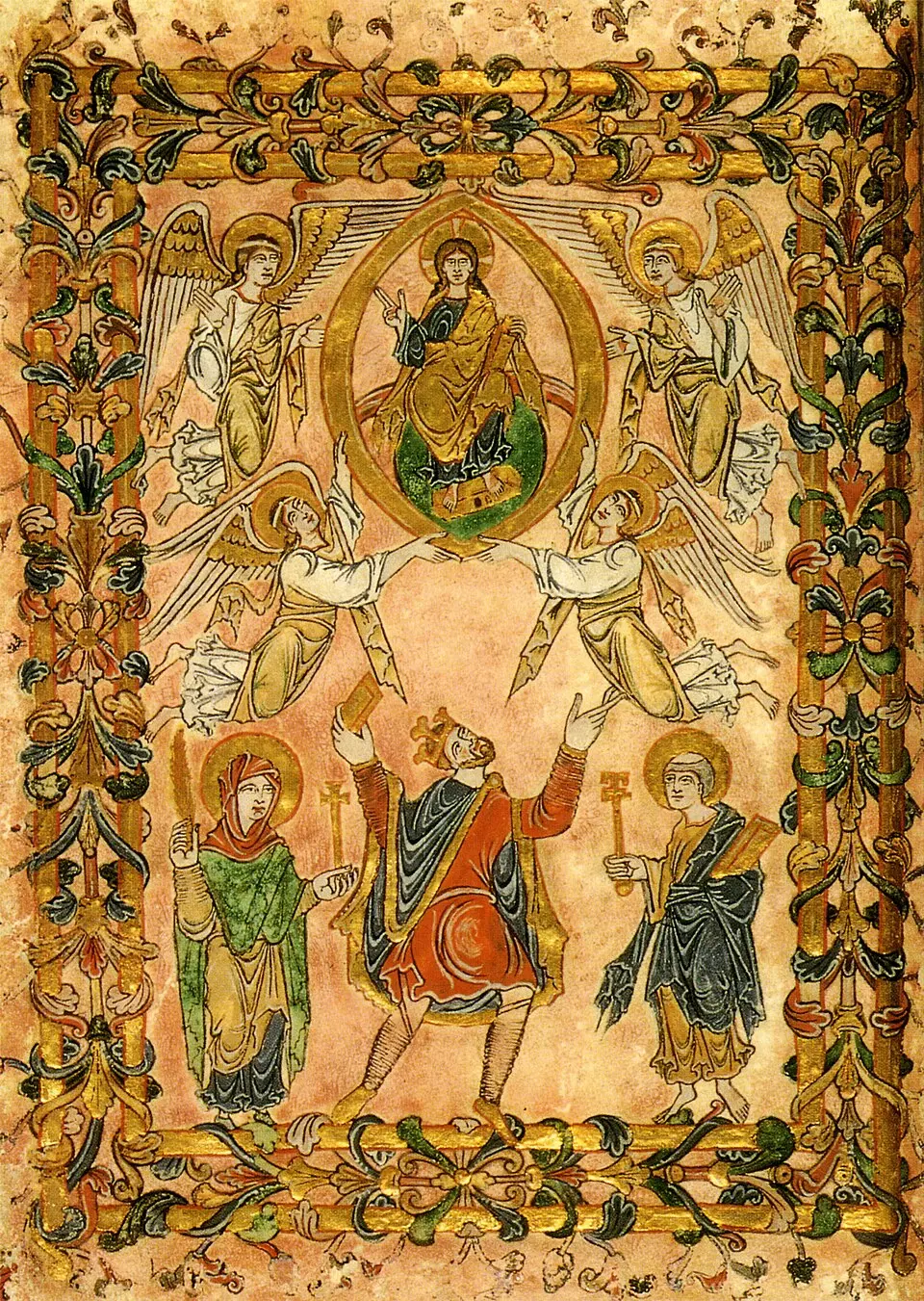
The extraordinary image beside this text was made in Winchester in 966, not Peterborough. It comes from the New Minster Charter, produced in the same world of royal authority, monastic reform and lavish religious patronage in which Æthelwold operated.
It is the only illuminated charter to survive from Anglo-Saxon England and the only surviving Anglo-Saxon manuscript written entirely in gold.
Edgar appears beneath Christ, presenting a written charter as an act of sacred kingship. It is almost the opposite end of the documentary world from the Ailsworth widow. Edgar is named, pictured and surrounded by authority. She survives as an unnamed sentence explaining why somebody else owned land.
The New Minster Charter has no direct connection with the Ailsworth case. Its value here is that it shows the royal and monastic culture of Edgar and Æthelwold during the period in which Ailsworth was transferred to Peterborough.
Even the place where she died is uncertain.
Modern translations commonly say that the widow was drowned “at London Bridge”. Read literally, that suggests the famous crossing over the Thames.
Ailsworth is a considerable distance from London. Scholars have therefore questioned why a local property dispute would end with the widow being transported so far simply to be drowned.
The Old English phrase can potentially be understood as a bridge on the road to London rather than necessarily the bridge in London itself.
That has encouraged various local theories, including crossings on major routes through this part of England.
None can currently be demonstrated.
We do not know where the water was.
The traditional translation “London Bridge” remains possible. What should disappear from the story is false certainty that we can identify the precise place where the widow died.
Was she “swum” as a witch? We simply do not know.
Because later witch trials became strongly associated with water, the Ailsworth widow's drowning has sometimes been described as an extraordinarily early example of swimming a witch.
That is possible, but the document never says an ordeal took place.
Early medieval English law did use ordeals in some circumstances, and lethal magic could be treated as a serious offence. Yet drowning is not otherwise a straightforward standard punishment for the offence described at Ailsworth.
Nor does the document record a trial, judgement, witnesses or the procedure by which guilt was established.
Scholars have consequently suggested several possibilities: formal execution, death during an ordeal, local violence, or punishment for circumstances the later land record no longer bothers to explain.
The widow's drowning is recorded. A trial by cold water is not. The later practice of “swimming” suspected witches should not automatically be projected backwards onto a tenth-century event whose legal circumstances remain obscure.
Who gained from the widow's disappearance?
The answer is impossible to ignore. Ælfsige, the man the widow and her son were accused of attacking, received Ailsworth from King Eadred in 948.
That does not prove the accusation was fabricated. People can commit crimes against people who later benefit from their punishment.
But it gives historians a reason to read the narrative critically.
The surviving account was produced within a culture where land, royal favour, inheritance and monastic ownership mattered enormously. It gives a neat justification for why one family lost an estate and another acquired it.
The widow is anonymous. Ælfsige and Wulfstan are named. Her alleged offence is remembered because it explains their title to the property.
It also protects somebody else's ownership.
We cannot now declare the widow innocent or guilty. The evidence is far too thin for that.
What we can do is refuse to mistake the voice of a property document for a complete account of her life.
There is no witch's cottage, no execution stone and no marked grave.
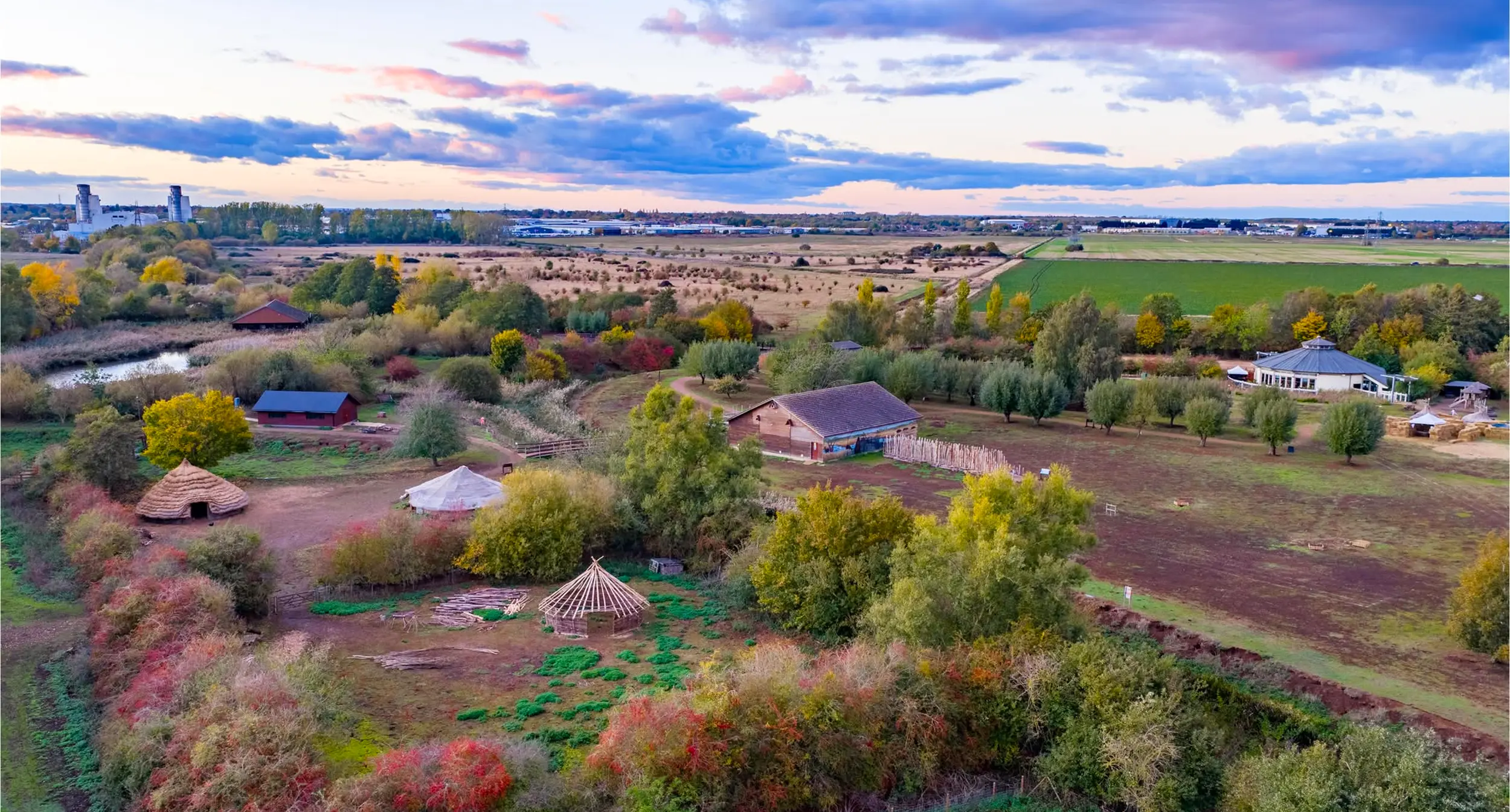
The surviving landscape is quieter than the story. Ailsworth remains a living settlement west of Peterborough, beside Castor and close to the Nene.
We cannot identify the widow's house. We cannot point to the chamber from which the mysterious object was supposedly taken. We do not know where she was buried, if she received a burial at all.
That absence is worth respecting rather than filling with invented folklore.
Nearby Castor adds several much older layers to the landscape. The monumental Roman complex that once stood there can be explored through Roman Peterborough → .
The neighbouring story of Lady Conyburrow's Way → adds another extraordinary local tradition, showing how the same small landscape accumulated stories about saints, roads, land and supernatural meaning across many centuries.
Walk through Ailsworth knowing that the exact house, object, bridge and burial place are all lost. The real historical experience is recognising that the ordinary landscape around you once contained a valuable estate whose confiscation became one of the strangest episodes preserved in Anglo-Saxon legal writing. Respect homes, private land and the fact that this is a living community.
The story becomes more powerful when we stop pretending to know too much.
A simple version of the story gives us a witch, a pierced effigy, a trial by water and an execution at London Bridge. It is vivid. It is also much more certain than the surviving evidence allows.
The real story gives us something better.
An unnamed landholding widow. A son who fled. An allegation involving iron stakes. A mysterious object in a private room. A drowning whose location is disputed. An estate confiscated by the king. A grant to the alleged victim. A later document written to explain why the land belonged to somebody else.
Somewhere inside that sequence lies an actual woman whose motives, beliefs and final hours are inaccessible to us.
Calling her a witch might describe what happened. It might describe what people believed happened. It might describe what later historians thought the text meant.
We cannot now tell which with complete confidence.
What remains certain is that the fate of an unnamed woman in tenth-century Ailsworth became entangled with the ownership of land that later helped support Peterborough's revived monastic community.
The contrast with King Edgar's golden charter is difficult to miss. Edgar survives in gold, enthroned beneath Christ. The widow survives only because somebody needed to explain where her land went.
The accusation survived.
The land changed hands.
Ailsworth sits inside a much older landscape of saints, estates and power.
Continue through nearby Castor, Peterborough's Anglo-Saxon monastery and other stories in which medieval documents, landscape and later folklore meet.
Lady Conyburrow's Way
A miraculous path attributed to St Kyneburgha crosses the neighbouring landscape, where archaeology and later tradition have become tightly intertwined.
Follow the story → 02 · THE MONASTERYPeterborough Cathedral History
Discover the monastery that ultimately received the Ailsworth estate and the tenth-century reform movement that restored Peterborough as a major religious centre.
Explore the history → 03 · THE OLDER LANDSCAPERoman Peterborough
Go further back into the Castor and Water Newton landscape, where Roman roads, settlements and monumental buildings shaped the ground inherited by later communities.
Explore Roman Peterborough → 04 · ANOTHER ANGLO-SAXON WOMANSt Pega of Peakirk
A very different early medieval woman survives through religious memory, place-name, manuscript tradition and one of Peterborough's most distinctive saintly stories.
Meet St Pega →More Peterborough Folklore
Medieval records, saints, strange creatures and stories rooted in Peterborough's oldest landscapes.
Lady Conyburrow's Way
A strange line across the fields became connected with St Kyneburgha and one of the oldest sacred landscapes around Peterborough.
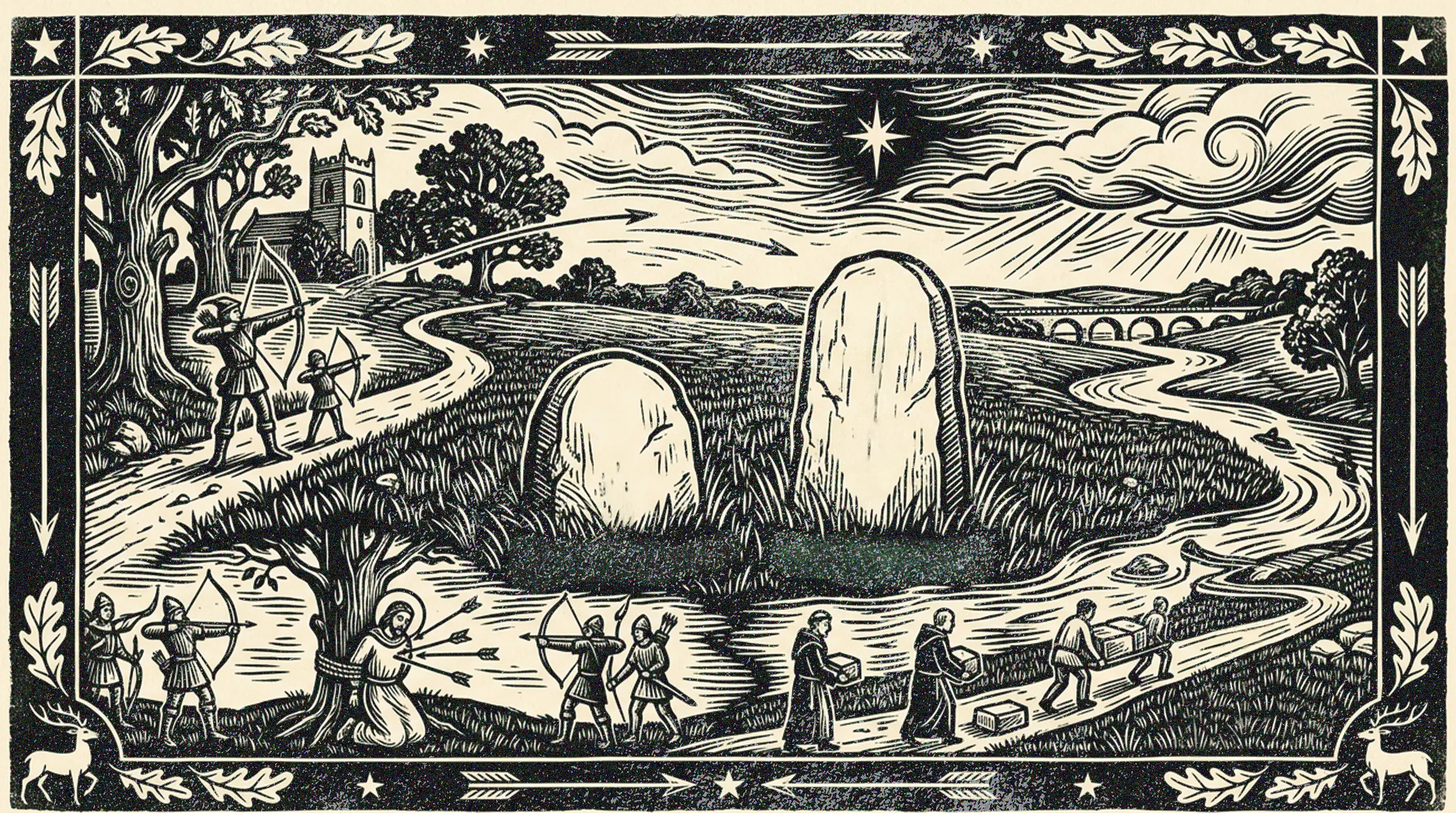
Robin Hood and Little John
Two old route markers in the neighbouring landscape eventually acquired an improbable story involving famous outlaws and impossible archery.
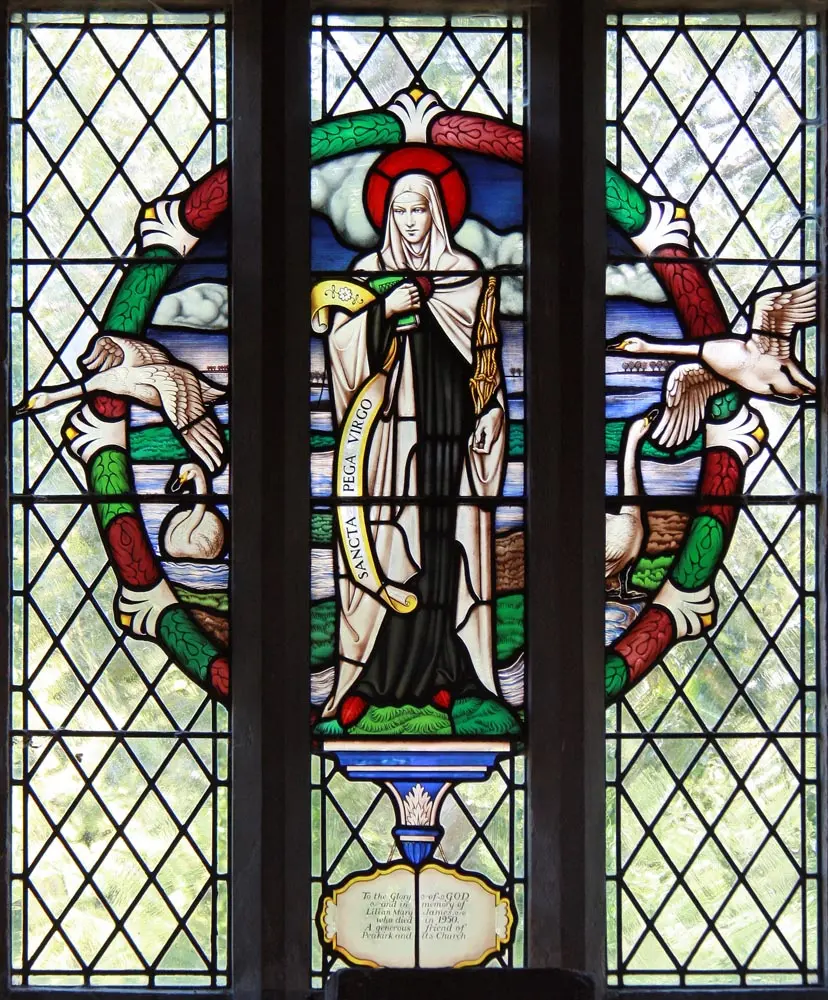
St Pega of Peakirk
Another woman survives in Peterborough's early medieval record, this time through sainthood, place-name and an extraordinary religious tradition.
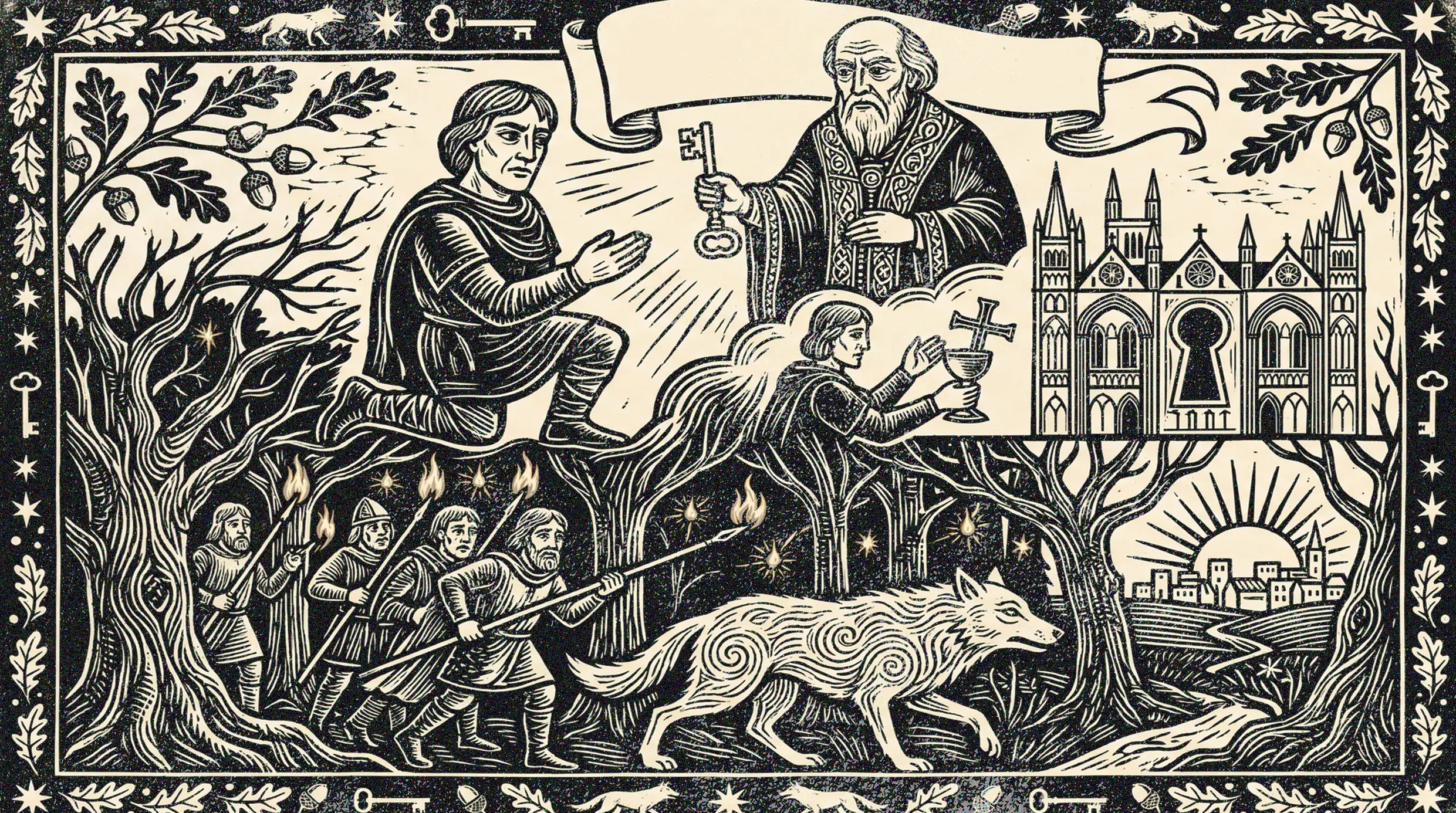
Hereward and the White Wolf
A documented raid on Peterborough became something much stranger as later generations added dreams, lights, treasure and a mysterious wolf.
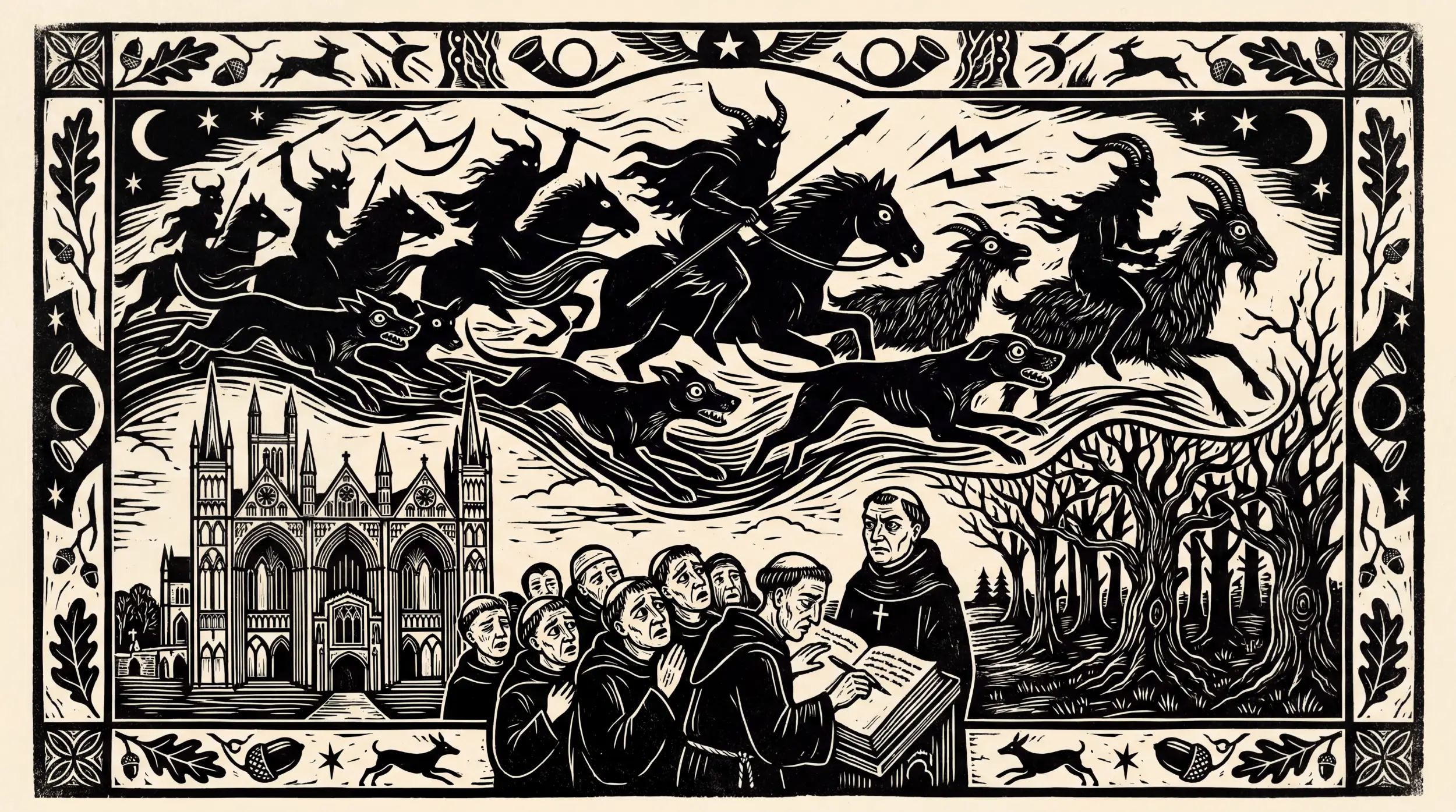
The Wild Hunt of 1127
Peterborough's own chronicler recorded black riders, monstrous hounds and hunting horns sounding through the night after an unpopular abbot arrived.
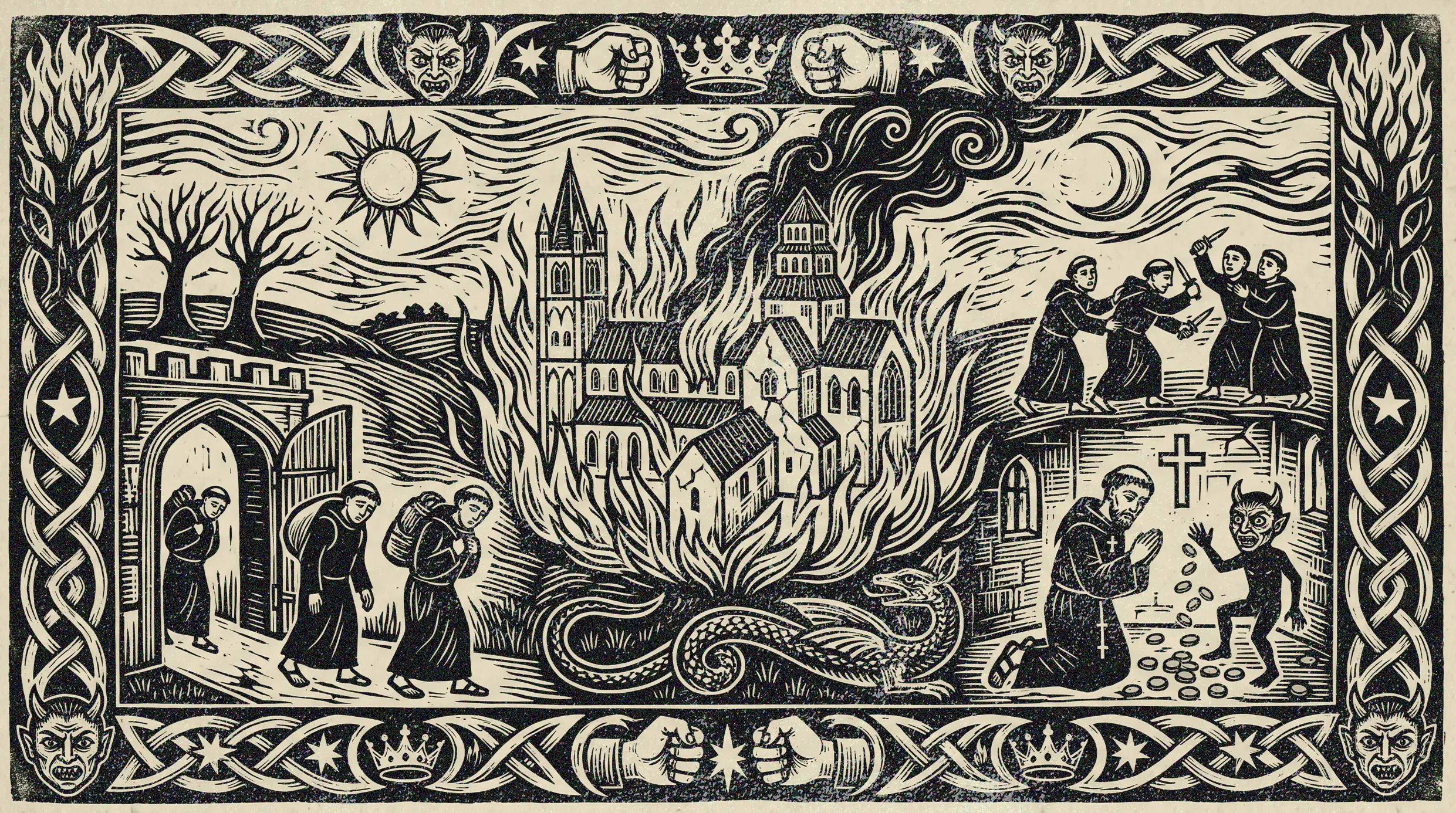
Come, Devil
A real medieval fire became entwined with one reckless sentence and Peterborough's powerful tradition of reading catastrophe through supernatural stories.
Behind the Ailsworth Widow
This page deliberately distinguishes what the surviving charters actually record from later interpretations of witchcraft, effigy magic, ordeal and execution. The title “Witch of Ailsworth” is retained as the familiar folklore name, not as a definitive judgement on the unnamed woman.
-
Electronic Sawyer · S1377
The principal later tenth-century source. Records the exchange involving Ailsworth and preserves the retrospective account of the widow, her son, the offence against Ælfsige, her drowning, his outlawry and the estate's subsequent history. -
Electronic Sawyer · S533 · King Eadred's grant · 948
Independent royal diploma recording King Eadred's grant of three hides at Ailsworth to Ælfsige in 948, providing the chronological anchor for the earlier forfeiture. -
Andrew Rabin · Anglo-Saxon Women Before the Law
Scholarly discussion of early English legal cases involving women, including the Ailsworth dispute and uncertainty surrounding the widow's punishment and the location traditionally translated as London Bridge. -
Martin Foys · How a Widow Becomes a Witch
Modern reassessment of S1377 focusing on land, legal narrative, gender and the process by which an unnamed landholding widow became routinely described by later historians as a witch. -
Winchester New Minster Charter · 966
The illuminated charter showing King Edgar flanked by the Virgin Mary and St Peter as he offers the charter to Christ. The manuscript provides visual context for the world of royal authority and monastic reform in which Æthelwold operated. -
Discover Peterborough · Cathedral History
Follow the monastery that eventually received the Ailsworth estate through the wider history of Peterborough. -
Discover Peterborough · Roman Peterborough
Explore the much older Castor and Nene Valley landscape within which Ailsworth later developed. -
Discover Peterborough · Peterborough Folklore
Explore the city's wider collection of medieval records, unusual customs, strange creatures and local traditions. -
Discover Peterborough · Weird Weekends
Follow Peterborough's stranger stories into the real places where their history survives. -
Image credit
Frontispiece of the Winchester New Minster Charter, 966. King Edgar is flanked by the Virgin Mary and St Peter and offers the charter to Christ, surrounded by four winged angels. British Library, Cotton MS Vespasian A VIII, f.2v.