


The Fire of 1116
Come, Devil,
and Blow on the Fire
A stolen treasure. A terrible prophecy. An angry servant struggling to light a fire. Then, on 4 August 1116, Peterborough Abbey began to burn.
The Devil made Peterborough Abbey three promises.
Medieval Peterborough remembered the great fire of 1116 as more than an accident.
The fire itself is not legend. The monastery burned. Much of the neighbouring town burned with it. The flames reached the great church and continued smouldering in its tower for days.
But the monks of Peterborough possessed another explanation for what happened.
According to the story preserved by their own chronicler, Hugh Candidus, the disaster had been foretold decades earlier.
The warning had been delivered not by a saint or prophet, but by the Devil himself.
And before the fire came, Peterborough believed that one part of his threat had already come true.
It began with a Peterborough monk and a buried treasure.
Æthelric had once been a monk at Peterborough before travelling north and eventually becoming Bishop of Durham in 1041.
His career later became entangled with one of the most extraordinary treasure stories in Anglo-Saxon England.
While an old church at Chester-le-Street was being replaced, a great hoard of treasure was discovered. Medieval accounts accused Æthelric of taking part of it and sending wealth south to his former monastery at Peterborough.
Modern historians treat the accusation with appropriate caution. Æthelric had enemies in the north, and the surviving accounts were written in communities with their own interests.
What matters for the Peterborough story is what the monks believed happened next.
Then something came to Æthelric at evening prayer.
By the time of the Norman Conquest, Æthelric was back at Peterborough.
According to the monastery's later historical tradition, he was attending his evening devotions when a figure appeared before him.
It looked like a boy.
But its face was terrible.
The visitor announced that he would take revenge on the monks and their monastery three times.
Then, the monastery would burn.
Finally, the monks themselves would be turned against one another.
Æthelric answered with a rebuke in the name of God.
The apparition vanished.
Hugh's story adds one last sensory detail: it left a dreadful smell behind.
Then the abbey was attacked.
Only a few years after the prophecy was supposed to have been heard, Peterborough suffered one of the most violent episodes in its history.
In 1070, amid resistance to Norman rule, Hereward and his allies came to Peterborough.
The monks tried to keep them outside the precinct. The attackers set fire to monastic buildings and entered through the flames.
What followed was a spectacular act of plunder.
Gold and silver crosses, shrines, vestments, money and books were carried away. The Peterborough Chronicle says the amount of treasure taken was beyond description.
For a community that already knew the prophecy, the parallel was hard to miss.
The church's goods had been given over to despoiling.
One promise, they believed, had been fulfilled.
The second was still waiting.
It began with a fire that would not catch.
The day of the disaster began badly.
Hugh Candidus remembered Abbot John of Sais losing his temper after being disturbed during a meal. Angry with the monks, the abbot cursed the house and left Peterborough for Castor, where he was due to attend legal business.
Elsewhere in the monastery, a servant was trying to light a fire in the bakehouse.
It would not burn.
He lost his temper too.
and blow on the fire.”
According to Hugh, the response was immediate.
The flame rose.
It reached the roof.
And Peterborough began to burn.
The flames reached far beyond the bakehouse.
This part of the story belongs firmly to history.
The Peterborough version of the Anglo-Saxon Chronicle records that the minster burned on Friday 4 August 1116. Most of the monastery was destroyed and a large part of the neighbouring town burned with it.
Hugh Candidus gives an even more personal account.
The church and its buildings were devastated. Crosses were broken. Fire remained in the great tower for nine days.
On the ninth night a violent wind rose and blew burning material towards the remaining buildings.
Hugh wrote as one of the community experiencing the disaster. At that moment, the monks believed that everything left to them might be lost.
Peterborough's first named writer turned disaster into story.
Hugh Candidus spent almost his entire life inside Peterborough Abbey.
He knew its buildings, its relics, its monks and its stories. He was a child when he entered the monastery and eventually became sub-prior.
More importantly for us, he wrote.
His history of Peterborough Abbey is one of the great sources for the city's early past. When he described the fire, he was not simply collecting an old legend about somewhere he had never seen.
He had lived through the catastrophe himself.
Yet Hugh also interpreted what he remembered through the spiritual world of a medieval monk. Accident, negligence, human anger, divine punishment and diabolical intervention could all inhabit the same explanation.
To Hugh, the supernatural story and the historical fire did not contradict one another.
They explained one another.
We can see where the record ends and the interpretation begins.
The fire of 1116 unquestionably happened.
The Peterborough Chronicle records its date and destruction without mentioning a demonic visitor, an ancient prophecy or the bakehouse servant calling on the Devil.
Hugh's later abbey history supplies that extraordinary narrative.
He also gives the fire two causes that a modern reader might separate but a medieval monk did not necessarily need to.
One was supernatural.
The other was painfully ordinary.
Negligence.
That makes the story more interesting, not less.
It preserves the way one medieval community made sense of catastrophe. The Devil may have promised destruction, but human anger and carelessness still gave the flames somewhere to begin.
The fire changed Peterborough forever.
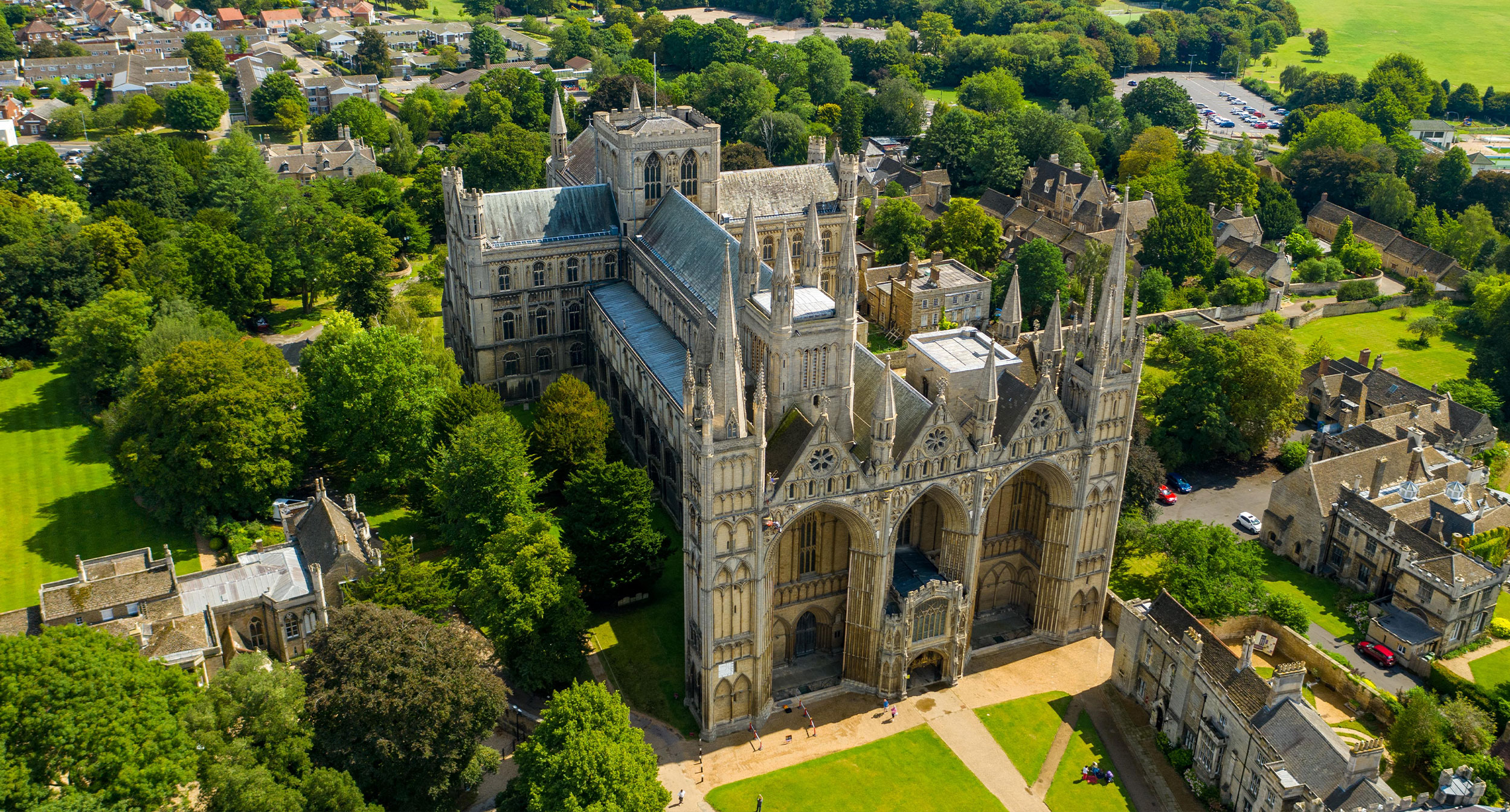
The Cathedral standing in Peterborough today is, in part, the architectural consequence of the disaster.
The old abbey church had been so badly damaged that a huge rebuilding campaign followed.
Work on the great Norman church began around 1118, only a short time after the fire.
Building continued through generations.
The vast Norman interior, the great eastern arm and ultimately the extraordinary Gothic west front all belong to the new monastery that rose after 1116.
That creates one of the most remarkable links between Peterborough folklore and the physical city.
The story is not simply about something that vanished.
Its aftermath is still standing.
A medieval warning hidden inside a real catastrophe.
“Come, Devil, and blow on the fire” survives because it sits in the uncomfortable space between history and belief.
There really was an Æthelric. There really was a dispute over treasure. Peterborough really was plundered in 1070. The abbey really did burn in 1116. Hugh Candidus really did witness the aftermath.
Around those events the monks constructed meaning.
Anger mattered. Greed mattered. Carelessness mattered. Inviting evil into ordinary life mattered.
Hugh's moral was therefore much larger than the question of whether a supernatural being literally blew upon a medieval fire.
Words had consequences.
Tempers had consequences.
And disaster could begin with something as small as a flame that refused to catch.
The story survived.
And a new Peterborough rose from the fire.
More Peterborough Folklore
Peterborough Cathedral and its ancient precinct contain some of the strangest stories in the city, from spectral hunts to demons carved in stone.
The Wild Hunt
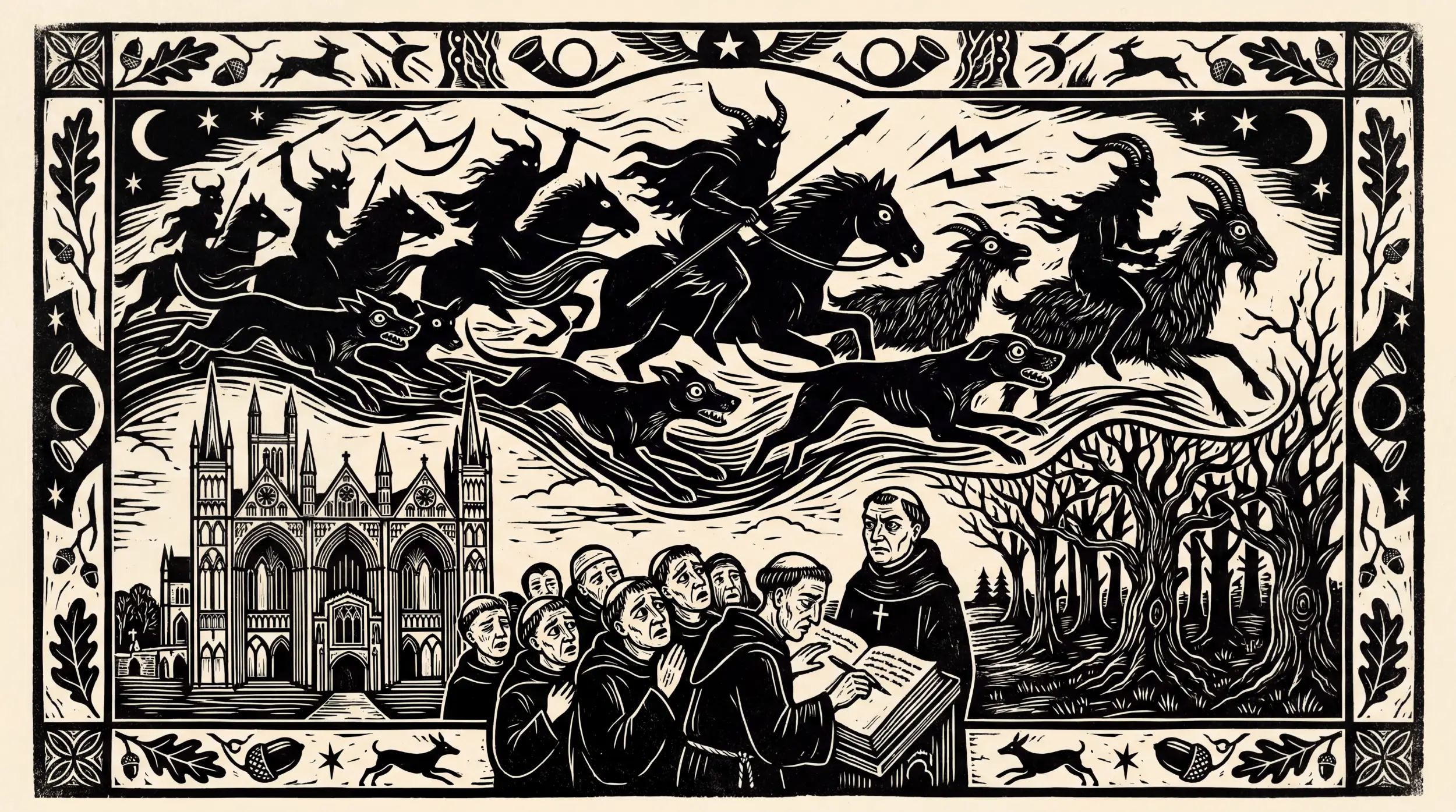
Black riders, monstrous hounds and hunting horns were heard around Peterborough after the arrival of an unpopular abbot.
Hereward & the White Wolf
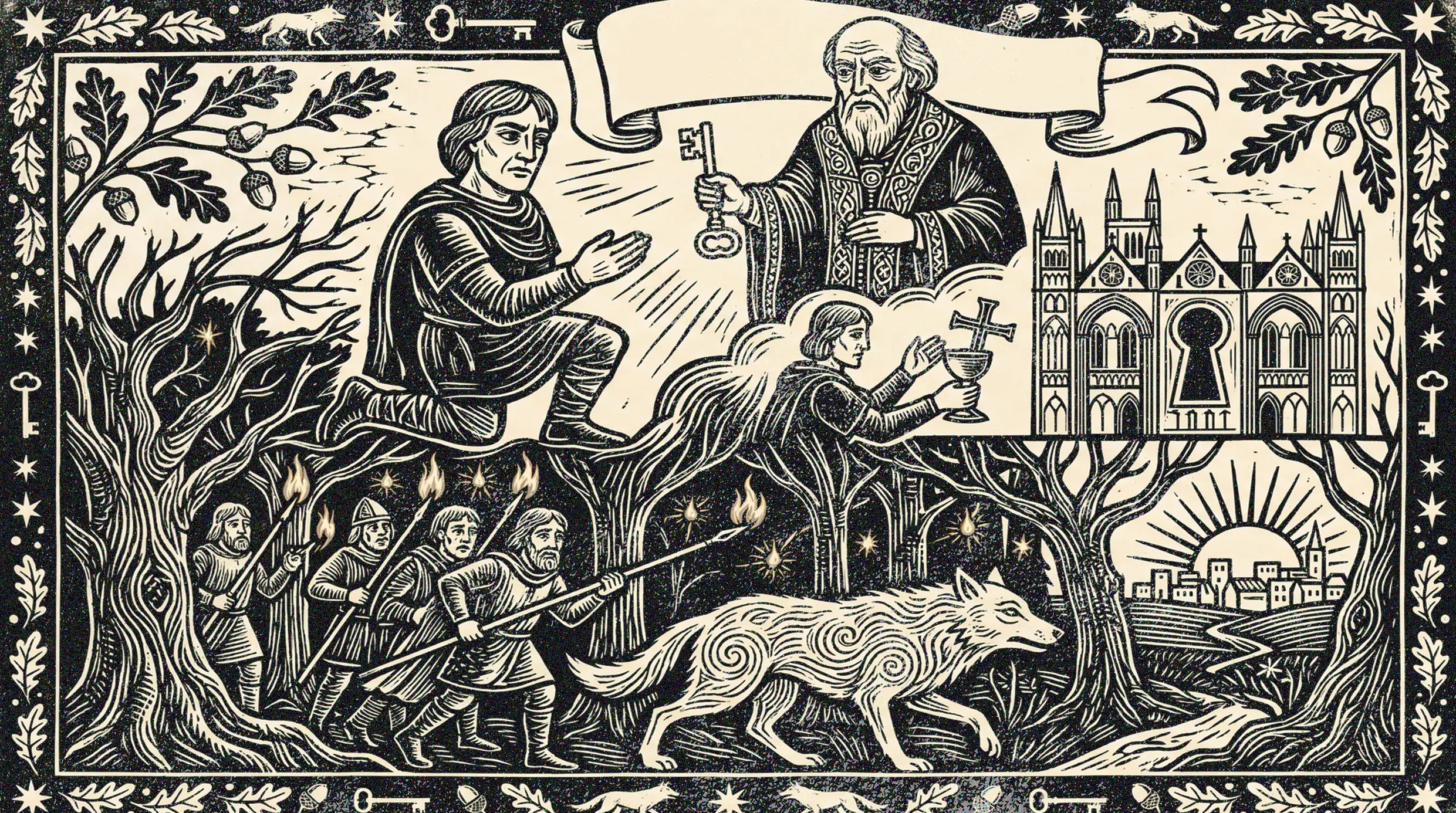
A warning dream, a mysterious white wolf and a legendary journey through the dark forests beyond Peterborough.
Simon Magus
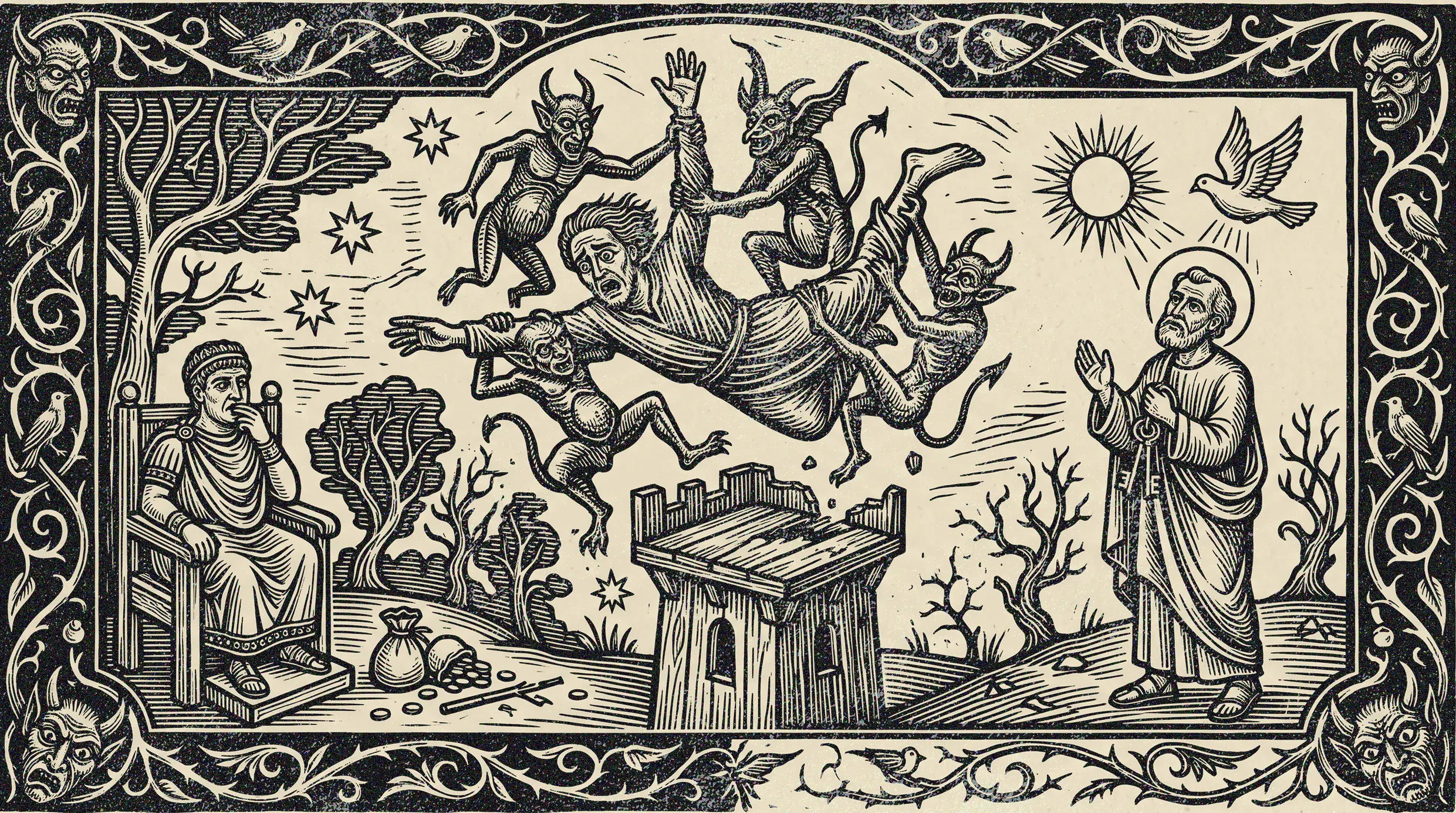
At the Cathedral's west end, four demons tear a man apart in one of Peterborough's strangest medieval carvings.
The Hedda Stone
Generations of visitors put their fingers into mysterious holes worn smooth in one of the Cathedral's oldest stones.
The Hare in the Close
A hare appearing in the Minster Close was once believed to mean fire would strike Peterborough before the week was out.
The Princes & the Hart
A royal hunt, a hidden hart and the violent legend once told in the medieval cloister windows.
Behind the folklore
This story brings together a documented medieval catastrophe, the Peterborough monastic historical tradition and the way Hugh Candidus interpreted events he experienced himself.
-
Hugh Candidus · Chronicle of Peterborough Abbey
Hugh's twelfth-century abbey history preserves the story of Æthelric's prophecy, the bakehouse servant's words and a detailed account of the 1116 fire. -
Peterborough Chronicle · Anglo-Saxon Chronicle, E text
Independently records the fire on Friday 4 August 1116 and the destruction of the monastery and much of the neighbouring town. -
Historic England · Peterborough Cathedral
Historical overview of the 1116 fire and the beginning of the present Cathedral's construction from 1118. -
Discover Peterborough · Hugh Candidus
Discover Peterborough's biography of the monk who witnessed the fire and became Peterborough's first named writer.