


The Sexton Beneath the West Door Old Scarlett
He buried generations of Peterborough people, survived almost the entire Tudor age and became the human link between two of the most famous queens in British history.
Peterborough remembered the man who dug the graves.
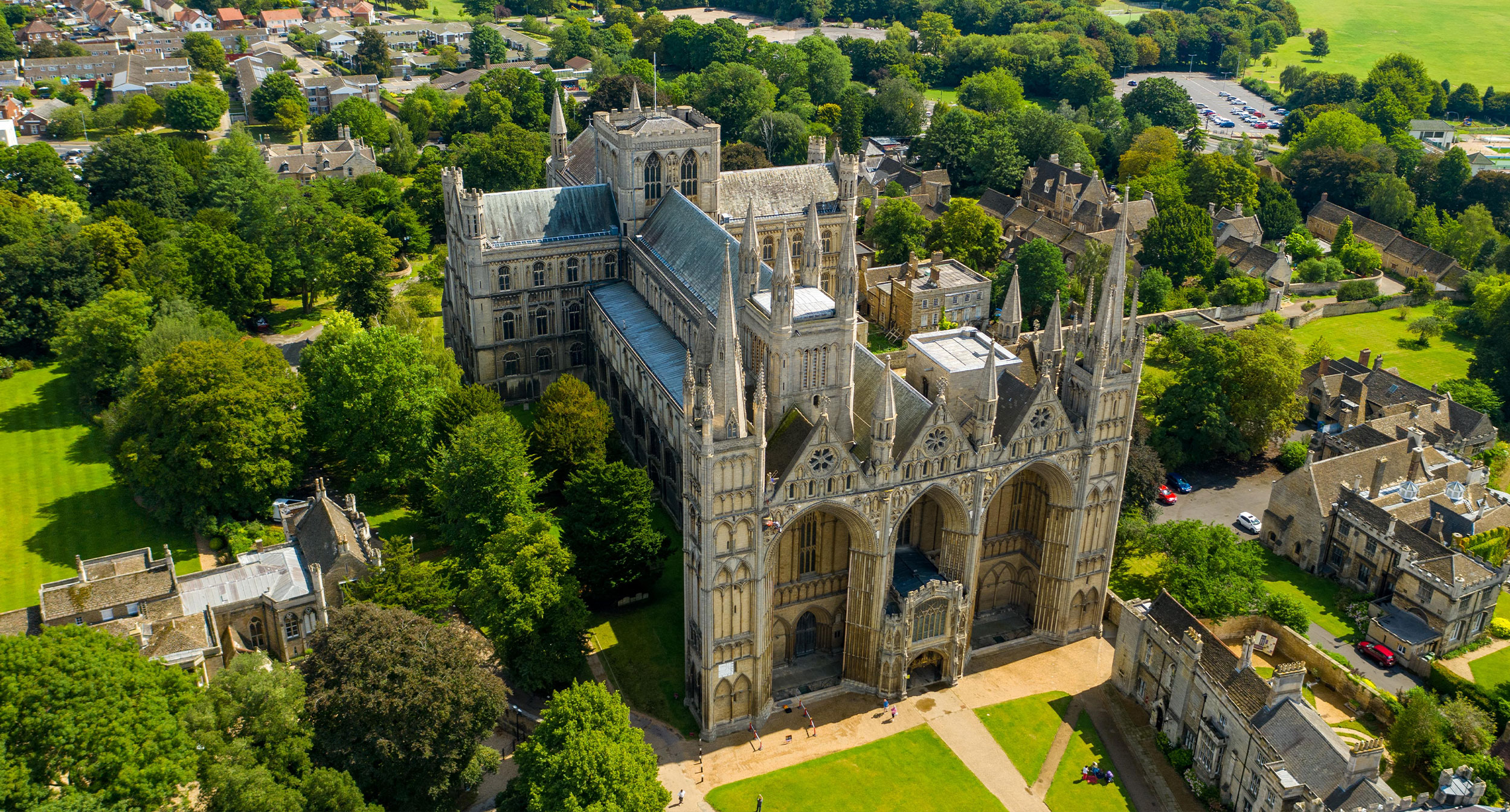
Robert Scarlett was not royal, wealthy, learned or powerful. Yet nearly five centuries after his death, his face still looks down on visitors entering Peterborough Cathedral.
He was a working man.
Scarlett served for decades as Peterborough's sexton, one of those practical church officials whose work was essential but rarely glamorous.
He kept order around the church. He rang bells. He looked after the burial ground.
And, above all, he dealt with the dead.
The people Scarlett buried came from every part of Tudor Peterborough.
Two of them happened to be queens.
Death was only part of the job.
A Tudor sexton occupied the point where worship, administration and everyday physical labour met.
Scarlett's responsibilities included preparing graves and assisting with burials, caring for the church and burial ground and carrying out practical jobs required by the parish.
Cathedral records even preserve glimpses of the ordinary details of his working life.
New spades were supplied for him in the 1560s.
As an elderly man he was given a gown to keep him warm when he had to go out and toll the bell for sick parishioners.
He also helped organise supplies for poor people in the town.
Old Scarlett did not become memorable simply because he happened to stand near royal history.
He spent a lifetime embedded in the ordinary life and death of Peterborough.
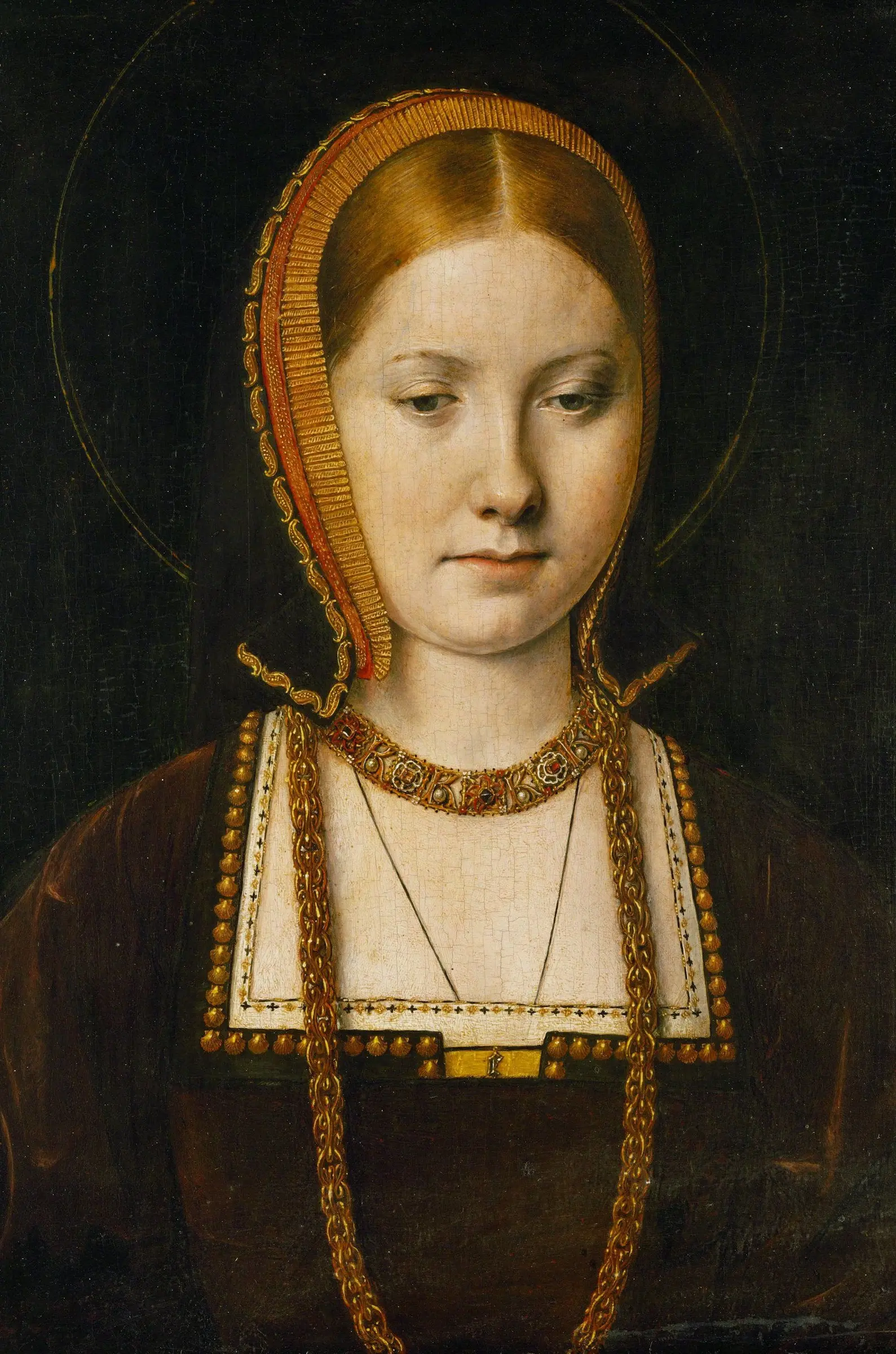
Katharine of Aragon came to Peterborough.
On 29 January 1536, Peterborough Abbey buried the woman who had been Queen of England for more than twenty years.
Katharine had died at Kimbolton Castle three weeks earlier.
Henry VIII did not give his former wife the burial of a reigning queen.
But her funeral was still a major royal event.
She was buried on the north side of the choir of Peterborough Abbey.
Scarlett was already established as the local sexton.
His role was not the ceremonial one. Bishops, clergy and royal representatives conducted the rites.
Scarlett belonged to the practical world beneath all of that ceremony: preparing and managing the burial itself.
It was the first royal funeral that would make his name.
Then fifty-one years passed.
The extraordinary thing about Old Scarlett is not simply that he was connected with two queens.
It is everything that happened between them.
The second was buried in a cathedral.
Scarlett lived through one of the most disruptive periods in English religious history.
Three years after Katharine's funeral, Henry VIII dissolved Peterborough Abbey.
The Benedictine monastery that had shaped the town for nearly nine hundred years ceased to exist.
Yet the great church survived.
In 1541 it became the cathedral of a new diocese.
Scarlett's workplace changed around him from medieval monastery to Tudor cathedral.
Kings died. Queens fell. England changed religion more than once.
Scarlett kept working.
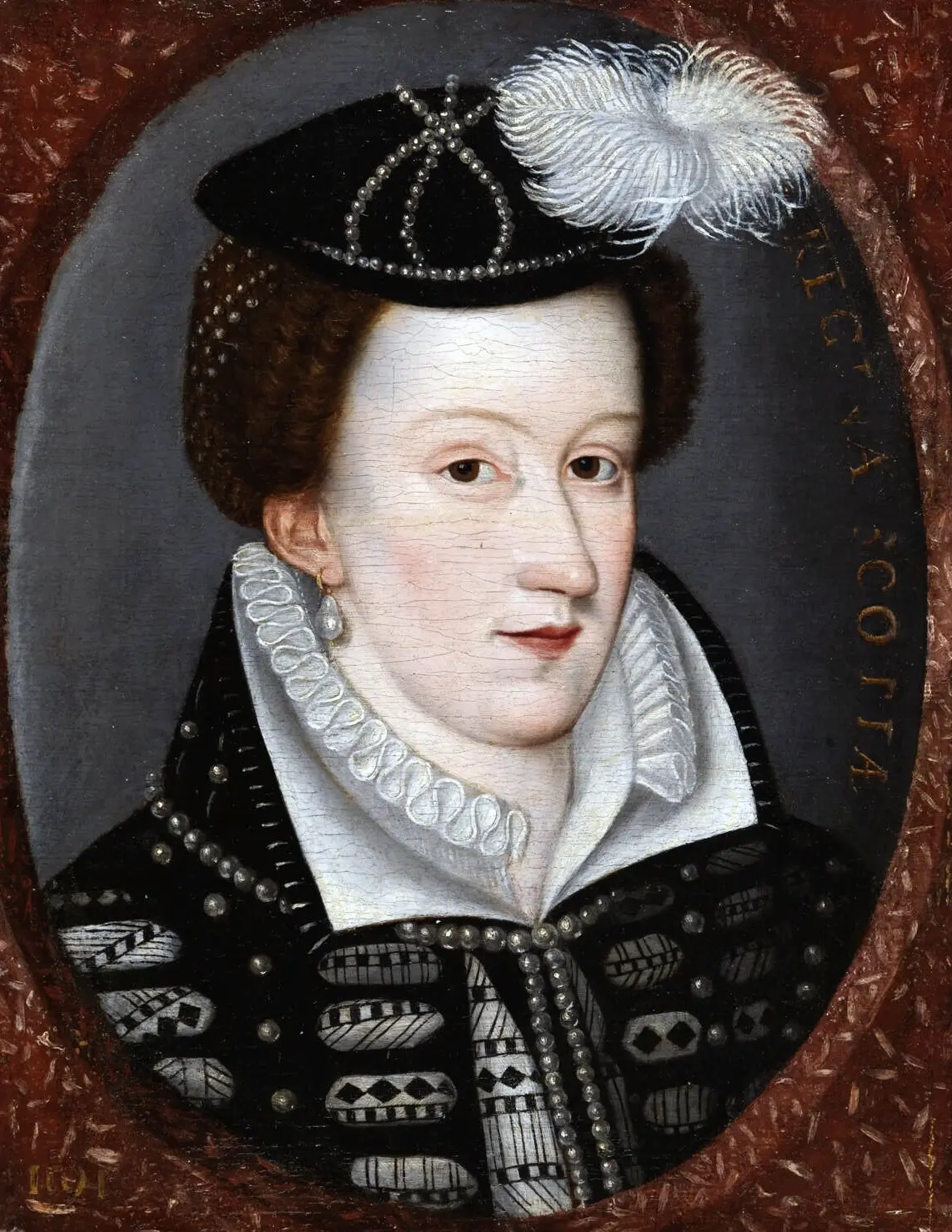
Then Mary, Queen of Scots arrived.
On 8 February 1587, Mary Stuart was executed at nearby Fotheringhay Castle.
Her body remained there for months.
Then, in the summer, it was brought to Peterborough.
On 1 August the Cathedral staged a magnificent heraldic funeral under the authority of Elizabeth I.
Mary's grave was prepared on the south side of the choir.
Across the church lay Katharine of Aragon.
And still serving Peterborough was Robert Scarlett.
He was by then around ninety years old.
More than half a century had passed since Katharine's burial, yet the same sexton was associated with the practical work surrounding Mary's interment.
That coincidence transformed him from an old parish officer into a local legend.
Peterborough held both queens beneath one roof.
Mary was buried almost opposite Katharine.
One had been Henry VIII's first wife.
The other was executed by his daughter Elizabeth.
Their stories belonged to different generations of Tudor politics, yet Peterborough brought them physically together.
Mary remained at Peterborough until 1612, when her son James I ordered her remains moved to Westminster Abbey.
Katharine stayed.
Scarlett had died eighteen years earlier.
But by then the phrase that would define him had already been attached to his memory.
The man who buried two queens.
Scarlett's memorial tells us exactly what Peterborough admired.
His memorial does not pretend that he was something grander than a sexton.
It celebrates the opposite.
The verse remembers his physical strength, his formidable appearance and his powerful voice.
It calls him a “Scarebabe”, suggesting a man capable of frightening children simply by looking or shouting at them.
Then comes the line that made him immortal.
The memorial goes further.
It claims that Scarlett had buried the householders of Peterborough “twice over”.
That is best read as proud commemorative exaggeration rather than a literal census.
But the meaning is obvious.
Scarlett had served so long that generations of the same Peterborough families had passed through his hands.
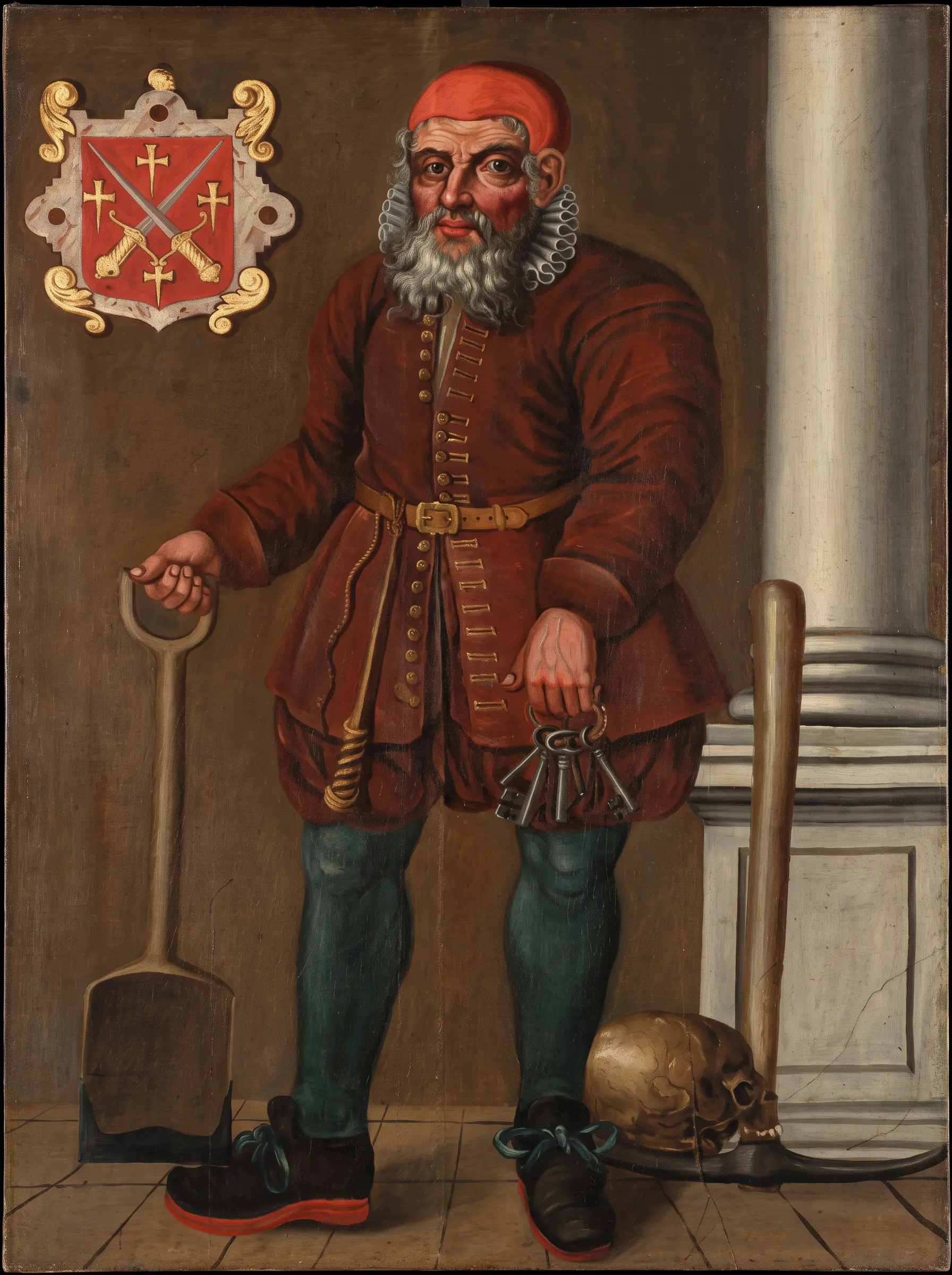
Peterborough gave its gravedigger a portrait.
That alone is remarkable.
Most Tudor working people vanished without leaving a known likeness.
Old Scarlett did not.
His image remains at the west end of Peterborough Cathedral, close to the place where he is buried.
He appears exactly as a sexton should.
He carries a shovel.
Keys hang at his side.
A pick and skull refer unmistakably to his work among the dead.
A whip is also shown at his belt.
It may represent another traditional sexton's duty: driving wandering dogs out of church during services.
The picture is not a straightforward portrait painted from life.
Cathedral accounts record payment for an Old Scarlett picture in 1665, more than seventy years after his death.
So even Scarlett's face reaches us through layers of memory.
His memorial is almost a portrait of an occupation.
The objects around Scarlett matter because they tell us why the people who commemorated him thought he deserved to be remembered.
He is not dressed as a gentleman.
He has no sword.
He is not holding a book.
He does not need a coat of arms to explain who he was.
The spade speaks for burial.
The keys speak for responsibility.
The pick speaks for physical labour.
And the whip, if the traditional interpretation is right, reminds us that maintaining order inside a Tudor church could occasionally require more than quiet persuasion.
Old Scarlett became memorable precisely because he remained recognisably ordinary.
According to one story, Scarlett actually buried three queens.
The Cathedral preserves a wonderfully dry piece of local tradition about the old gravedigger.
Scarlett was supposedly fond of telling people that he had buried not two queens, but three.
Katharine of Aragon was easy.
Mary, Queen of Scots was easy.
Then the listener was left to wonder who the mysterious third royal woman could possibly have been.
The answer?
His first wife.
It is impossible to know whether Scarlett himself actually told the joke.
But its survival tells us something about the character Peterborough created around him.
He was not remembered as a solemn servant of death.
He became a personality.
Did Old Scarlett become Shakespeare's gravedigger?
Peterborough has long enjoyed the idea that its famous sexton somehow found his way into Hamlet.
The temptation is obvious.
Shakespeare's graveyard scene contains an old gravedigger whose easy familiarity with death allows him to joke while handling human remains.
Peterborough had an unusually famous real gravedigger only a few years before the play was written.
There is even a possible human connection.
John Fletcher, who spent part of his childhood in the Cathedral precincts, later became one of the leading dramatists of his generation and eventually collaborated with Shakespeare.
Might Fletcher have remembered Old Scarlett?
Might stories about the Peterborough gravedigger have reached London theatre?
Perhaps.
But there is no evidence proving it.
So the connection should remain where it belongs.
A brilliant Peterborough possibility, not a historical fact.
Eventually the gravedigger needed a grave.
Scarlett's grave slab says that he died aged ninety-eight.
If that age is accurate, he had been born around 1496.
What is certain is the date.
Robert Scarlett died on 2 July 1594.
And then something extraordinary happened to a man of his social position.
He was buried inside Peterborough Cathedral.
His memorial verse understood the irony perfectly.
After a lifetime of doing the same thing for other people, Scarlett's own turn had finally come.
Somebody else picked up the spade.
He makes Tudor Peterborough human.
History often reaches us through exceptional people.
Kings.
Queens.
Bishops.
Generals.
Scarlett offers something different.
Through him we glimpse the person who unlocked the doors, rang the bell, dug the earth and carried on working while the great events of the Tudor age unfolded around him.
Katharine of Aragon arrived.
The abbey disappeared.
The cathedral was created.
Mary Stuart arrived.
And still the sexton was there.
That longevity turned an ordinary working life into something extraordinary.
The man with the spade connected them.
Old Scarlett stands at the centre of a much bigger story.
His extraordinary life connects Peterborough's people, Cathedral, royal burials and Tudor history. Follow those threads deeper across Discover Peterborough.
Katharine of Aragon
From Spanish princess and Queen of England to the royal burial that gave Peterborough an enduring place in Tudor history.
Discover Katharine → 02 · PETERBOROUGH PEOPLEMary, Queen of Scots
Execution at Fotheringhay, a torchlit journey to Peterborough and twenty-five years beneath the Cathedral.
Discover Mary → 03 · TUDOR PETERBOROUGHTwo Queens. One Cathedral.
Follow the extraordinary parallel stories of the two royal women whose graves once faced one another across the Cathedral choir.
Enter the story → 04 · CATHEDRAL HISTORYPeterborough Cathedral
Travel from Anglo-Saxon monastery through Norman rebuilding, Tudor transformation and the extraordinary building that survives today.
Explore 1,350 years → 05 · PETERBOROUGH PEOPLERobert “Old” Scarlett
Go beyond the folklore and explore the life, work, memorial and remarkable longevity of Peterborough's Tudor sexton.
Read his biography → 06 · HISTORY HUBDiscover Peterborough History
Place Old Scarlett within the much larger story of Peterborough, from prehistory and Rome to the modern city.
Explore Peterborough's history →More Peterborough Folklore
Old Scarlett is only one of the strange characters and stories waiting inside and around Peterborough Cathedral.
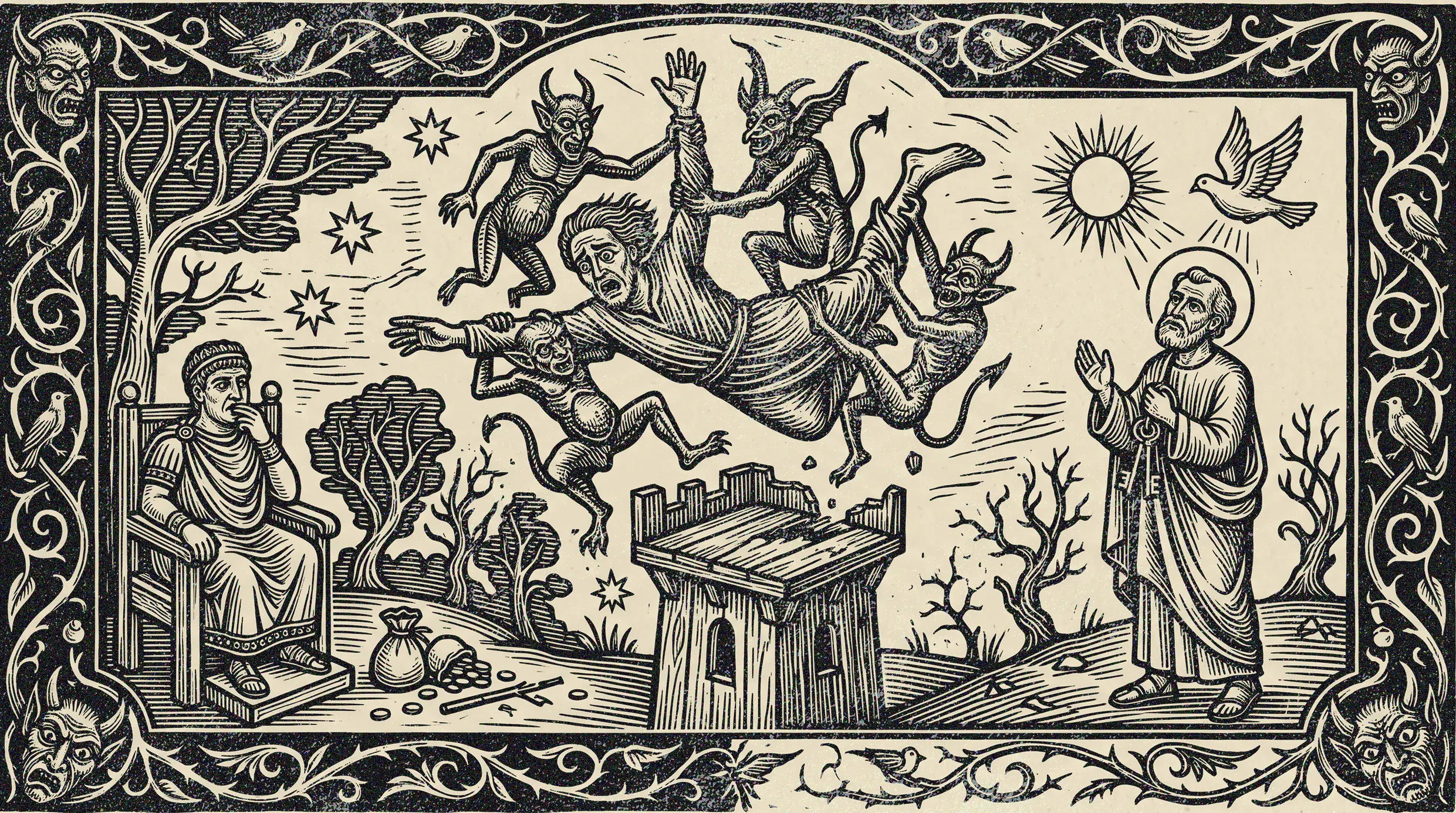
Simon Magus
At the Cathedral's west entrance, four demons tear at an upside-down man in one of Peterborough's strangest carvings.
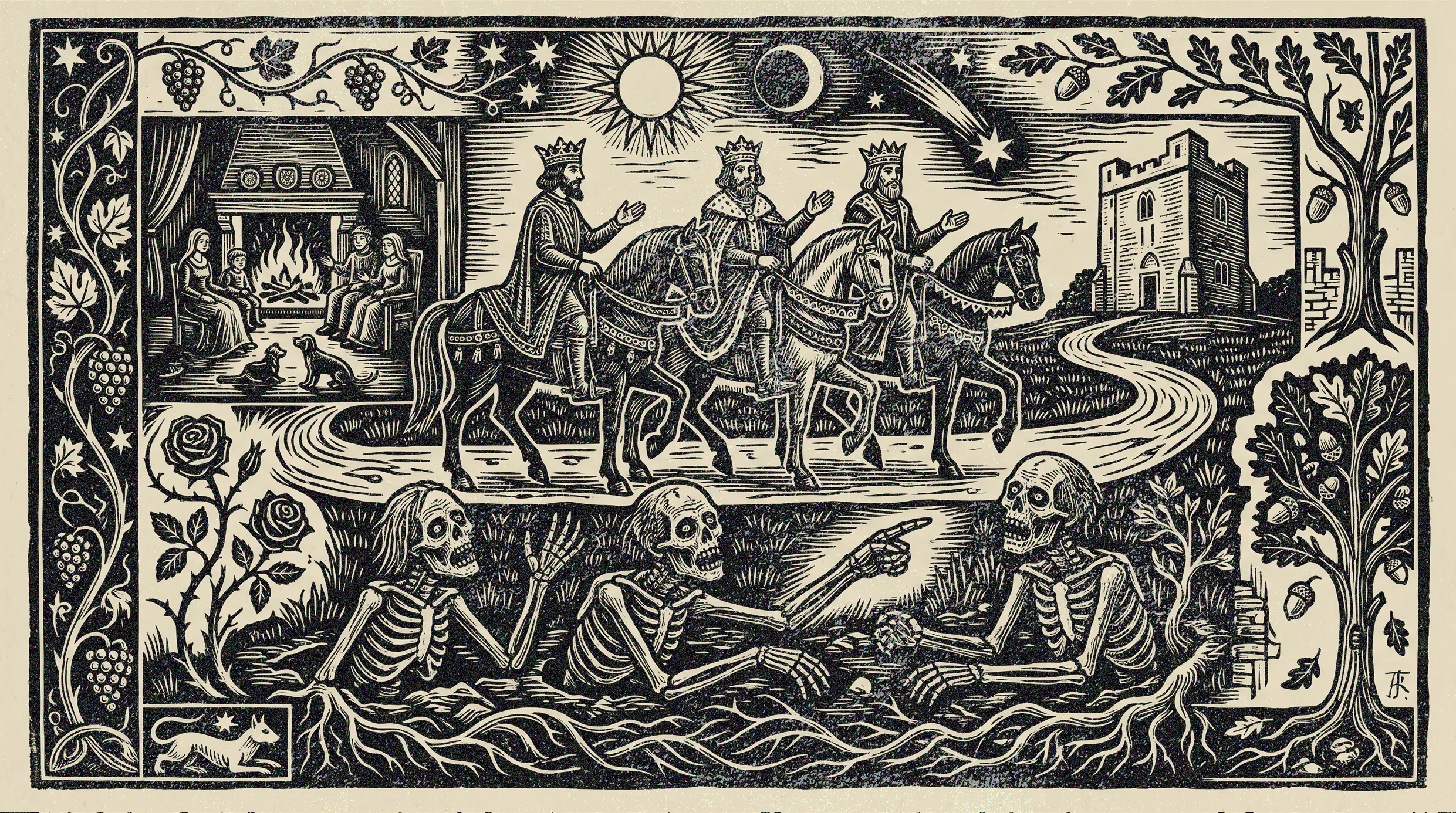
The Three Dead Kings
Three wealthy young men meet three corpses and discover exactly what waits for every king, lord and labourer.
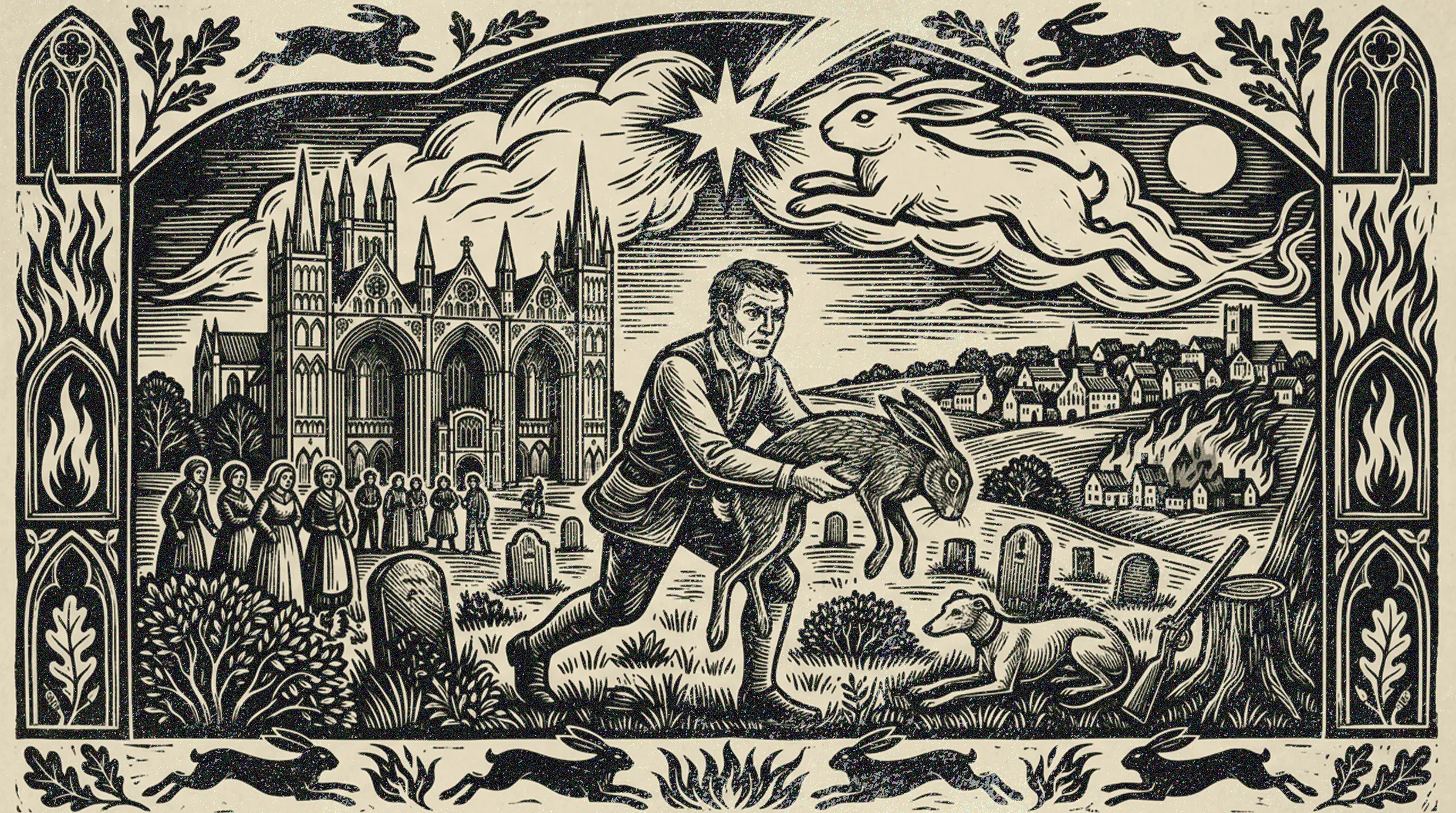
The Hare in the Close
If a hare made its form inside the Minster Close, Peterborough expected fire before the week was out.
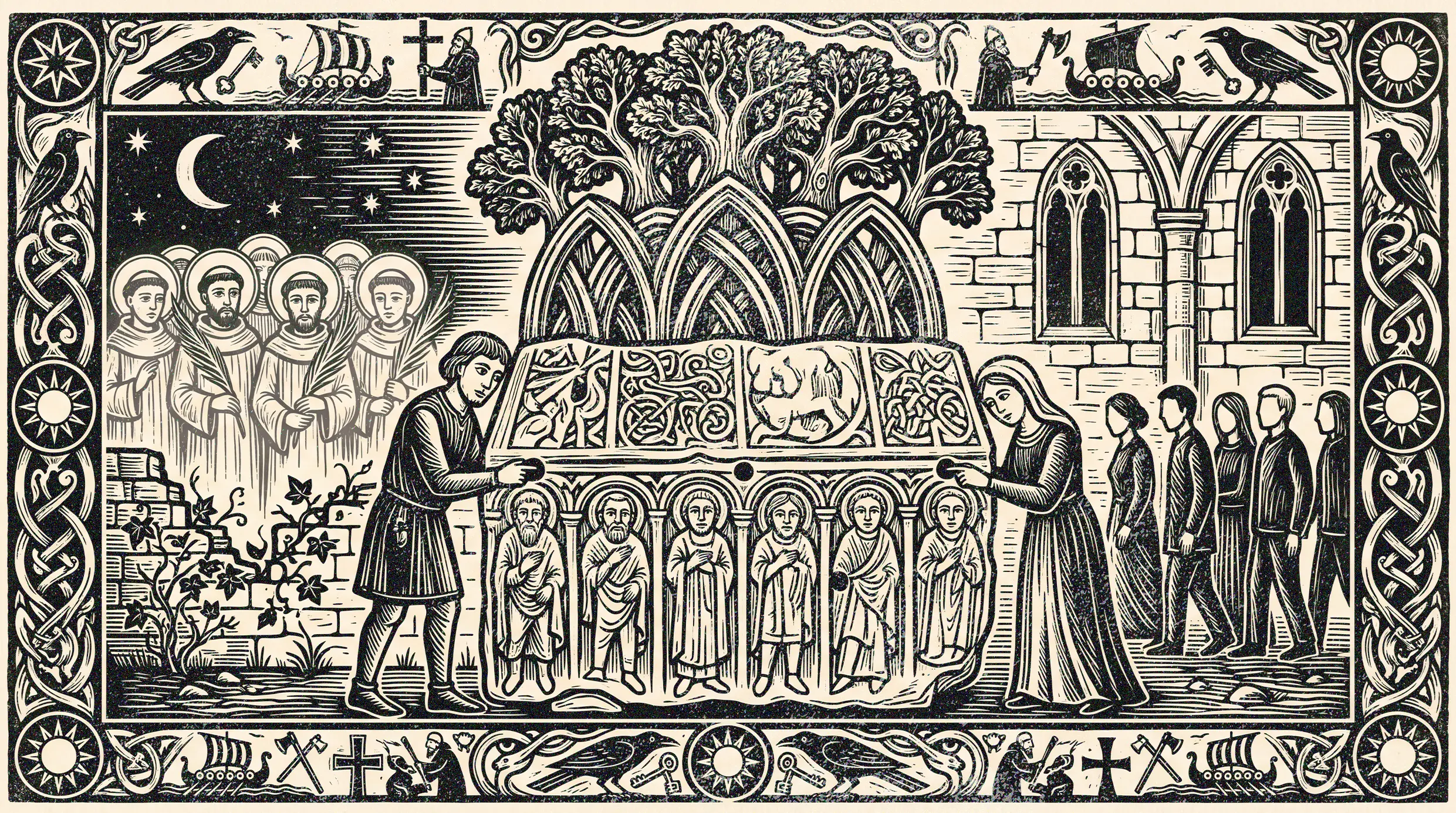
The Hedda Stone
Generations of visitors pushed their fingers into mysterious holes worn into one of the Cathedral's oldest surviving stones.
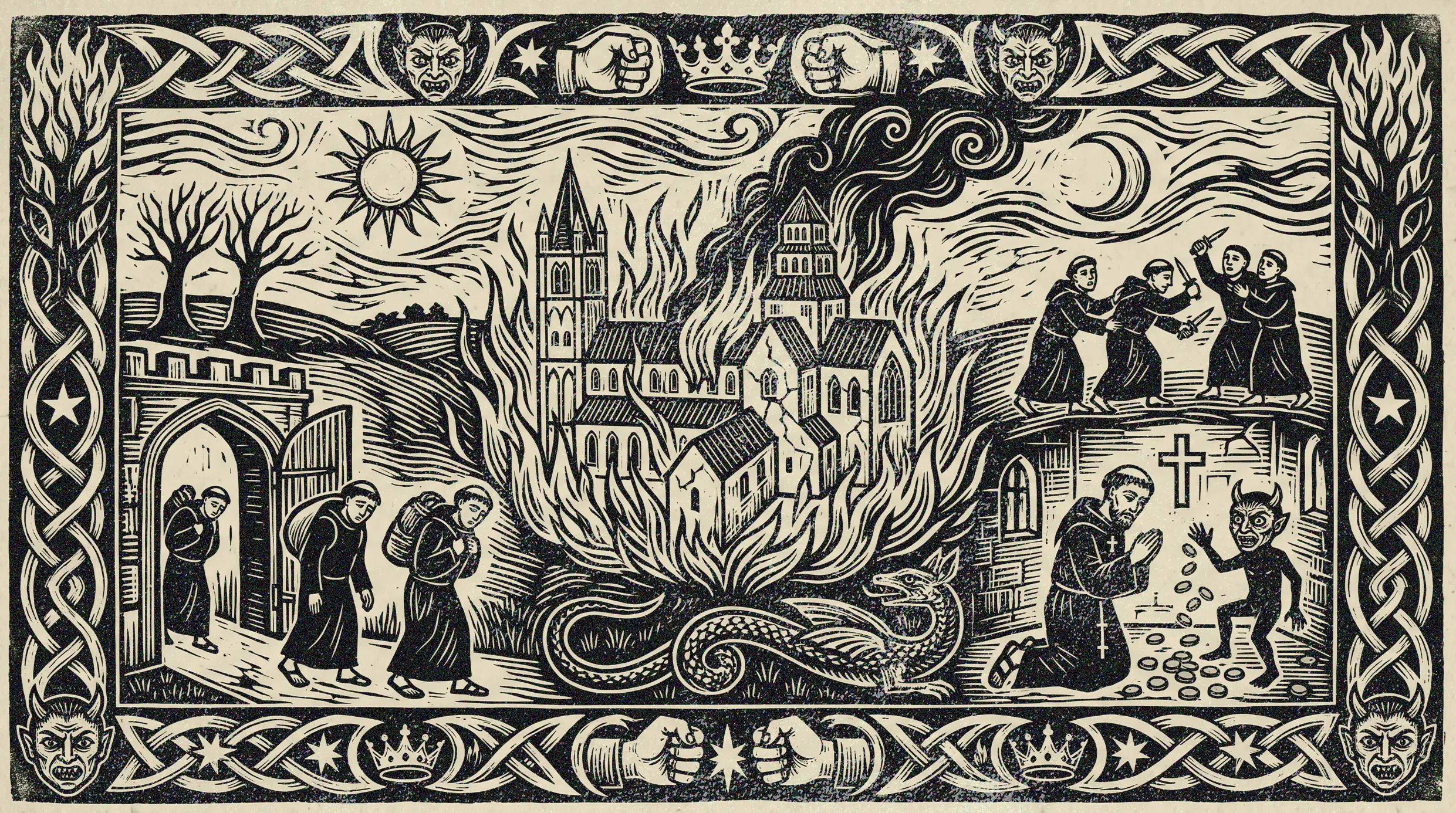
Come, Devil, and Blow on the Fire
A terrible prophecy, an angry servant and the fire that helped create the Cathedral Scarlett later served.
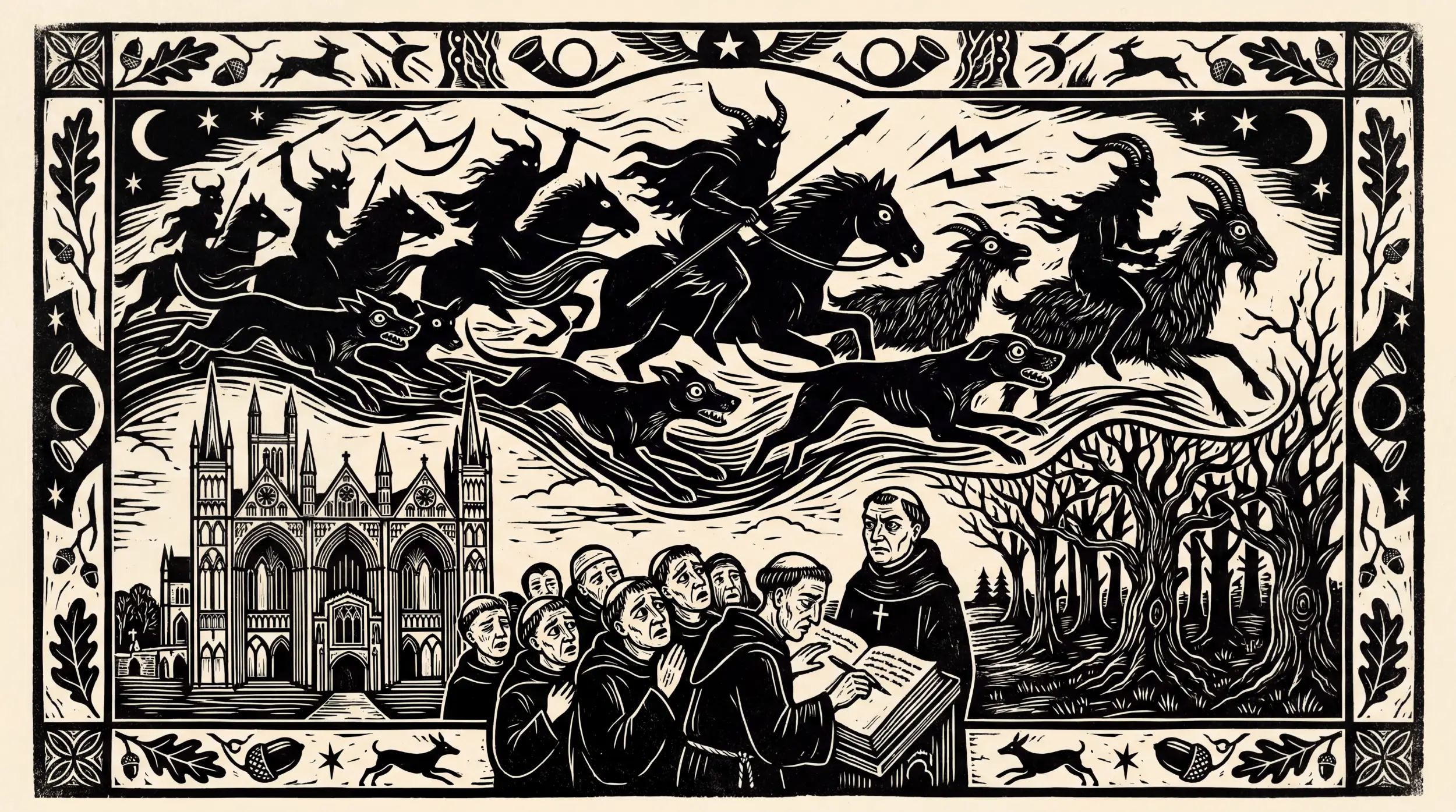
The Wild Hunt
Black riders, monstrous hounds and hunting horns haunted the woods around Peterborough for weeks.
Behind the folklore
Old Scarlett sits unusually close to documented history. His grave, memorial verse, Cathedral accounts and later portraits survive, while several entertaining traditions grew around him after his death.
-
Peterborough Cathedral · Old Scarlett
Cathedral tradition and surviving records concerning Robert Scarlett, his work as sexton and his association with the burials of Katharine of Aragon and Mary, Queen of Scots. -
Discover Peterborough · Old Scarlett
Detailed biography covering Scarlett's work, the two royal burials, the Dissolution, his memorial, portrait and surviving grave slab. -
Discover Peterborough · Two Queens
The wider story of Katharine of Aragon and Mary, Queen of Scots, their Peterborough burials and the extraordinary Tudor history connecting them. -
Discover Peterborough · Peterborough Cathedral
The wider history of the abbey and Cathedral that formed the physical setting for Scarlett's life and work.