
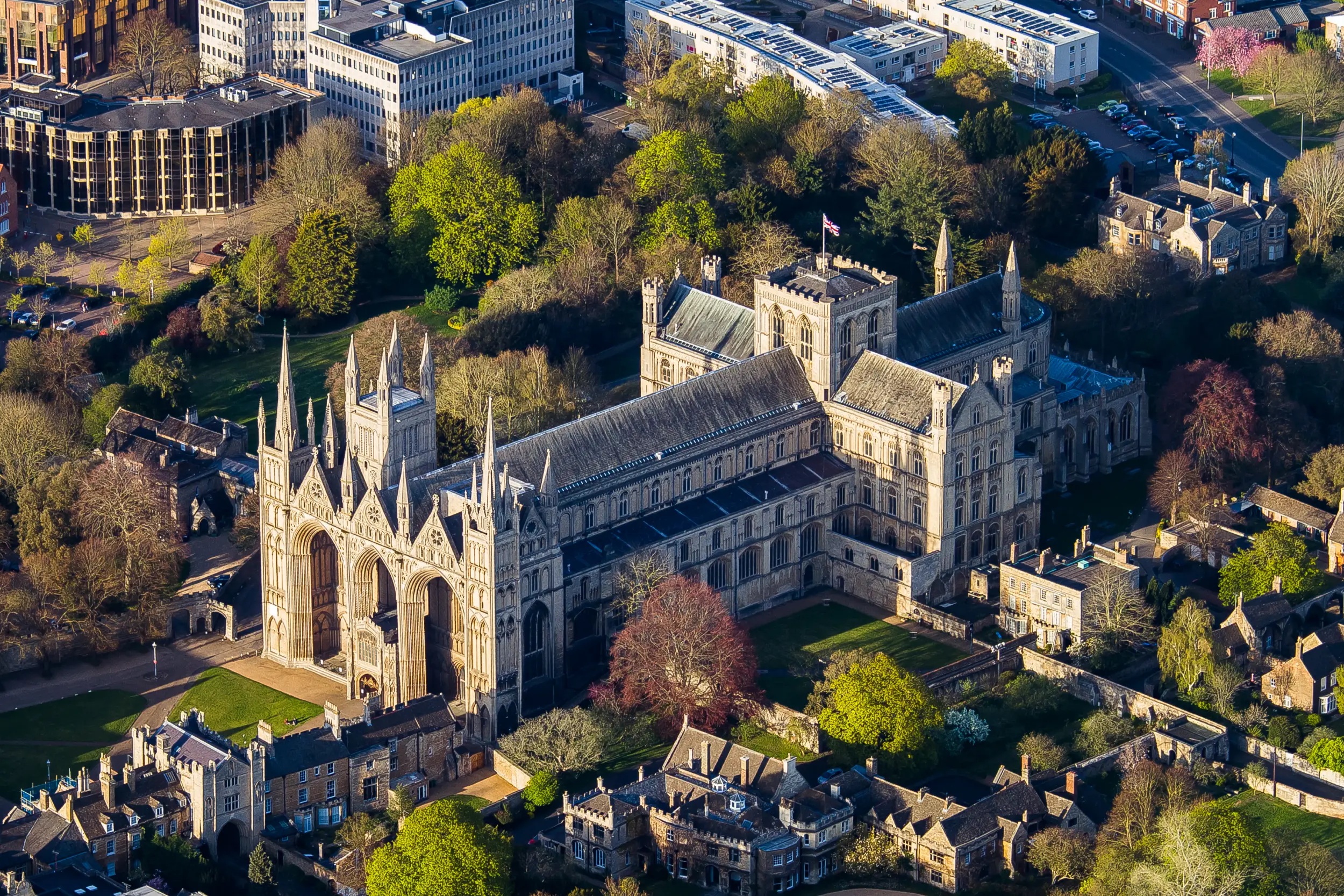


Robert “Old Scarlett” was Peterborough’s long-serving Tudor sexton, remembered for tending the city’s dead and helping to inter Katharine of Aragon and Mary, Queen of Scots. The two royal burials took place 51 years apart, making his life an extraordinary human thread running through one of the most turbulent centuries in English history.
Life in dates
- c.1496 Born in or near Peterborough
- By 1535 Established as Peterborough’s parish sexton
- 1536 Associated with the burial of Katharine of Aragon
- 1539 Witnesses the dissolution of Peterborough Abbey
- 1541 The former abbey church becomes Peterborough Cathedral
- 1587 Associated with the burial of Mary, Queen of Scots
- 1594 Dies and is buried inside Peterborough Cathedral
- 1665 Cathedral accounts record payment for a memorial portrait
- 1747 A later copy or renewal of the portrait is traditionally dated to this year
- 1793 James Caulfield publishes an engraving of Old Scarlett
The man behind “Old Scarlett”
Robert Scarlett lived through almost the entire Tudor age. He was born while Henry VII was king and survived the reigns of Henry VIII, Edward VI and Mary I before dying during the final decade of Elizabeth I’s rule.
Unlike the monarchs whose reigns divided his lifetime, Scarlett belonged to Peterborough’s working community. He served as a sexton, carrying out the practical and often physically demanding duties needed to maintain the parish church, burial ground and ceremonies surrounding death.
Even Scarlett’s date of birth illustrates the boundary between documented history and local tradition. His grave slab records that he died on 2 July 1594 at the age of 98, placing his birth at about 1496. An alternative antiquarian account gives his age as 95, which led some older biographies to suggest 1499 instead.
For this reason, c.1496 is now the most useful description of his birth year, although it should not be treated as a precisely documented date.
A Tudor sexton’s work
A sexton was a practical church officer rather than a member of the clergy. In sixteenth-century Peterborough, the position included digging and maintaining graves, tolling the bells, obtaining bread for communion and helping to keep the church and burial ground in good order.
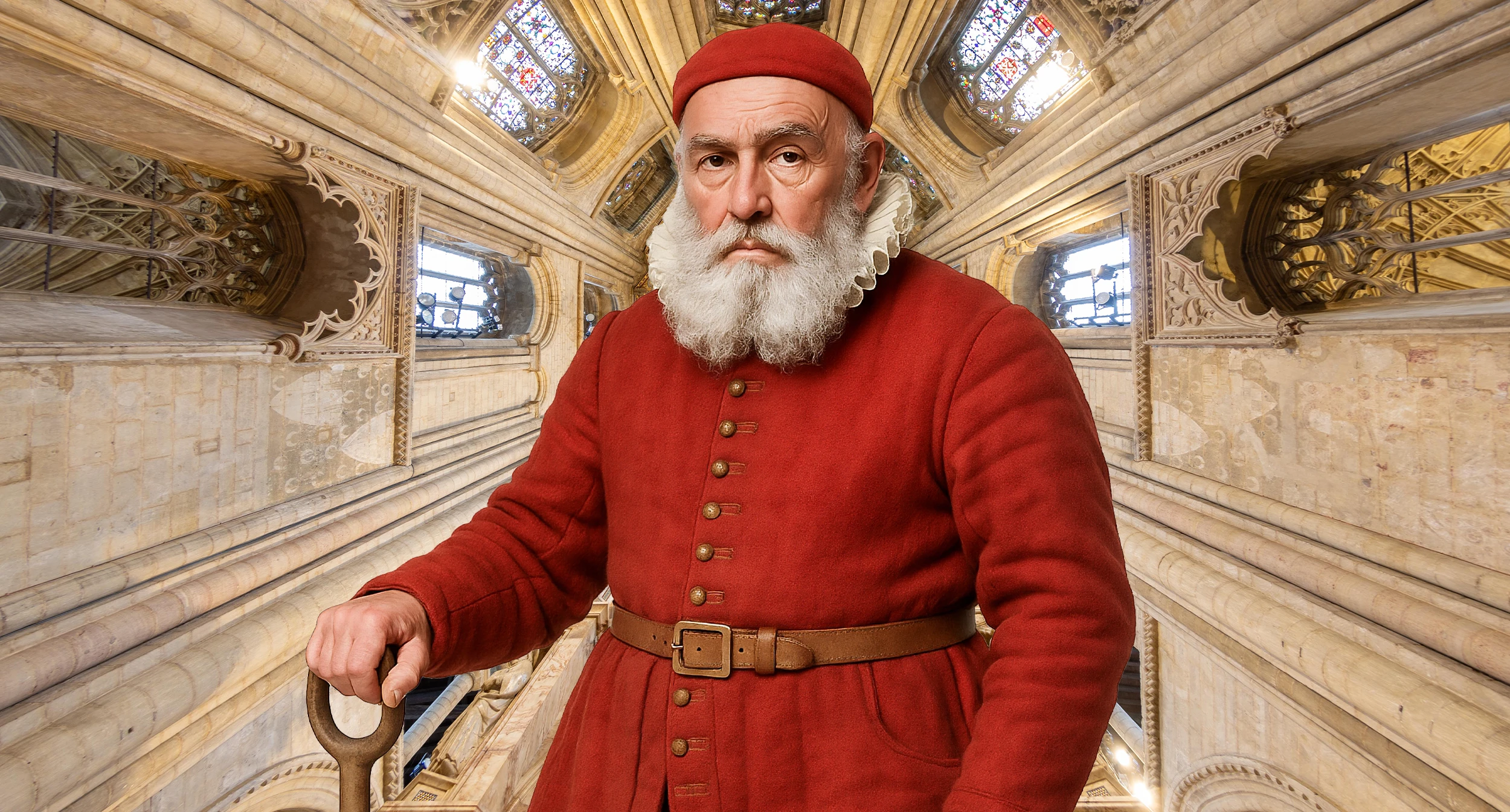
The objects shown in Scarlett’s memorial portrait communicate those responsibilities. He appears with a spade or shovel, a pickaxe and keys. A whip hanging from his belt may represent another traditional sexton’s duty: driving dogs out of the church during services.
Scarlett’s was demanding work, carried out at the point where parish administration, religious ceremony and everyday mortality met. During his exceptionally long career, he would have buried generations of Peterborough residents while maintaining the routines through which the community marked death.
The burial of Katharine of Aragon
Katharine of Aragon, whose name is also commonly written Catherine, died at Kimbolton Castle on 7 January 1536. Her funeral took place at Peterborough Abbey on 29 January, when she was laid to rest on the north side of the choir.
Scarlett’s contribution was practical rather than ceremonial. The clergy conducted the funeral rites, while the sexton was responsible for the grave and the physical work surrounding the interment.
His involvement in Katharine’s burial would eventually become one half of the remarkable claim that defined his reputation. Her resting place remains at Peterborough Cathedral and is now one of the building’s most important historic sites.
From medieval abbey to Tudor cathedral
Between Peterborough’s two royal funerals, Scarlett witnessed the greatest institutional upheaval in the city’s medieval history.
Henry VIII dissolved Peterborough Abbey in 1539 as part of the nationwide suppression of the monasteries. The great abbey church survived and, in 1541, became the cathedral of a newly created diocese. Peterborough formally became a city at the same time.
Scarlett’s workplace therefore changed around him from a Benedictine monastery to a post-Reformation cathedral. His long service connected the daily life of the medieval abbey with the new religious settlement created during the Tudor Reformation.
No reliable evidence survives to reveal Scarlett’s personal response to those changes. It is therefore important not to impose later assumptions about his beliefs upon him.
The burial of Mary, Queen of Scots
Mary, Queen of Scots was executed at nearby Fotheringhay Castle on 8 February 1587. Her body remained at the castle for several months before being taken to Peterborough Cathedral for a grand funeral on 1 August.
The parish register records that the Queen of Scots was “most sumptuously buryed” in the Cathedral. Scarlett, by then around 90 years old, was the parish sexton responsible for the practical arrangements surrounding her grave and interment.
Mary was buried on the south side of the choir, opposite Katharine of Aragon. Her remains stayed in Peterborough until 1612, when her son, James VI of Scotland and I of England, had them transferred to Westminster Abbey.
Scarlett’s association with both burials gave rise to his enduring description as “the man who buried two queens”. The phrase is rooted in real events, although it compresses the distinction between the sexton’s physical responsibilities and the ceremonial role of the clergy.
The memorial epitaph
Scarlett’s memorial verse explains that his picture stands above while his body lies beneath the visitor’s feet. It celebrates his strength, his “mighty voice” and his stern appearance, describing him as a “Scarebabe” whose formidable presence could frighten children.
Most famously, the epitaph declares:
“Hee had interd two Queenes within this place.”
The verse also claims that Scarlett buried the householders of Peterborough “twice over” during his lifetime. This memorable line should be understood as commemorative rhetoric rather than a reliable population count. It expresses the extraordinary length of his service and the number of local generations he outlived.
The conclusion of the epitaph turns the gravedigger’s own death into the final chapter of his story. After performing the same duty for so many others, Scarlett’s time arrived and another person did for him what he had spent his life doing for Peterborough.
The portrait and grave
Scarlett’s grave slab survives just inside Peterborough Cathedral, close to the west entrance. It is marked with his initials, the date of his death and the statement that he had reached the age of 98.
Above it is the celebrated image of an elderly, white-bearded man dressed in reddish clothing and surrounded by the tools of his office.
The history of the painting is more complicated than a portrait produced immediately after his death. Cathedral accounts record payment for an Old Scarlett portrait in 1665, more than 70 years after he died. Antiquarian accounts describe the surviving work as a later copy or renewal, commonly dated to 1747.
Scarlett’s likeness continued to circulate. A 1793 engraving by James Caulfield is represented in the collection of the National Portrait Gallery, carrying the image of Peterborough’s Tudor sexton far beyond the Cathedral in which he worked.
Why Old Scarlett matters
Most Tudor labourers passed into history without a portrait, a marked grave or even a recorded name. Scarlett’s unusual combination of longevity, local service and proximity to royal history preserved all three.
His memorial does not celebrate wealth, scholarship, military victory or inherited rank. It commemorates a working man whose occupation made him indispensable to his community.
Kings, queens and religious upheaval transformed Peterborough from an abbey town into a cathedral city. Yet beneath the west doors, it is the working sexton with his shovel, keys and mighty voice who became one of the city’s most recognisable Tudor faces.