
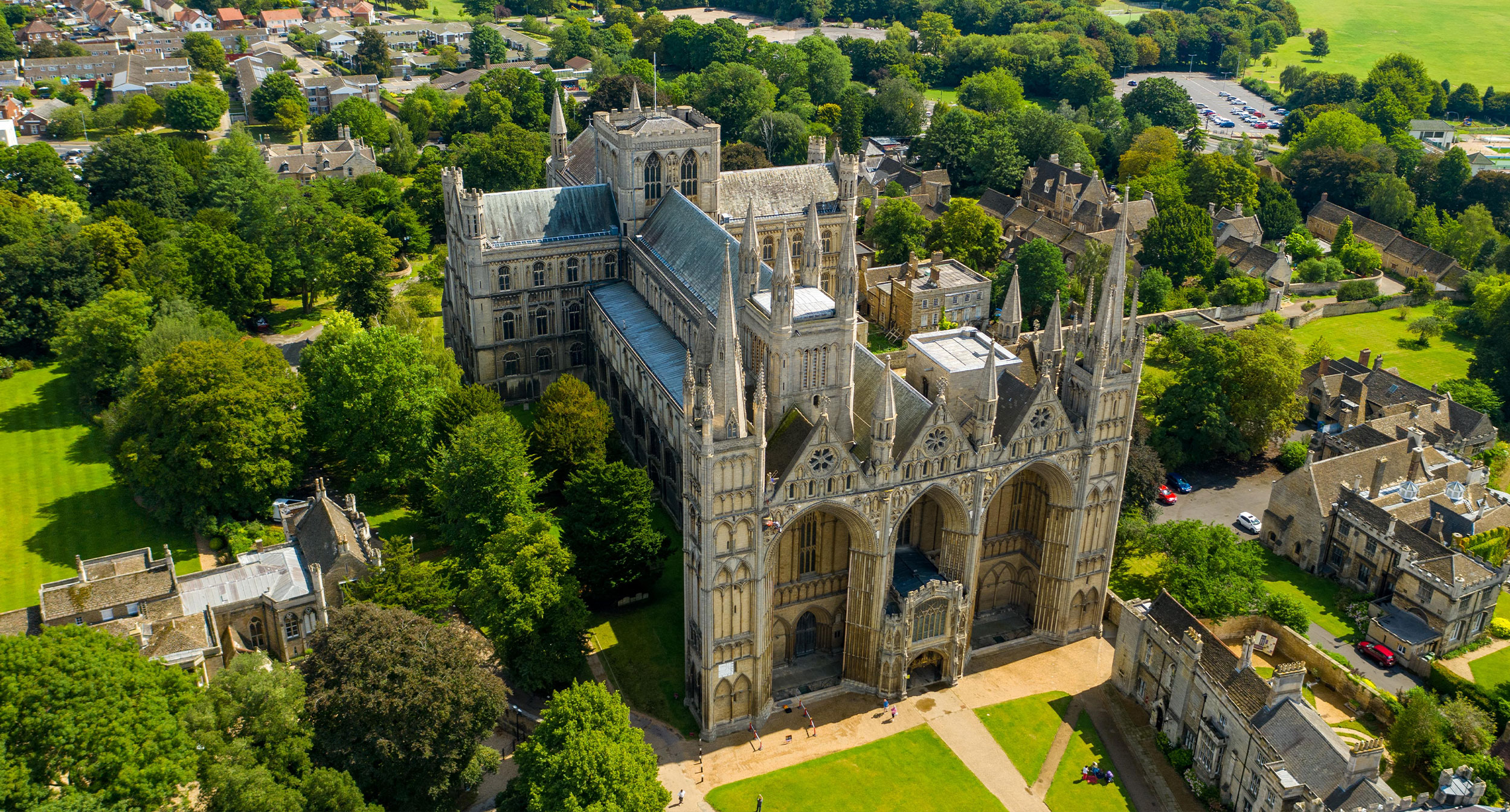


Anglo-Saxon Stone · Sacred Touch · A 17th-Century Joke
The Finger Holes
in the Hedda Stone
Behind the high altar of Peterborough Cathedral stands one of the city's oldest and most mysterious objects. For centuries visitors noticed the holes drilled into its weathered surface, put their fingers inside and added another layer to a story already more than a thousand years old.
The holes may be the strangest part of an object nobody fully understands.
The Hedda Stone is one of those rare objects where almost every confident explanation eventually produces another question.
It is a huge solid block of Barnack limestone, shaped like a small building or shrine and covered with worn figures, foliage, birds and animals. It belongs to the artistic world of Anglo-Saxon Peterborough and probably dates from around the late eighth or early ninth century.
Yet we do not know exactly what it was made for, where it originally stood, whose memory it first preserved or why holes were drilled into its faces.
Even the familiar name “Hedda Stone” comes from a later tradition that connected it with an abbot supposedly killed when Danish invaders destroyed the early monastery.
What we do know is that people kept returning to it. They touched it, drilled or enlarged holes in it, told stories about it, moved it, studied it and eventually placed it among the treasures of the Cathedral.
The stone survived because generation after generation decided that it mattered, even when nobody could agree exactly why.
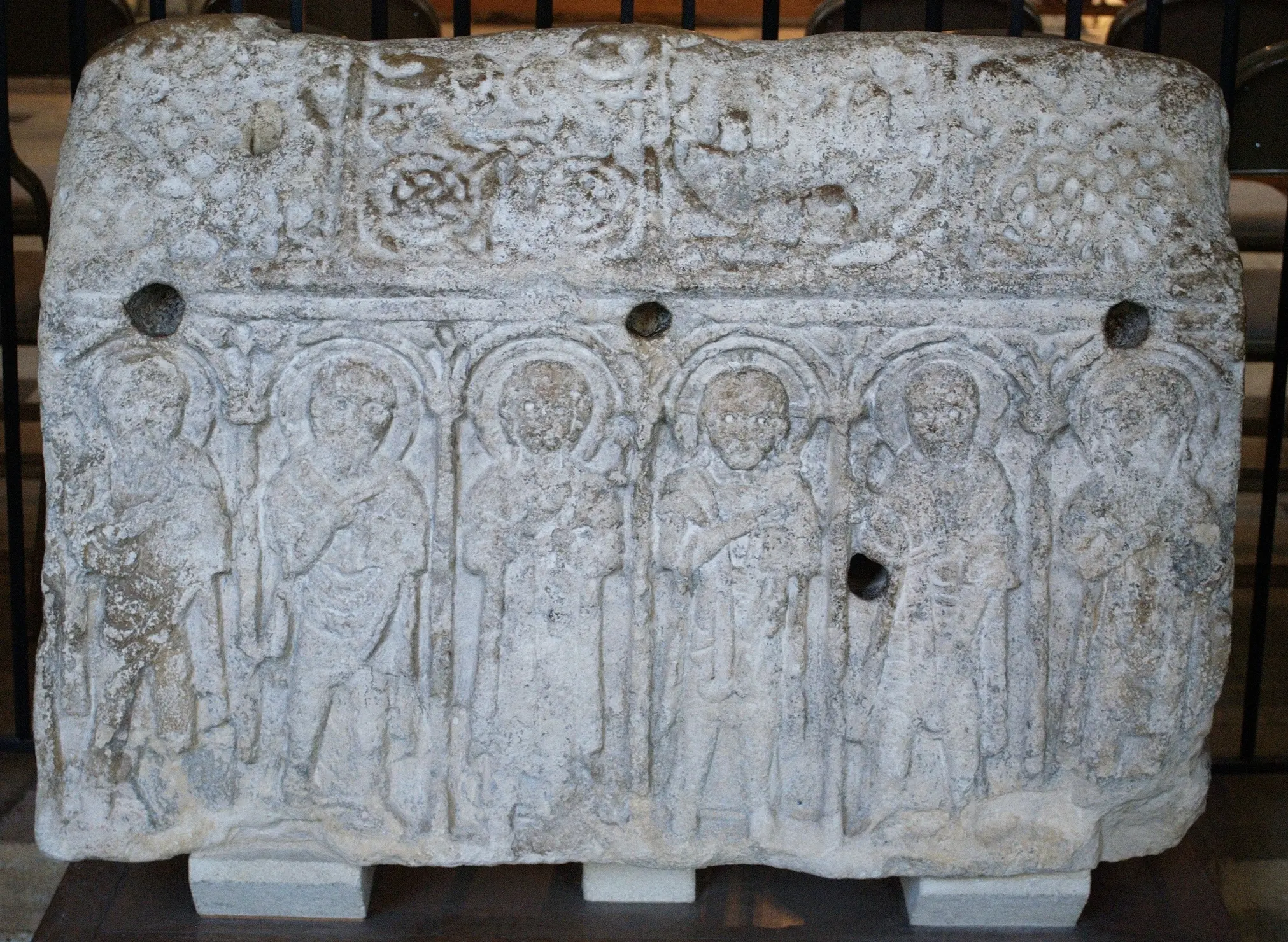
It looks more like a stone reliquary than a gravestone.
The monument is roughly a metre long and fashioned from one enormous solid block rather than being assembled from slabs.
Its pitched upper surface makes it resemble a miniature house, tomb or metal reliquary translated into stone. Figures stand beneath arcades along both long faces, while the sloping roof carries heavily worn plant, bird and animal ornament.
That form is one reason scholars have repeatedly wondered whether the stone originally marked a sacred burial or functioned as some form of shrine or cenotaph.
It is also unusually large and unusually complete for Anglo-Saxon sculpture.
Then there are the holes.
The stone belongs to Medeshamstede.
When this sculpture was created, Peterborough Cathedral did not exist and the settlement around it was not yet called Peterborough.
The religious centre here was the Anglo-Saxon monastery of Medeshamstede, founded in the seventh century within the kingdom of Mercia. It developed into an important centre of Christianity, landholding and artistic production long before the Norman church transformed the site.
Modern scholarship dates the Hedda Stone broadly to the late eighth or early ninth century. That places it within the mature life of the early monastery, not automatically after its supposed destruction.
Older than the name Peterborough.
A survival from Medeshamstede.
It is therefore one of the most direct physical connections between the modern Cathedral and the Anglo-Saxon religious community from which the city eventually developed.
Six on one side. Six on the other.
The two long faces carry twelve standing sacred figures, arranged beneath a sequence of round-headed arches.
Centuries of weathering have made some identities difficult to read, but several details remain recognisable. One figure is Christ with a cross in his halo. The Virgin Mary has also been identified, along with St Peter carrying his keys. On the opposite face, one figure has been interpreted as John the Baptist.
Earlier antiquaries assumed that the twelve figures represented Abbot Hedda and monks killed with him. Modern art historians instead see the imagery within a much broader early Christian tradition.
Its artistic ancestry reaches back towards Rome.
Then came Abbot Hedda and the Danes.
Later Peterborough tradition told of the destruction of Medeshamstede by Danish invaders around 870 and the killing of Abbot Hedda with his monastic community.
The story eventually became attached to this stone. It was said to have marked the burial of the slaughtered monks, and the twelve carved figures were interpreted as members of the community.
That explanation became so powerful that the monument itself acquired Hedda's name and even had the date 870 carved into one end at a much later period.
There is a problem, however. If the modern dating of the sculpture to the late eighth or early ninth century is approximately right, the stone already existed before the supposed massacre.
It may not describe its original purpose.
There are more holes than you might think.
Modern detailed study records six holes across the two long faces of the Hedda Stone.
On the face containing Christ there are three holes arranged across the upper part of the stone, together with another lower down which cuts into the figure identified as St Peter.
Two further holes are present on the reverse.
2 on the other
6 holes in total
Not all are equally easy for the visitor to see, which may help explain why simplified accounts often refer only to the four most obvious holes.
Candle holders? Handles? Railings? Roman engineering?
There is no single explanation for the holes that commands universal agreement.
One old suggestion is that they held candles or tapers when the monument functioned as a sacred memorial. Another theory proposed that poles were inserted so the heavy stone could be carried, while the holes might instead have secured some form of protective railing.
A more radical possibility is that at least some of them existed before the Anglo-Saxon carving was created. Scholars have argued that the huge block may itself be reused Roman stone and that the original holes could have been dowel sockets connected with an earlier architectural purpose.
The block beneath it might be older.
Most are shallow. One reaches much deeper.
Detailed study records most of the holes as roughly 50 millimetres deep. The lower opening on the Christ face is different.
Deep hole: about 140 mm
That deeper opening has encouraged another interpretation. Perhaps it was deliberately enlarged so worshippers could put a finger inside and obtain dust from the monument, or make direct physical contact with a sacred space or burial beneath it.
We cannot prove that this happened at Peterborough, but it provides a fascinating possible bridge between the archaeology of the holes and the much later custom of putting fingers into them.
By the seventeenth century, visitors were definitely putting their fingers in.
This part is not speculation. Simon Gunton, prebendary of the Cathedral and one of Peterborough's earliest historians, recorded the custom.
His History of the Church of Peterburgh, published in 1686, describes the stone still standing in the old cemetery. Gunton notes the little holes in its sides and says visitors had developed what he called a “merry custom”.
Gunton's account proves that the stone was already a participatory visitor curiosity more than three centuries ago. People did not merely look at Peterborough's antiquities. They touched them.
That appears to be a later layer of the tradition.
Modern Peterborough folklore often turns the finger holes into wishing holes: choose one, put in a finger and make a wish.
It is a charming continuation of the object's long history of being touched, but Gunton does not mention wishes. He records the joke about strangers putting their fingers into the holes so they could claim to have “been at Peterburgh”.
The wishing element therefore seems to represent folklore doing what folklore does best. The physical action survives while the explanation changes.
Seventeenth-century joke?
Modern wishing hole?
Possibly all three, at different moments in the stone's very long life.
What if the block was already ancient when the monks carved it?
Peterborough's early monastery stood within a landscape full of monumental Roman stone.
Durobrivae, the great Roman settlement beside the Nene, lay only a few miles away. The enormous complex at Castor and other Roman buildings provided ready sources of worked limestone that could be quarried again by later generations.
Archaeology shows that the early monastery reused Roman material elsewhere, so the possibility that the Hedda Stone began as a Roman architectural block is not inherently far-fetched.
Anglo-Saxon sculpture.
Medieval shrine.
Early modern curiosity.
Modern Cathedral treasure.
St Peter may be staring back at you.
One of the figures on the more visible face is identified as St Peter, carrying the keys that became his great medieval attribute.
That connection has particular resonance here. The monastery that succeeded Medeshamstede was dedicated to St Peter, the settlement became Burgh St Peter, and eventually the saint's name became embedded in Peterborough itself.
At the West Door, Simon Magus lies defeated beneath the church of St Peter. Here, centuries earlier, Peter appears among the sacred figures of Anglo-Saxon Medeshamstede.
The stone itself has travelled around the Cathedral precinct.
We do not know where the Hedda Stone first stood. By the late medieval period, however, it was recorded outdoors in the monastic cemetery.
That helps explain its heavily weathered surface. Generations of rain, frost, hands and human interference have softened details that were once much sharper.
During the eighteenth century it was moved indoors, protecting it from further exposure. Today it stands behind the high altar in the eastern part of the Cathedral.
Cemetery curiosity.
Antiquarian treasure.
Cathedral masterpiece.
Find the holes, but look at everything around them too.
The Hedda Stone stands in the eastern part of Peterborough Cathedral behind the high altar and can be surprisingly easy to miss if you are concentrating on the architecture around it.
Start with the whole object. Notice the pitched roof, the arcades and the sequence of figures. Look for Christ, Mary and St Peter, then find the circular openings that have generated so many explanations.
The stone is now a protected historic object, so the old tradition of physically putting a finger into the holes should be understood as part of its folklore rather than an invitation to handle the sculpture today.
The finger-hole tradition is part of the story, but the Hedda Stone is an exceptionally important and vulnerable piece of Anglo-Saxon sculpture. Follow current Cathedral guidance and enjoy the old custom with your eyes rather than your hands.
Because people kept touching a mystery.
The Hedda Stone has survived far longer than the buildings for which it may originally have been created.
Its first meaning became uncertain, so later generations supplied new ones. It became the memorial of Hedda and the murdered monks. Its holes became candle sockets, shrine openings, finger holes, a visitor joke and eventually wishing holes.
None of these interpretations has completely erased the others. Instead they have accumulated on the object just as visibly as the weathering on its surface.
That is what makes the Hedda Stone such a perfect piece of Peterborough folklore. The archaeology and the storytelling are both part of what the stone has become.
People have been putting stories into them for centuries.
One stone opens more than a thousand years of Peterborough.
Follow the Anglo-Saxon monastery into the Norman Cathedral, the strange carvings at its doors and the legends preserved throughout the building.
Peterborough Cathedral
Follow the site from Anglo-Saxon Medeshamstede through Norman rebuilding, Gothic ambition, Reformation, royal burials and the modern Cathedral.
Explore 1,350 years → 02 · ST PETERSimon Magus
At the other end of the Cathedral, a falling magician lies beneath the great western entrance to the church of St Peter.
Look beneath the West Door → 03 · FIRE & REBUILDINGCome, Devil, and Blow on the Fire
A prophecy and a catastrophic fire in 1116 lead directly into the rebuilding that created the Norman Cathedral.
Enter the fire → 04 · FOUNDING LEGENDThe Princes & the Hart
Explore the later medieval legend created to explain the beginnings of Christian Peterborough and its Mercian royal connections.
Enter the founding legend → 05 · CATHEDRAL MEMORYOld Scarlett
Meet the Tudor sexton whose portrait, grave and legend connect Peterborough Cathedral with two famous queens.
Meet Old Scarlett → 06 · THE CITYPeterborough History
Place the Hedda Stone within the much wider story of the city from prehistoric landscapes and Roman settlement to Medeshamstede and modern Peterborough.
Explore the history →More Peterborough Folklore
Ancient stones, strange carvings, warnings and stories hiding in plain sight around Peterborough Cathedral.
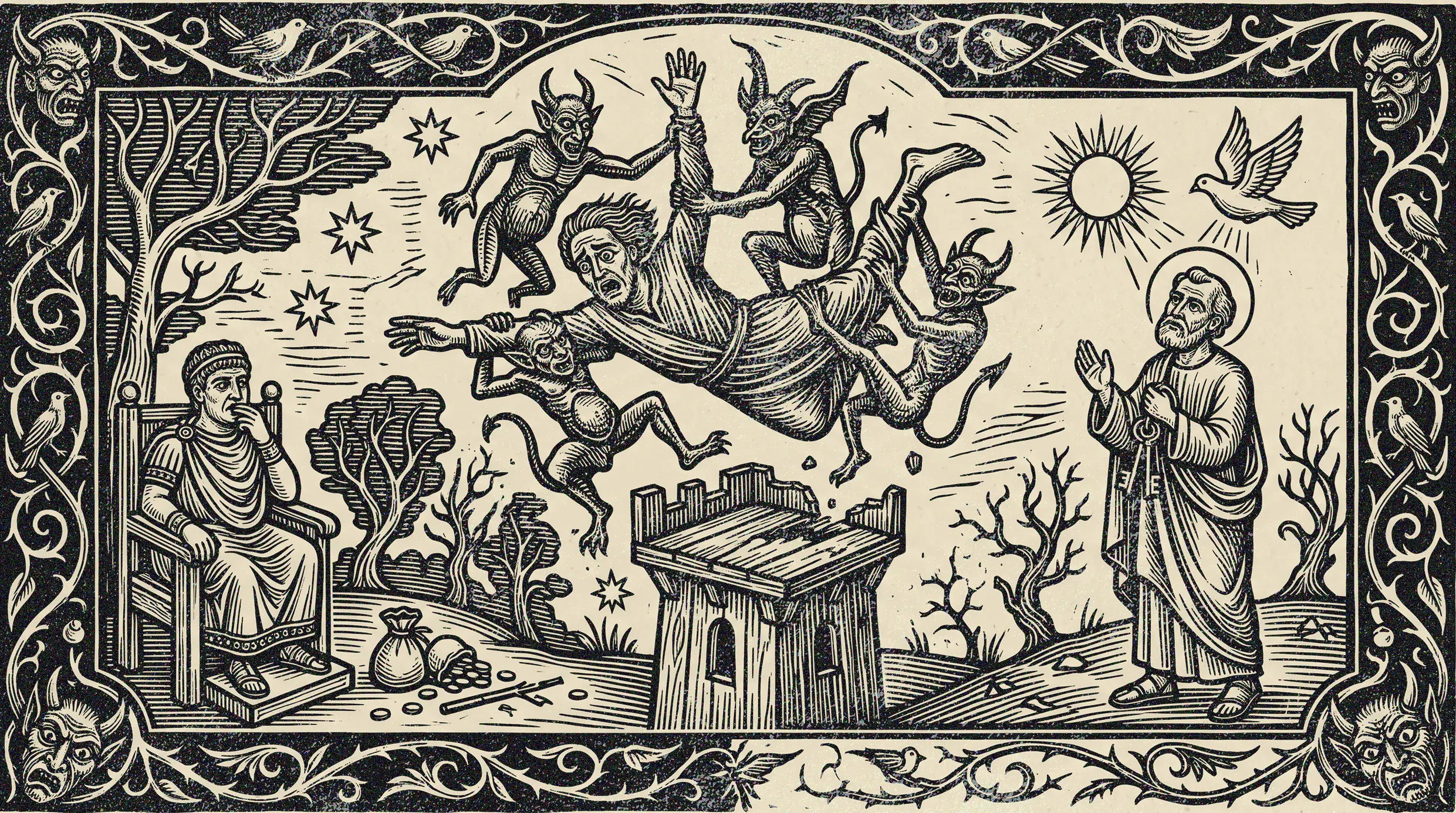
Simon Magus
An upside-down man falls among demons at the base of the Cathedral's great western entrance.
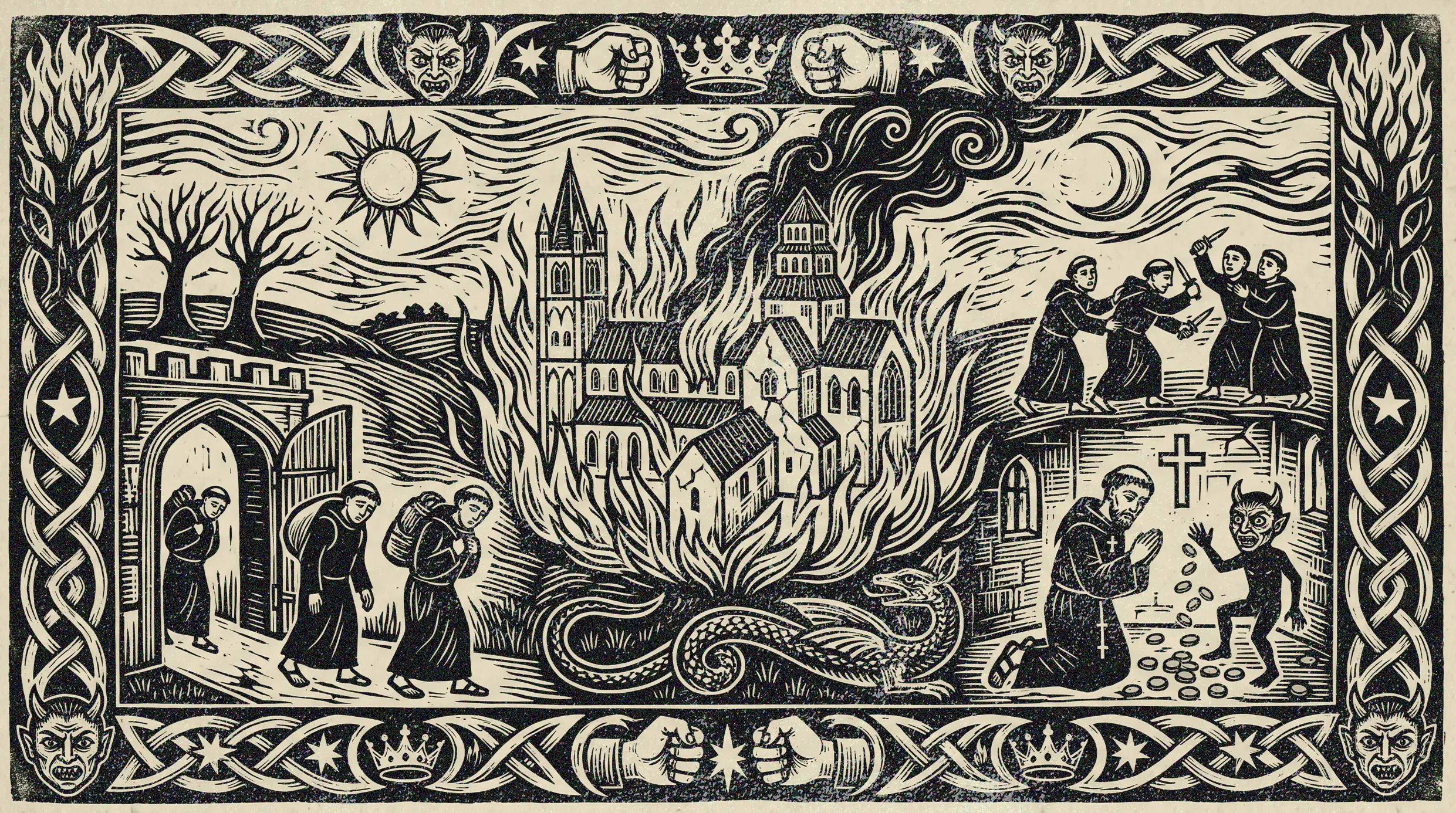
Come, Devil
An angry servant, an old prophecy and the catastrophic fire from which the present Cathedral eventually arose.
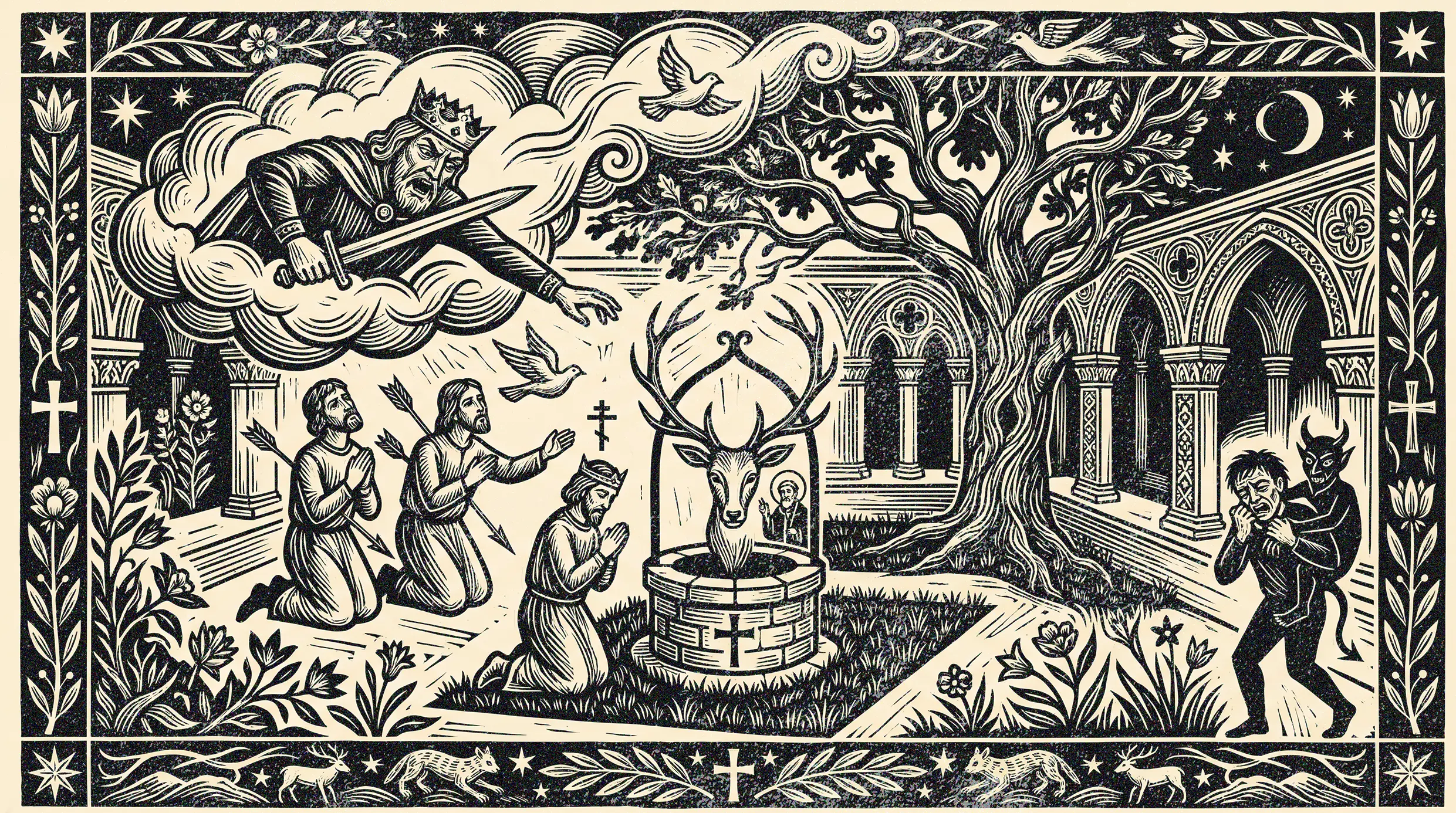
The Princes & the Hart
A royal hunt, St Chad and the extraordinary story once painted into Peterborough Abbey's medieval cloister.
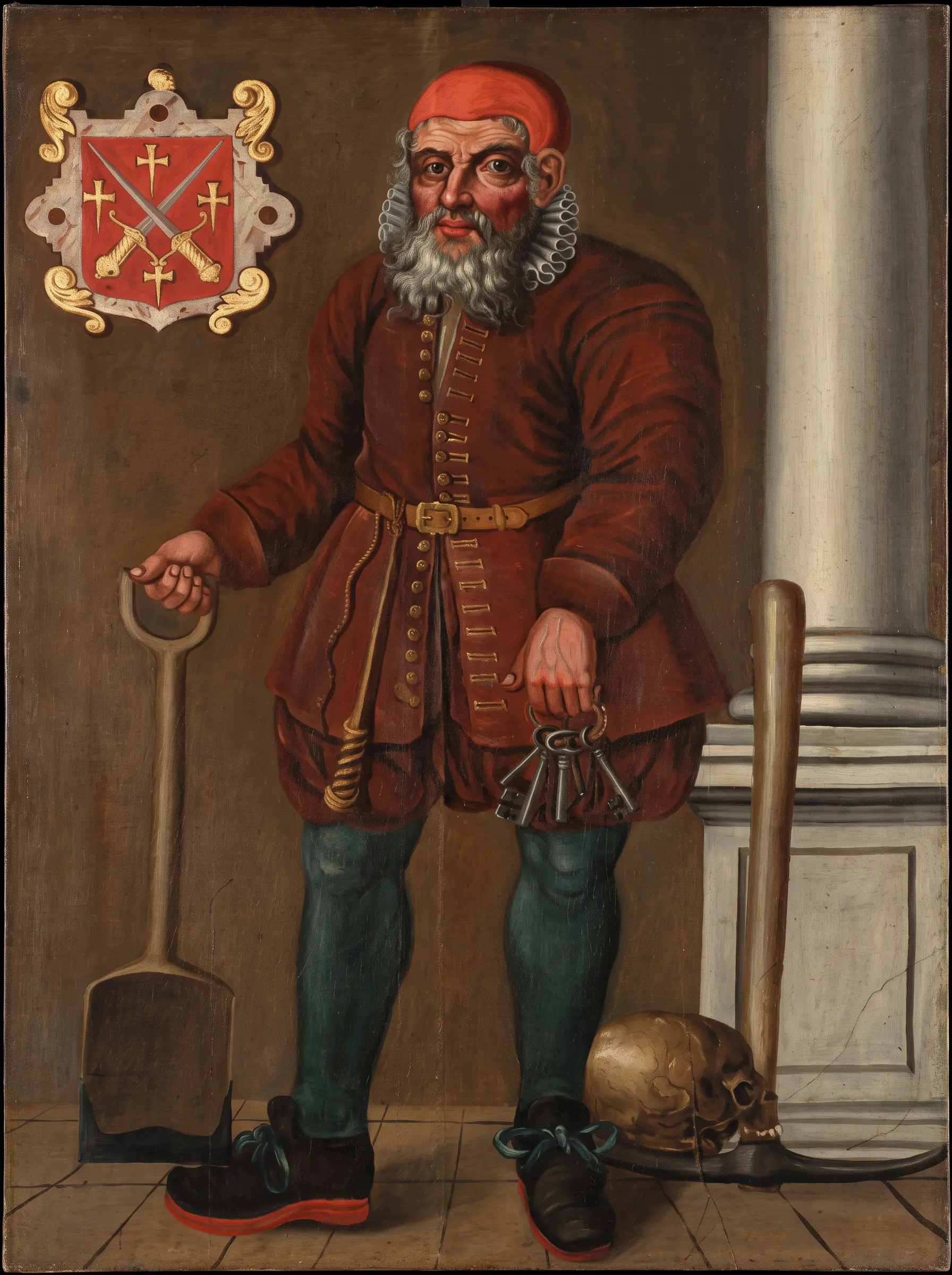
Old Scarlett
The Cathedral sexton permanently associated with the burials of Katharine of Aragon and Mary, Queen of Scots.
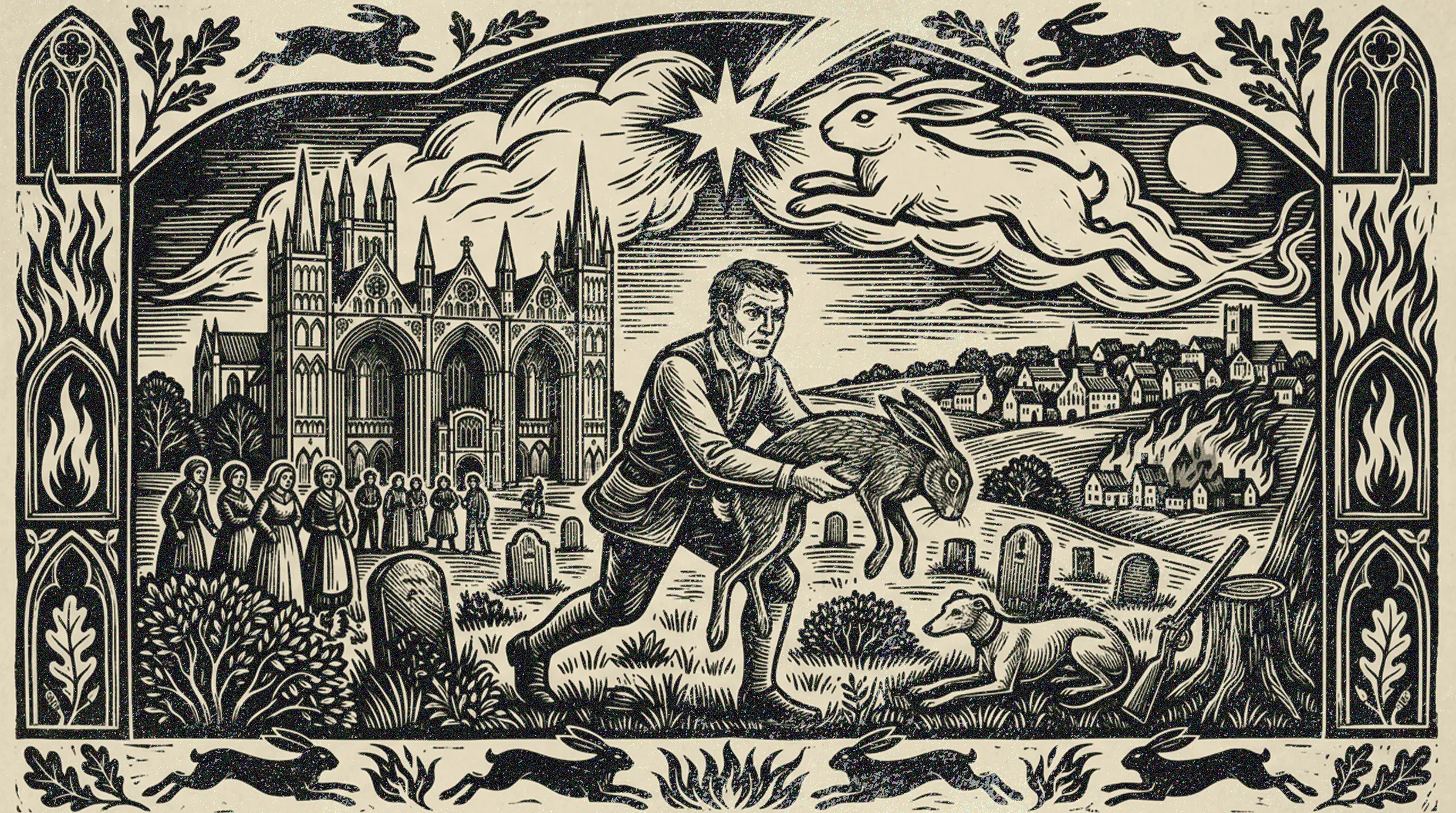
The Hare in the Close
If a hare made its form inside the Minster Close, Peterborough expected fire in the town before the week was out.
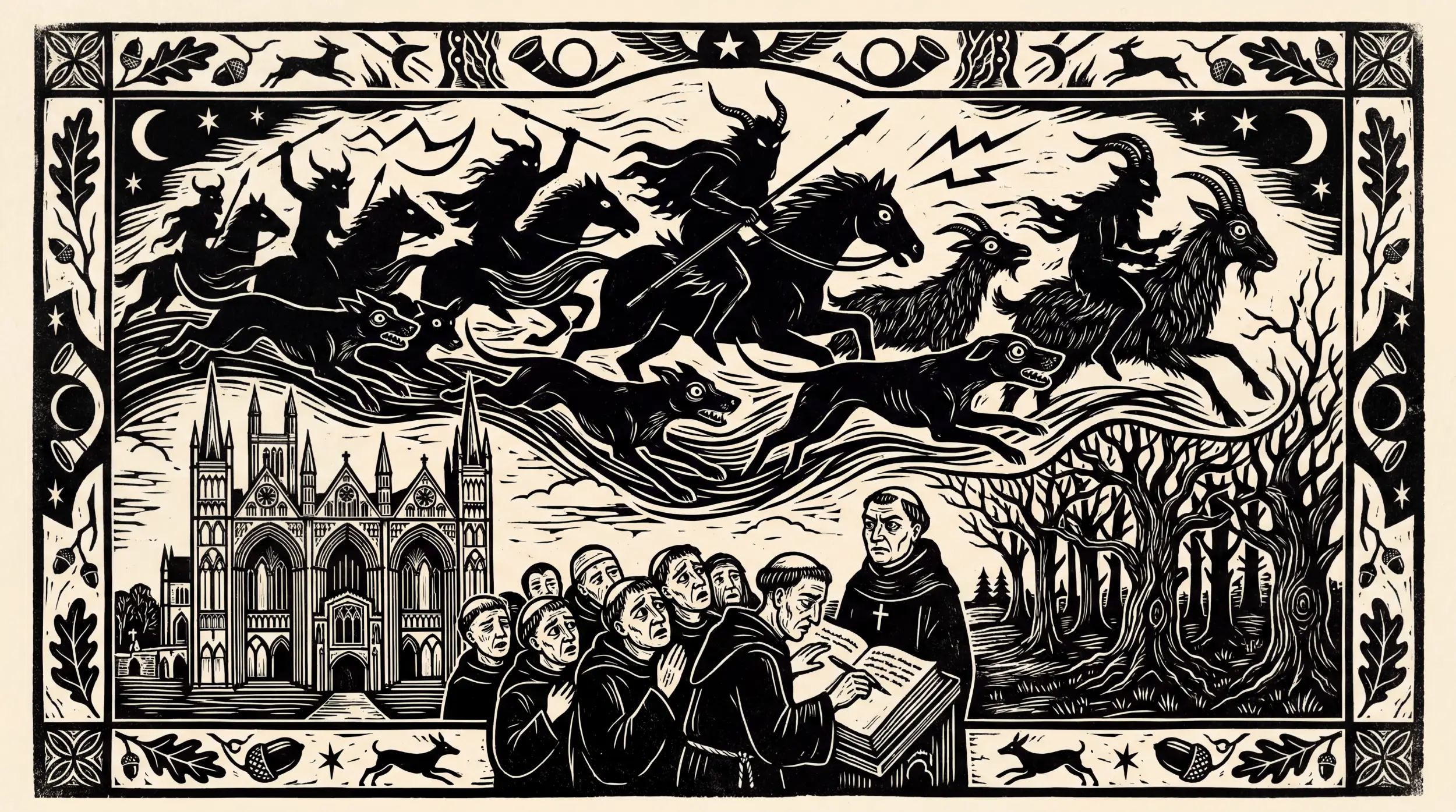
The Wild Hunt
Black riders, monstrous hounds and hunting horns entered the written record during the rule of an unpopular abbot.
Behind the mystery
The Hedda Stone is a genuine Anglo-Saxon sculpture, but its original purpose, the meaning of its holes and its relationship to the later story of Abbot Hedda remain subjects of scholarly debate.
-
Historic England · Peterborough Cathedral
The Cathedral's Grade I listing identifies the Hedda Stone as an important monument within its exceptional historic fabric. -
Peterborough and the Soke · Art, Architecture and Archaeology
Modern scholarship includes detailed reassessment of the Hedda Stone and the possibility that the Anglo-Saxon sculpture reuses Roman stone. -
Simon Gunton · The History of the Church of Peterburgh, 1686
Gunton records the early modern custom of strangers inserting a finger into the holes so that they could say they had been at Peterburgh. -
Hedda Stone photograph · NotFromUtrecht / Wikimedia Commons
Photograph used on this page, licensed under Creative Commons Attribution-ShareAlike 3.0. -
Discover Peterborough · Peterborough Cathedral History
The wider story of Medeshamstede, Anglo-Saxon Peterborough, the Norman rebuilding and the Cathedral's continuing place at the centre of the city. -
Discover Peterborough · Weird Weekends
The Hedda Stone forms part of the Cathedral curiosities trail.