

The Knight Who Refused to Stop Fighting
The Disembowelled
Knight
Inside a medieval church west of Peterborough lies a 700-year-old stone knight. Around his left wrist is a curious loop. Antiquaries called it cloth. Local tradition decided it was something far more memorable.
Everything depends on what is wrapped around his wrist.
Behind the chancel stalls of Holy Trinity Church at Orton Longueville lies the weathered stone figure of a medieval knight, still recognisable after roughly seven centuries.
His hands are raised together in prayer, his legs are crossed and a shield lies beside him. At his feet is the familiar medieval image of a lion. None of that is particularly unusual for a military effigy of the late thirteenth century.
The strange part is his left arm. Something appears to pass around the wrist in a loop, an ambiguous piece of carving that has invited interpretation precisely because it is difficult to identify.
It may represent cloth or part of the knight's clothing or equipment. Weathering and damage make certainty difficult. Local storytellers, however, supplied an explanation that was considerably more memorable.
They said it was his intestines.
The knight is genuinely medieval.
Historic England identifies the monument as a late thirteenth-century knight effigy, placing it broadly within the same period as major rebuilding at Holy Trinity.
This is important because the folklore has sometimes made the figure seem older than the sculpture actually is. Whatever event the monument commemorates, the carving belongs to the world of Plantagenet England rather than the age of Viking invasion.
The knight is shown recumbent, with his hands joined in prayer, a shield beside him and his legs crossed. The figure is now partly hidden on the north side of the chancel and can be easy to miss unless you know where to look.
Crossed legs.
One unexplained loop around the left wrist.
It is the kind of incomplete visual evidence from which folklore thrives. If the sculptor's intention had remained obvious, there would have been no mystery to solve.
What exactly is around his wrist?
The cautious answer is that we do not know with complete confidence.
Clothing, drapery or part of the knight's equipment provides a perfectly reasonable explanation. Medieval military effigies contain straps, belts, sword fittings, folds and decorative details that can become difficult to interpret after centuries of erosion.
Yet the loop is prominent enough to demand an explanation, and at some point people around Orton supplied one that no visitor was likely to forget.
It was what was left inside him.
From that single reinterpretation, the stone knight acquired one of the most graphic legends anywhere in the Peterborough landscape.
Lord Longueville went to war with the Danes.
According to the old tradition, the effigy represented a Lord Longueville who fought a Danish force somewhere near Orton.
During the battle he received a terrible wound across the abdomen. His belly opened and his entrails fell from the wound. For almost anybody else, the fighting would have ended there. Lord Longueville apparently had other plans.
wrapped them around his left wrist
and kept fighting with his right hand.
The loop carved around the effigy's wrist therefore became the crucial piece of evidence. What looked to historians like some obscure detail of medieval dress became, in the local version, the physical record of a warrior continuing to fight after a wound that should already have killed him.
The legend was not finished.
He still had a Danish king to kill.
With his left hand occupied holding his own body together, Longueville continued the battle with his right. The story gives him one final opponent: the king of the Danes.
Then Lord Longueville allowed himself to die.
It is a perfectly constructed heroic death. The wound is impossible to survive, but the warrior remains upright long enough to complete the one task the story requires of him. Only when his enemy is dead does the knight finally collapse.
Because the loop remains visible on his effigy, the tale appears to carry its own proof in stone.
The dates do not work.
The sculpture belongs to the late thirteenth century. The Longueville family appears in the documentary history of Orton from the twelfth century onward.
That is far too late for one of these Norman-descended lords to have died fighting the Viking armies that gave early medieval England its great stories of Danish invasion.
Peterborough certainly had real encounters with Danish forces. Most famously, Danish troops accompanied Hereward when the abbey was attacked in 1070. The knight in Holy Trinity, however, belongs to a later world.
The family is real.
The Danish battle belongs to legend.
That does not make the story worthless. It suggests that the tradition developed after the original identity of the monument had become uncertain enough for explanation to migrate into folklore.
There really were de Longuevilles here.
The folklore did not invent the family name. Medieval documents genuinely connect the de Longuevilles with the manor that eventually carried their name.
Henry de Longueville is recorded here in 1166, with later generations continuing to hold land at Orton through the thirteenth century.
John de Longueville died before 1265, leaving a young son, Henry, whose wardship became entangled in the political conflicts surrounding Simon de Montfort and Henry III.
These are real medieval landholders, living within the broad period in which Holy Trinity developed into the building we recognise today. What we cannot safely do is attach a particular surviving name to the effigy without stronger evidence.
Crossed legs do not make him a Crusader.
Older guidebooks often described medieval knights with crossed legs as Crusaders, Knights Templar or men who had taken a vow to fight in the Holy Land.
Holy Trinity's knight has been described in exactly those terms in older writing, but modern study of medieval monuments has shown that the rule simply does not work.
Known Crusaders were sometimes shown with straight legs, while many knights with crossed legs had no known connection with crusading at all. Specialists now treat the pose as part of the changing visual language and fashion of medieval military effigies rather than a reliable biographical code.
They do not give us the knight's military CV.
This is another reason the Orton monument is such a useful folklore object. Different generations have repeatedly looked at its physical details and transformed them into stories. Crossed legs became a Crusade. A loop around the wrist became something considerably more anatomical.
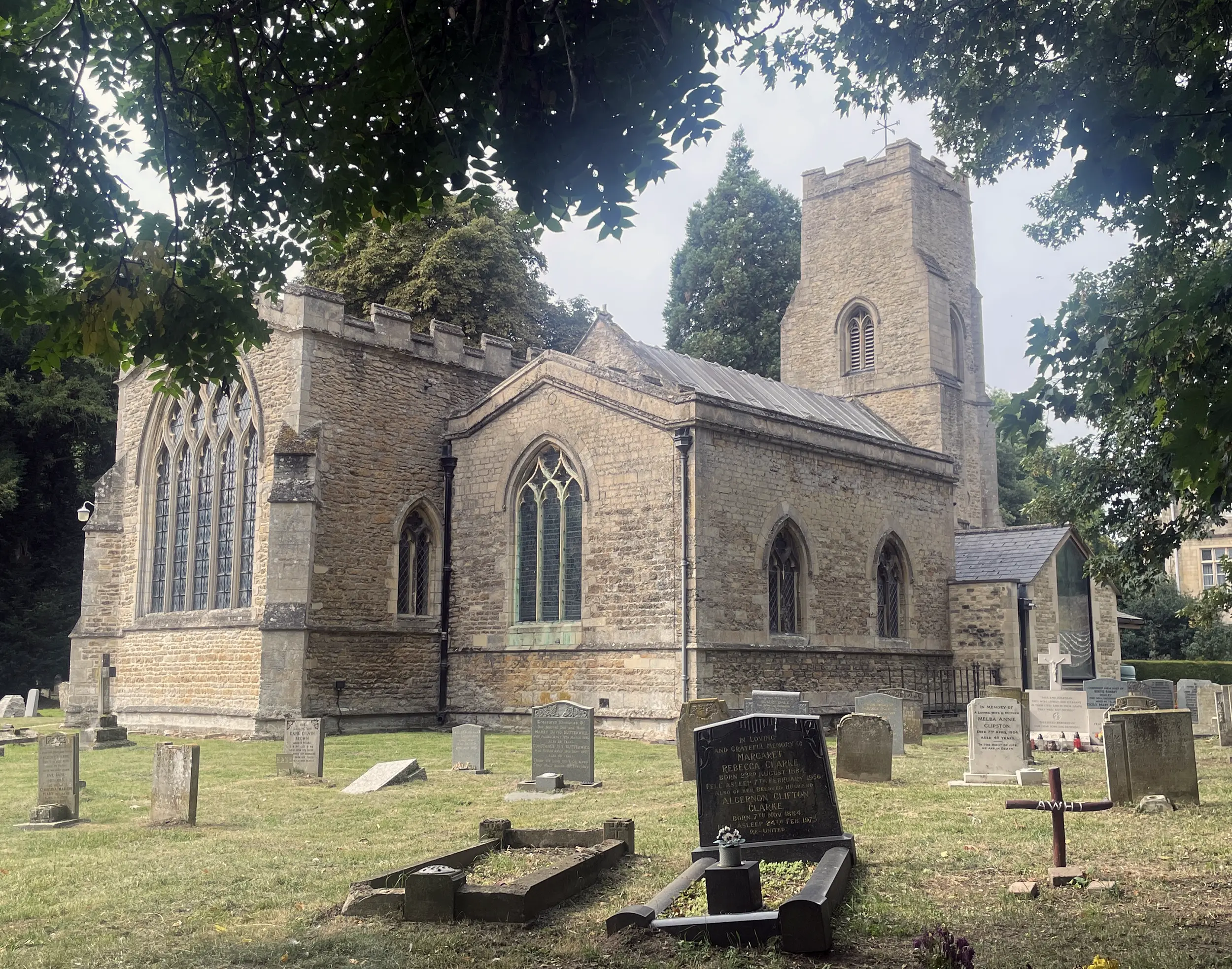
He lies inside Holy Trinity Church.
The church surrounding the knight is as interesting as the legend attached to him.
A church existed at Orton by the time of Domesday Book in 1086, although nothing obvious survives from that earliest building. Most of the present medieval fabric developed from the later thirteenth century onward.
Historic England describes Holy Trinity as Grade I listed. Its chancel and north chapel contain substantial late thirteenth-century work, while the nave, aisles and tower largely belong to the period around 1300 and the early fourteenth century.
The knight therefore belongs remarkably naturally within the building. He is not an ancient carving imported from some completely different age. Monument and church grew from much the same medieval world.
The knight is not the church's only reason to look closely.
Holy Trinity contains layers of medieval fabric and later memorial history extending far beyond its most gruesome resident.
The church retains two piscinae of around 1300, fragments of thirteenth-century stained glass, a fifteenth-century font and bell, and an early sixteenth-century wall painting of St Christopher.
Later monuments include members of prominent families associated with Orton Hall, among them an elegant nineteenth-century monument to Lady Mary Seymour by the celebrated sculptor Francis Chantrey.
The disembowelled knight is funniest and strangest when encountered not as an isolated curiosity, but as part of a church where generations continually added new layers of commemoration around older ones.
White Kennett found people already telling it.
We cannot say when somebody first looked at the loop and decided it represented human entrails, but the story was already old enough to attract antiquarian attention centuries ago.
White Kennett, the antiquary who later became Dean and then Bishop of Peterborough, recorded the local tradition attached to the monument.
Later nineteenth-century topographical works repeated the story, preserving its essential details: a Lord Longueville, a fight against the Danes, a wound to the belly, the entrails wrapped around his left wrist, the Danish king killed and the knight dying immediately afterwards.
This is not a modern joke invented for a heritage trail. The tale belongs to a much older tradition of local people explaining damaged or mysterious medieval monuments through stories.
Stone forgets. Stories fill the gaps.
Medieval monuments were designed for audiences who often knew exactly whose tomb they were looking at. Names, heraldry, inscriptions, family memory and the position of a burial provided context that could seem obvious at the time.
Over centuries, those clues disappear. Paint wears away, inscriptions are lost, heraldry becomes unreadable, tombs move during rebuilding and the person once commemorated can become anonymous.
The sculpture remains, however, and people continue to look at it. That is when physical details acquire new explanations. A crossed leg means the Crusades. A damaged object becomes a weapon. An unusual carving becomes evidence for an impossible death.
The resulting story may tell us very little about the knight who actually died, but a great deal about the generations who continued to live beside him.
The historians still have the less exciting answer.
The sensible interpretation remains that the feature belongs to the knight's clothing, armour or associated drapery.
Centuries of wear make a definitive reading difficult, and there is no serious historical evidence that the monument depicts somebody carrying his own intestines around his wrist. Nor could the late medieval Longueville represented here have fought the Danish king of the local story.
Folklore is therefore comprehensively losing on chronology, anatomy and military history.
It does, however, have one considerable advantage.
you will never look at that wrist normally again.
That is why the legend survived. The scholarly explanation may be more plausible, but the folklore has permanently altered what visitors see.
It turns an anonymous monument back into a person.
We may never know with certainty whose body the knight was originally intended to commemorate. His name has faded, the meaning of some details has become obscure and his stone face has endured centuries of damage.
Folklore refuses to leave him anonymous. It gives him a family, an enemy, a battlefield, an impossible wound and a final act of courage. Above all, it gives a reason for the one strange detail that generations kept noticing.
The story is almost certainly not what happened, but it is exactly the sort of story that happens to old stone.
The village gave him a death.
And the loop around his wrist did the rest.
One stone knight opens onto a much larger medieval world.
Explore real medieval art, historical encounters with Danish forces and other Peterborough stories in which old monuments acquired extraordinary explanations.
Longthorpe Tower
Step into a medieval household built at roughly the same time as Holy Trinity's knight and see one of Europe's most remarkable surviving schemes of domestic wall painting.
Explore Longthorpe Tower → 02 · MEDIEVAL DEATHThe Three Dead Kings
A few miles away, another medieval image confronts its audience with mortality as three young rulers encounter three corpses and discover exactly what awaits them.
Meet the dead kings → 03 · DANES IN PETERBOROUGHHereward the Wake
If you want a documented Peterborough encounter involving Danish warriors, go back to 1070 and the devastating attack on the monastery by Hereward and his allies.
Read the real story → 04 · THE BIGGER STORYPeterborough History
Place the knight within the much wider story of Peterborough, from the Anglo-Saxon monastery and Norman Conquest to the medieval communities that developed around it.
Explore Peterborough history →More Peterborough Folklore
Old monuments, medieval images and real places that acquired stories far stranger than their makers could have expected.
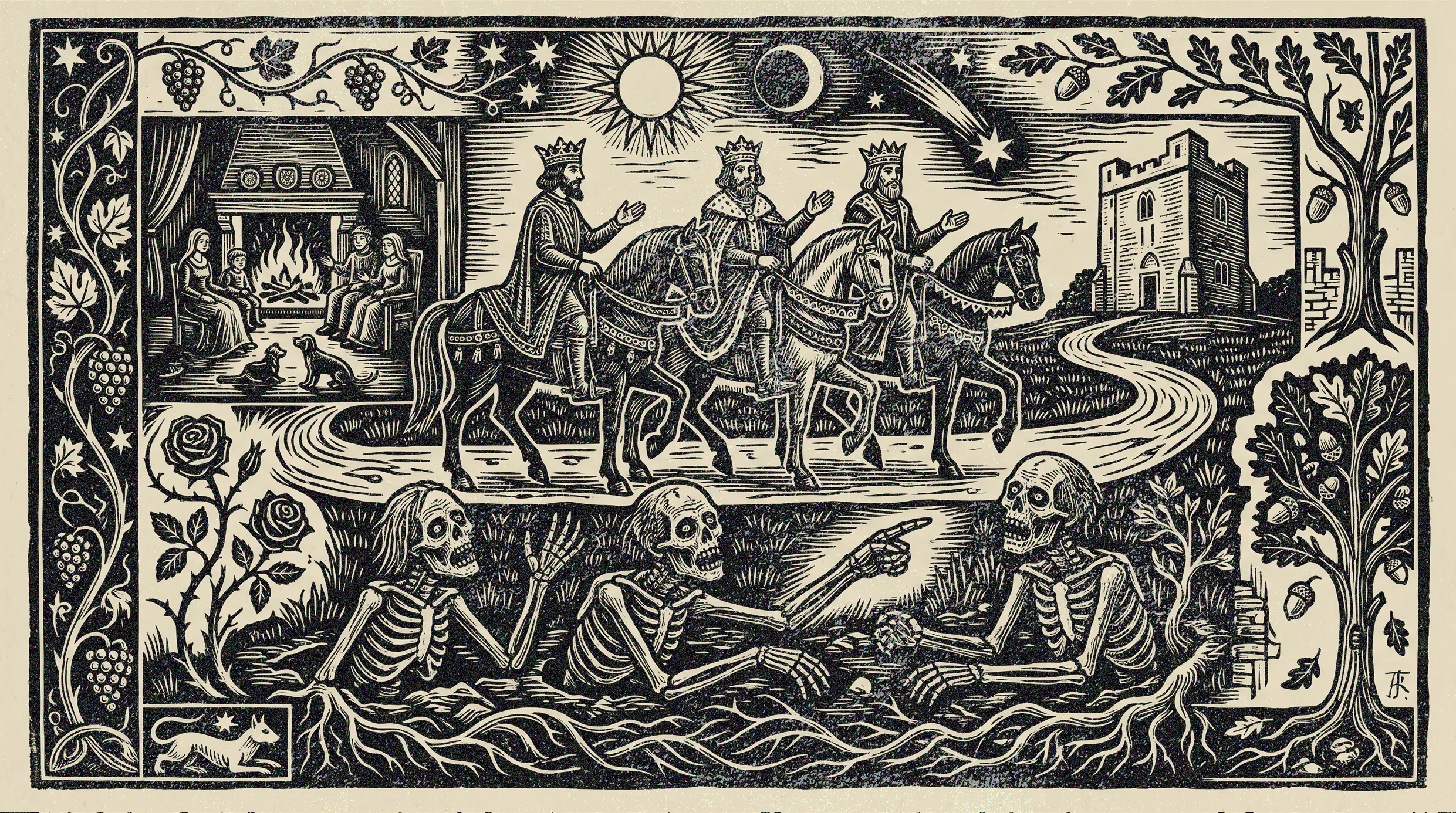
The Three Dead Kings
Three young rulers ride out in splendour and meet three corpses waiting to explain where wealth and power eventually end.
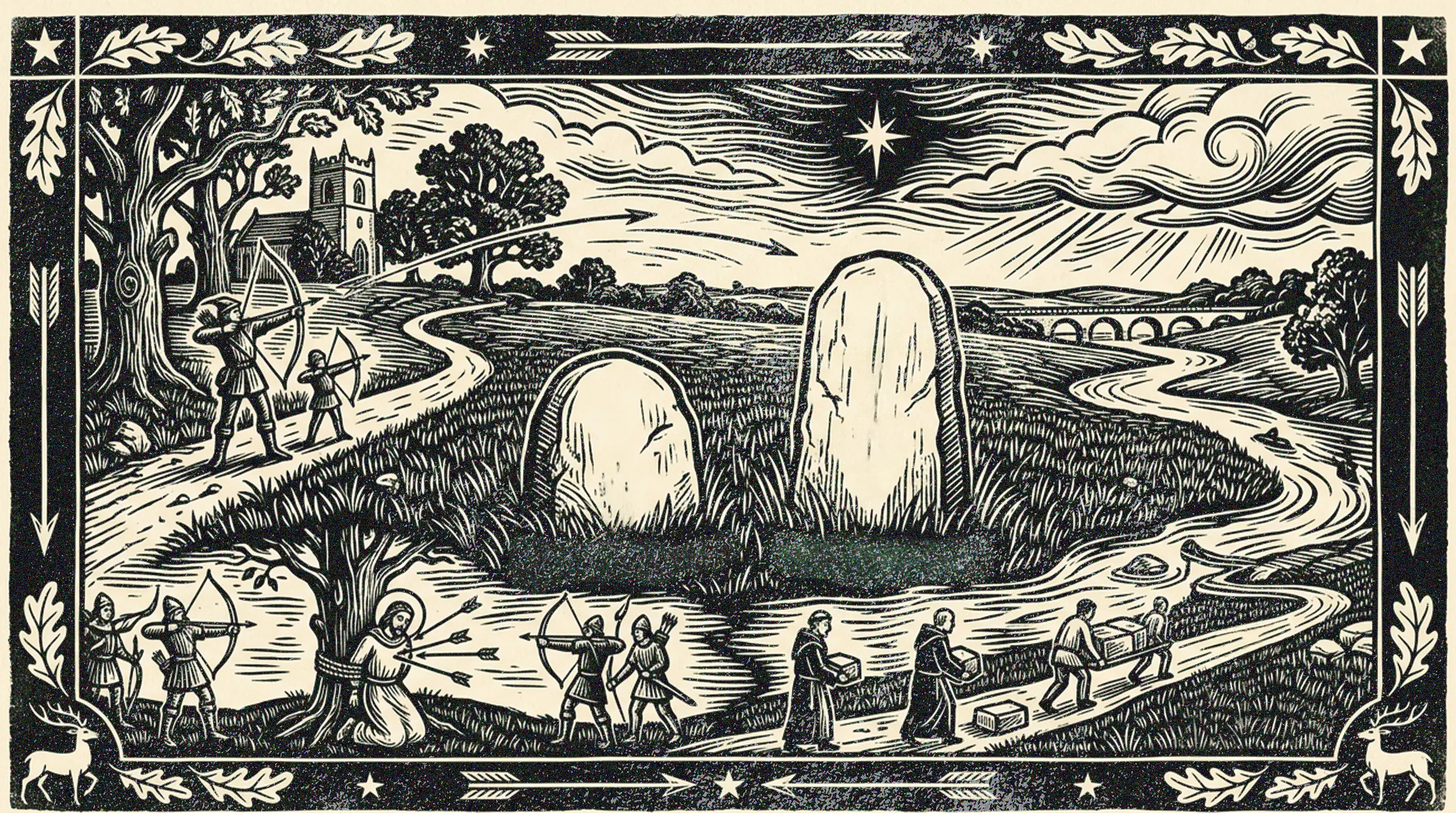
Robin Hood & Little John
Two medieval route markers lost their original meaning, so local tradition gave them to England's two most famous outlaw archers.
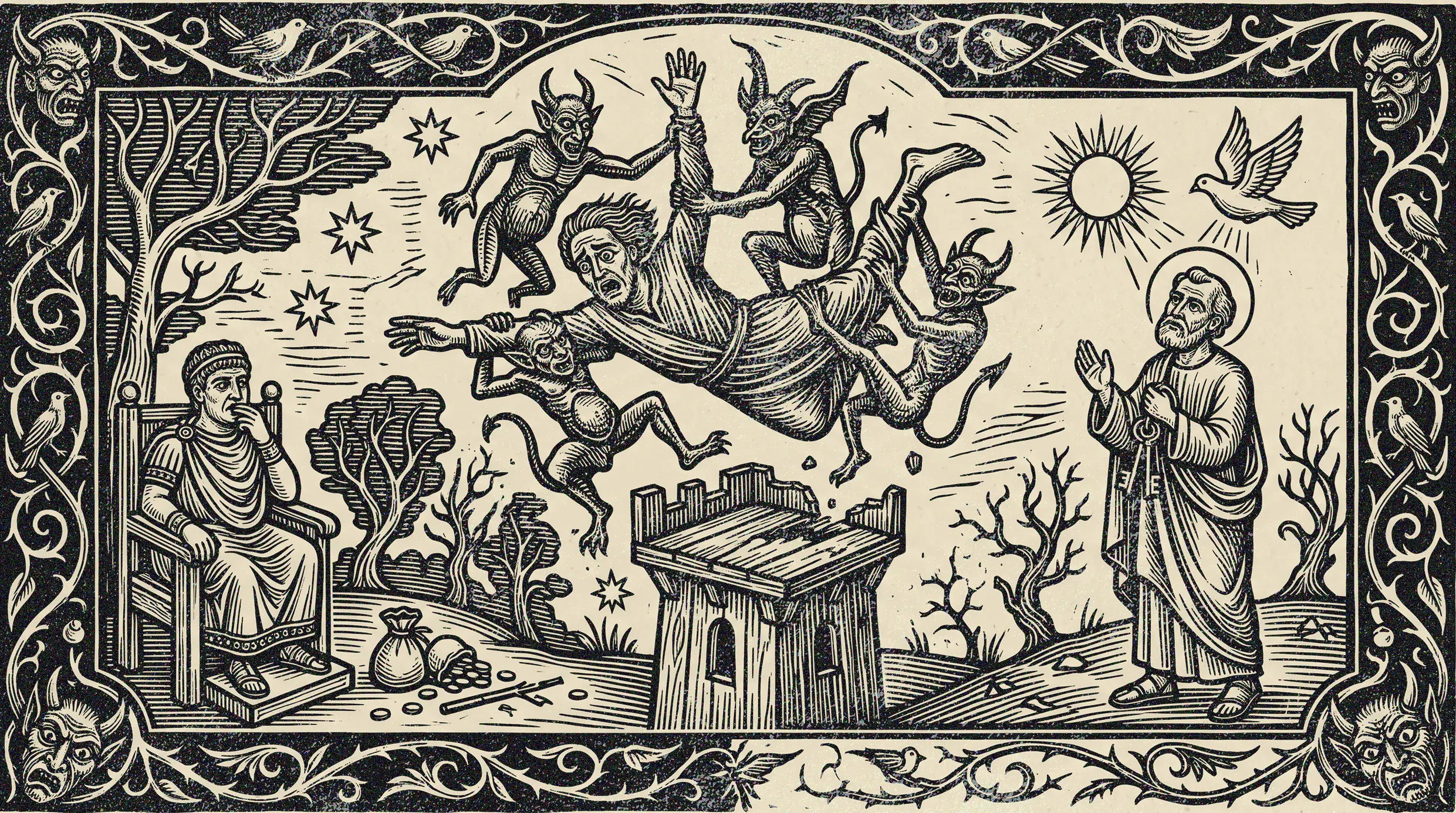
Simon Magus
An upside-down man and a crowd of demons hide at the base of the Cathedral's western entrance beneath the authority of St Peter.
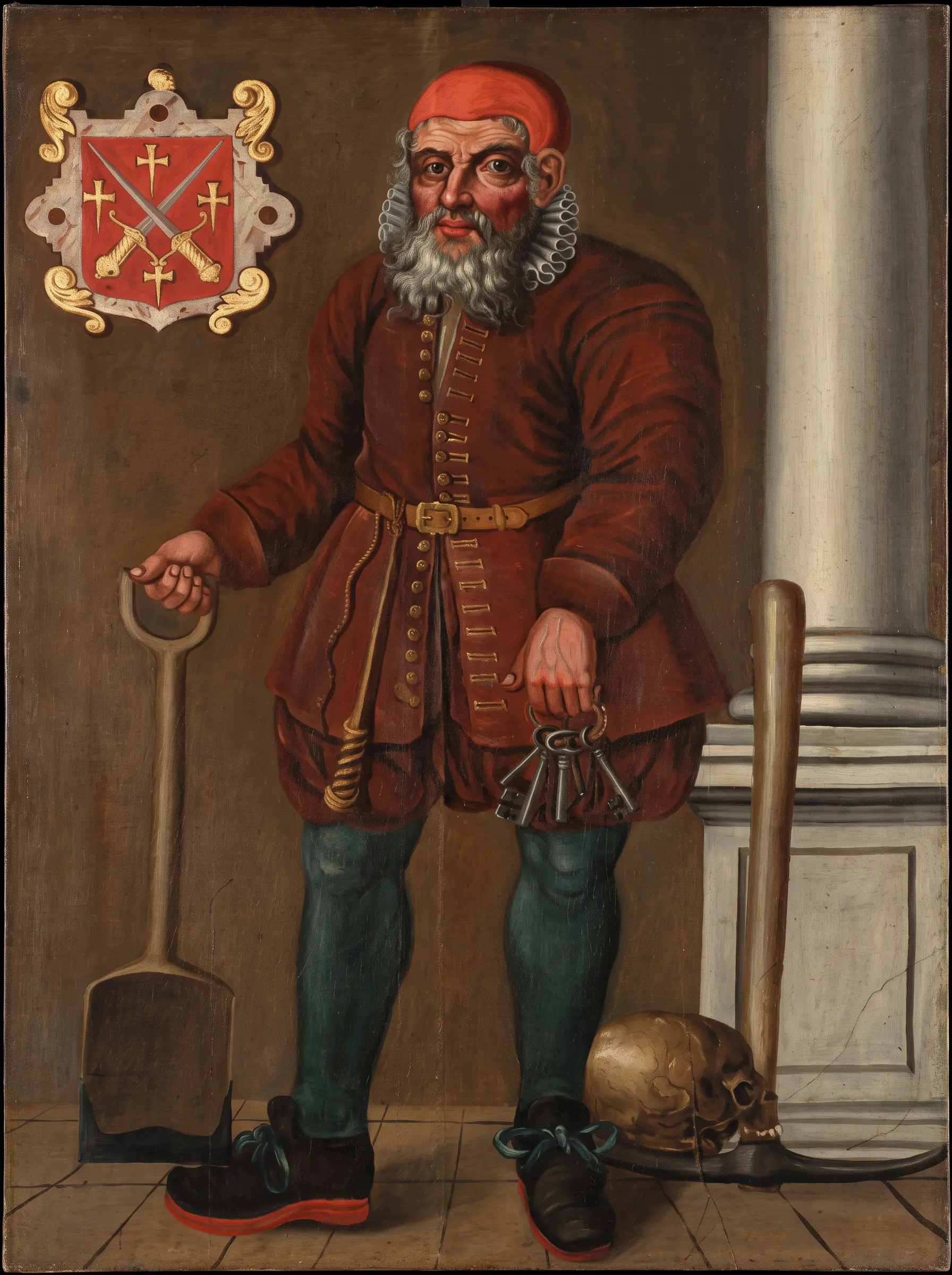
Old Scarlett
Peterborough's Tudor sexton buried generations of local people and became famous for connecting two queens beneath the same Cathedral roof.
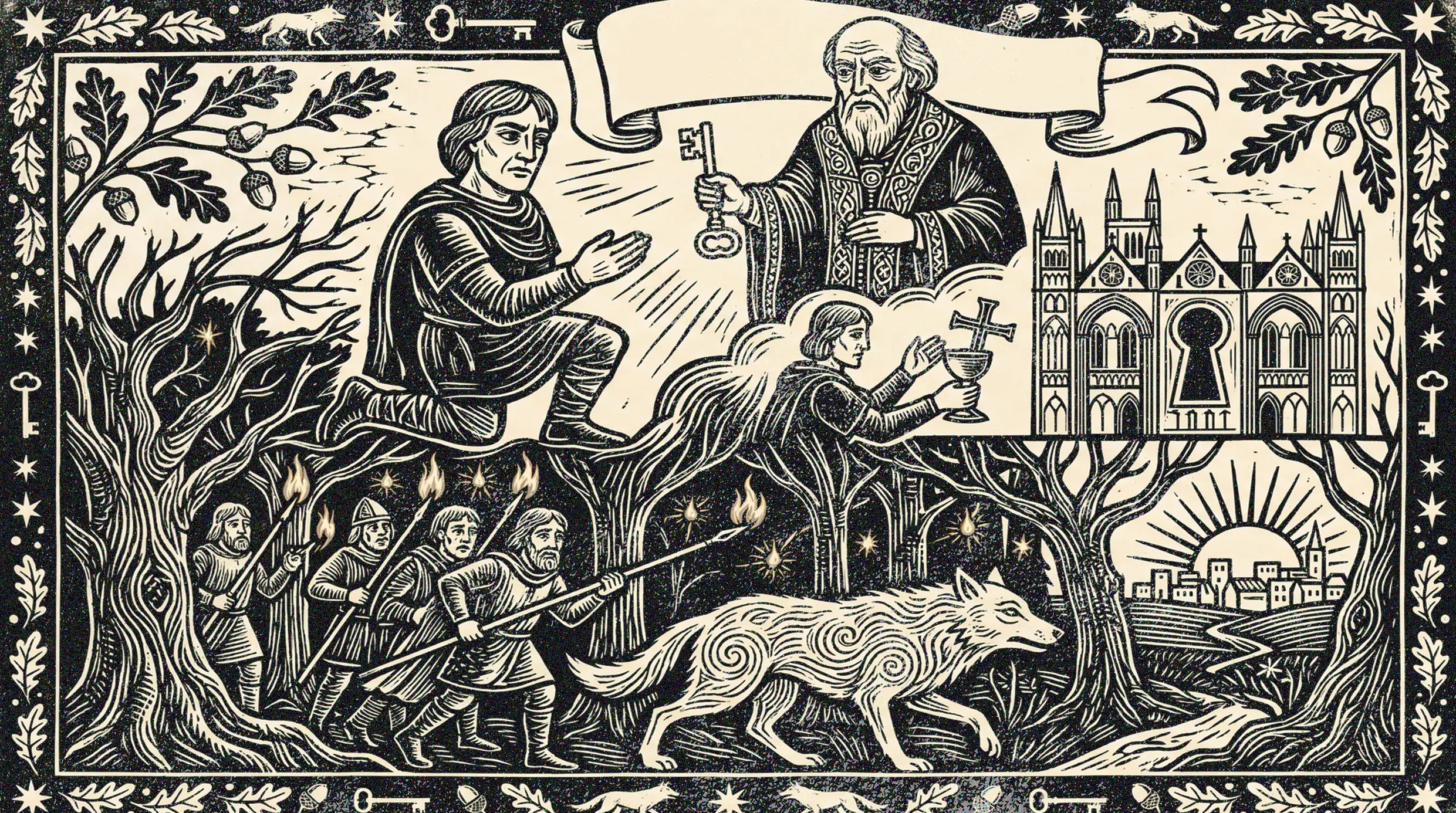
Hereward & the White Wolf
A real rebel and real raid eventually acquired an angry saint, mysterious lights and a huge wolf that guided men through the darkness.
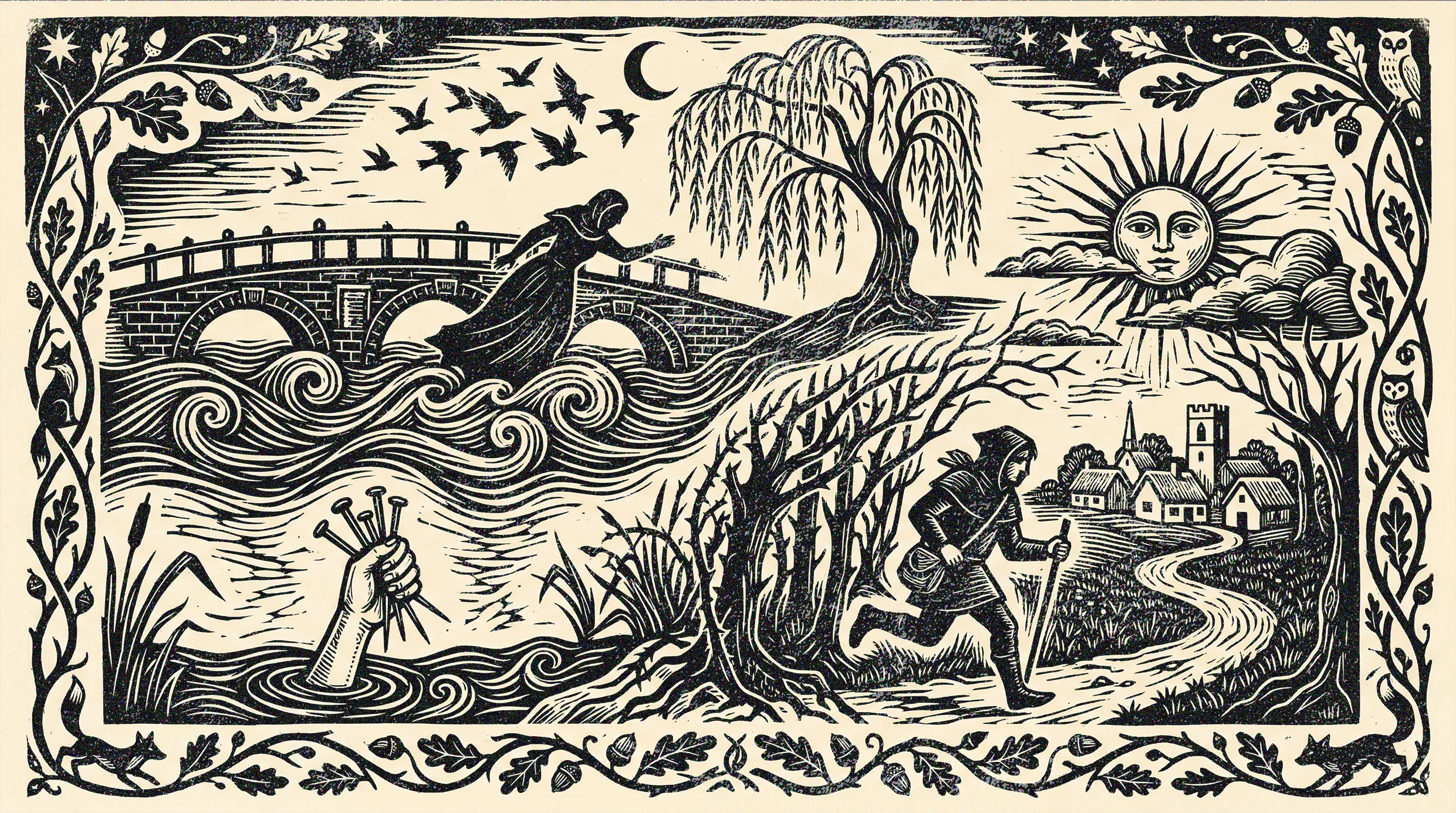
The Witch of Ailsworth
An accusation involving iron pins survives not because somebody preserved a ghost story, but because an Anglo-Saxon land charter preserved the legal aftermath.
Behind the folklore
The effigy is a genuine late medieval monument. Its traditional identification, the Danish battle and the extraordinary explanation for the loop around the wrist belong to later layers of local storytelling and antiquarian interpretation.
-
Historic England · Church of the Holy Trinity
The official Grade I listing records the late thirteenth-century knight effigy alongside Holy Trinity's medieval architecture, piscinae, stained glass, font, bell, St Christopher painting and later monuments. -
Orton Longueville Parish Council · History
Local historical material drawn from the Victoria County History traces the de Longueville family's documented association with the manor from Henry de Longueville in 1166 through the thirteenth century. -
White Kennett · local tradition
The antiquary White Kennett, later Dean and Bishop of Peterborough, recorded the tradition that the monument represented a Lord Longueville mortally wounded while fighting the Danes, who wrapped his entrails around his left wrist and continued fighting. -
Church Monuments Society · Cross-Legged Effigies
Specialist monument research explains why crossed legs should not be treated as evidence that a medieval military figure was a Crusader or Knight Templar. -
Holy Trinity · A Church Near You
Current church information. Check current opening and access arrangements before visiting. -
Discover Peterborough · Weird Weekends
The knight forms part of the Hearts & Bones strand of Weird Weekends alongside medieval death imagery, unusual burials, relic traditions and other anatomical curiosities.