



St Peter, Fairy Fire & the Forest Road
Hereward and
the White Wolf
A church plundered. An angry old man carrying a great key. A rebel army lost in the night. Then, among the trees, something pale began to walk ahead.
Hereward's Peterborough story begins with fire.
Hereward the Wake would eventually become one of England's great resistance heroes. Peterborough had good reason to remember him rather differently.
In the years after the Norman Conquest, Hereward became one of the most celebrated figures still resisting William the Conqueror.
His world was the Fenland: islands of dry ground, marshes, waterways and woodland stretching through the country around Peterborough, Ely and southern Lincolnshire.
Later generations imagined him as the last great Englishman standing against Norman rule.
But in Peterborough's own surviving record, Hereward does not first appear as a romantic outlaw.
He arrives with armed men.
The town burns.
And the treasures of one of England's richest monasteries disappear into the Fens.
Before the wolf came the raid.
The historical core of Hereward's connection with Peterborough is unusually well documented.
After the death of the English Abbot Brand, William the Conqueror appointed a Norman, Turold, to rule Peterborough Abbey.
Hereward and his allies were already operating with a Danish force based around Ely. Before Turold could establish himself, Hereward's men came to Peterborough.
The monks tried to keep them out.
The attackers used fire.
They entered the monastic precinct and stripped the church of an astonishing quantity of treasure: crosses, reliquaries, vestments, money, books and precious metalwork.
The contemporary Peterborough Chronicle says the treasure was taken to Ely and that much of it subsequently left England with the Danes.
That is history.
Then the storytelling begins.
Later generations gave Peterborough another version.
Decades after the events themselves, the Gesta Herewardi transformed the rebel's life into something much closer to heroic adventure.
Its Hereward fights impossible battles, escapes traps, adopts disguises and repeatedly outwits the Norman regime.
Peterborough appears again.
In this later narrative, Hereward had captured the Norman abbot Turold during fighting and released him for an enormous ransom.
Turold responded by using church lands to reward soldiers who would continue the campaign against Hereward.
Hereward discovered what the abbot was doing.
He returned to Peterborough in anger.
Again the town was laid waste by fire.
Again the church was plundered.
But this time the story did not end with treasure disappearing into the Fens.
That night, somebody came looking for Hereward.
An old man stood before him with a great key.
Hereward slept.
In the dream, a man appeared.
He was old and extraordinary to look at, dressed more magnificently than anything Hereward could remember seeing.
But there was nothing comforting about him.
His face was terrible.
In his hand he carried a great key.
The identity of the visitor hardly needed explaining.
Peterborough Abbey was dedicated to St Peter, traditionally imagined as the keeper of the keys of Heaven.
Hereward woke in terror.
The outlaw who had resisted armies did not argue with the man carrying the key.
Hereward took the treasure back.
According to the legend, the warning worked immediately.
Hereward rose that same hour.
Everything his men had removed from the church was carried back.
Then Hereward and his followers left Peterborough.
It is an elegant piece of medieval storytelling.
The rebel remains dangerous enough to burn towns and defy a king, but even he must recognise the authority of Peterborough's patron saint.
The monastery that history says Hereward attacked could now tell a story in which St Peter himself forced the great outlaw to submit.
Yet the saint's involvement may not have ended there.
Because once Hereward left Peterborough, the road disappeared.
The darkness closed around them.
Hereward and his men lost the path.
The Gesta describes a stormy night and deep gloom. The soldiers wandered backwards and forwards through the woodland, no longer certain where they were going.
This was not the landscape we know today.
The country around medieval Peterborough contained great areas of woodland as well as fen and marsh. Roads could be uncertain, darkness almost complete and landmarks invisible.
Hereward's men kept moving.
Then an animal stepped onto the path in front of them.
At first they thought it was a white dog.
It was enormous, but strangely tame.
The animal moved ahead of the men and behaved like a household dog, apparently inviting them to follow.
In the darkness its grey coat looked pale.
The soldiers decided it must be a white dog from some nearby settlement.
A dog knew where it was going.
So they followed it.
Hereward's army followed behind.
But the animal was not the only strange thing travelling with them.

Then lights appeared on the soldiers' weapons.
Small flames began clinging to the tips of their lances.
They were not bright.
The medieval writer compared them with the wandering lights ordinary people knew as will-o'-the-wisps.
The men tried to remove them.
They could not.
They tried to put them out.
They would not go.
A pale animal on the road.
And enough light to keep walking.
Whatever the soldiers thought was happening, the lights allowed them to see their way.
The wolf continued in front.
The men continued behind.
And gradually the lost road became a road again.
At daylight they finally saw what had led them.
Dawn changed the animal.
In daylight, Hereward's men realised that the creature they had followed through the night had never been a dog.
It was a huge wolf.
Almost as soon as they understood what they were looking at, it disappeared.
The lights disappeared with it.
The men looked around.
They had reached safety beyond Stamford.
The Gesta Herewardi tells us what they did next.
They gave thanks to God.
Christian miracle, older symbol or simply a very good story?
The white wolf is tempting to interpret.
Wolves carried enormous symbolic weight in northern European mythology and heroic storytelling. Later generations have therefore been drawn to the idea of an older, pagan creature walking through a story otherwise dominated by a Christian saint.
But the medieval source itself does not say that.
The Gesta Herewardi presents the journey as something marvellous and potentially miraculous. The adventure begins immediately after Hereward obeys the frightening vision of Peterborough's patron saint, and it ends with his men thanking God for reaching safety.
The wolf can therefore be read in several ways.
Perhaps St Peter frightened Hereward into returning the treasure and then ensured he escaped safely.
Perhaps later storytellers preserved older imagery inside a Christian tale.
Or perhaps a real wolf, moving confidently through familiar woodland, became something much stranger in the retelling.
The story never explains.
That is why the wolf remains interesting.
The White Wolf tells us something history alone cannot.
Hereward really existed.
His involvement in the attack on Peterborough in 1070 is preserved in the Peterborough version of the Anglo-Saxon Chronicle.
His resistance against Norman rule around Ely is historical.
The dream of St Peter, the returned church treasure, the wandering lights and the white wolf belong to a different category.
They come from the Gesta Herewardi, written after the events and already transforming Hereward into a legendary hero.
That distinction matters.
But it does not make the folklore worthless.
Quite the opposite.
The legend shows later generations trying to solve a problem.
How could Hereward be both the man who attacked a holy place and the hero who defended England?
The story gives its answer.
He sinned against St Peter.
St Peter corrected him.
Hereward made restitution.
And afterwards the supernatural world itself helped guide him through the darkness.
Peterborough's enemy became England's hero.
Hereward did not remain confined to medieval chronicles.
Over centuries his historical resistance was surrounded by increasingly elaborate adventures.
Victorian writers transformed him again.
Charles Kingsley's 1866 novel Hereward, the Last of the English helped create the powerful national image of Hereward as the heroic final defender of Anglo-Saxon freedom.
Peterborough kept his name too.
Streets, businesses, broadcasting and popular culture have all reused “Hereward”, often with little memory of the uncomfortable fact that the city's earliest surviving account knew him as a raider.
That contradiction is precisely what makes him such a rich Peterborough figure.
Explore Hereward's Peterborough story →
It is a story about finding a road through darkness.
Strip away the politics, the disputed chronology and nearly a thousand years of reinvention, and the central image remains extraordinarily simple.
People are lost.
It is night.
They cannot find the road.
Then something appears and walks ahead.
That is one of the oldest structures in storytelling: the mysterious guide who appears exactly when the familiar world stops making sense.
For Peterborough, however, the legend does something more.
It takes the man who burned and plundered the monastery and places him under the authority of its patron saint.
Hereward does not cease to be a rebel.
He simply learns that even rebels must sometimes give something back.
The lights showed him the road.
And the white wolf walked ahead.
More Peterborough Folklore
Spectral hunts, burning monasteries, impossible archery, ancient roads and some of the oldest strange stories in Peterborough's landscape.
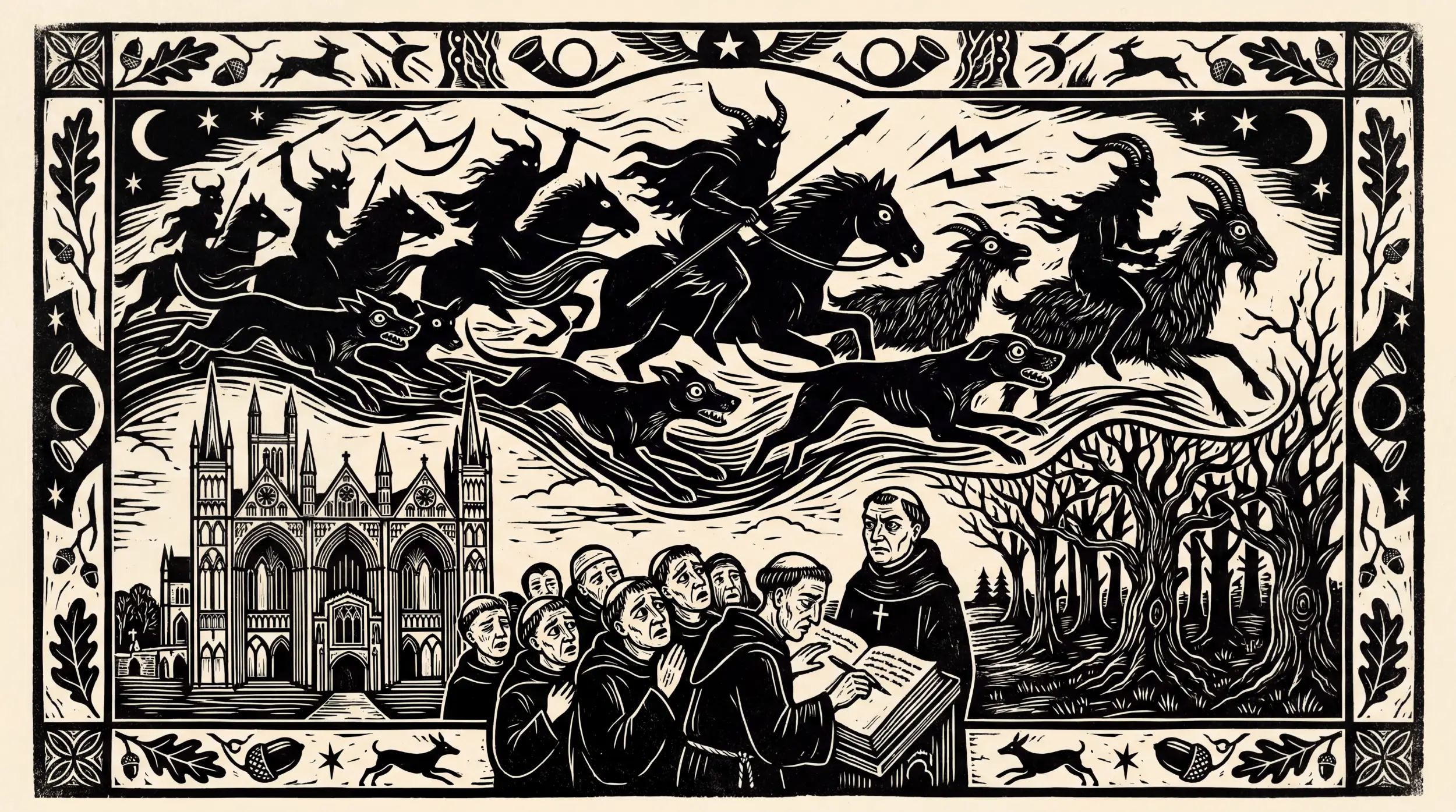
The Wild Hunt
Black riders, monstrous hounds and hunting horns were heard in the woods after the arrival of an unpopular abbot.
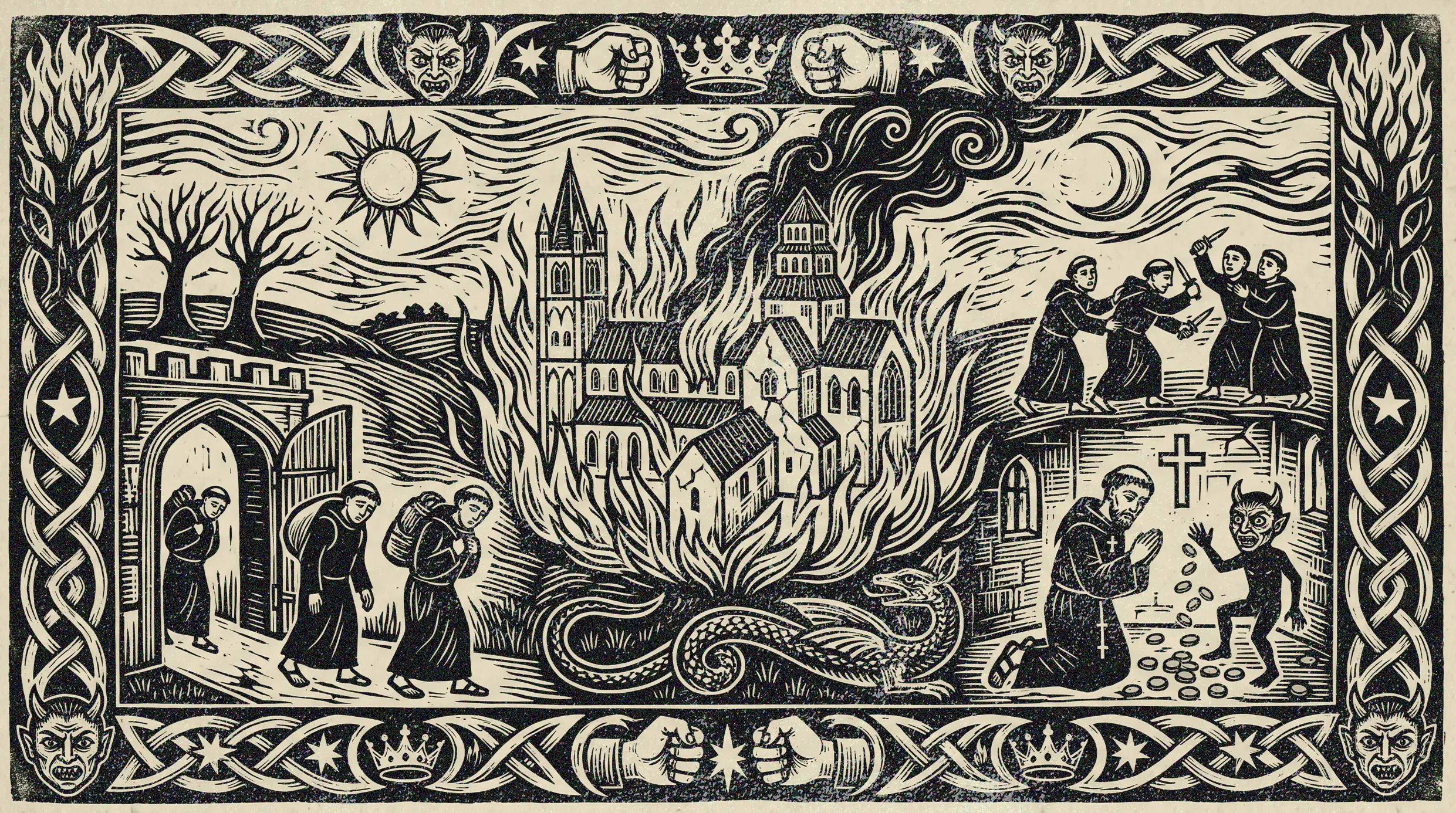
Come, Devil, and Blow on the Fire
A prophecy, an angry servant and the catastrophic fire from which the present Cathedral eventually arose.
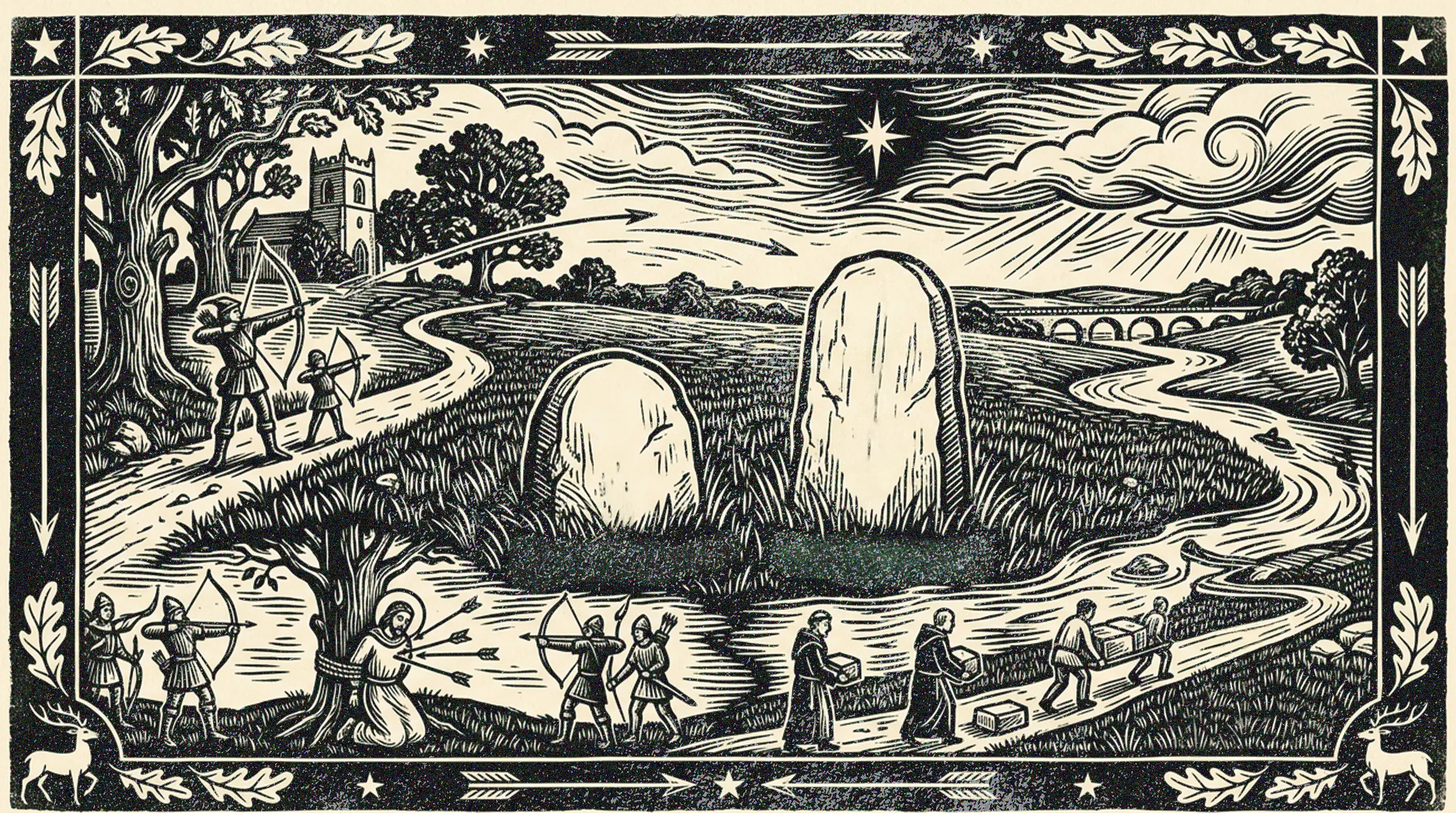
Robin Hood & Little John
Two stones in a field were said to mark where impossible arrows fired by England's other great outlaw finally fell.
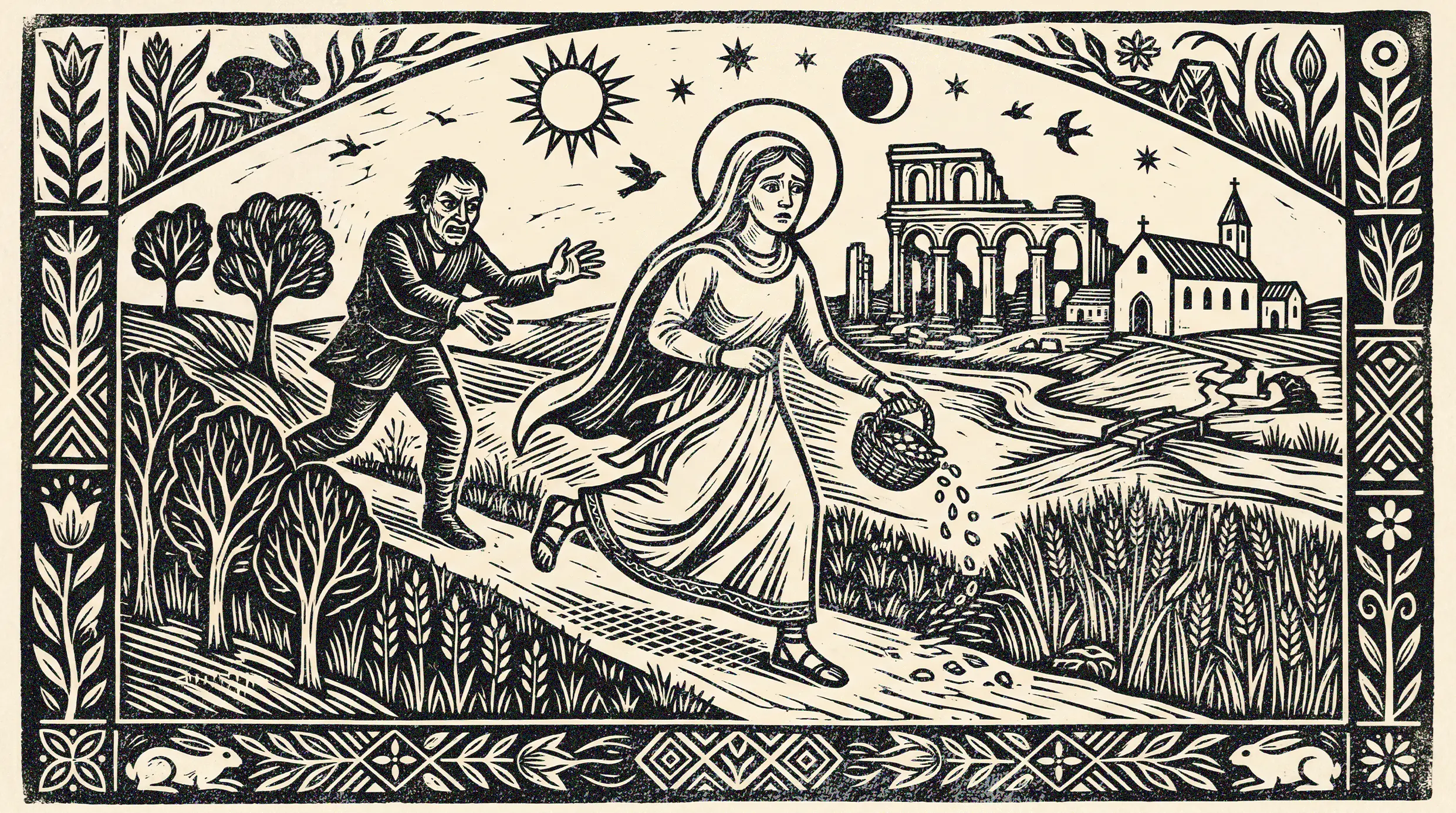
Lady Conyburrow's Way
A strange line through the fields was once remembered as the road of St Kyneburgha, founder of Castor's monastery.
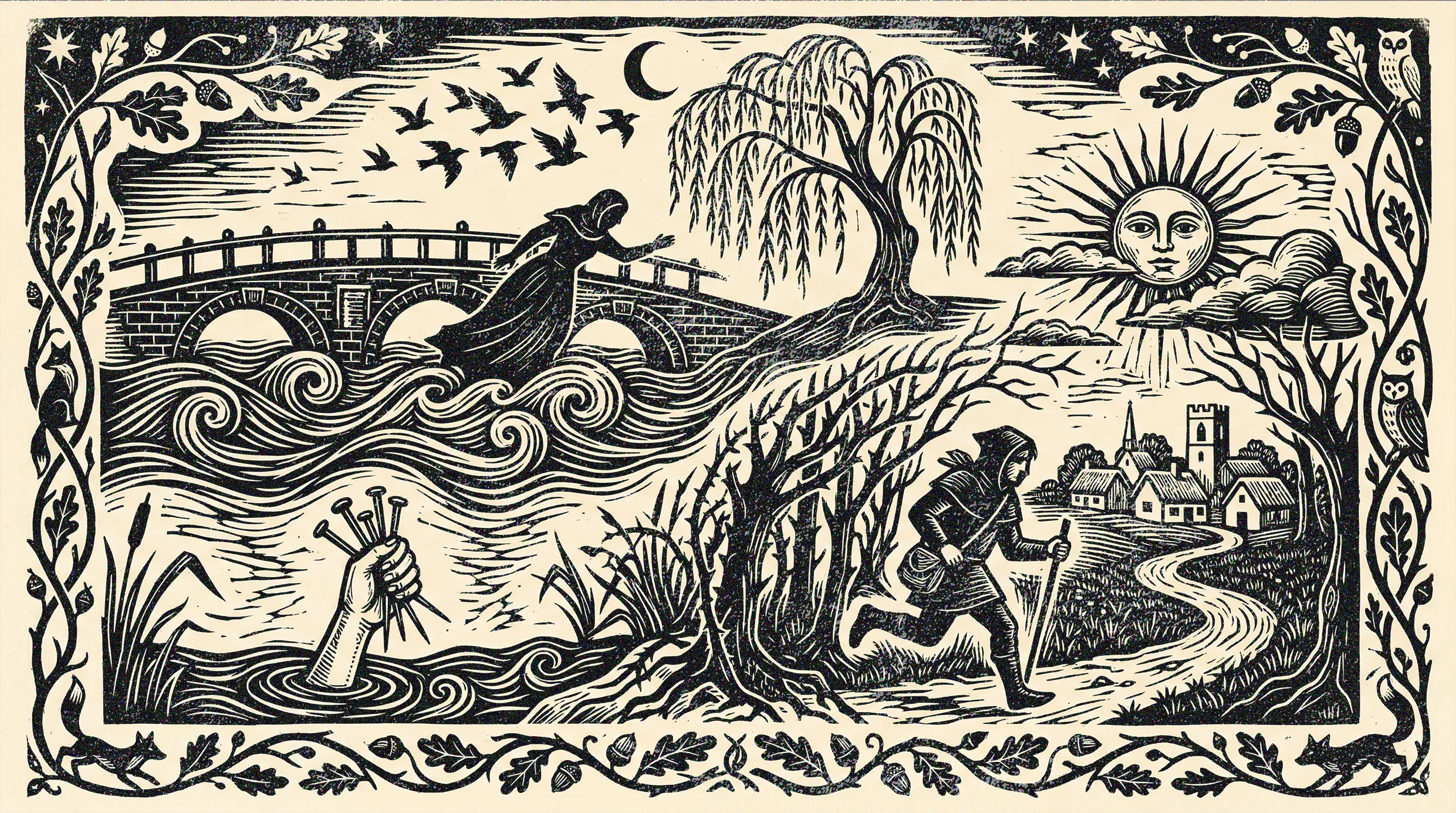
The Witch of Ailsworth
Iron pins, an accusation of sorcery and one of England's earliest surviving documentary traces of witchcraft.
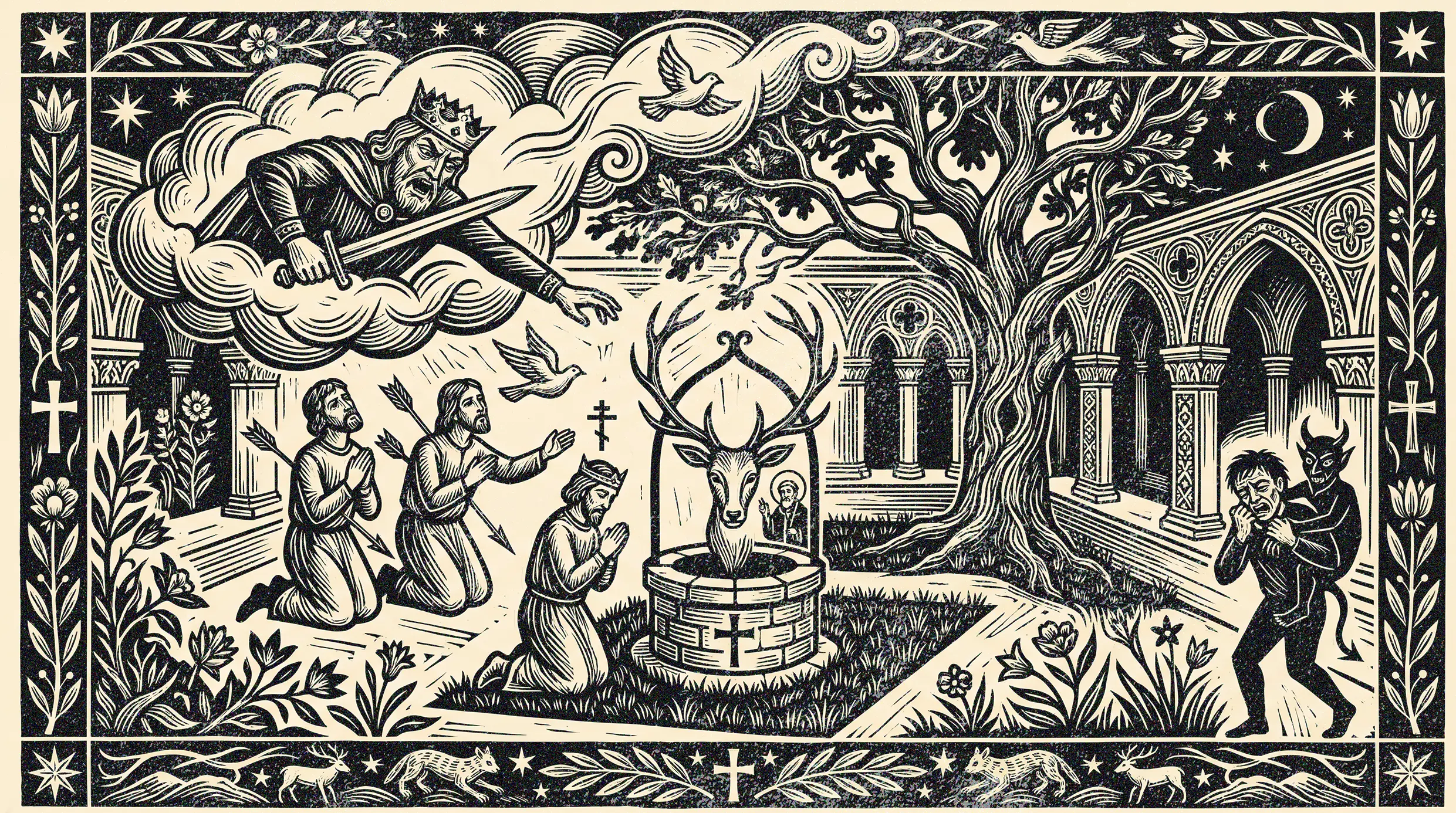
The Princes & the Hart
A royal hunt, a hidden hart and the extraordinary legend once told in the windows of Peterborough's medieval cloister.
Behind the folklore
Hereward's story is a particularly good example of the point where documented medieval history becomes heroic legend. This page distinguishes between Peterborough's contemporary record and the later narrative preserved in the Gesta Herewardi.
-
Peterborough Chronicle · Anglo-Saxon Chronicle, E text
The Peterborough version of the Chronicle records Hereward's involvement in the destructive raid of 1070, including the burning of the monastic precinct and town and the removal of the abbey's treasures. -
Gesta Herewardi · modern English translation
The later medieval life of Hereward contains the vision of the old man with the great key, the restitution of the treasure, the white wolf and the unexplained lights on the soldiers' lances. -
Discover Peterborough · Hereward the Wake
A fuller account of the historical Hereward, the raid on Peterborough, the resistance at Ely and the development of his legend. -
Hereward the Wake: Peterborough's Rebel, Raider and Legend
The wider Peterborough story of Hereward's transformation from medieval enemy to national folk hero and enduring local name.