
Black hunters · black hounds · horns in the night
The Wild Hunt
of 1127
Soon after a deeply unpopular new abbot arrived at Peterborough, people began reporting something in the woods. Black hunters. Black horses. Black hounds. Riders on strange animals. At night, the monks could hear their horns.
Almost nine hundred years later, the insistence is still striking.
The Peterborough Chronicle does not introduce its strange riders as a campfire tale. Before describing them, its writer effectively warns the reader not to dismiss what follows. The story, he says, was widely known.
It was 1127. Peterborough Abbey had been given a new abbot, Henry of Poitou, a royal appointee whom the Peterborough monks regarded with deep suspicion. Soon after his arrival, the chronicler says, people began seeing and hearing hunters in the countryside around the monastery.
They were described as black, enormous and hideous. Their hounds were black and wide-eyed. They rode black horses and animals that the medieval wording has been translated as bucks or he-goats. At night, horns sounded through the woods.
The reports did not come from one frightened traveller. The chronicler speaks of many people seeing or hearing the hunters and says trustworthy men who deliberately kept watch estimated perhaps twenty or thirty horn-blowers.
Most remarkable of all, the phenomenon was said to continue from Henry's arrival through Lent until Easter.
The surviving record was made by the community that heard the horns.
This is what makes Peterborough's night hunt so important. We are not relying on a Victorian collector trying to reconstruct a medieval legend. The extraordinary account survives in the Peterborough continuation of the Anglo-Saxon Chronicle.
The manuscript now known as Oxford, Bodleian Library, MS Laud Misc. 636 was maintained at Peterborough Abbey. Its first continuation covers the years 1122 to 1131 and was being updated during the period in which the hunt was reported.
In other words, the 1127 entry is unusually close to the people, place and moment it describes.
The hunters were black, huge and loathsome, and the monks heard their horns blowing in the night.
Condensed from the 1127 entry. Translations differ slightly in their rendering of several medieval words.The original entry places the sightings in the monastery's deer enclosure at Peterborough and through the woods extending towards Stamford. The monks themselves are specifically said to have heard the horns.
The sound reached inside the monastery.
The supernatural riders arrive at exactly the right moment.
The hunt cannot be separated from the man whose arrival immediately precedes it in the Chronicle. Henry was not simply a new administrator. To the Peterborough writer, he represented everything that had gone wrong.
Henry of Poitou had previously been abbot of Saint-Jean-d'Angély in western France. King Henry I gave him Peterborough Abbey despite the wishes of the local monastic community, and the chronicler portrays the appointment as a deeply improper intrusion.
The writer's most memorable insult compares Henry to a drone in a beehive: while the bees gather, the drone consumes. Henry was accused of taking wealth from Peterborough and sending it overseas rather than caring for the house entrusted to him.
Then come the hunters.
In the logic of the Chronicle, that sequence is not accidental. The monstrous procession is an omen, a visible and audible sign that the natural and religious order has been disturbed.
The woods answer.
This matters when considering what the record means. The chronicler was not neutrally collecting unexplained phenomena. He was writing about a political and religious conflict inside one of medieval England's great monasteries.
The hunt makes Henry's arrival look cosmically wrong.
Henry is sometimes called Henry de Angeli or Henry d'Angély in modern local retellings because of his connection with Saint-Jean-d'Angély. Henry of Poitou, or Henry of Saint-Jean-d'Angély, more clearly describes the historical abbot.
The Chronicle is not the only medieval Peterborough account.
A second version appears in the Latin history of Peterborough Abbey associated with the monk Hugh Candidus.
Hugh spent his life at Peterborough and was alive when the events of 1127 occurred. His account again describes nocturnal portents throughout Lent, hunters with horns and hounds, black horses, riders on goats and a company of around twenty or thirty.
The wording is close enough to the Chronicle that the two texts cannot simply be treated as completely independent witness statements. Even so, Hugh's decision to preserve the incident shows that the story remained part of Peterborough's institutional memory.
The Peterborough Chronicle
Written in the developing language that takes the Chronicle from late Old English towards early Middle English. The entry insists that sightings and sounds were widely reported.
Read a translation →Hugh Candidus
Peterborough's own monk and historian repeated the story in his history of the abbey, preserving the hunters, horns, black animals and weeks of nocturnal disturbance.
Meet Hugh Candidus →The chronicler does not send the riders vaguely into the night.
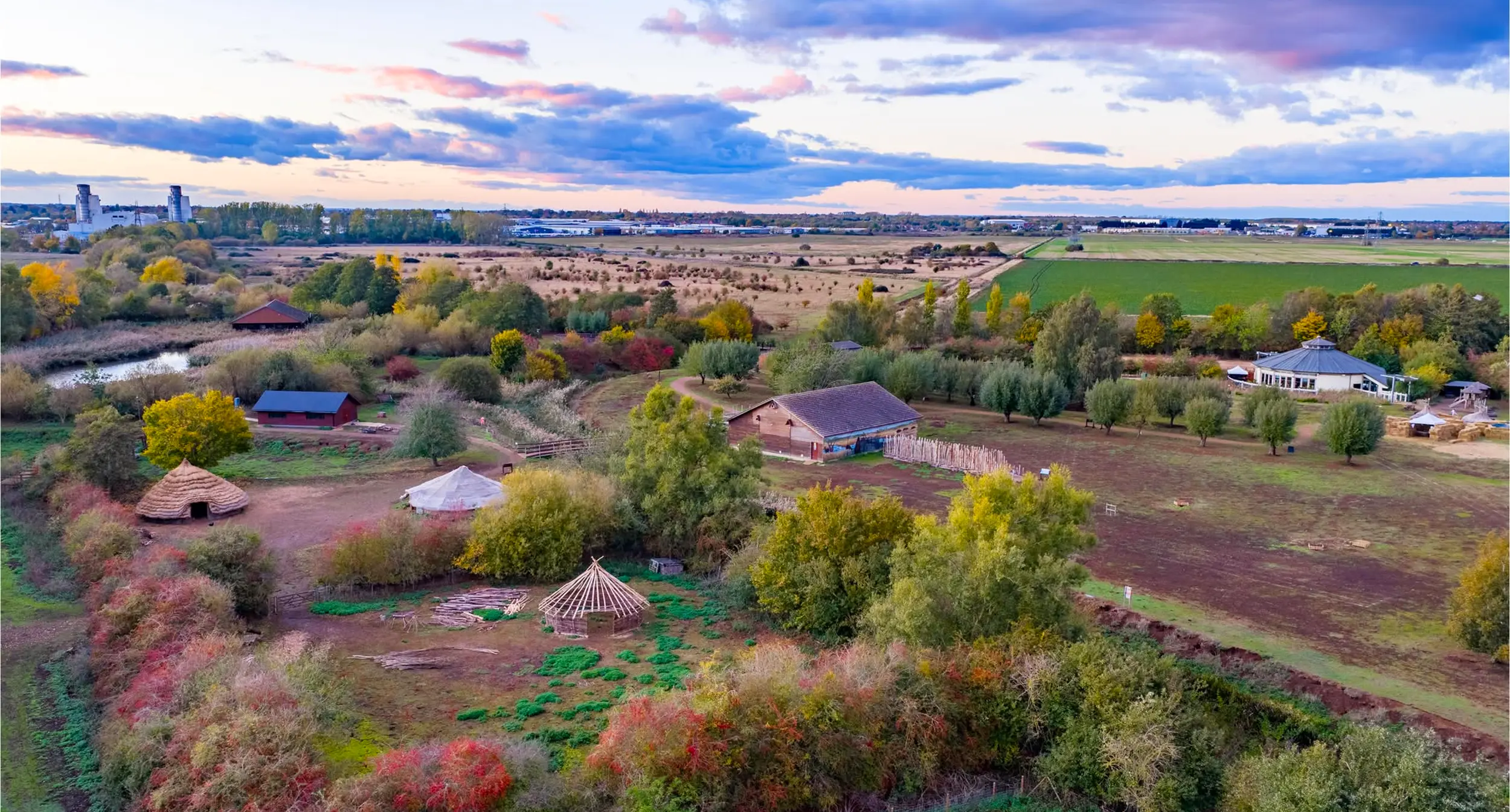
He places them in a real landscape: the deer enclosure at Peterborough and the wooded country extending north-west towards Stamford.
That specificity is one of the most compelling features of the account. The hunt is not said to be travelling through some imaginary wilderness. It occupies the economic and managed landscape surrounding the abbey.
Medieval Peterborough was not the dense city we know today. Beyond the monastery and settlement lay woods, open ground, pasture, hunting territory, roads and estates. At night, artificial light fell away very quickly.
The sound of real hunting horns could travel a considerable distance. Dogs, deer, horses and human voices could all become difficult to locate once they were somewhere beyond the edge of sight.
Yet the Chronicle does not describe a normal hunt mistakenly overheard once. It describes repeated sightings and sounds interpreted collectively as something monstrous.
into the woods towards Stamford.
Whatever lay behind the reports, the landscape is part of the story. This was a supernatural warning imagined moving through places Peterborough people actually knew.
Seven centuries later, Europe imagined the riders very differently.
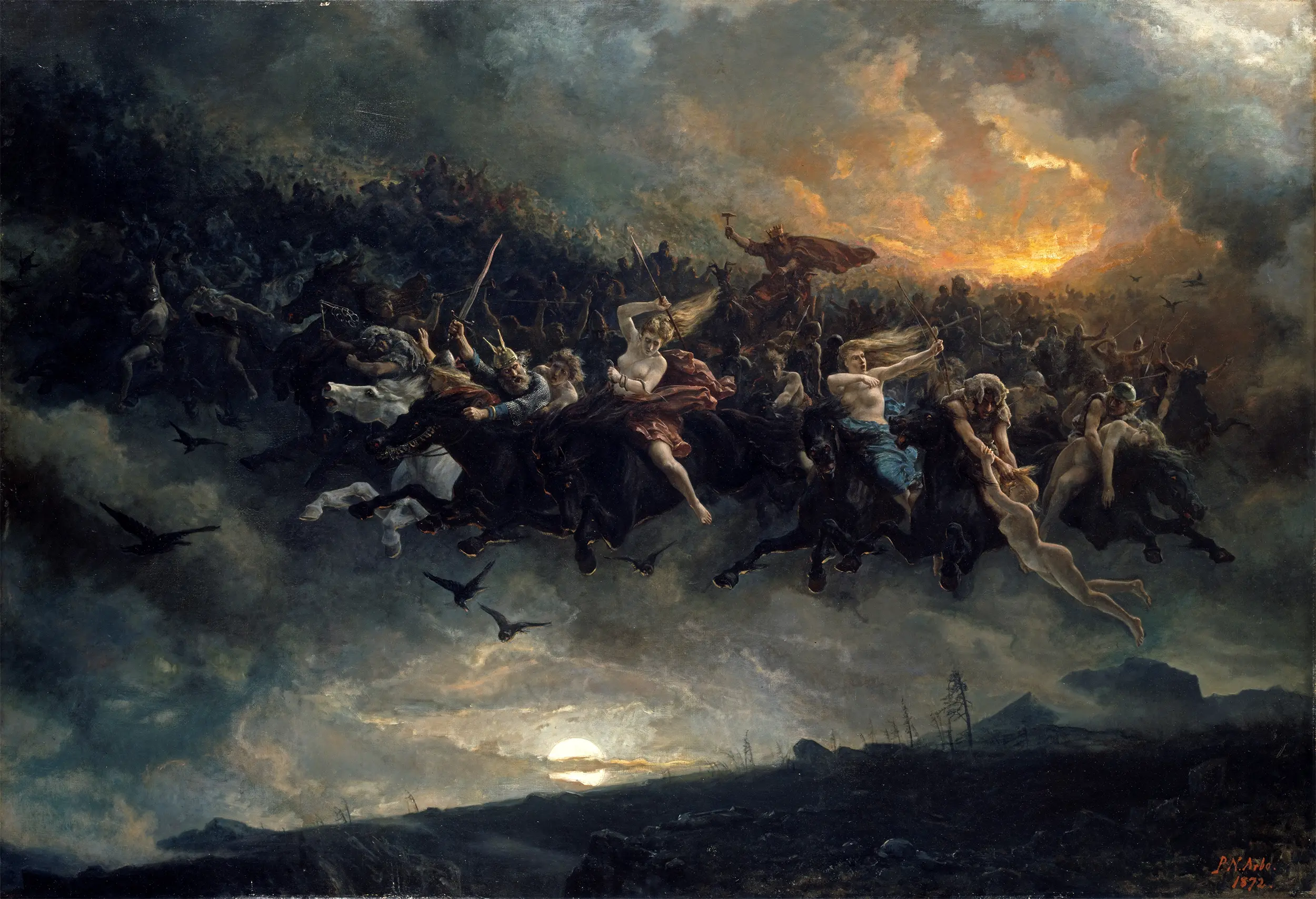
Peter Nicolai Arbo's spectacular 1872 painting Åsgårdsreien, usually known in English as The Wild Hunt of Odin, is one of the most famous visual interpretations of the wider Wild Hunt idea.
Arbo's riders tear across a dramatic night sky in a work shaped by Norwegian folklore, Norse mythology and the National Romantic imagination of the nineteenth century. The painting now belongs to the National Museum in Oslo.
It is a magnificent image for understanding what later generations came to mean by the Wild Hunt, but it should not be mistaken for a reconstruction of Peterborough in 1127.
Odin never appears in the Peterborough Chronicle.
Modern discussions of the Wild Hunt often begin with Odin or Woden leading supernatural riders across the sky. It is tempting to carry that imagery straight back into Peterborough. The medieval source does not allow us to do that.
Peterborough's chronicler gives the hunters no named leader. He does not identify them as Norse gods. He does not say they are the souls of the dead. He does not even use a medieval equivalent of the modern title “Wild Hunt”.
He describes hunters.
They are black, enormous and horrible. They have hounds. They ride black animals. They blow horns. They appear at night in the deer park and woods.
That is enough.
Later centuries gave them a mythology.
Historian Ronald Hutton has shown how the modern umbrella idea of the Wild Hunt was largely constructed by the German scholar Jacob Grimm in the nineteenth century from a range of medieval and later European traditions.
Peterborough's episode fits remarkably well beside those traditions, which is why scholars routinely discuss it as a Wild Hunt. But allowing the original account to remain strange on its own terms makes it more interesting, not less.
We have a remarkable record. We do not have a solution.
The most responsible answer is also the most interesting: something was being reported around Peterborough, but the surviving sources tell us far more about how it was interpreted than about what physically produced it.
Real nocturnal hunting is one possibility behind some of the sights or sounds. Hunting horns, dogs and mounted riders were not supernatural objects in medieval England.
Darkness could distort size, colour and distance. Repeated storytelling could then give later witnesses a framework through which ambiguous sights or noises were interpreted.
It is also possible that the Chronicle has shaped disparate rumours into a single coherent portent. Medieval chroniclers routinely understood unusual events as signs carrying moral or political meaning.
And, of course, the monks were not impartial observers of Henry's appointment. The supernatural hunt makes a devastating piece of commentary against an abbot they believed should never have been there.
There is no evidence that Odin literally rode through Peterborough, that the hunters were a surviving pagan cult, or that the Chronicle gives us a straightforward record of a modern paranormal event. Those are later interpretations placed over a much stranger medieval text.
The story survives because Peterborough was writing history.
The greatest treasure in this story may not be the spectral riders at all. It may be the manuscript that preserved them.
Peterborough Abbey maintained the longest surviving version of the Anglo-Saxon Chronicle, continuing it well beyond the Norman Conquest and into the middle of the twelfth century. Its later sections are also enormously important to historians of the English language because they show written English changing towards what we now call Middle English.
The 1127 hunt therefore sits at a remarkable crossroads. It is a piece of supernatural storytelling, a political attack on an unpopular abbot, a glimpse of the medieval landscape and a passage in one of the foundational documents of English history.
Peterborough did not merely inherit this story later. Peterborough wrote it down.
The words survived.
That is why the episode deserves more than the label of “ghost story”. It belongs to the history of the city, the Cathedral, medieval England, the English language and the development of European supernatural tradition.
Begin at Peterborough Cathedral, not in a mythical forest.
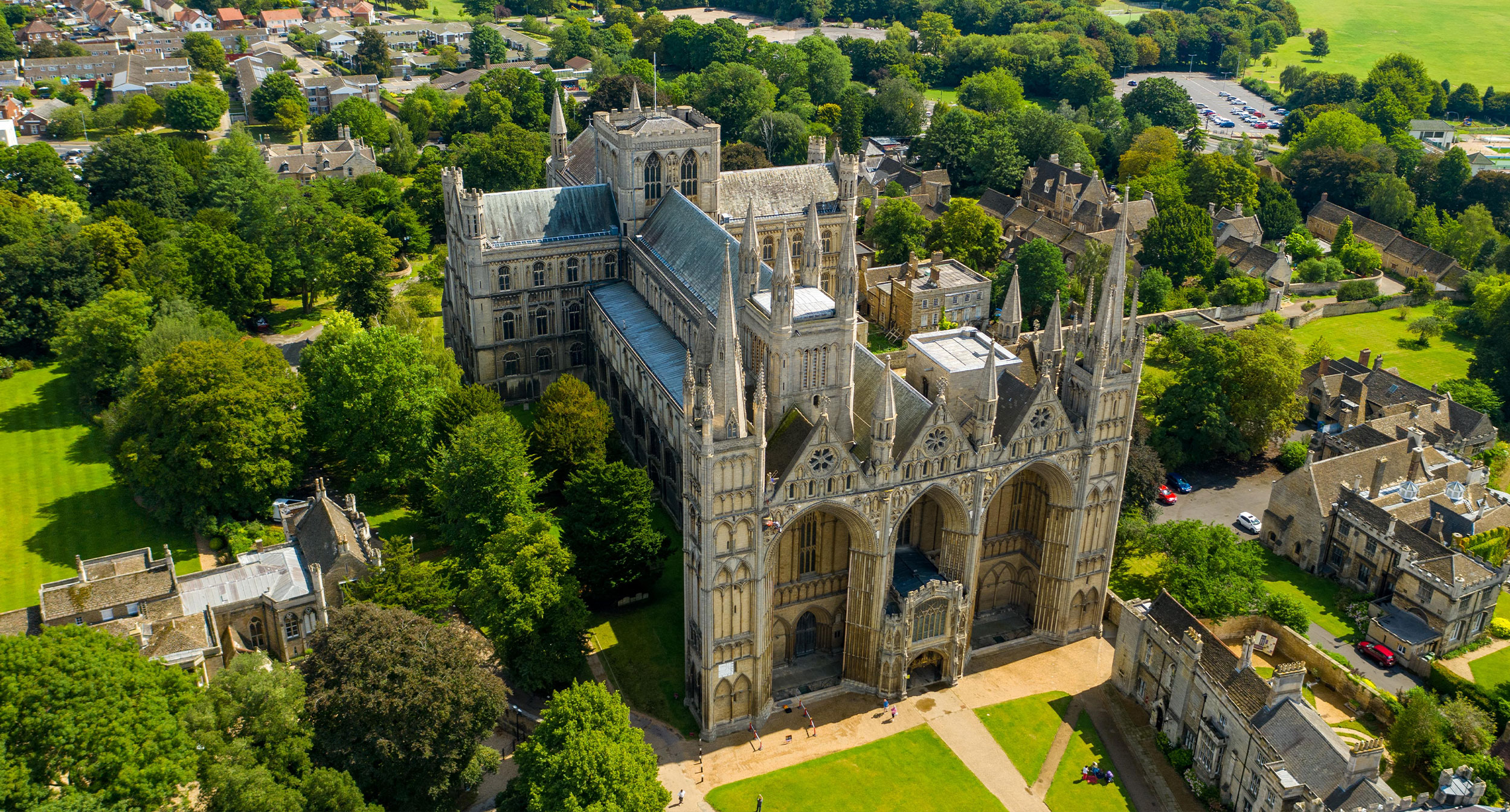
The medieval abbey that produced the Chronicle became Peterborough Cathedral. That makes the Cathedral precincts the best place to begin understanding the Wild Hunt of 1127.
Stand within the former monastic enclosure and remember that the monks who maintained the Chronicle described themselves hearing the horns from here.
The surrounding landscape has changed beyond recognition, and no reliable route of the spectral hunt can now be plotted. The account simply carries it through Peterborough's deer enclosure and the woodland stretching towards Stamford.
That uncertainty is worth preserving. This is a story rooted in a real landscape without pretending that every medieval wood, path or boundary can be recreated on a modern map.
Read the 1127 Chronicle entry before visiting the Cathedral precincts. Then look north and imagine the distance between the abbey and Stamford before roads, suburbs and electric lighting transformed the landscape. If exploring countryside, use public routes and do it safely. You do not need darkness to understand why the story worked.
Because the medieval writer understood exactly how to make us listen.
Strip away the nineteenth-century mythology and the Peterborough account becomes even more effective.
The chronicler gives us almost no explanation. There is no speech from the hunters. No named leader. No destination. Nobody tells us what they were hunting.
Instead we receive physical details: black bodies, wide eyes, horses, strange mounts and horns sounding through the night. Then geography. Then witnesses. Then repetition.
Finally comes the context that makes everything fall into place. The apparition begins when Henry arrives.
The story therefore works simultaneously as reported marvel and monastic judgement. Whether every detail came from actual experiences, rumour, literary shaping or some mixture of all three, the writer turned them into an unforgettable warning about bad authority.
Nearly nine centuries later, we are still hearing his horns.
The woods fill with hunters.
Peterborough writes it down.
The Wild Hunt belongs to a much bigger monastic story.
Continue into the Peterborough Chronicle, Hugh Candidus, the great abbey and the other extraordinary stories recorded around the Cathedral.
Hugh Candidus
Meet the Peterborough monk whose Latin history preserves another medieval account of the strange hunters seen and heard in 1127.
Meet Hugh Candidus → 02 · THE ABBEYPeterborough Cathedral History
Follow the site from Anglo-Saxon monastery through the Norman rebuilding and the medieval abbey that produced one of England's most important chronicles.
Explore the history → 03 · AN EARLIER ABBEY DISASTERCome, Devil, and Blow on the Fire
Only eleven years before the Wild Hunt, Peterborough's earlier church and much of the town had been devastated by the great fire of 1116.
Enter the story → 04 · NORMAN PETERBOROUGHHereward and the White Wolf
Return to the dangerous decades after the Norman Conquest, when Peterborough Abbey stood amid rebellion, raiding, political change and later legend.
Follow Hereward →More Peterborough Folklore
Medieval portents, strange animals and unsettling stories from Peterborough's monastic and rural landscape.
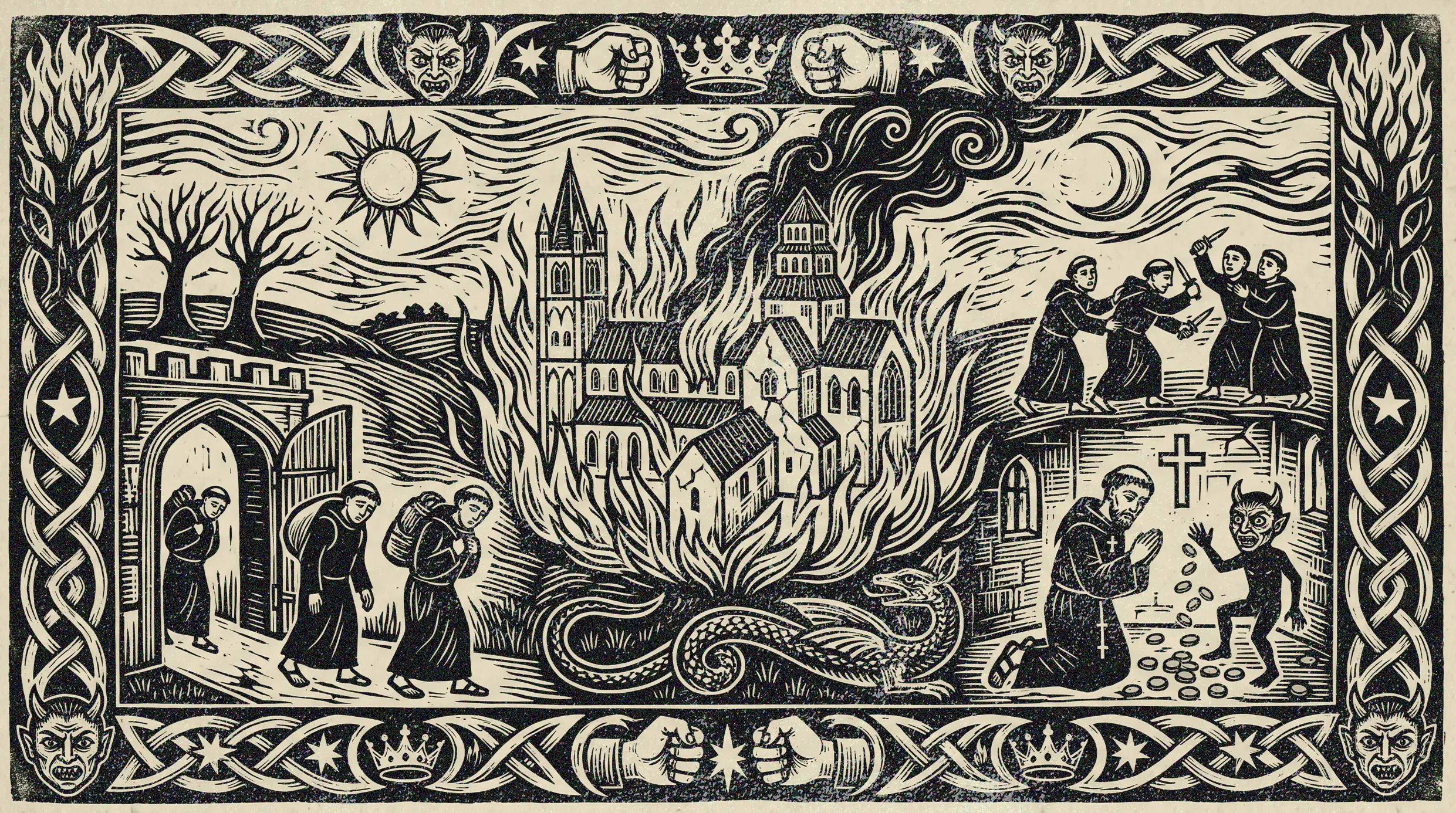
Come, Devil
A great medieval fire became inseparable from a rash invitation and one of Peterborough's most memorable stories about supernatural catastrophe.
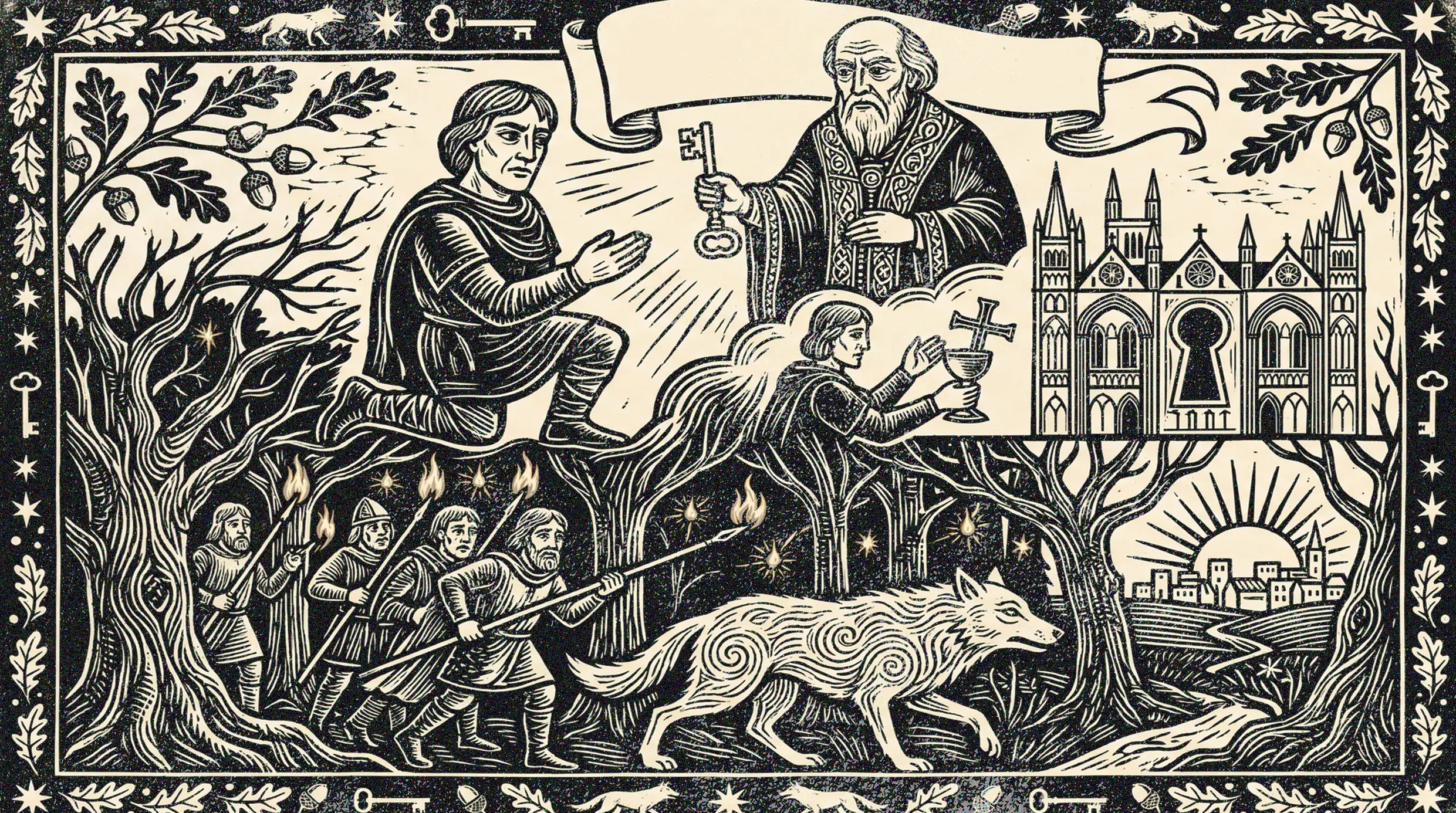
Hereward and the White Wolf
A documented raid on Peterborough later grew into a richer legend of warnings, dreams, treasure and a mysterious white wolf.
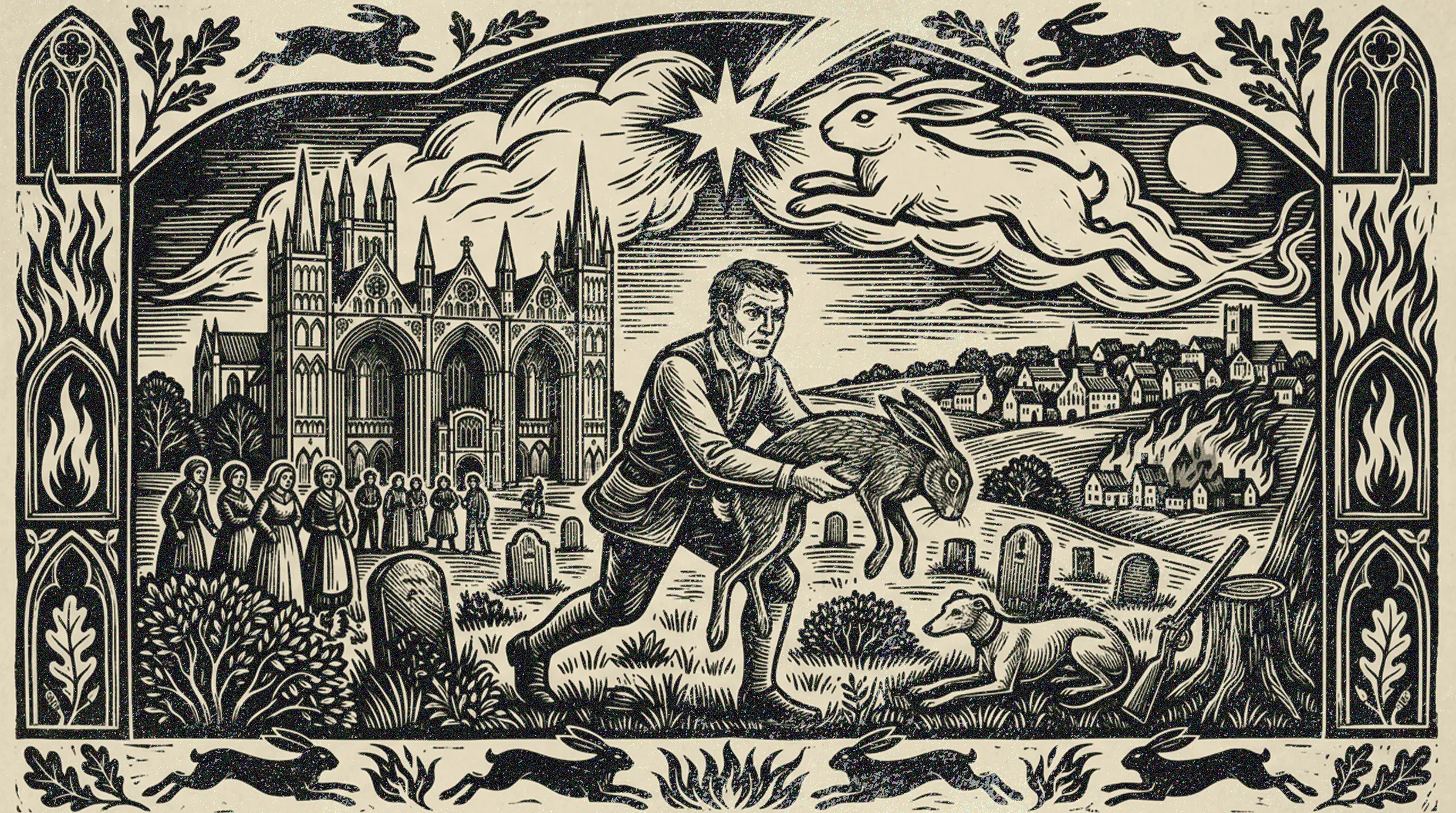
The Hare in the Close
A hare making its resting place beside the Minster was once said to warn that Peterborough would suffer a fire before the week was out.
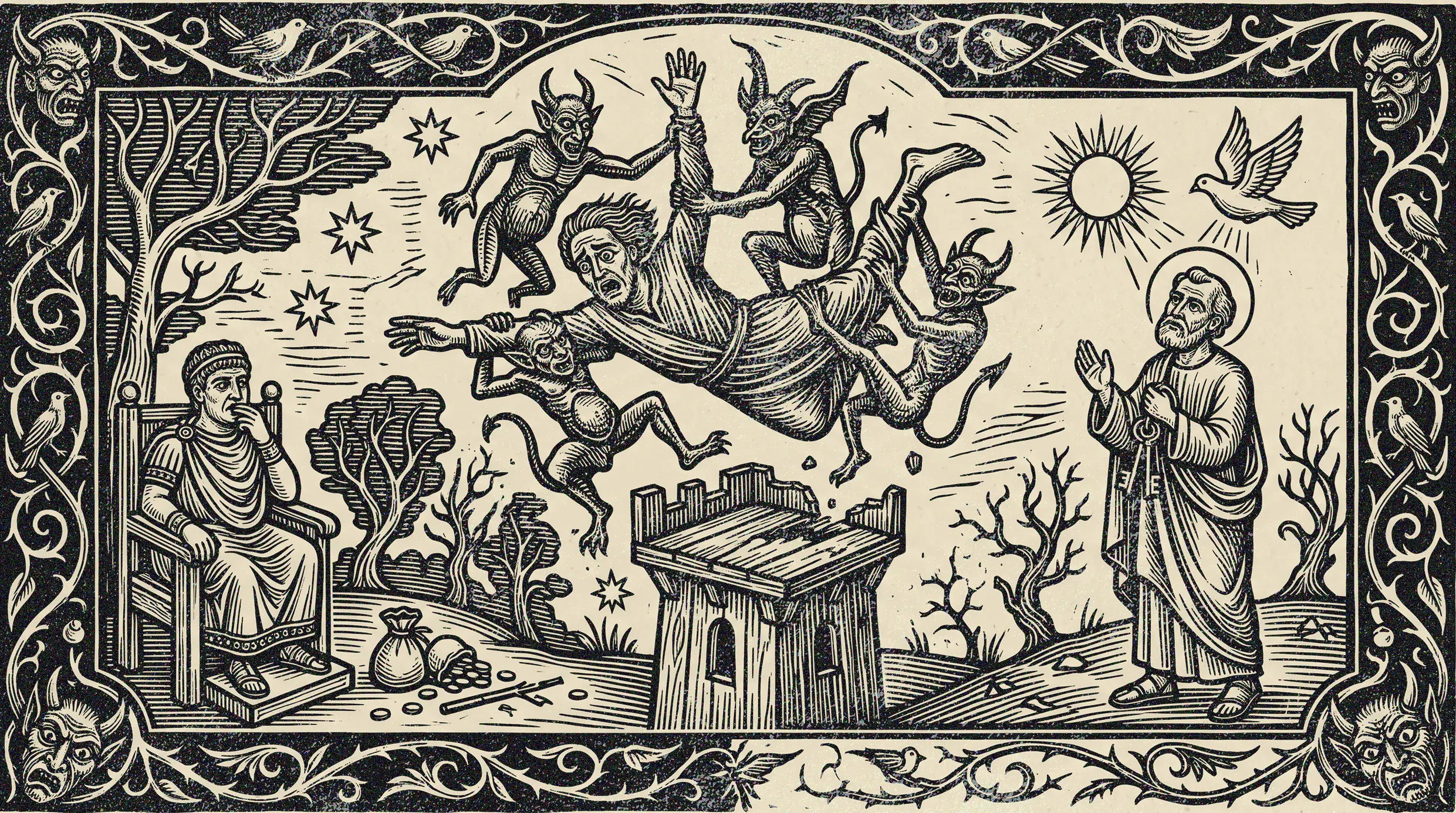
Simon Magus
Beneath the West Front, an upside-down man pulled by demons may preserve another medieval Peterborough warning.
The Toadmen
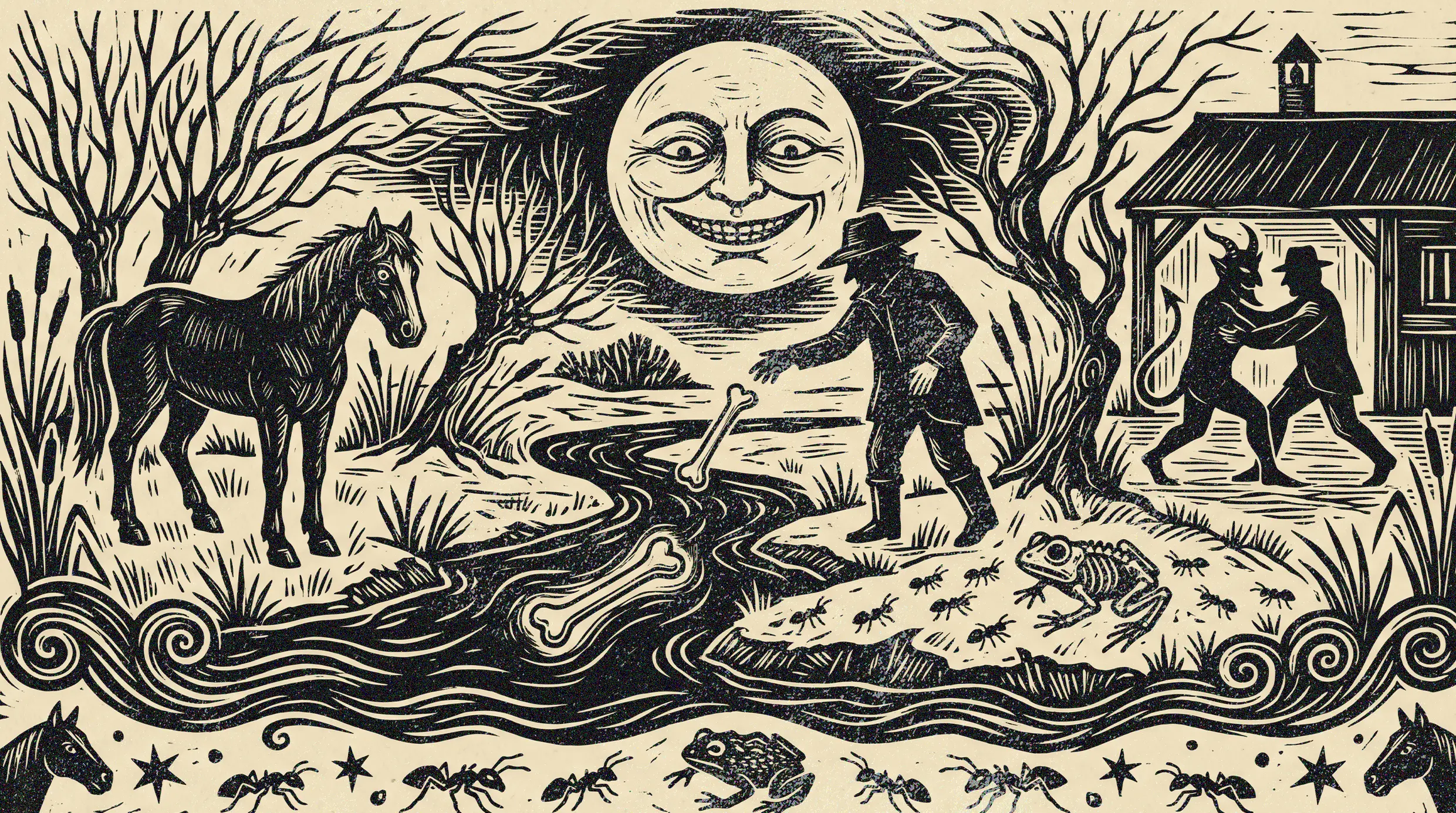
Centuries later, Peterborough's countryside still contained people said to possess secret power over working horses.
The Shag Foal
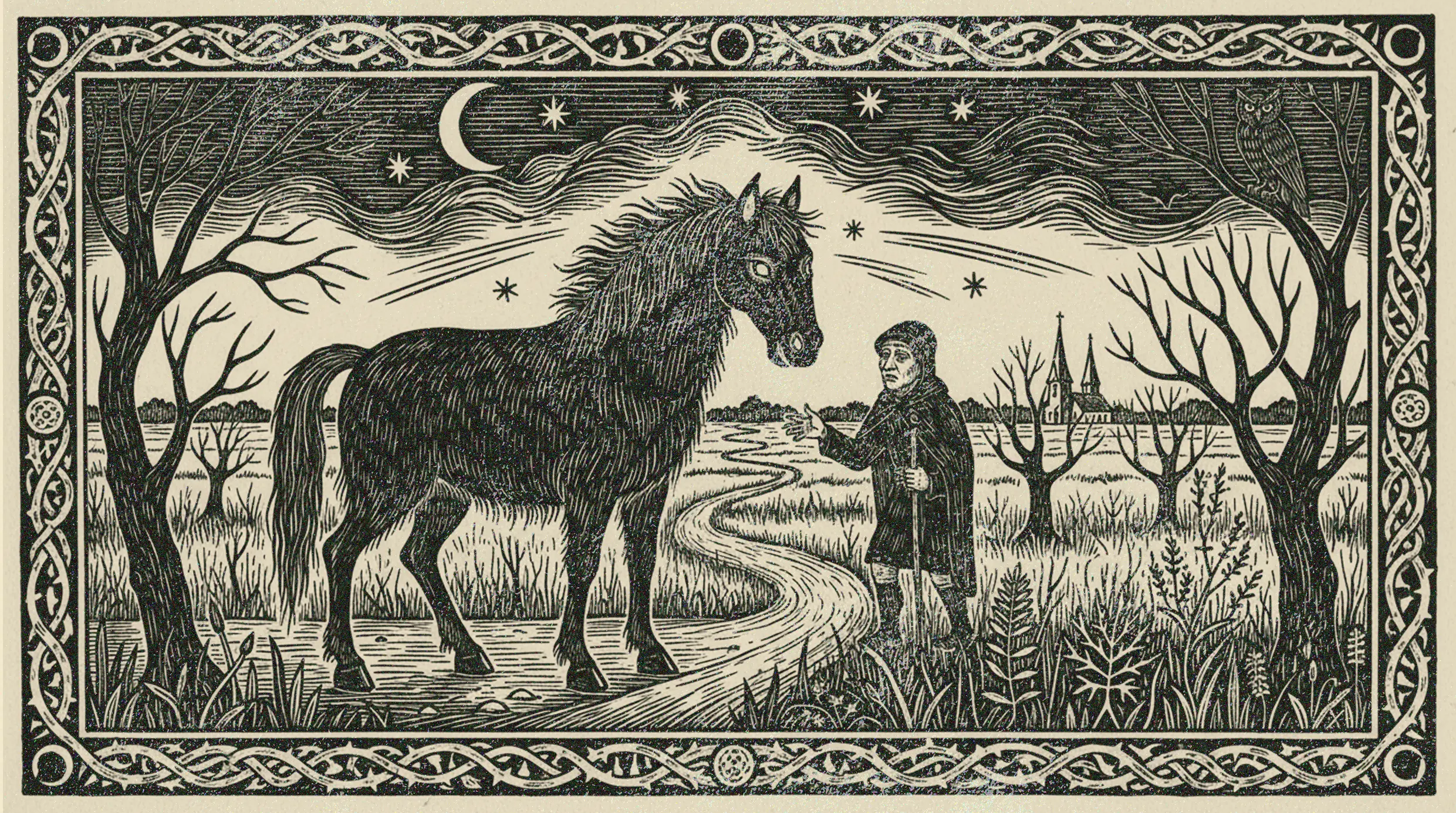
Barnack, Thorney and Ailsworth remembered a huge black creature whose appearance changed depending on where the story was told.
Behind the Wild Hunt
The 1127 event is one of the earliest English records routinely interpreted through the later concept of the Wild Hunt. This page keeps the contemporary Peterborough evidence separate from later European mythology and nineteenth-century interpretations.
-
Bodleian Libraries · MS Laud Misc. 636
The surviving Peterborough Chronicle manuscript, including the continuation written at Peterborough Abbey during the early twelfth century. -
The Anglo-Saxon Chronicle · English translation
Includes the entry describing Henry's arrival, the black hunters, hounds, horses and other mounts, the deer enclosure, the woods towards Stamford and the horns heard at night. -
Peterborough Museum · Chronicle Writers and a Wild Hunt
Local museum account drawing together the Peterborough Chronicle, Hugh Candidus and the medieval context of the 1127 portent. -
Ronald Hutton · The Wild Hunt in the Modern British Imagination
Peer-reviewed research explaining the modern development of “Wild Hunt” as an umbrella concept and treating the Peterborough episode cautiously within that later framework. -
National Museum, Oslo · Peter Nicolai Arbo,
The Wild Hunt of Odin
Museum record for Arbo's 1872 painting Åsgårdsreien, a Norwegian National Romantic interpretation of the later Wild Hunt tradition. -
Discover Peterborough · Hugh Candidus
Discover the Peterborough monk and historian who preserved another medieval account of the 1127 hunters. -
Discover Peterborough · Peterborough Cathedral History
Follow the monastery that produced the Chronicle through more than a millennium of Peterborough history. -
Discover Peterborough · Peterborough Folklore
Explore the city's wider collection of medieval portents, legends, ghosts, strange creatures and old beliefs. -
Discover Peterborough · Weird Weekends
Follow Peterborough's stranger stories back into the places and landscapes that produced them. -
Image credit
Åsgårdsreien, also known as The Wild Hunt of Odin, Peter Nicolai Arbo, 1872, National Museum, Oslo. Featured Wild Hunt artwork from the Discover Peterborough folklore collection.