

St Peter · Sorcery · Pride · The Fall
Simon Magus
at the West Door
Before you enter Peterborough Cathedral, look down. Beneath one of medieval England's great façades, a man falls head first among grotesque figures. His identity is not certain, but one powerful interpretation connects the carving directly with St Peter and a story that began in the Book of Acts.
To understand the carving, first remember whose church stands above it.
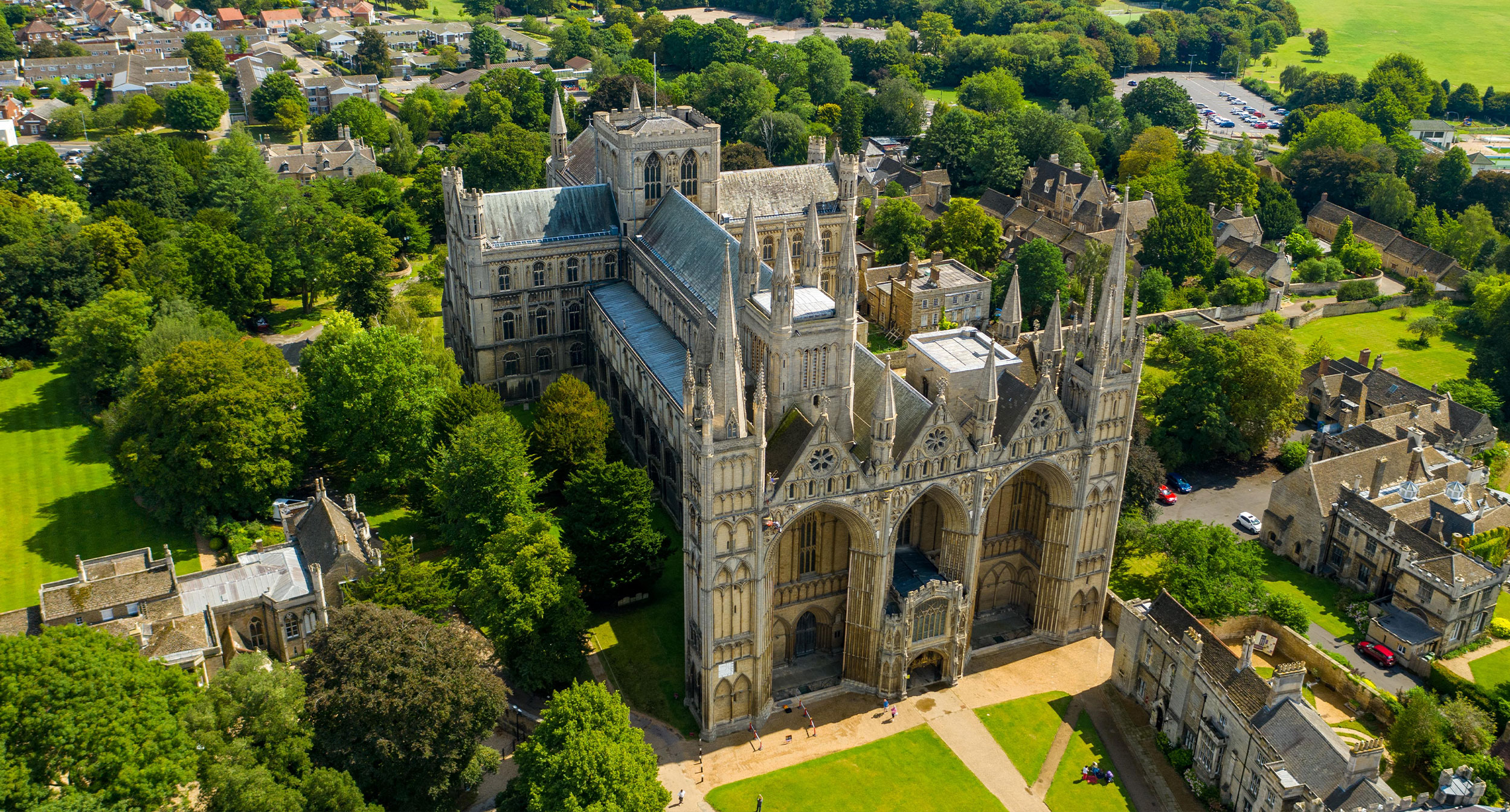
Peterborough Cathedral's West Front was designed to make people look upwards. Three immense Gothic arches rise above the square, drawing the eye towards saints, stonework and the enormous architectural screen beyond. Yet one of the façade's strangest images is almost at ground level.
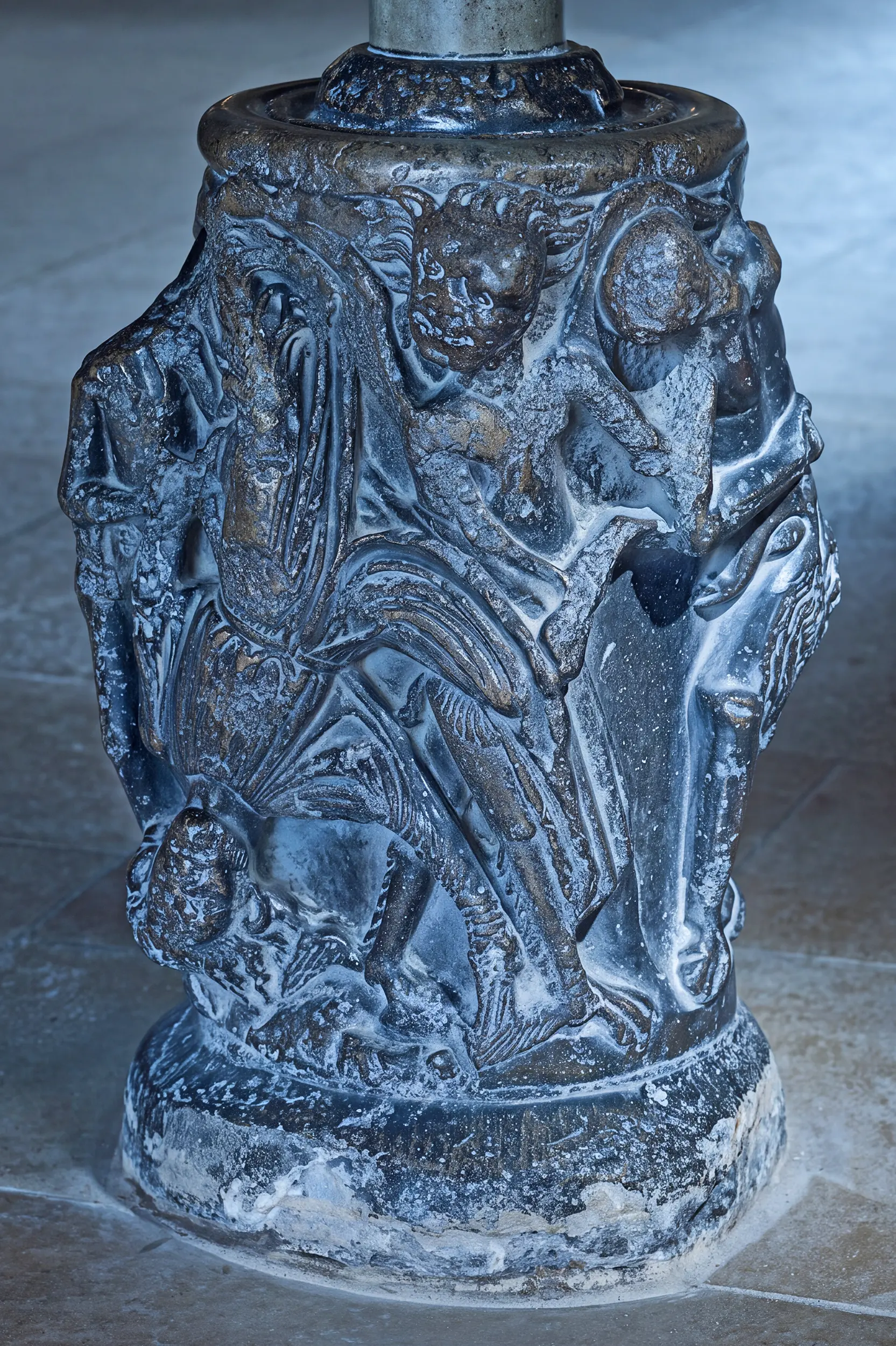
Approach the central west doorway and look at the carved stone base supporting the column between the doors. The sculpture is dark and heavily worn, but a human figure can still be made out amid twisting, grotesque forms. He is inverted, apparently falling head first.
Scholars have debated exactly what the scene represents. One of the most compelling interpretations identifies the fallen man as Simon Magus, the magician who appears briefly in the Acts of the Apostles and later became the legendary supernatural rival of St Peter.
That identification matters particularly at Peterborough. Simon is not simply carved on any medieval church. He lies at the bottom of a building whose identity has been bound to St Peter for more than a thousand years.
A sophisticated sculpture hidden almost at your feet.
The socle is only about 85 centimetres high, yet the carving is remarkably complex. Its low, shadowed position makes it easy to walk past without ever realising that a narrative scene is unfolding across the stone.
The central human figure is inverted. Around him are grotesque beings generally interpreted as demonic, together with twisting forms that have been read as serpents. The stone is badly worn, so individual details should be treated cautiously, but the overall impression of punishment, inversion and defeat remains powerful.
Its location is as important as its imagery. This is the base of the central doorway, the threshold between the secular world outside and the sacred interior beyond. Whatever medieval viewers understood the figure to be, he occupies the lowest part of that transition.
The figure falls.
To understand why Simon Magus became such a persuasive explanation, we need to begin with a much earlier encounter between a magician and an apostle.
Simon wanted to buy what Peter possessed.
The biblical Simon is not yet the airborne villain of later legend. Acts introduces him as a magician in Samaria whose performances had astonished local people and earned him a formidable reputation.
Christian missionaries arrived, Simon was baptised, and then the apostles Peter and John came to Samaria. Simon watched as the Holy Spirit was given through the laying on of their hands. What he saw impressed him so greatly that he offered the apostles money in exchange for the same ability.
Peter's response was severe. Spiritual authority was not a commodity and the gift of God could not be bought. Simon had mistaken something sacred for something transactional.
In the biblical account, the confrontation ends without a flight, demons or spectacular fall. Those elements entered the story later, as Christian writers expanded Simon's brief role into a much larger drama about false power and apostolic authority.
Simon Magus left the medieval Church a word it feared.
Simon's attempted purchase became so notorious that his name eventually entered the language of the Church.
The buying or selling of ecclesiastical office, spiritual privilege or sacred things became known as simony. In the medieval world, where great churches and monasteries possessed land, wealth, appointments and political influence, this was not an abstract theological issue. It touched the practical exercise of power.
Simon therefore became more than a biblical magician. He represented spiritual corruption, the attempt to turn divine authority into something that could be acquired through money or personal ambition.
For a major Benedictine monastery such as Peterborough, the symbolism would have been immediately relevant. Simon stood for corrupted authority. Peter was the apostle who rejected it.
Later tradition sent Simon into the sky.
Early Christian literature transformed the confrontation into something far more theatrical. In the apocryphal Acts of Peter, Simon becomes a supernatural rival to the apostle and their conflict moves to Rome.
Simon performs wonders and builds a following. Peter confronts him, and eventually the magician promises a demonstration that will prove his power beyond doubt: he will fly.
Simon rises into the air before a crowd. Peter responds not with magic of his own, but with prayer. The supernatural support beneath Simon fails and he crashes back to earth.
That later episode supplied medieval artists with an image far more dramatic than the exchange of money in Acts. Simon's spiritual failure could now be shown physically.
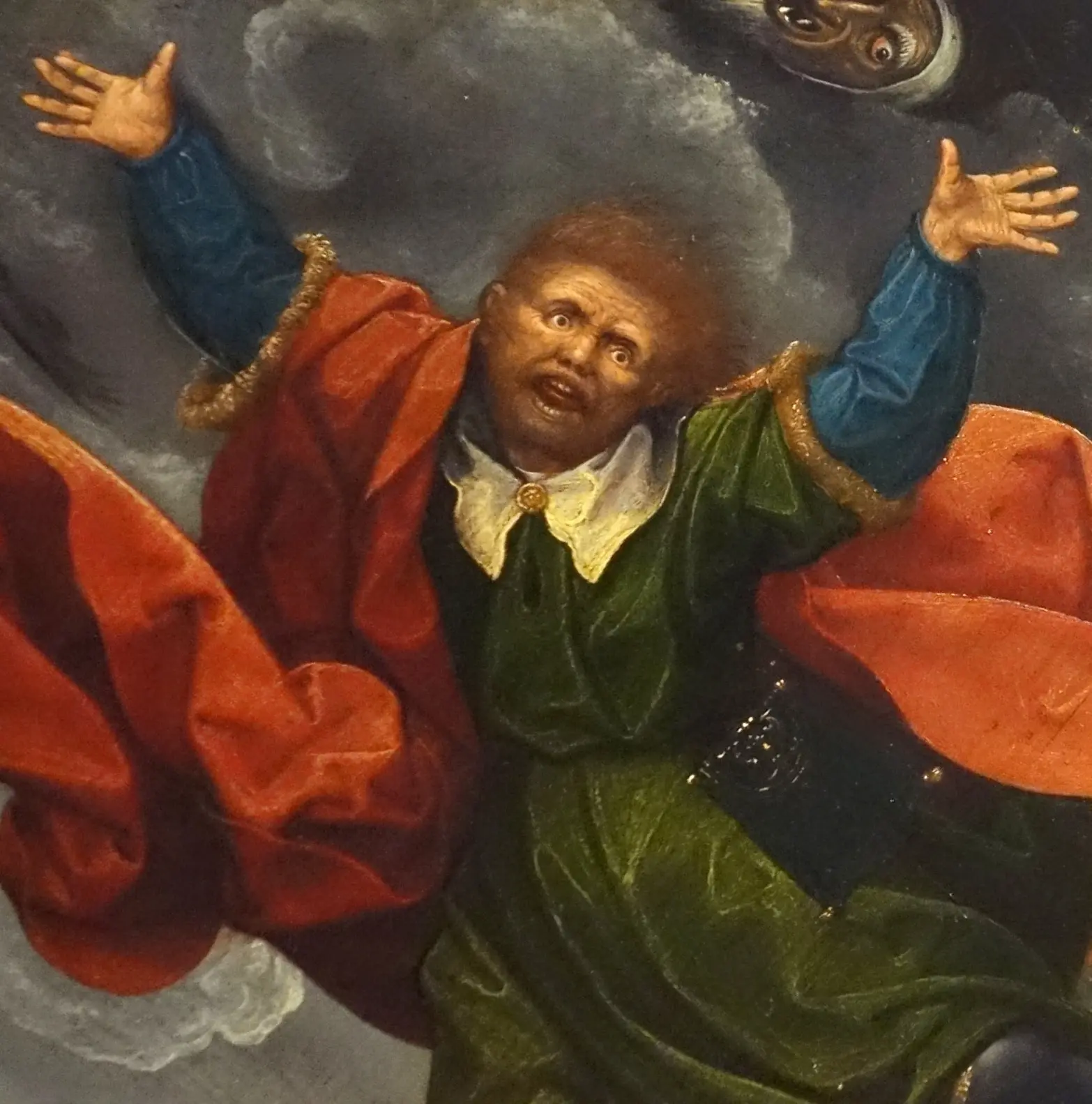
The man who tried to rise above Peter came down head first.
The later legend turned a theological argument into a visual reversal. Simon tries to demonstrate that his supernatural power can lift him above ordinary humanity. Instead, the authority he challenges remains standing while he falls.
Different versions of the story describe the aftermath in different ways, but the important visual moment is remarkably consistent: Simon is airborne, Peter intervenes through faith, and the magician is brought violently back down.
Simon is inverted.
It is difficult to imagine a more useful image for a medieval sculptor. Pride becomes falling. False power becomes physical collapse. The defeated rival of Peter can be shown beneath the feet of people entering Peter's church.
Now the strange stone at Peterborough begins to make sense.
This was, above all, St Peter's church.
The Simon Magus interpretation becomes particularly powerful because St Peter is woven into the identity of Peterborough itself.
The great monastery at the centre of the settlement was dedicated principally to St Peter. Medieval Peterborough was known as Burgh St Peter, and over time that name became Peterborough. The modern Cathedral is formally the Cathedral Church of St Peter, St Paul and St Andrew, but its defining Petrine inheritance reaches back through the abbey.
St Peter also occupied an important place within the imagery of the West Front. High above the doorway, the architecture and sculptural programme belonged to the apostle whose authority Simon had challenged.
Simon below.
St Peter's church rising over his defeated rival.
Catherine Oakes has argued that the setting may be as important as the individual figures carved on the socle. The dark sculpture at the bottom of the façade acts as a counterpoint to the sacred building above it.
In that reading, the entire church participates in the image. Simon does not merely decorate Peterborough Cathedral. His position helps express what the building claims to represent.
The carving may even be older than the doorway around it.
The socle does not fit its architectural setting as neatly as we might expect. The thirteenth-century doors appear to have been cut around it, raising the possibility that the sculpture was already present, or had been made elsewhere, before the present entrance was completed.
Oakes notes that the carving has no close surviving parallel elsewhere at Peterborough and that stylistic comparison does not provide a secure date. It may belong to the early stages of the West Front or conceivably predate it.
That uncertainty makes the image more interesting rather than less. Whether the socle was made specifically for the doorway or selected for the position later, somebody considered its subject appropriate for the threshold.
The position is not.
Medieval architecture often accumulated over generations. Sculptures could be reused, adapted and reinterpreted, while new structures changed the way older imagery was seen. What matters here is that the disturbing scene remained at the entrance to St Peter's church.
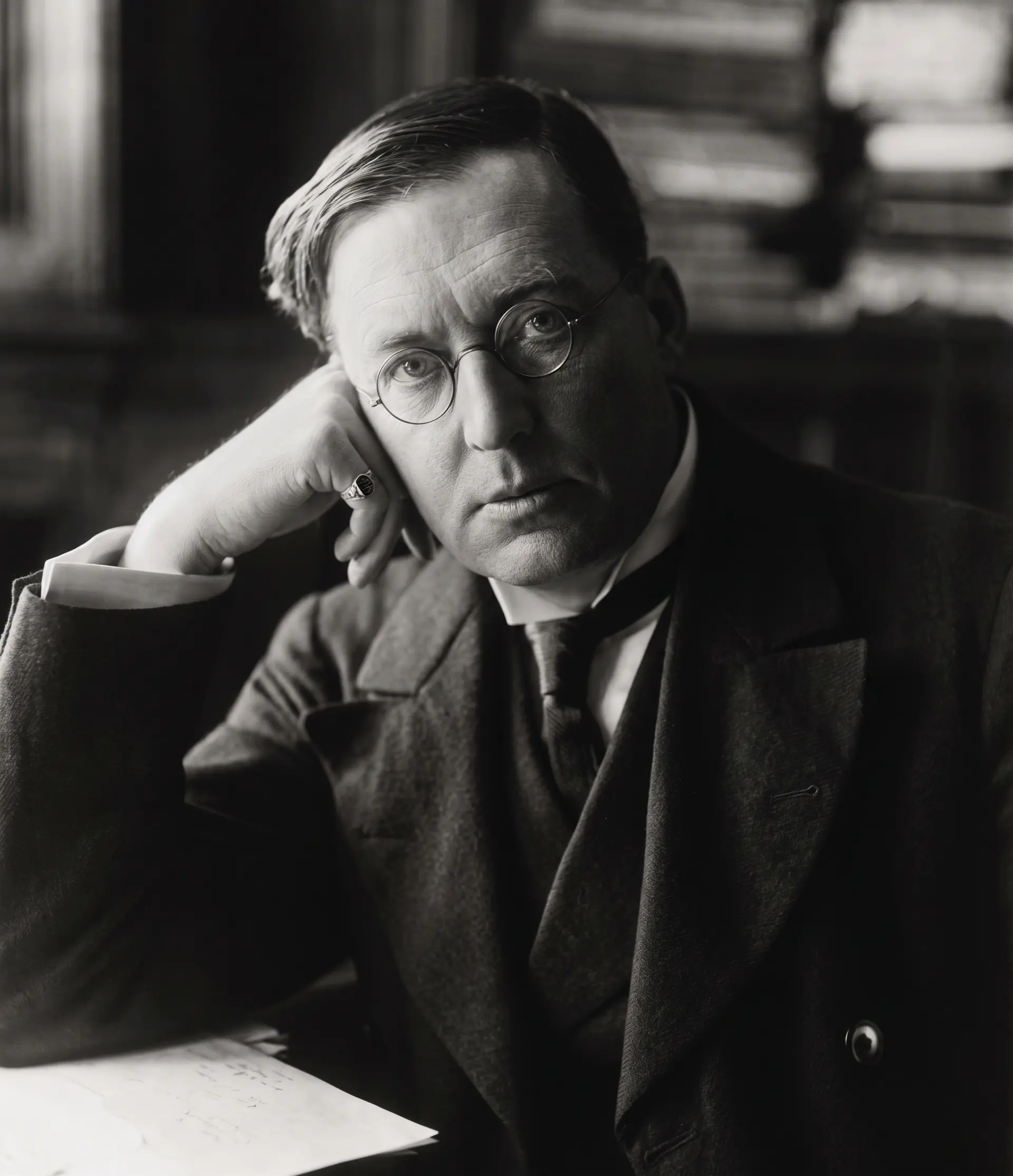
M. R. James was one of the scholars who saw Simon Magus in the stone.
The connection is almost too appropriate. One of the people who helped establish the Simon Magus interpretation was Montague Rhodes James, better known to generations of readers simply as M. R. James.
James is now famous as the master of the English antiquarian ghost story, but supernatural fiction was only one side of his life. He was an exceptional medieval scholar, manuscript specialist, archaeologist and antiquary, as well as Director of the Fitzwilliam Museum and later Provost of King's College, Cambridge.
Old churches, obscure manuscripts, apocryphal texts and half-understood medieval imagery were precisely his territory. When James considered the inverted figure at Peterborough, he was approaching it not primarily as a writer of ghost stories but as a scholar steeped in the visual and literary world that produced it.
Modern scholarship does not treat James's identification as the final word, but Catherine Oakes specifically places him alongside George Henderson and Alberto Ferreiro among the scholars who proposed the fall of Simon Magus as the subject of the socle.
At King's College, James was a friend and colleague of E. G. Swain, who later became vicar of Stanground. Swain's 1912 Stoneground Ghost Tales was dedicated to James and recalled their “twenty pleasant years” of friendship. Swain later served at Peterborough Cathedral as Honorary Canon, Librarian and Precentor, and wrote The Story of Peterborough Cathedral.
Simon Magus is persuasive, but the stone keeps some of its mystery.
Medieval sculpture rarely comes with the kind of evidence that allows a modern viewer to identify every figure beyond doubt. Peterborough's socle is especially difficult because centuries of weathering have erased details that might once have made the scene more explicit.
The Simon Magus interpretation has considerable strengths. The inversion fits the famous later story of Simon's fall. The demonic imagery suits the way medieval Christianity represented the magician, and his position beneath a church so strongly identified with St Peter gives the narrative an unusually powerful context.
Yet Oakes also suggests a broader reading. The figure may operate not only as Simon himself but as an image of vice, pride, greed, corruption or spiritual exclusion. Medieval art was capable of carrying several meanings at once.
Those possibilities do not necessarily compete. Simon Magus had already become a personification of precisely those failures. A medieval viewer could recognise a particular story and a universal warning at the same time.
Thousands of people walk past him without noticing.
That is part of what makes the Simon Magus carving such a satisfying Peterborough curiosity. The West Front encourages you to admire its scale, but the detail that changes the story is at ground level.
Walk towards the central western entrance and find the column dividing the doors. Instead of immediately looking up at the giant arches, examine the stone at the base.
Once you know there is an inverted human figure among the worn forms, the carving becomes much easier to read. Then look upwards again and remember the identity of the church towering over it.
That movement from ground to façade is perhaps the best way to experience the sculpture. The architecture supplies the final part of the story.
It turns the Cathedral doorway into part of the argument.
If the figure is Simon Magus, the genius of the sculpture is not simply that it illustrates an old Christian story. Its physical position allows the building to complete that story.
Simon tried to acquire sacred power and later tradition imagined him trying to rise above Peter. At Peterborough he occupies the lowest, darkest part of Peter's great church, inverted and defeated as visitors cross the threshold.
Even if the carving carried a broader medieval message about pride or corruption, that relationship still works. The figure below represents disorder, false authority and spiritual failure. The church above represents the order into which the visitor is about to enter.
That is why this small sculpture deserves more attention than it usually receives. Once noticed, it changes the way the entire West Front can be read.
Later legend made him rise above Peter.
At Peterborough, he remains beneath him.
Simon Magus connects architecture, folklore and ghost-story history.
Continue through the Cathedral itself, discover the Peterborough writer linked directly with M. R. James, and explore the wider medieval stories surrounding the building.
Peterborough Cathedral
Follow the sacred site from Anglo-Saxon Medeshamstede and Burgh St Peter through Norman rebuilding, the Gothic West Front, Reformation, Civil War and the Cathedral today.
Explore 1,350 years → 02 · SEE THE CARVINGVisit Peterborough Cathedral
Plan a visit to the Cathedral and find the socle at the central western entrance before exploring the Norman nave, painted ceiling and royal burials.
Plan your visit → 03 · M. R. JAMES'S FRIENDE. G. Swain
James's friend and King's College colleague became vicar of Stanground, transformed it into the haunted “Stoneground”, and later served at Peterborough Cathedral.
Meet E. G. Swain → 04 · MEDIEVAL PETERBOROUGHThe Princes, the Hart & the Well
Follow another story Peterborough Abbey told about itself, linking royal brothers, St Chad, a hunted hart and the foundation of the monastery.
Enter the founding legend →More Peterborough Folklore
Strange carvings, lost images, supernatural warnings and stories that accumulated around Peterborough's ancient sacred centre.
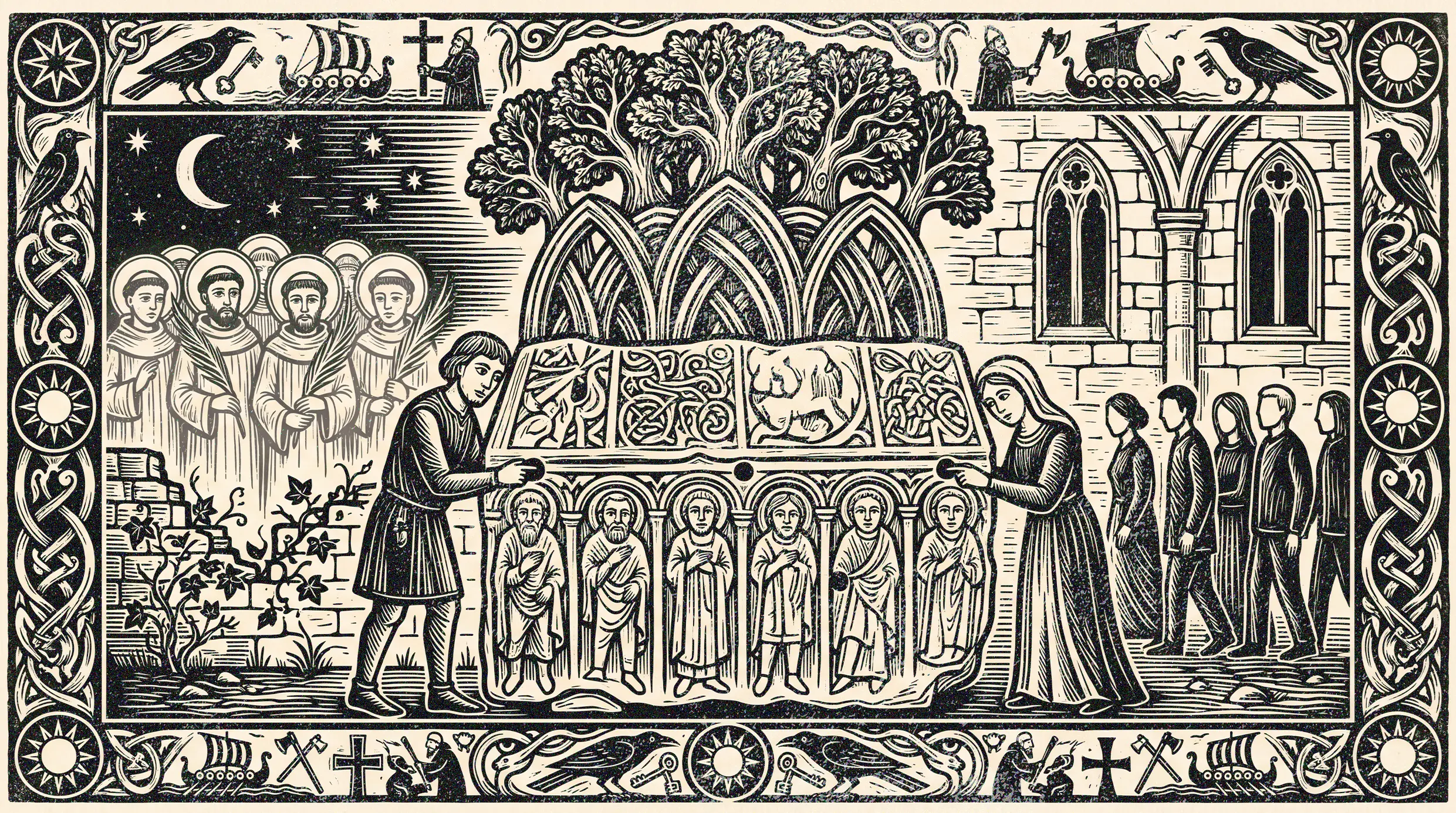
The Hedda Stone
Six mysterious holes in one of Peterborough's oldest sculptures became the focus of centuries of explanation and folklore.
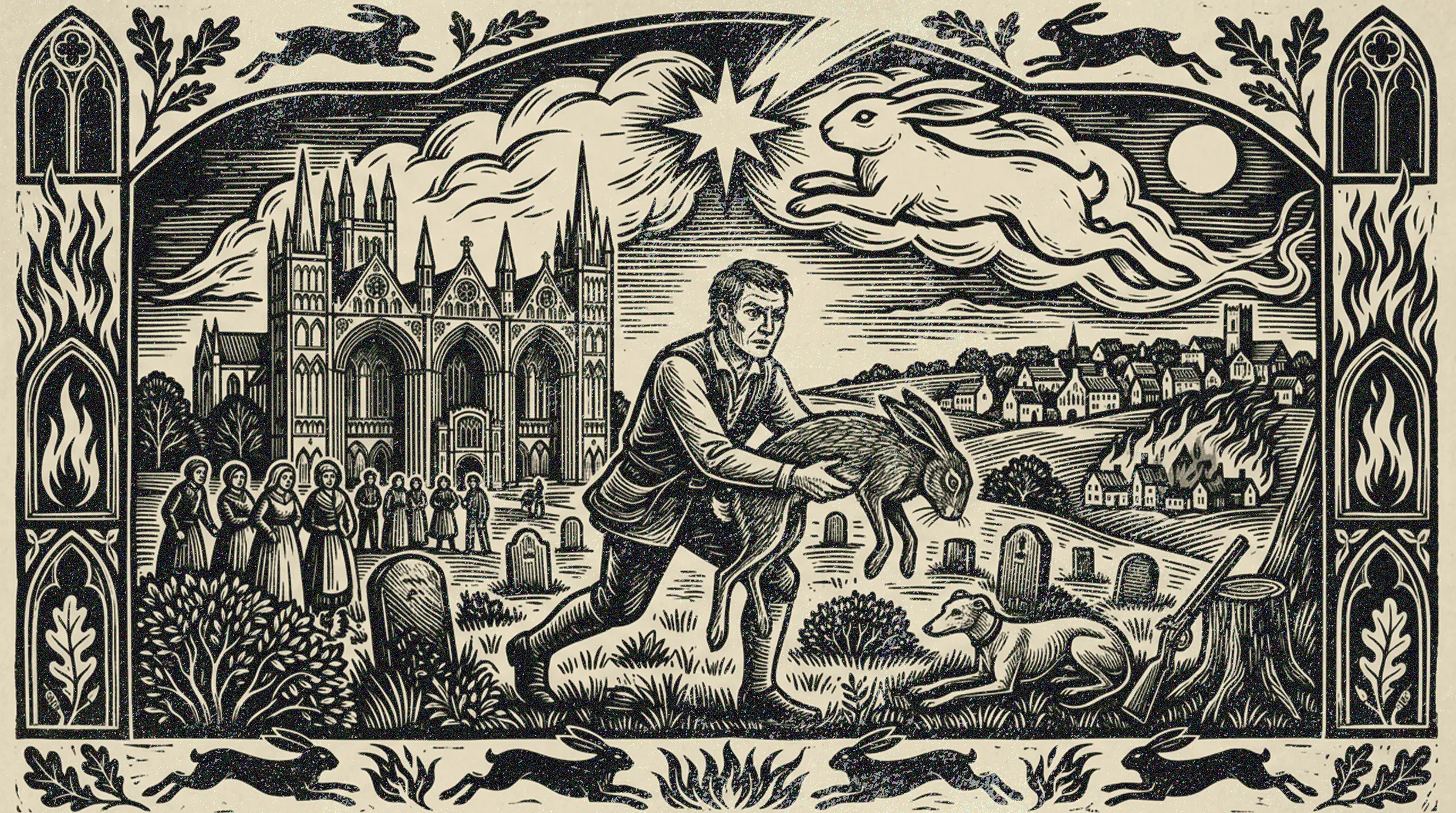
The Hare in the Close
If a hare settled in the Cathedral Close, old Peterborough expected a fire somewhere in the town before the week was over.
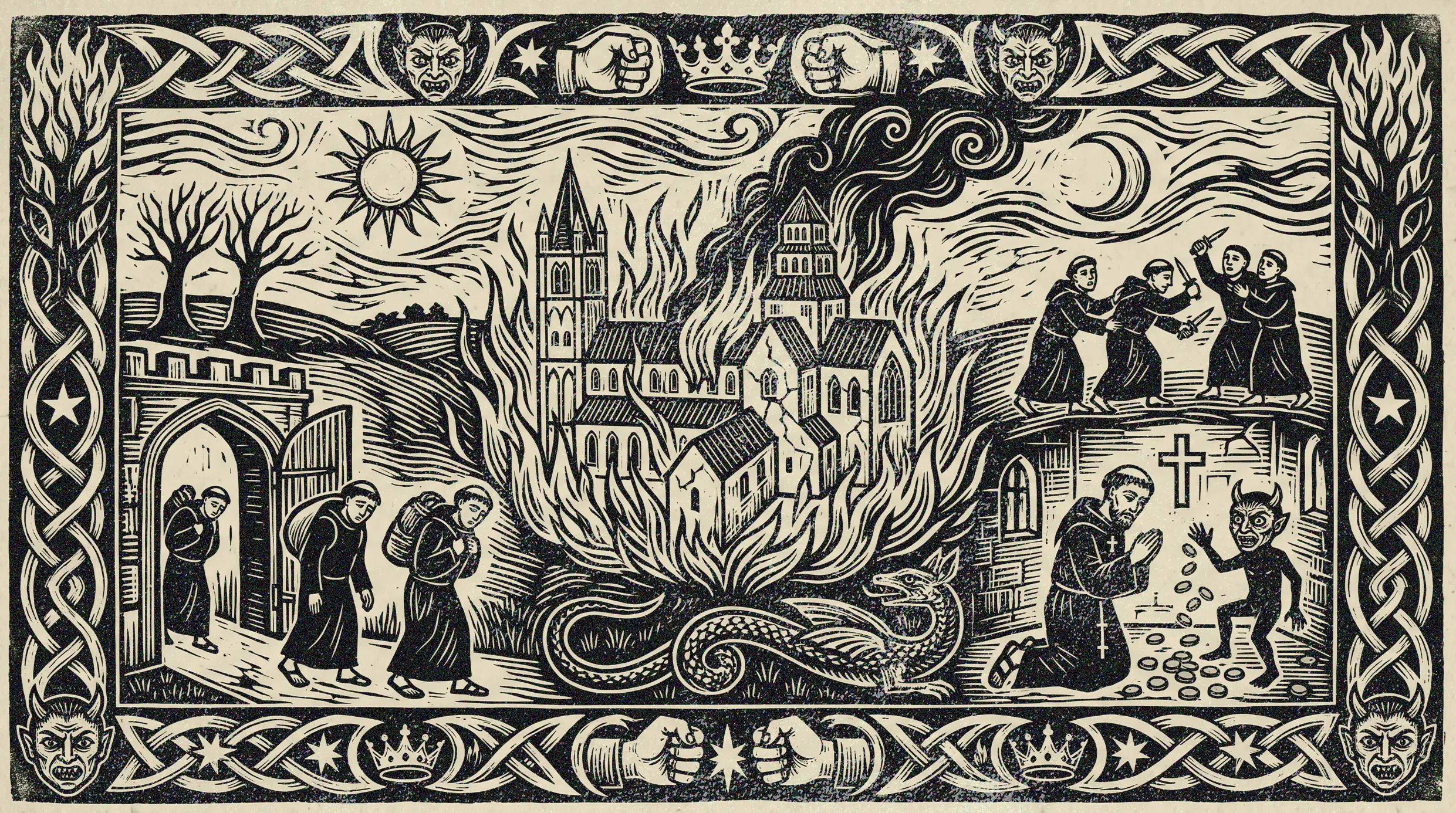
Come, Devil
A catastrophic medieval fire became inseparable from a prophecy, an angry servant and one disastrous invitation.
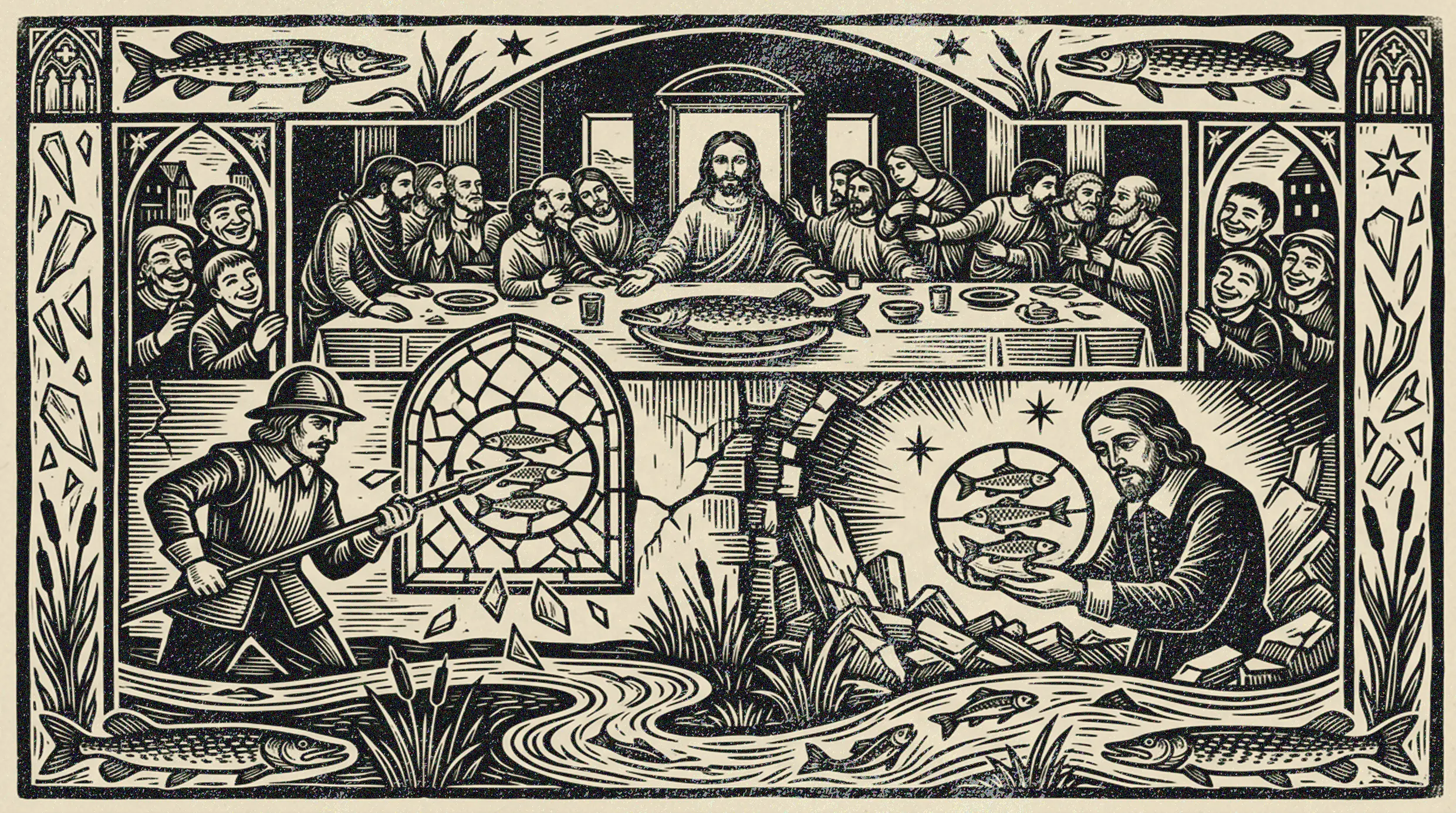
The Paschal Pickerel
Peterborough's vanished medieval imagery remembered a distinctly watery guest at the Last Supper.
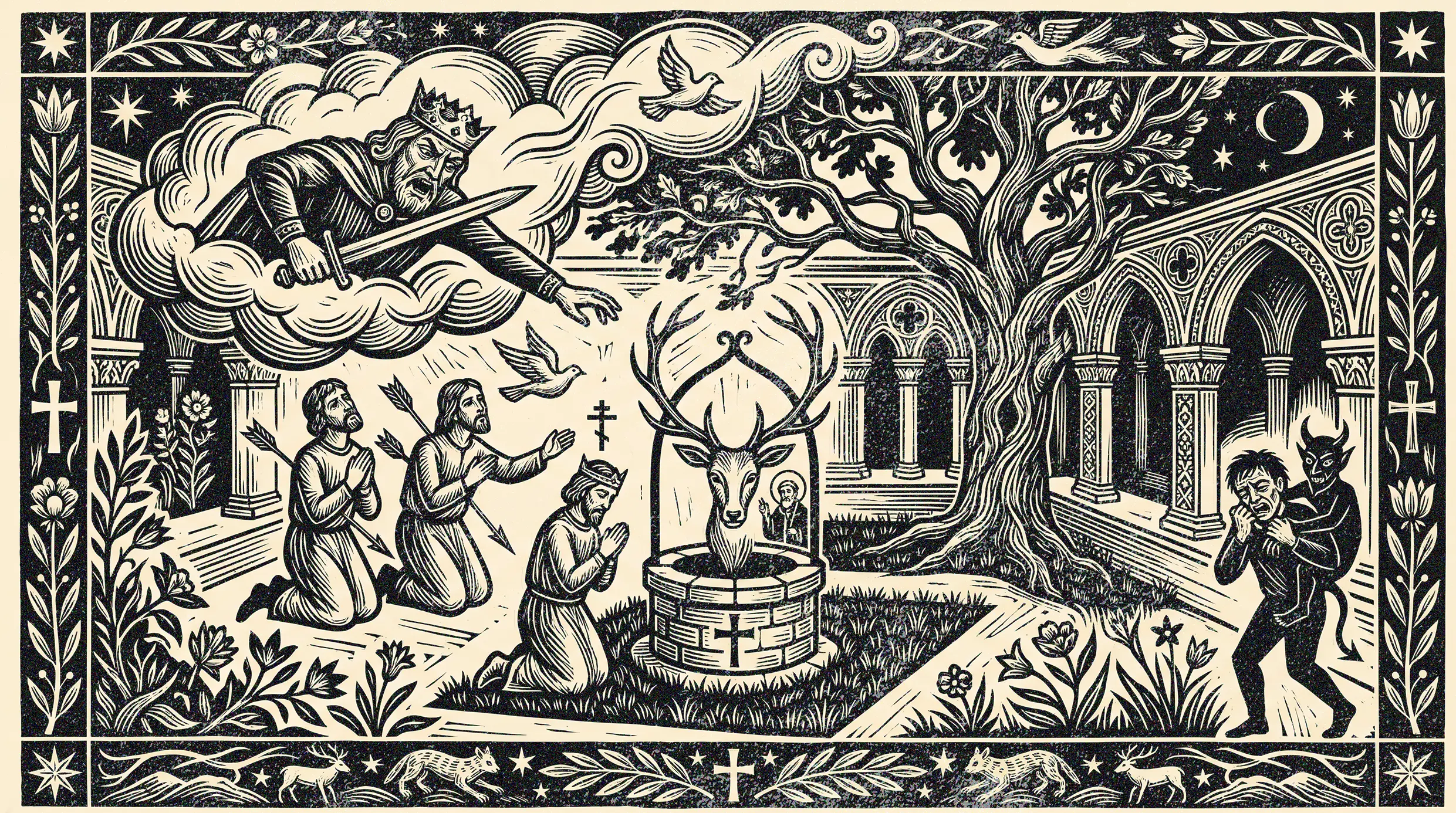
The Princes & the Hart
A royal hunt, a hidden hart and St Chad became part of the story Peterborough Abbey told about its own beginnings.
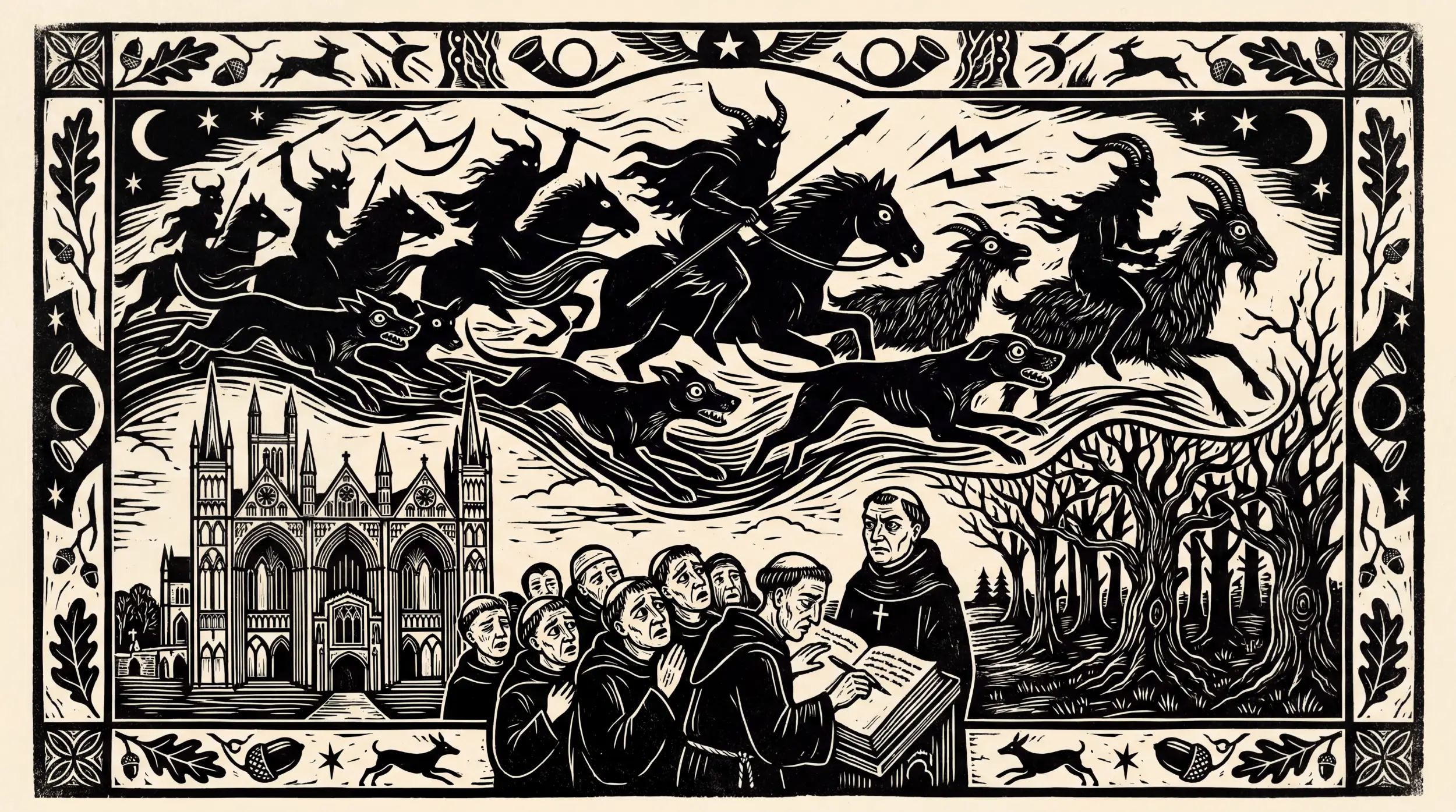
The Wild Hunt
Black riders, unnatural hounds and hunting horns entered Peterborough's written record during the rule of an unpopular abbot.
Behind the carving
The identification of the Peterborough socle with Simon Magus is a scholarly interpretation rather than a documented medieval label. The distinction between the biblical Simon, later apocryphal legend and modern interpretation is preserved throughout this page.
-
Acts of the Apostles · 8:9-24
The biblical source for Simon's encounter with Peter and John, including his offer of money in exchange for apostolic power. The biblical account does not include Simon flying or falling. -
Acts of Peter
The later apocryphal tradition that develops Simon into a supernatural rival of Peter at Rome and includes the famous episode of his flight and fall. -
Catherine Oakes · What is the subject carved on the socle
in the West doorway of Peterborough Cathedral?
Detailed modern study of the carving, its architecture, possible dating, previous Simon Magus identifications by M. R. James and other scholars, and the significance of its position beneath the church of St Peter. -
Fitzwilliam Museum · Montague Rhodes James
Biography of M. R. James as medieval scholar, museum director, Provost of King's College and influential writer of supernatural fiction. -
E. G. Swain · The Stoneground Ghost Tales, 1912
Swain's collection is dedicated to his friend M. R. James and explicitly recalls their twenty years of friendship. The stories fictionalise Stanground as “Stoneground”. -
Discover Peterborough · Edmund Gill Swain
Swain's Peterborough story, including Stanground, The Stoneground Ghost Tales and his later work at Peterborough Cathedral. -
Discover Peterborough · Peterborough Cathedral History
The wider history of the sacred site, from Medeshamstede and Burgh St Peter through the Norman church, Gothic West Front and modern Cathedral. -
Image credit
The historical artwork shown above is a detail from The Fall of Simon Magus by Jan Rombouts the Elder , 16th century. -
Discover Peterborough · Peterborough Folklore
Explore Peterborough's wider collection of strange carvings, legends, customs, hauntings and historical folklore. -
Discover Peterborough · Weird Weekends
Find Simon Magus and other unusual Peterborough stories in the real places where they belong.