
The Saint, the Field & the Forgotten Road
Lady Conyburrow's
Way
A woman runs across a field. The earth remembers every step. Centuries later the path is still visible, and on autumn nights the saint returns in a coach and six.
The ground itself was said to remember her.
For generations, people in Castor pointed towards a strange narrow line running through the fields south of the village.
It did not look quite like the land around it.
The strip was only a few feet wide, but the earth was said to be poorer and barer there. Crops behaved differently. Ploughs encountered old stone beneath the soil.
The villagers had a name for it.
Lady Conyburrow's Way.
And they had an explanation.
More than a thousand years earlier, St Kyneburgha had run across these fields to escape a man who intended to attack her.
According to the legend, her flight marked the earth forever.
Before she was Lady Conyburrow, she was a Mercian princess.
Kyneburgha belonged to one of the most powerful royal families in Anglo-Saxon England.
She was a daughter of Penda, the formidable pagan king of Mercia, and sister to Peada and Wulfhere, rulers closely connected with the foundation and early history of Medeshamstede, the monastery that became Peterborough Abbey.
Kyneburgha herself married into the Northumbrian royal family before returning south.
Tradition associates her with the foundation of a religious community at Castor in the seventh century, probably somewhere within the extraordinary landscape of abandoned Roman structures occupying the hill above the Nene.
Her sister Kyneswitha was also associated with the community.
Kyneburgha's memory proved extraordinarily durable.
Centuries after her death, Castor's Norman church was dedicated to her. Historic England describes that dedication as unique in England.
But the villagers preserved something less formal than a dedication in stone.
They preserved her in the fields.
Castor was ancient long before Kyneburgha arrived.
Beneath the church and surrounding village lie the remains of one of Roman Britain's most extraordinary building complexes.
Around the third century, an enormous complex was built on the high ground overlooking the Nene valley and the Roman town of Durobrivae.
Archaeologists usually call it the Castor Praetorium, although exactly what it was remains debated.
It included monumental rooms, mosaics, heated spaces and bath buildings. The complex extended across a huge area around the site now occupied by St Kyneburgha's Church.
By the time Kyneburgha's religious community emerged centuries later, the Roman world had gone.
Its masonry had not.
Roman stone was reused. Foundations remained beneath the ground. Old roads still crossed the fields.
This matters because Lady Conyburrow's Way would eventually become tangled with that much older landscape.
A man pursued her across the fields.
By the early eighteenth century, the story was already old enough for an antiquary to write it down.
John Morton published his Natural History of Northamptonshire in 1712.
When he described Castor, he recorded the tradition attached to Kyneburgha's mysterious path.
In Morton's version, a man attempted to violate her.
Kyneburgha fled across the fields.
And the route of her escape was miraculously preserved in the earth.
The idea is characteristic of saintly folklore.
Holiness does not simply affect people.
It affects landscape.
Rocks split, springs rise, footprints remain in stone and paths refuse to disappear.
At Castor, the land itself became the witness.
Folklore had attached itself to something physical.
Morton did not simply record the legend. He described the ground beneath it.
Lady Conyburrow's Way ran through Normangate Field towards the Nene.
He described it as a narrow tract of poorer ground, visibly different from the field on either side.
When the strip was ploughed, the plough sometimes struck stone beneath the surface.
Pieces of worked stone and small square Roman bricks could be brought up.
This is where Lady Conyburrow's Way becomes particularly interesting.
People were explaining a real feature of their landscape.
They did not have aerial archaeology, geophysics or modern excavation reports.
They had a saint.
But Lady Conyburrow's Way was not simply Ermine Street.
This distinction is worth making because the landscape around Castor contains more than one ancient route.
Ermine Street, one of Roman Britain's great north to south roads, crossed the Nene at Durobrivae and continued through this landscape.
Its straight line can still be traced archaeologically.
Lady Conyburrow's Way appears to have been another route.
Research by landscape historian Susan Kilby compared Morton's eighteenth-century description with Edmund Artis's nineteenth-century mapping and later aerial evidence.
The historic Lady Conyburrow's Way appears to have crossed Ermine Street near the river and continued towards Water Newton.
Even more intriguingly, the modern public footpath generally associated with the tradition does not precisely match the line recorded by Artis.
So the story has moved slightly across the landscape even as the name survived.
Inside St Kyneburgha's, the legend may have found an image.
Look high into the extraordinary Romanesque crossing at St Kyneburgha's Church and the stone is full of life.
Birds, beasts, foliage, warriors and strange creatures crowd the carved capitals.
One is particularly relevant here.
It shows a woman beside armed male figures.
Local tradition has long interpreted the woman as Kyneburgha and connected the scene with the story of her pursuit.
Later versions of the legend elaborate the escape.
In one telling, she drops the flowers from her basket and they spring into life, creating a barrier between her and the men chasing her.
Another says the earth opened and swallowed her pursuers.
Another has thorns rise from the ground to trap them.
The carving itself cannot prove which story, if any, its medieval sculptor intended.
Modern academic study has noted that the figures can be read in other ways.
What it unquestionably shows is how effectively an ambiguous medieval image could become absorbed into a much older local tradition.
Then Lady Conyburrow acquired a coach and six.
Twenty-five years after Morton recorded the miraculous path, another great antiquary came to Castor.
William Stukeley knew Roman roads exceptionally well.
In September 1737 he travelled through Castor and followed Ermine Street towards the Nene.
But alongside his archaeological observations, he recorded something altogether stranger.
Kyneburgha had become Lady Ketilborough in the local tongue.
The saint who once fled across the landscape on foot now returned in supernatural splendour.
Stukeley offered his own explanation.
He thought the strange nocturnal tradition might preserve a fading memory of Kyneburgha's old festival, celebrated in September before her relics were eventually removed from Castor.
Whether he was right or not, it gives us something remarkable.
By 1737, Kyneburgha was not merely remembered in church.
She still travelled through the landscape.
Kyneburgha became Conyburrow.
Even the name tells us how long the story had been living outside books.
Anglo-Saxon royal names are not necessarily easy names to preserve unchanged through centuries of everyday speech.
Kyneburgha acquired variants.
↓
Kinneburga
↓
Conneyburrow
↓
Conyburrow
Stukeley heard another form: Lady Ketilborough.
Names bend towards familiar sounds.
But they can preserve memory even while changing almost beyond recognition.
Castor forgot how to pronounce an Anglo-Saxon princess's name exactly as her contemporaries had.
It did not forget her.
Almost every layer of the story belongs to a different century.
There is a real Kyneburgha, although many details of her life remain uncertain.
There was an early religious community at Castor associated with her memory.
There is a real Roman landscape beneath and around the village.
There really was a route called Lady Conyburrow's Way.
John Morton described it in 1712.
Edmund Artis mapped it in the nineteenth century.
The attack, the miraculous imprint of Kyneburgha's footsteps, the flowers, the opening earth and the coach and six belong to folklore.
But that does not make them detached from history.
They are evidence of another kind.
They tell us how Castor's inhabitants understood the ancient features surrounding them.
A Roman road was not simply an archaeological monument.
A strange cropmark was not simply buried masonry.
A medieval sculpture was not simply decoration.
All of them could become part of the saint's continuing story.
Castor is one of those places where the layers are still visible.
Begin at St Kyneburgha's Church and you are already standing inside several different Peterboroughs.
Roman masonry survives beneath and around the church hill.
Anglo-Saxon Christianity remains in the dedication and fragments of sculpture.
The Norman church rises above it all.
Below the village, fields descend towards the Nene, Normangate and the Roman landscape around Durobrivae.
Somewhere across those fields ran the route remembered as Lady Conyburrow's Way.
Its exact historic line is now more complicated than the simple version of the legend suggests.
That makes the landscape more interesting, not less.
This is what happens when a landscape remembers for us.
Lady Conyburrow's Way is not simply a story about a saint escaping danger.
It is a story about people trying to understand old things.
A line runs across a field.
Nobody remembers who made it.
Stone catches the plough.
Roman bricks appear in the soil.
A church nearby carries the name of a woman who lived a thousand years earlier.
A carving seems to show her story.
Eventually all of those things become connected.
Archaeology would later provide one kind of explanation.
Folklore had already provided another.
Castor gave it a saint.
And the field kept the story.
More Peterborough Folklore
Ancient roads, saints, witches, impossible arrows and strange creatures all survive in the landscape west of Peterborough.
The Witch of Ailsworth
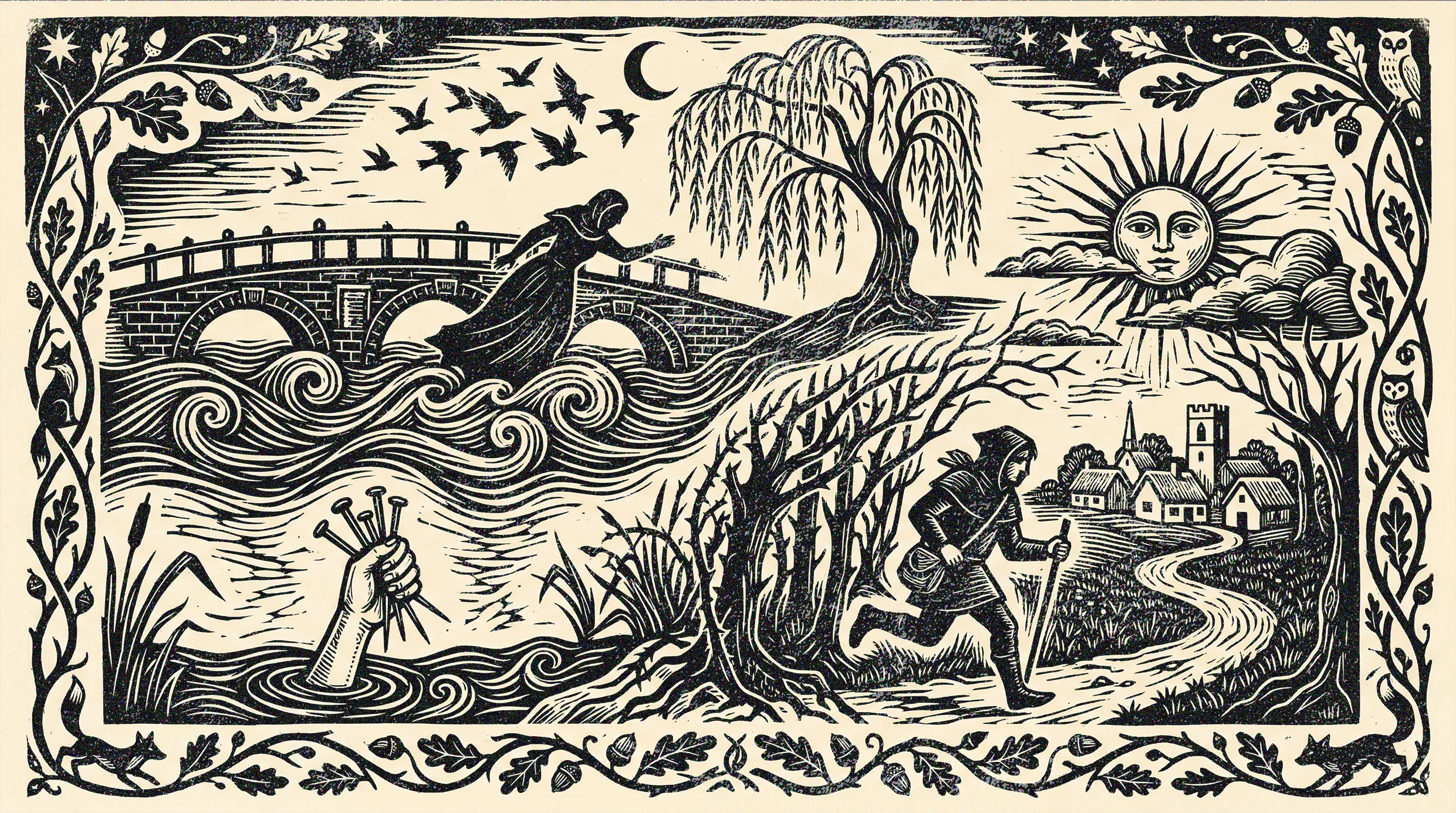
Iron pins, a widow, her son and an accusation preserved for more than a thousand years in an Anglo-Saxon charter.
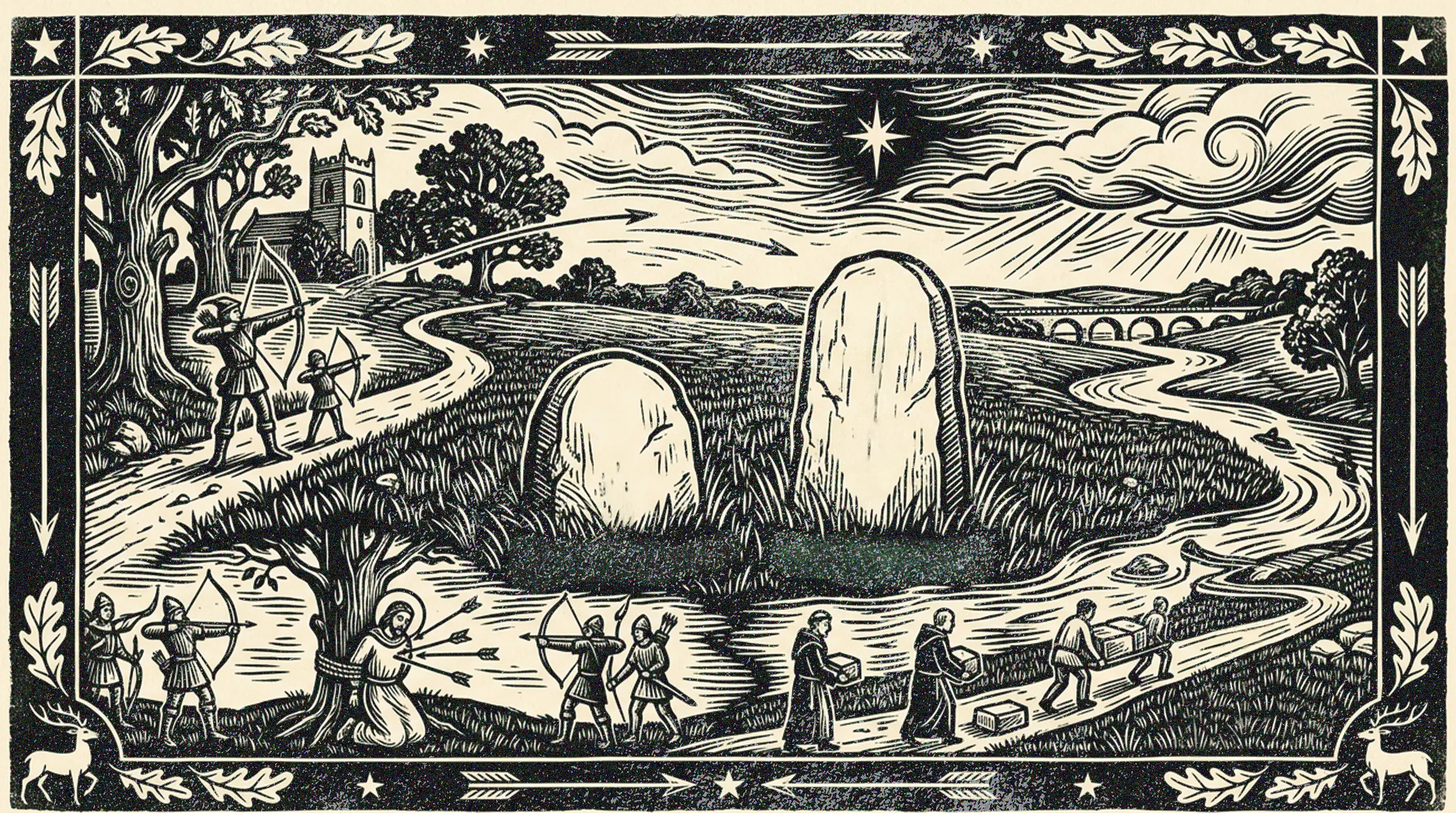
Robin Hood & Little John
Two stones in a field became the landing points of two truly impossible arrows.
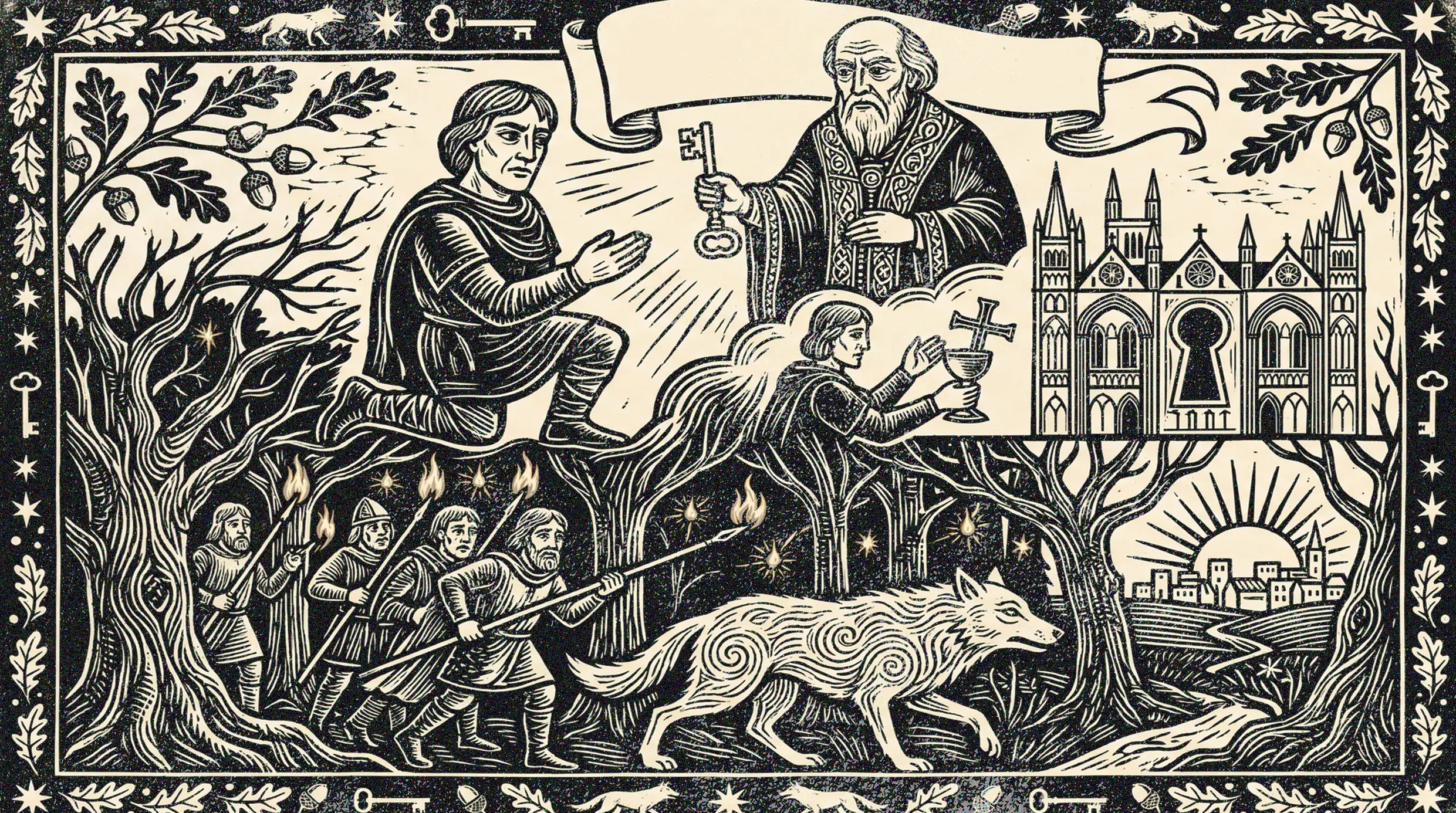
Hereward & the White Wolf
An outlaw army loses the road in darkness until a huge pale animal appears and begins to walk ahead.
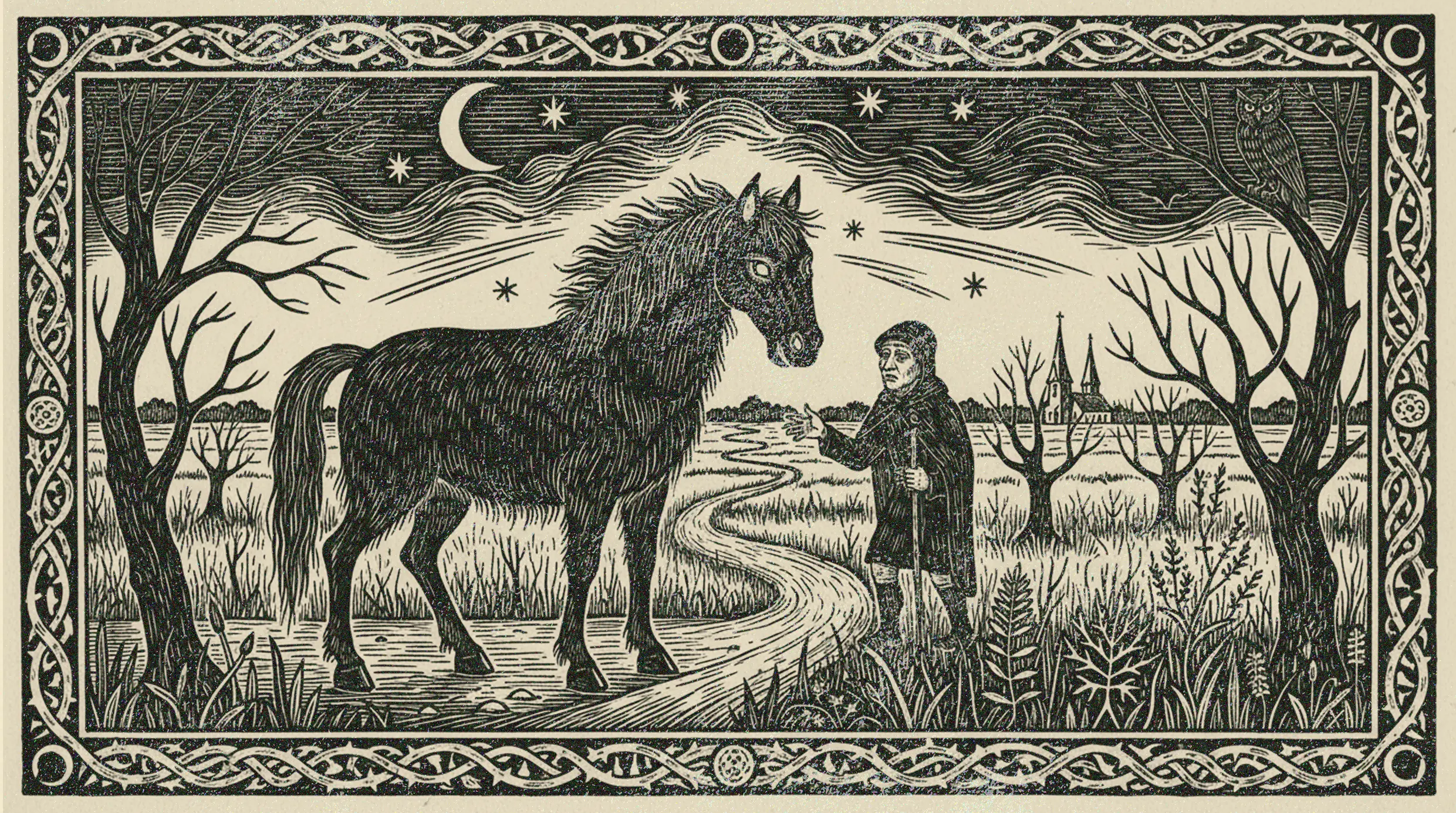
The Shag Foal
Country people knew to be careful after dark because a great shaggy creature might be waiting on the road.
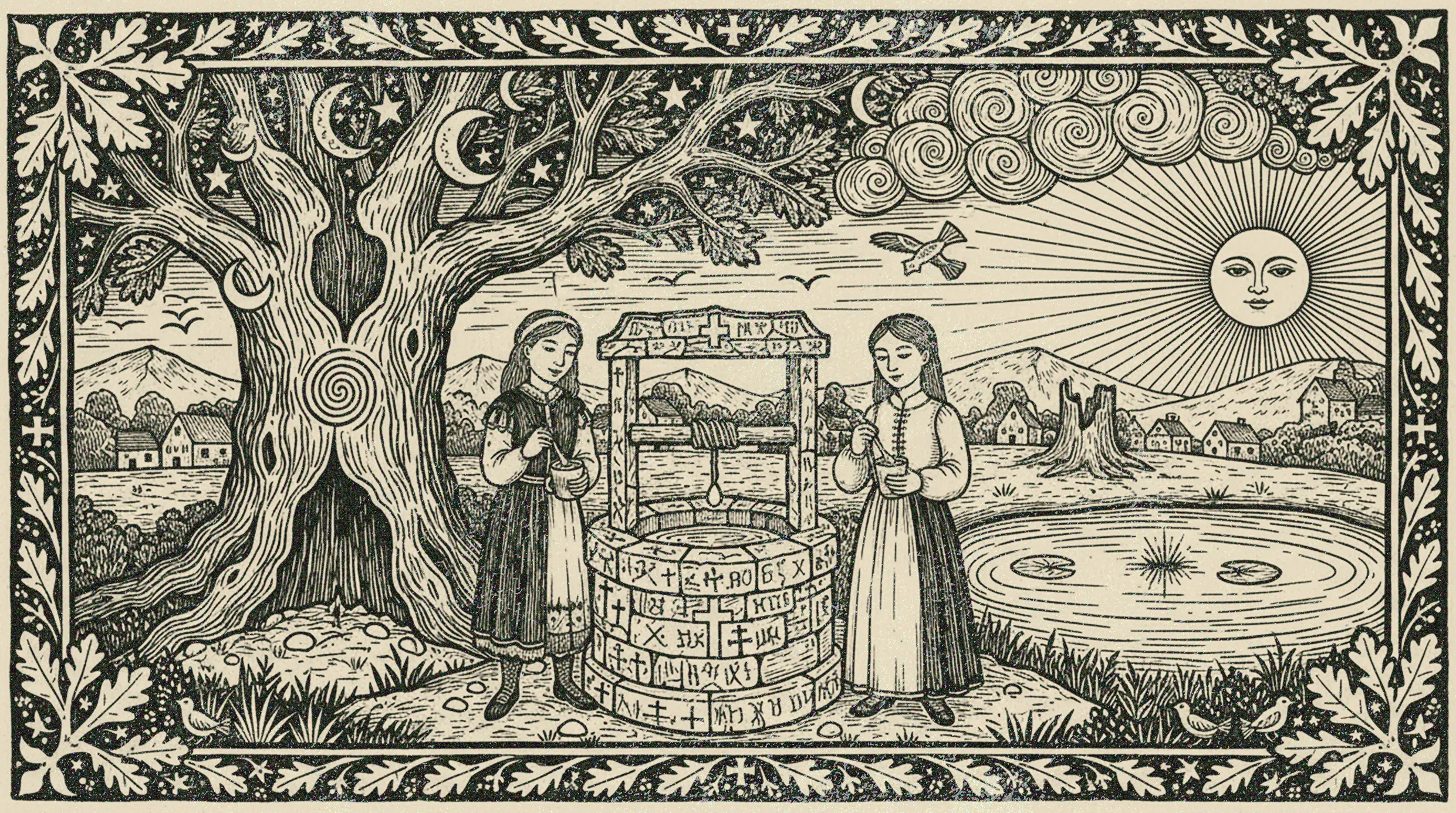
Sugar Cupping at East Well
On Whit Sunday, villagers gathered at an ancient spring and sweetened its water before drinking it.
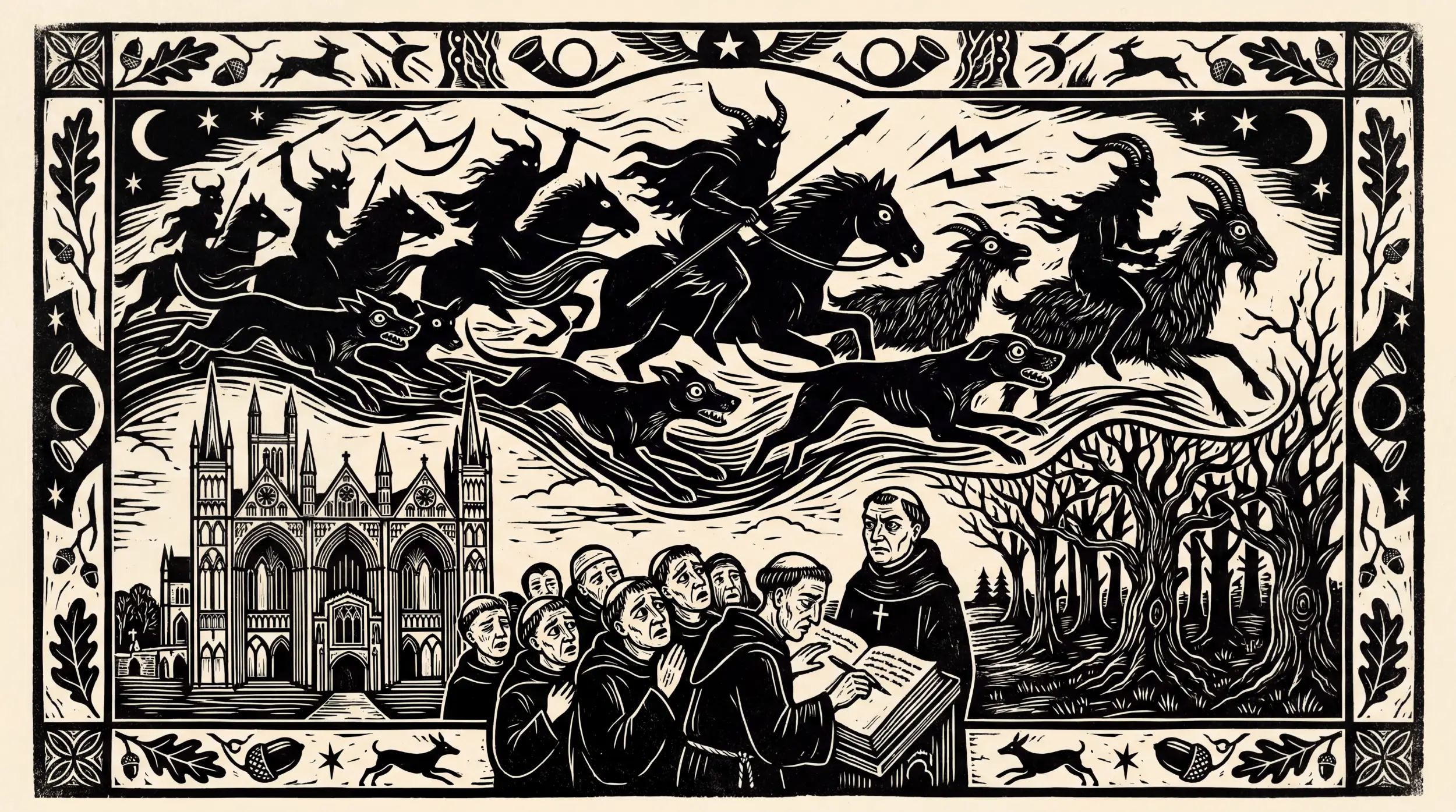
The Wild Hunt
Black riders, monstrous hounds and hunting horns were heard in the woods around Peterborough.
Behind the folklore
Lady Conyburrow's Way is unusually valuable because antiquarian descriptions, archaeological landscape evidence, church sculpture and living folklore can all be compared.
-
John Morton · The Natural History of Northamptonshire, 1712
Morton's account is the earliest documented version of Kyneburgha's pursuit and describes the physical path through Normangate Field, including the poorer ground and Roman building material encountered by ploughing. -
Susan Kilby · Peasant Perspectives on the Medieval Landscape
Detailed landscape research comparing Morton's account, Edmund Artis's mapping, aerial archaeology, field names, Ermine Street and the possible historic course of Lady Conyburrow's Way. -
William Stukeley · Family Memoirs, entry for September 1737
Records Castor's tradition that St Kyneburgha, locally called Lady Ketilborough, travelled along the Roman road in a coach and six shortly before Michaelmas. -
St Kyneburgha Building Preservation Trust
Local historical information on Kyneburgha, the early religious community, the Roman Praetorium and the development of the present church. -
Historic England · Church of St Kyneburgha
Official Grade I listing information for the church, including its unique dedication and important Romanesque fabric.