
Horses · secret knowledge · the toad bone The Toadmen
In the Fens there were horsemen people spoke about differently. They could stop a team in its tracks, calm an animal nobody else could handle, or make a quiet horse suddenly impossible. Their secret, people said, was hidden in one small bone from a toad.
Peterborough's Toadmen belonged to the world of working horses.
This is not a story about an ancient pagan priesthood surviving unchanged in the Fens. The evidence takes us into a much more recent agricultural world, when a skilled horseman could build an extraordinary reputation because a farm depended on his ability to understand powerful animals.
Before tractors transformed farming, horses pulled ploughs, carts, wagons and agricultural machinery. A team that refused to move could halt work. An uncontrollable horse could injure people, damage equipment and cost its owner money.
Men who seemed able to control horses effortlessly therefore possessed something valuable. Some guarded practical methods. Some cultivated mystery. And some became associated with a very particular piece of East Anglian folklore.
They were called Toadmen.
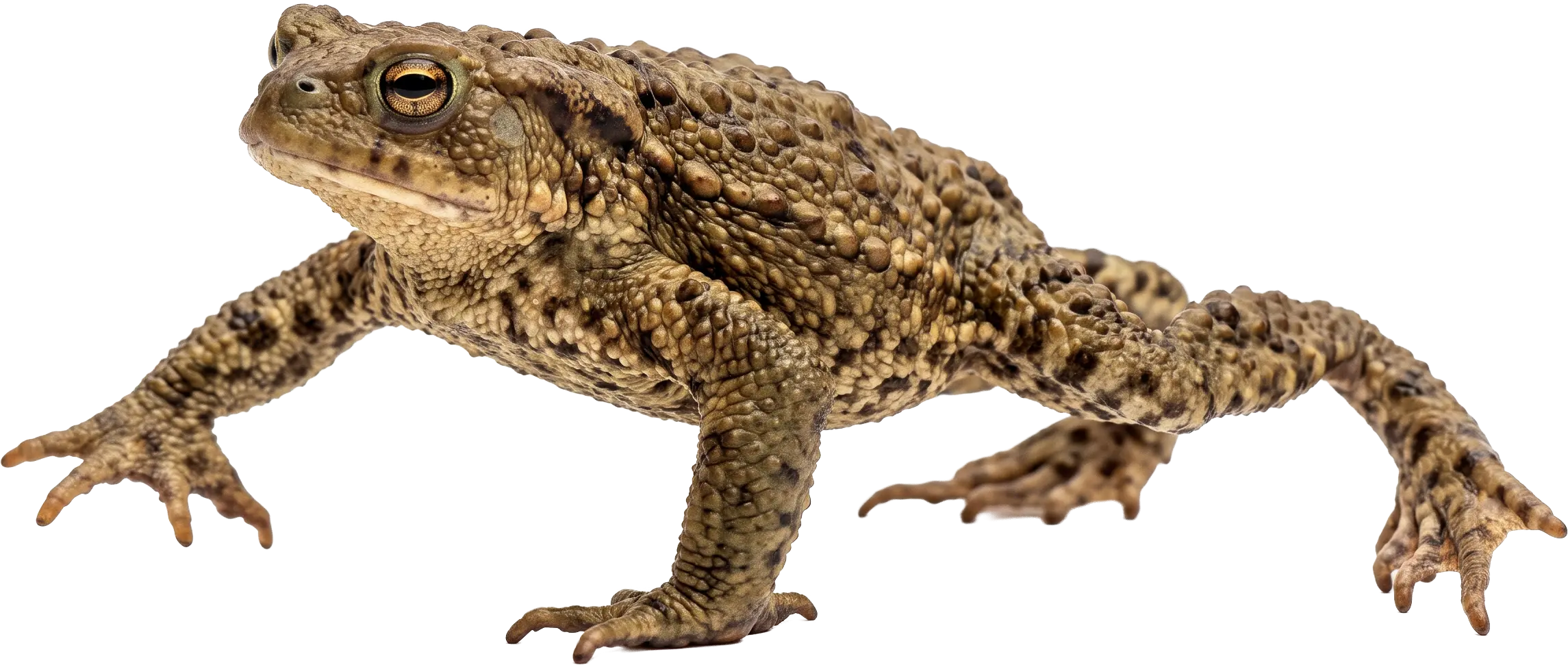
The toad was the source of the name.
Nothing about the living animal itself explains the alleged power. The crucial object in the folklore was a bone.
Toads had carried strange associations in European folklore for centuries, appearing in stories of medicine, poison, witchcraft, charms and transformation. East Anglian horsemen gave that older symbolism a very particular agricultural use.
The person who possessed the correct bone was said to gain an unnatural influence over horses. In some accounts the holder could calm an animal. In others he could stop it completely, make it move against another handler's wishes, or deliberately make a previously manageable horse difficult.
The image shown here is a common toad, one of Britain's familiar native amphibians. Historical accounts sometimes use regional expressions such as “walking toad”, and the surviving folklore should not be treated as a precise zoological description of one required species.
The famous ritual was designed to prove that you were prepared to continue.
Wider East Anglian accounts describe a deliberately disturbing process in which a toad's skeleton was prepared, dried and eventually taken alone to running water at night.
The details varied considerably from teller to teller, which is important. There was no single surviving instruction manual and no reason to assume every person called a Toadman performed exactly the same rite.
In the best-known versions, the bones entered a running stream at midnight. Most moved with the current. One behaved differently and appeared to resist the water or travel against it. That was the bone the initiate needed to recover.
The surrounding experience became increasingly supernatural in the telling. Terrible noises might be heard. The bones could be said to scream. The landscape itself seemed to resist what was taking place.
Some traditions went further and brought in the Devil. He might appear to demand the bone, challenge the new Toadman or complete the initiation during a later night in the stables.
It was refusing to let fear make you surrender it.
These dramatic details belong to some versions of the wider East Anglian tradition. They should not automatically be attributed to every Toadman remembered around Peterborough. What the local evidence establishes much more securely is the belief that certain horsemen possessed unusual powers and that a toad bone lay behind them.
The historical rite involved cruelty to an animal and should not be recreated. The interest here is in what people believed, why the story became associated with skilled horsemen and how remarkably late those beliefs survived around Peterborough.
Because control of a horse was economic power.
It is difficult to understand the Toadmen if we imagine horses only as leisure animals. In the agricultural world that created the story, they were engines.
A ploughman needed to read movement, mood and temperament almost instinctively. He knew how a horse responded to voice, touch, harness, food, routine and other animals. The best horsemen could make difficult work appear effortless.
To somebody watching from outside that relationship, the difference between extraordinary expertise and magic could become surprisingly small.
This also explains why specialist knowledge was guarded. Knowing how to settle a nervous horse or make a reluctant team work gave a labourer status and bargaining power. A secret loses some of its value once everybody knows it.
The horseman possessed the knowledge.
The Toadman legend turned that imbalance into something supernatural. The labourer might own very little, but the farmer could still depend on something only he understood.
The same working world survives in another Peterborough tradition recorded by the Plough Witches → , where agricultural labourers temporarily turned the plough itself into a source of ritual authority.
This is where the story stops being safely remote.
In 1953 G. W. Pattison published evidence collected through adult education work in the Fens. His informants were not discussing something they believed had disappeared in the distant past.
Pattison recorded information at March and Thornhaugh, near Stamford. Those informants also knew stories from people or older relatives connected with Thorney, Eye, Stamford and what the published material appears to identify as Wansford.
That geographical spread places Toadman tradition firmly across the fenland and rural landscape around Peterborough. It reached from the country east of the city towards the villages and market towns to the west and north.
Thorney & Eye
Pattison's informants remembered Toadman traditions among people connected with the fen settlements immediately east of Peterborough.
Thornhaugh & Stamford
The belief was not confined to deep fenland. Pattison collected testimony at Thornhaugh and recorded further knowledge associated with Stamford.
Somebody had worked with one
Most strikingly, one of Pattison's informants claimed direct experience of working alongside a man he understood to be a Toadman.
He asked again and again. The answer never changed.
One of Pattison's 1953 informants said he had worked beside a Toadman and repeatedly tried to discover how the man's power worked.
The Toadman would not tell him.
It is a remarkable piece of testimony because the secrecy is more important than the supernatural claim. Whatever this man believed he knew, he considered it something that could not be passed casually to another person.
Another informant remembered a father announcing that he wanted to become a Toadman. His own father reacted so strongly that the idea was abandoned.
This is not the language of a picturesque custom being performed for visitors. In the middle of the twentieth century, some families still treated the subject with genuine unease.
The best explanation does not have to flatten the story.
It would be easy either to accept every supernatural claim literally or to dismiss the entire tradition as superstition. The historical reality is more interesting.
George Ewart Evans spent years recording East Anglian rural life from people who had worked with horses before mechanisation. His accounts repeatedly show how closely practical skill, professional secrecy and supernatural reputation could overlap.
Horsemen knew techniques outsiders did not. Some guarded preparations and practical tricks. They understood animal behaviour through long experience. A particular word, movement, scent or routine could acquire enormous significance when only one person appeared able to make it work.
Mystery could also protect professional status. If people believed that a horseman's ability depended on a terrible initiation and a magical bone, copying his methods became much more difficult.
Perhaps the skill protected the magic.
None of this proves what any individual Toadman believed about his own abilities. Some may have accepted the supernatural explanation completely. Others may have enjoyed allowing employers and younger workers to wonder.
Folklore often survives best in precisely that uncertainty.
“The Toadmen” sounds more organised than the evidence allows.
Rural horsemen did form secretive fraternities in parts of Britain, and traditions such as the Horseman's Word have their own initiation ceremonies, passwords and ritual language. Toadmanry overlapped with that broader culture, but it should not automatically be treated as one single organised society.
The evidence is consistent with individual practitioners working within a shared world of stories and guarded knowledge. They knew the reputation of the toad bone, knew what a Toadman was supposed to be capable of, and recognised other horsemen who were said to possess the secret.
That may explain why the ritual itself varies. One storyteller adds a full moon. Another emphasises the running water. Another remembers the Devil. Different horsemen could share the same identity without belonging to one centrally controlled group.
Wider East Anglian folklore also remembers occasional Toadwomen. The Peterborough-area testimony discussed here focuses principally on male agricultural horsemen, but the magical tradition was not necessarily understood as exclusively male everywhere.
This distinction makes the Peterborough evidence stronger, not weaker. We are not looking for the headquarters of a hidden Fenland order. We are looking at a belief embedded in ordinary agricultural communities.
The animal deserves a rather better ending than the folklore gave it.
Common toads remain widespread across mainland Britain, but their numbers have declined significantly in many areas.
They spend much of the year away from water, sheltering in woodland, hedges, rough grassland and gardens before returning to traditional breeding ponds in spring. That strong attachment to ancestral ponds makes road crossings particularly dangerous.
Modern conservation work is therefore trying to keep toads alive rather than obtain anything from their bones.
The common toad is a biodiversity priority species in Britain and is legally protected from sale and trade. Habitat loss, disappearing ponds and road mortality remain serious pressures.
Learn the Toadmen story. Look for living toads responsibly. Never attempt the historic rite, disturb an animal or remove one for folklore purposes. The strangest part of this story is that the belief survived around Peterborough into living memory. That is more than enough.
Because Peterborough's rural folklore survived the tractor.
The Toadmen belong to a Peterborough landscape that changed extraordinarily quickly during the twentieth century.
Working horses disappeared from most farms. Agricultural labour became mechanised. The intimate hierarchy of waggoners, horsemen, ploughmen and farm servants faded with them.
Yet when Pattison collected testimony in 1953, the old knowledge had not quite vanished. Men around Peterborough could still name places where Toadmen had been known. One could remember working with one. Another family could remember somebody wanting to become one.
That makes this a story about more than magic. It captures the final years of an agricultural culture in which reputation, secrecy and highly specialised knowledge passed orally between generations.
Then the horses went.
The secret nearly went with them.
One man knows why.
He is not telling you.
The Toadmen belonged to a landscape full of guarded knowledge.
Continue through the customs, strange animals and supernatural traditions of Peterborough's rural and Fenland landscape.
The Plough Witches
Meet another tradition shaped by farm labourers, horses, ploughs and the temporary power of people who normally worked for somebody else.
Enter the story → 02 · ANIMAL FOLKLOREThe Shag Foal
Around Barnack, Thorney and Ailsworth another animal became something more unsettling once darkness, memory and folklore began working together.
Meet the Shag Foal → 03 · MAGIC IN THE RECORDThe Witch of Ailsworth
Travel much further back to a tenth-century accusation of harmful magic preserved because the dispute entered the documentary record.
Enter the case → 04 · THE FEN AT NIGHTThe Will-o'-the-Wisps
John Clare knew how quickly the wet landscape could become uncanny when strange lights appeared after dark.
Follow the lights →More Peterborough Folklore
Strange creatures, seasonal customs and beliefs preserved around Peterborough and the Fen edge.
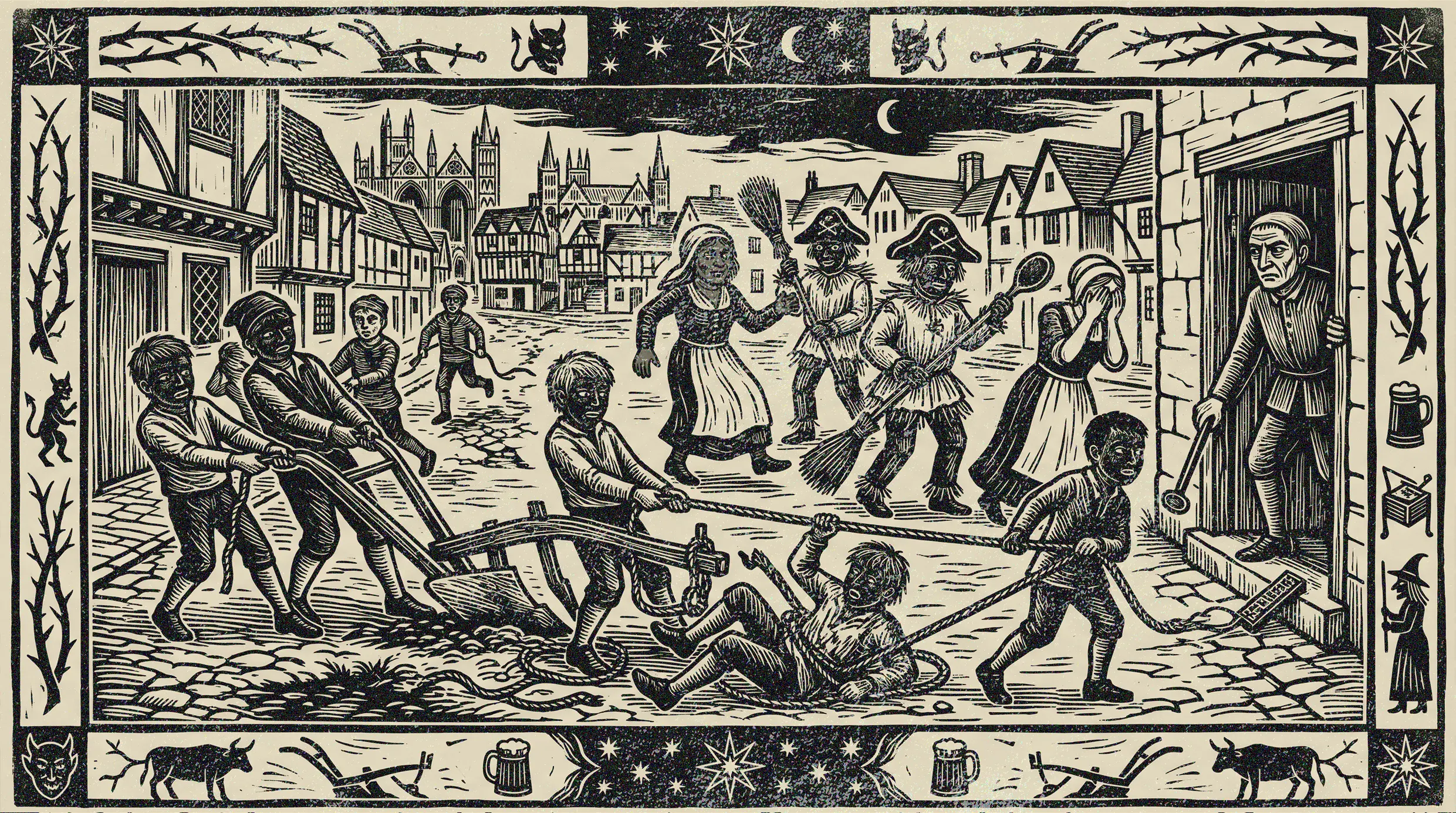
The Plough Witches
On Plough Monday the workers took the plough out of the field and turned it into the centre of one day of licensed misrule.
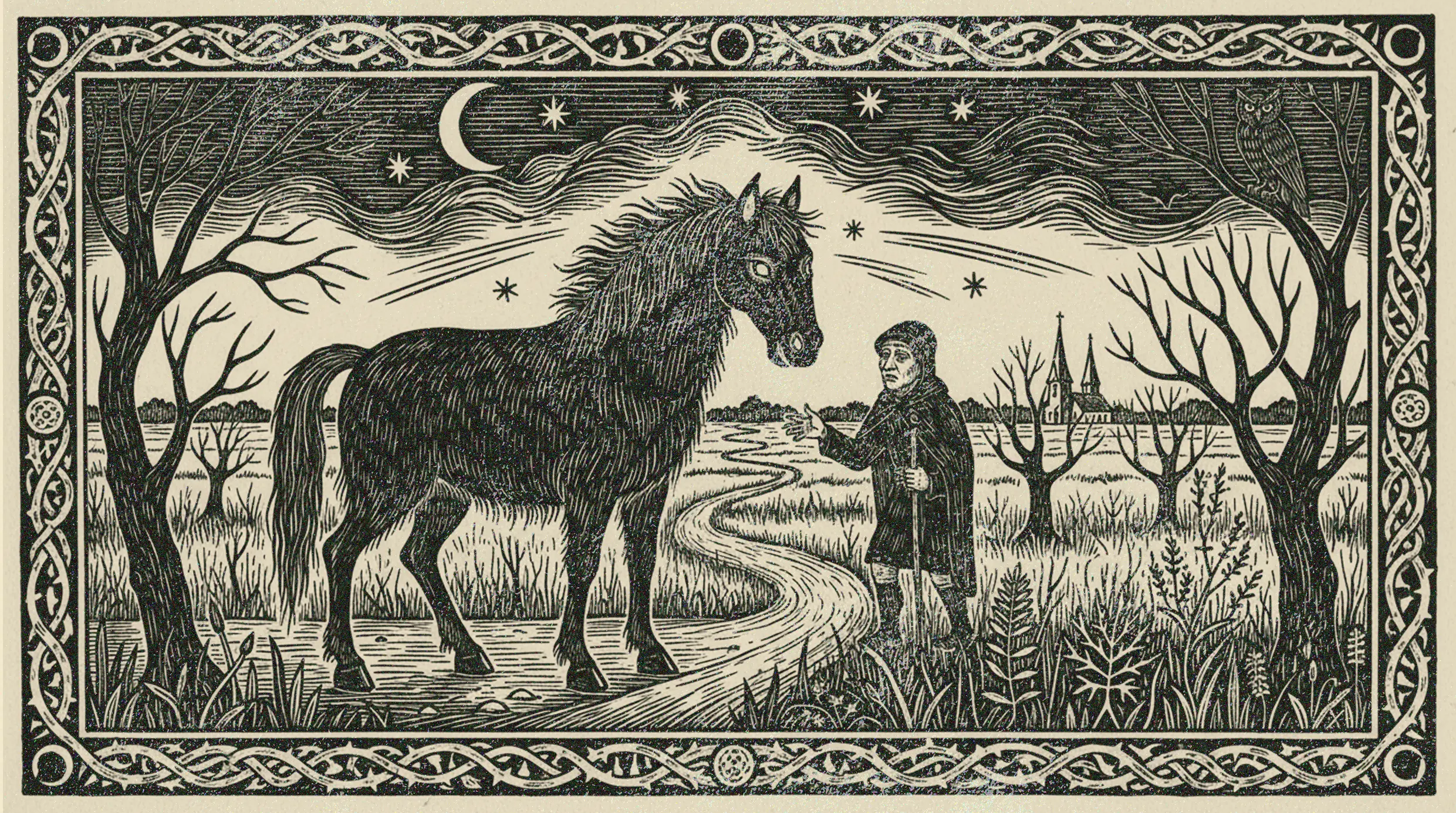
The Shag Foal
A black creature that could resemble a bear, a horse or a dog waited at the edge of recognition after daylight faded.
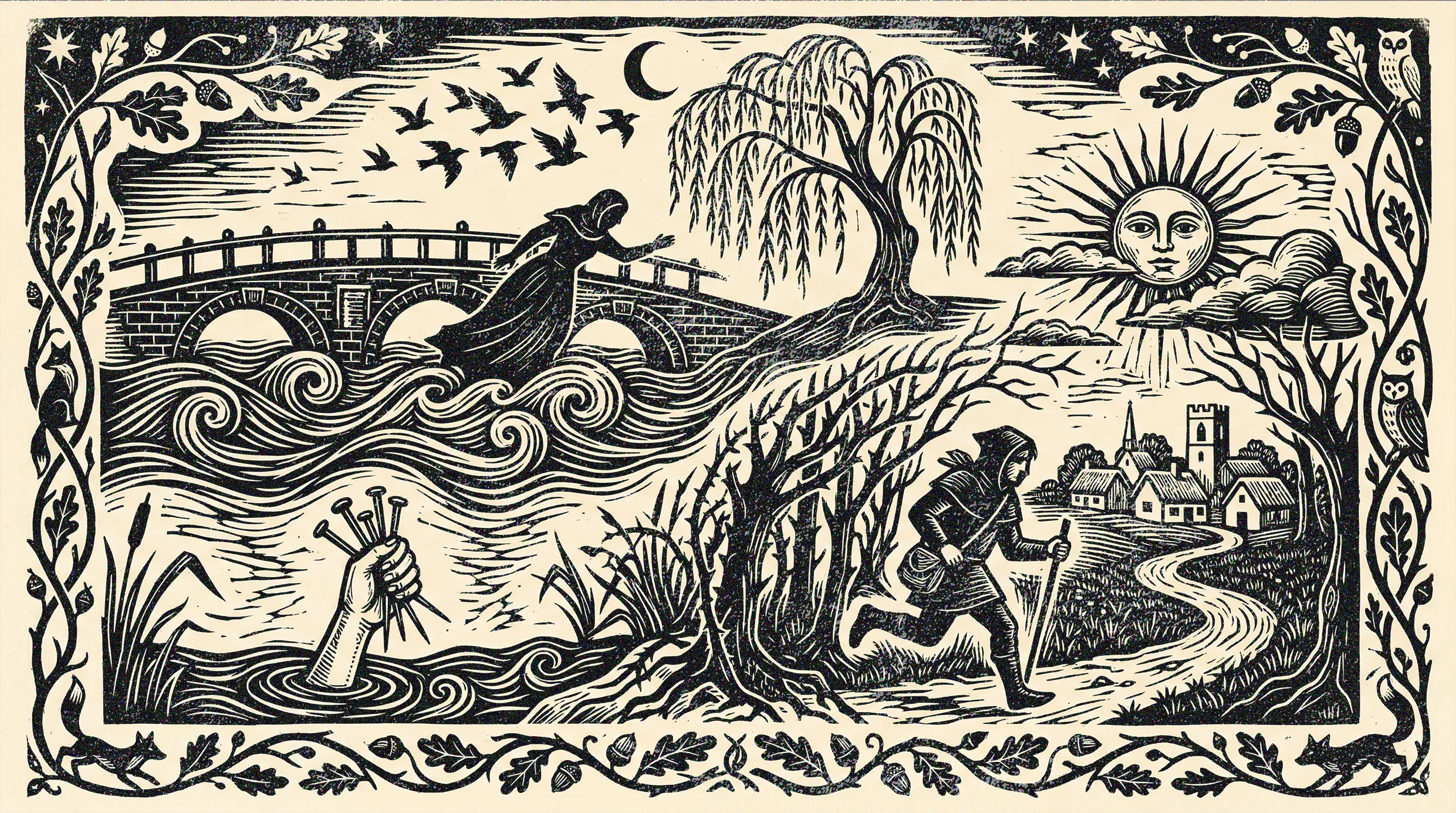
The Witch of Ailsworth
An accusation involving iron pins and harmful magic survives from Anglo-Saxon Peterborough because a later land charter remembered the dispute.
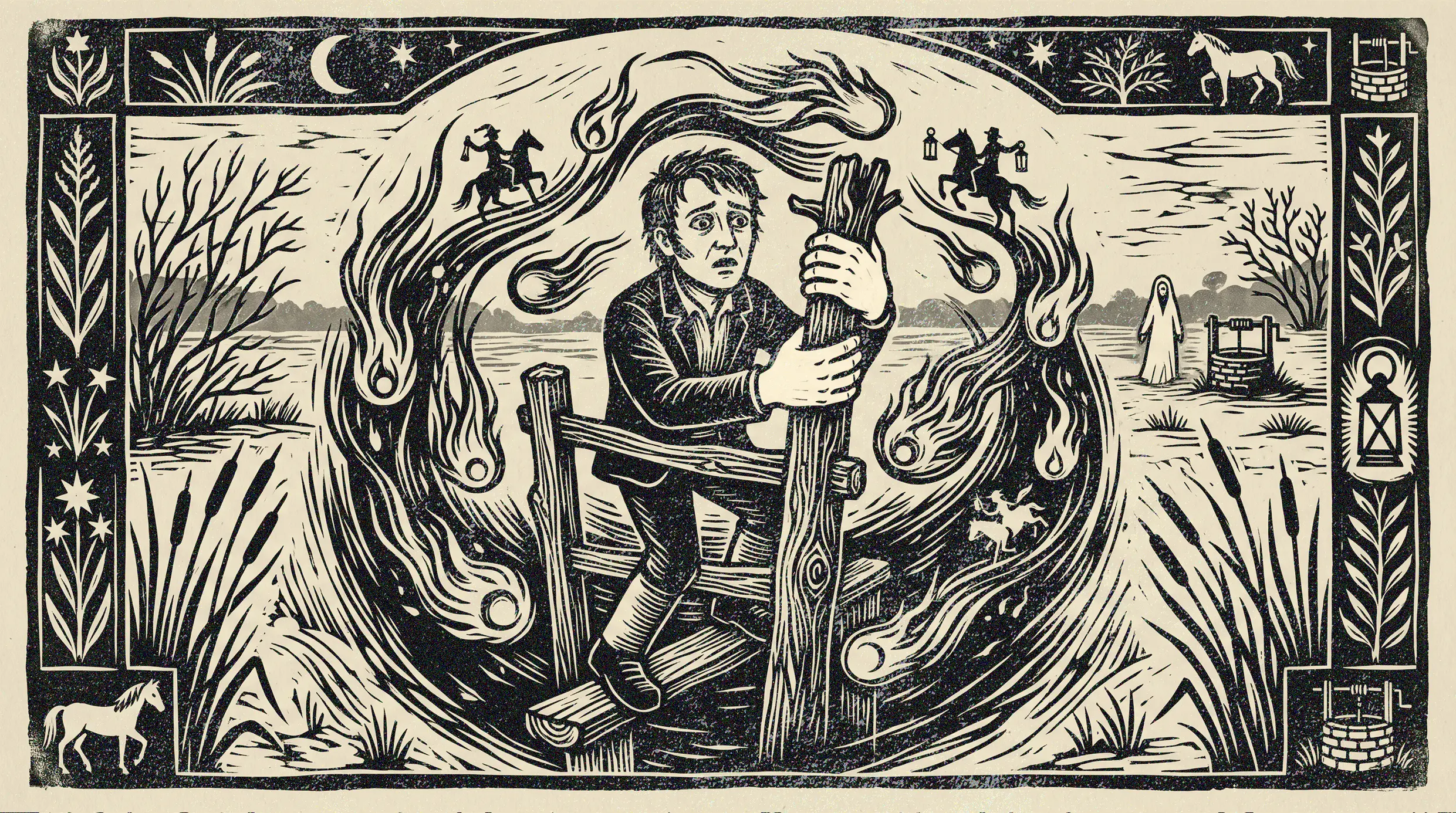
The Will-o'-the-Wisps
Strange lights moved through the wet landscape around Helpston and remained one form of supernatural experience John Clare found difficult to dismiss.
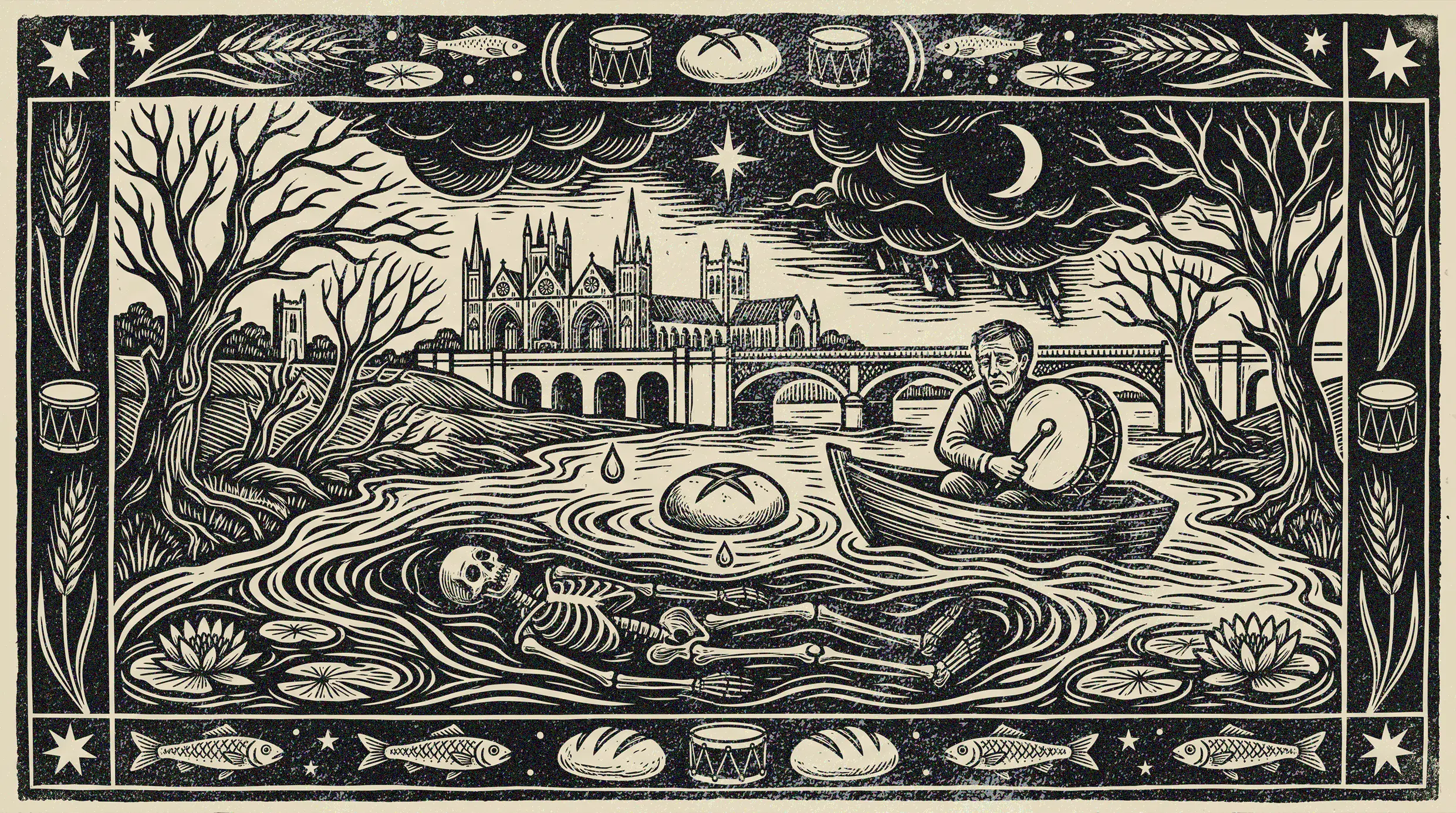
Drumming Up the Dead
When somebody drowned and the body would not surface, nineteenth-century Peterborough still knew traditional methods for searching the river.
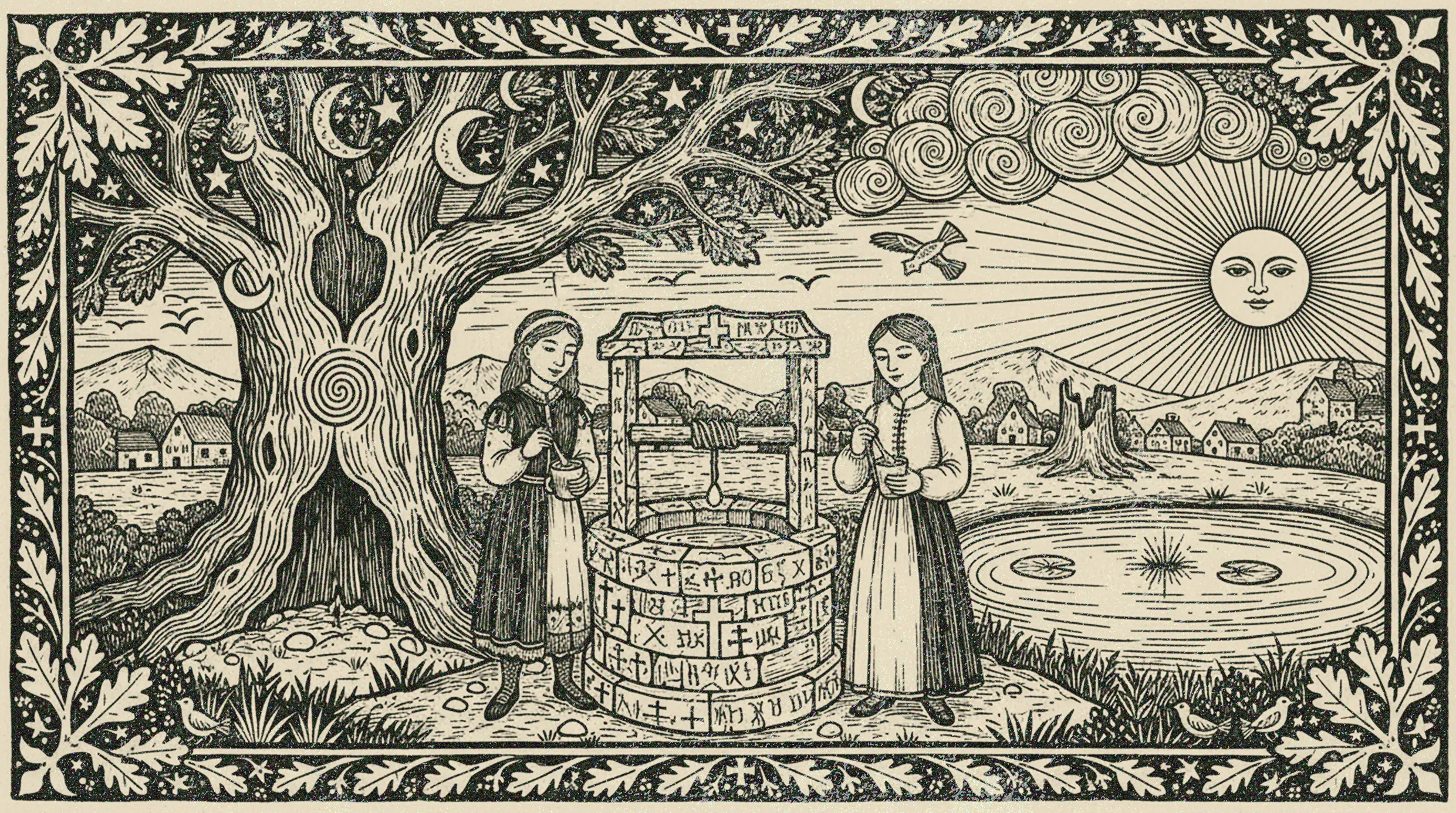
Sugar Cupping
John Clare remembered another rural custom, when people visited East Well at Whitsun and mixed sugar with the spring water for luck and wishing.
Behind the Toadmen
This page distinguishes the unusually strong Peterborough-area testimony collected in 1953 from the wider East Anglian toad-bone ritual. Details of the rite varied between sources and should not be assumed to describe every person locally remembered as a Toadman.
-
G. W. Pattison · Adult Education and Folklore · 1953
Published in Folklore, volume 64. Pattison recorded living Fenland testimony about Toadmen, including informants at March and Thornhaugh and memories connected with Thorney, Eye, Stamford and the Peterborough area. -
History and Folk Tales of the Fens · source extracts
Educational source pack reproducing relevant extracts from Pattison's 1953 article, including testimony from a man who said he had worked with a Toadman. -
George Ewart Evans · The Horse in the Furrow
Evans's classic study of the working horse and East Anglian horsemen. His folklore section discusses Toadmen, horse whisperers, secret knowledge and the world in which these traditions operated. -
JSTOR Daily · The Toadmen, Masters of Equine Magic
Accessible introduction to the East Anglian tradition and the close relationship between agricultural horse handling, professional status and supernatural reputation. -
Norfolk Record Office · Ancient Animal Magic
Archive-based discussion of horsemen, Toadman traditions and the guarded practical knowledge that sat alongside beliefs in supernatural control of animals. -
Amphibian and Reptile Conservation · Common Toad
Modern information on Bufo bufo, its ecology, population decline, conservation status and legal protection from sale and trade. -
Discover Peterborough · The Plough Witches
Explore another Peterborough tradition rooted in the working lives, horses and social world of agricultural labourers. -
Discover Peterborough · Peterborough Folklore
Explore Peterborough's wider collection of strange creatures, local customs, hauntings and historical traditions. -
Discover Peterborough · Weird Weekends
Follow Peterborough's stranger stories into the real landscapes where they were remembered. -
Image credit
Common toad, Bufo bufo · Discover Peterborough. Featured Toadmen artwork from the Discover Peterborough folklore collection.