

Cathedral Close · Hares · Fire
The Hare in the
Minster Close
A hare settling in the grass around Peterborough Cathedral was once enough to make people look nervously towards the town. The animal itself was harmless. The omen attached to it was not.
A hare in the Close meant people started thinking about fire.
Peterborough once had a remarkably specific superstition. If a hare came into the Minster Close and settled itself in the grass, a fire somewhere in the town was expected before the week was over.
The belief sounds almost absurd now because the animal and the predicted disaster seem to have no obvious connection. A hare does not carry fire, start fires or behave in any way that should logically make a city fear combustion. Yet the association was powerful enough to be remembered in rhyme, repeated by local antiquaries and reinforced whenever coincidence appeared to prove it right.
Peterborough was not alone in this. Similar beliefs were recorded elsewhere in eastern and southern England, where a hare entering a settlement could be interpreted as a warning that fire was coming.
What makes Peterborough's version special is its precise setting. The hare had to enter the ground surrounding the Minster, settle there, and in doing so cross an invisible boundary between ordinary wildlife and omen.

An ordinary hare carried an extraordinary warning.
Hares were a familiar part of the open landscape around Peterborough, but seeing one cross into the town or Cathedral precinct could transform an ordinary encounter into something people remembered.
Unlike rabbits, hares generally do not retreat into burrows. They rest above ground in shallow depressions known as forms, often relying on stillness and camouflage rather than disappearing underground.
That ordinary piece of hare behaviour helps explain the wording of the Peterborough tradition. The ominous moment was not necessarily the animal merely running through the Close.
It was the hare settling down.
Once it had made its form inside the Minster Close, the old belief said the town should begin watching for fire.
A hare makes a form, not a burrow.
Older versions of the Peterborough belief sometimes use the word “lair”, while local retellings often speak of the hare making its “form”.
A form is the shallow resting place in which a hare lies pressed close to the ground. To somebody walking across open grass, the animal can remain almost invisible until it suddenly bolts away.
That behaviour may have helped give hares some of their uncanny reputation. An apparently empty patch of ground can suddenly produce a large, fast animal that seems to have appeared from nowhere.
Then the hare is already running.
Peterborough folklore added another thought to that moment. If the animal had been lying in the Minster Close, somebody should start watching for smoke.
Easy to remember. Difficult to disprove.
By the nineteenth century the Peterborough belief had been compressed into a short rhyme linking a hare in the Minster Close with a fire before the end of the week.
Charles Dack included the tradition in his Weather and Folk Lore of Peterborough and District, published in 1911, alongside local sayings about clocks, weather, floods, weddings and death.
Before the week is over, fire comes to the town.
This is a paraphrase of the traditional rhyme rather than a claim that everybody repeated precisely the same wording. Folklore changes as it passes between speakers, newspapers and collectors.
What remained constant was the structure. Hare first. Fire afterwards.
The dangerous part of a belief like this is that any later fire becomes evidence for it, while all the weeks in which nothing burns are much easier to forget.
Then a hare entered the marketplace.
The most striking Peterborough episode attached to the superstition did not actually happen in the Minster Close. It happened in the heart of the town.
Research drawing on the nineteenth-century antiquary W. D. Sweeting records that a hare wandered into Peterborough's marketplace during the autumn of 1884.
People knew the fire omen, and the animal was killed.
The story then acquired exactly the coincidence required to preserve it. On the evening that notice of the hare incident appeared in the local newspaper, a substantial fire broke out at an inn in the marketplace.
From the viewpoint of somebody who already believed the omen, the sequence appeared unmistakable. A hare had entered the town. A fire followed.
From a modern viewpoint, of course, one event provides no evidence that the other caused it. But folklore rarely requires statistical proof. It needs memorable coincidences.
The hare was an ordinary wild animal and had nothing to do with the fire. The 1884 incident is a useful reminder that superstition could have consequences for the animals onto which people projected fear.
Hares warned other English towns about fire too.
The Peterborough rhyme belongs to a wider but relatively unusual English tradition in which a hare entering a street, settlement or built-up place was treated as an omen of fire.
In Ely in 1866, a hare entering the city was reportedly chased by people and animals while residents discussed the fear that fire would follow. Similar beliefs were recorded in parts of Northamptonshire, Cambridgeshire, Huntingdonshire and several other southern counties.
At Rushden in 1884, another hare was noticed in the streets shortly before a damaging fire. Again, the coincidence was interpreted by some people as confirmation that the old belief worked.
every new coincidence makes the belief stronger.
Peterborough's Minster Close rhyme was therefore a local version of something larger, given its own particular setting beside the Cathedral.
Nobody can give us one certain origin.
Hares occupy an unusually rich place in European folklore. Their speed, night-time activity, sudden appearances and ability to remain almost invisible in open ground have made them useful animals onto which people could attach supernatural ideas.
They appear in traditions involving witches, transformation, bad luck and death, but that does not automatically explain why Peterborough connected one specifically with fire.
Folklorist Joseph Pentangelo has proposed a much deeper possibility. Around 1211, the medieval writer Gervase of Tilbury described an English creature called the Grant, a strange animal said to race through streets before a fire.
Pentangelo argues that the Grant may itself represent an exaggerated or distorted hare tradition, and that the later belief in a hare entering a settlement before a fire could preserve elements of the same much older idea.
It is not a proven family tree for the Peterborough rhyme.
That distinction matters. The medieval Grant provides a possible parallel and perhaps a distant ancestor of the belief, but there is no continuous Peterborough record linking a thirteenth-century creature directly to the hare in the nineteenth-century Minster Close.
Fire already occupied an important place in Peterborough's stories.
Long before the hare rhyme was written down, fire had shaped both the real history and the legendary memory of the Cathedral precinct.
The monastery suffered major fires during the medieval period, most famously the catastrophic blaze of 1116 that destroyed much of the church and town and helped lead to construction of the Norman Cathedral standing today.
Peterborough's monastic tradition even wrapped that disaster in supernatural storytelling. One version blamed a servant who cursed his uncooperative fire and called on the Devil to blow upon it.
There is no reason to connect that medieval disaster directly with the later hare superstition. What it does show is that fire had been part of Peterborough's historical imagination for centuries.
Another watched the hares.
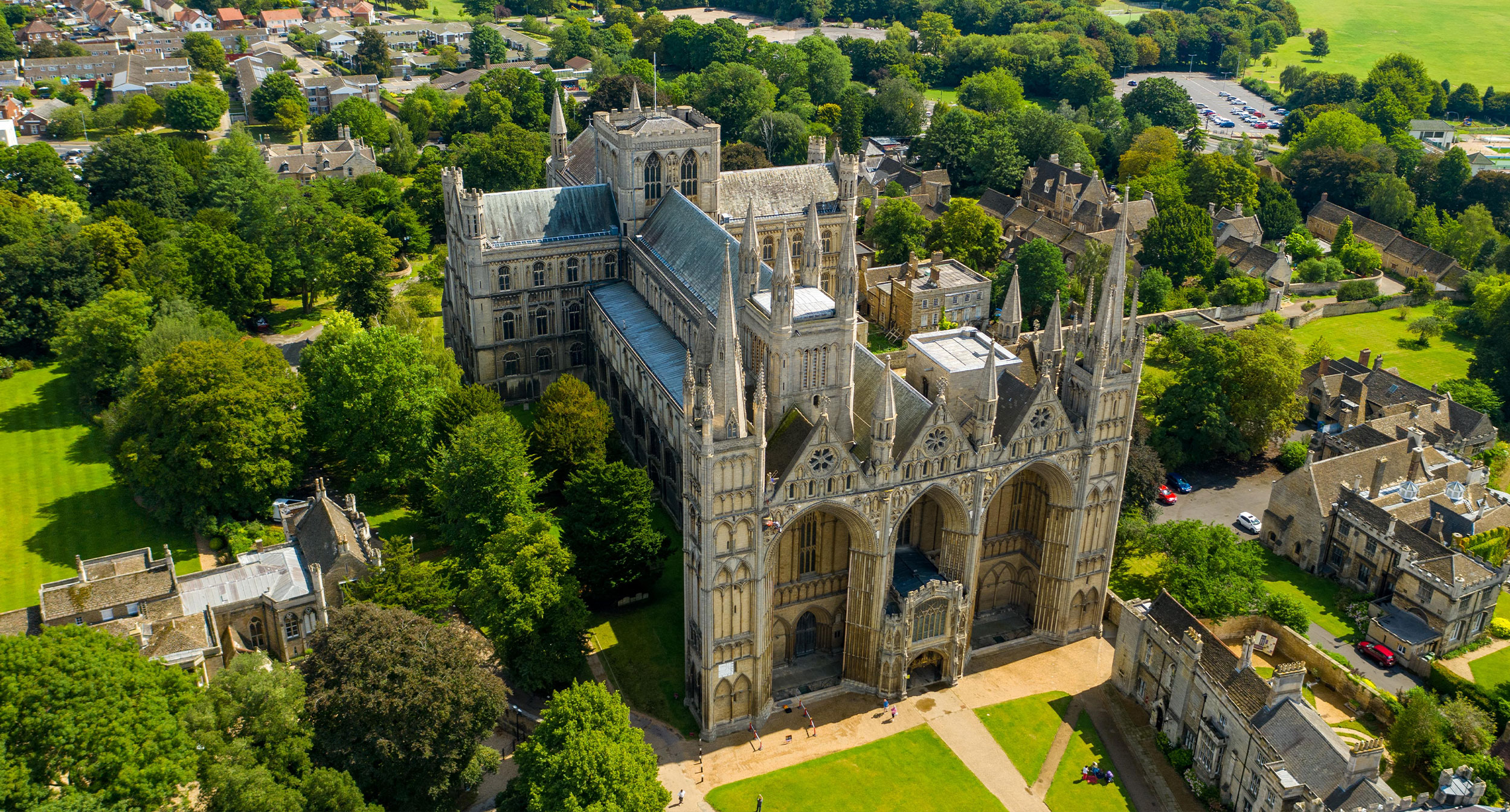
The Minster Close is still one of Peterborough's great open spaces.
The landscape has changed dramatically since the nineteenth century, but the essential geography of the story remains wonderfully easy to understand.
Stand on the grass around Peterborough Cathedral and imagine a time when the edge of the built town lay much closer, open ground was easier for wildlife to reach and the appearance of a hare inside the precinct was unusual enough to be noticed.
Nothing visible marks the superstition. There is no plaque, stone or monument to find. The location itself is the curiosity.
Sit on the Close grass and look towards the city. The hare probably will not appear, and Peterborough would prefer you not to test the second half of the tradition.
Because every town remembers the coincidence that came true.
The hare superstition shows how folklore can turn randomness into a pattern.
A hare enters the town and nothing happens. Nobody remembers. Another hare appears and a chimney fire breaks out days later. Suddenly the old saying has evidence.
The extraordinary 1884 Peterborough incident made that process even stronger because the animal and a real fire became linked in public memory.
More than a century later we can reject the omen while still recognising what makes the story compelling. A wild animal crosses an invisible boundary between countryside and city, and an ordinary moment acquires a sense of warning.
That boundary is the heart of the story.
Peterborough supplied the prophecy.
The hare is only one strange story hiding around the Minster.
Follow the Cathedral's fires, carvings, Anglo-Saxon mysteries and supernatural traditions through the real places that inspired them.
Come, Devil, and Blow on the Fire
The catastrophic fire of 1116 entered Peterborough's monastic history with a servant, a curse and a Devil who apparently took the invitation seriously.
Enter the fire → 02 · ANOTHER OMENThe Wild Hunt of 1127
Black riders, strange hounds and hunting horns appeared in Peterborough's written record during the troubled arrival of a new abbot.
Follow the Hunt → 03 · ANGLO-SAXON MYSTERYThe Hedda Stone
One of the Cathedral's oldest objects carries six mysterious holes and centuries of changing explanations about what people did with them.
Examine the stone → 04 · THE BIGGER STORYPeterborough Cathedral
Follow the site from Anglo-Saxon Medeshamstede through fire, Norman rebuilding, Gothic architecture, Reformation, Civil War and the Cathedral today.
Explore 1,350 years →More Peterborough Folklore
Strange animals, lights, omens and traditions that turned familiar Peterborough landscapes into places where people watched carefully.
The Wild Hunt
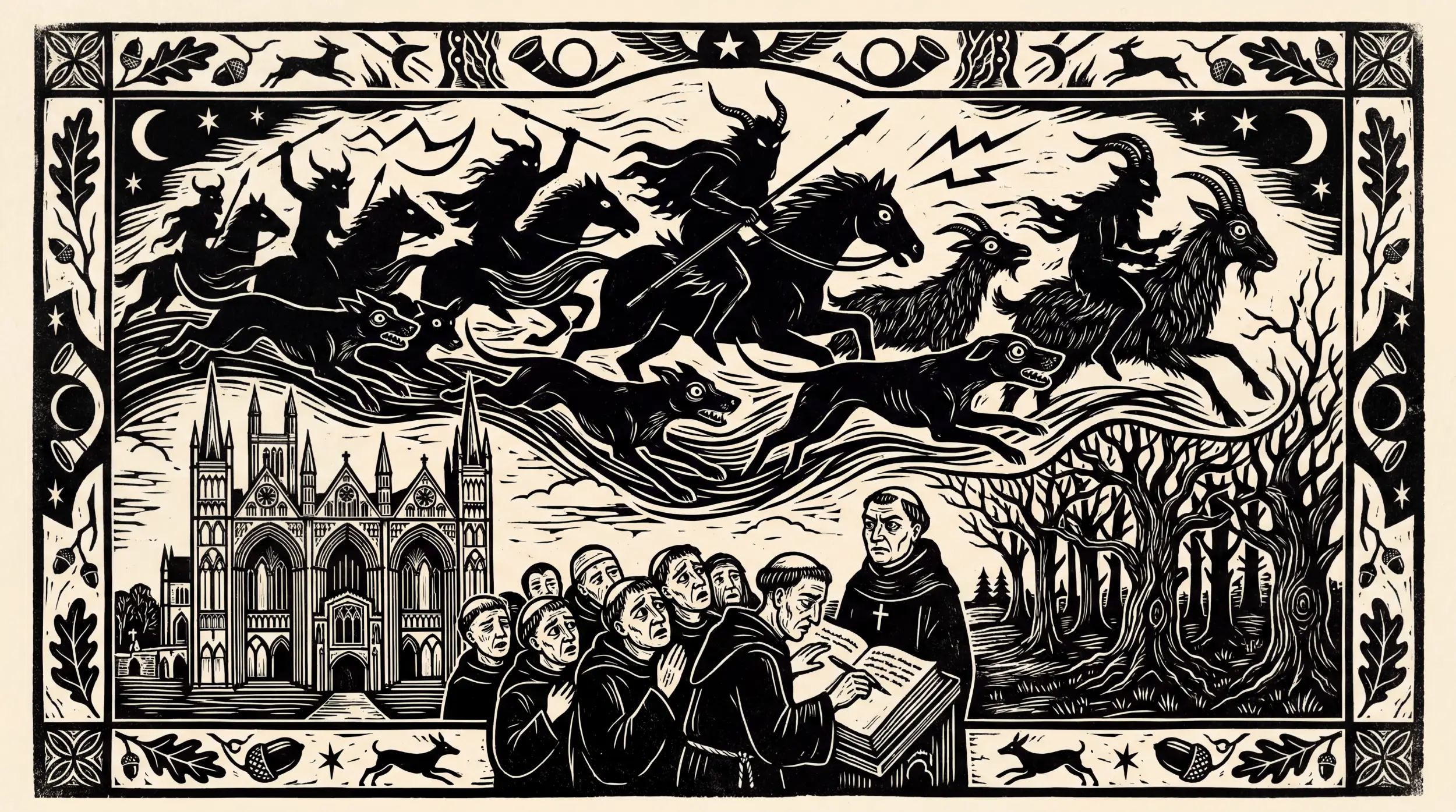
Black riders and monstrous hounds were heard outside Peterborough for weeks after the arrival of an unpopular Norman abbot.
The Shag Foal
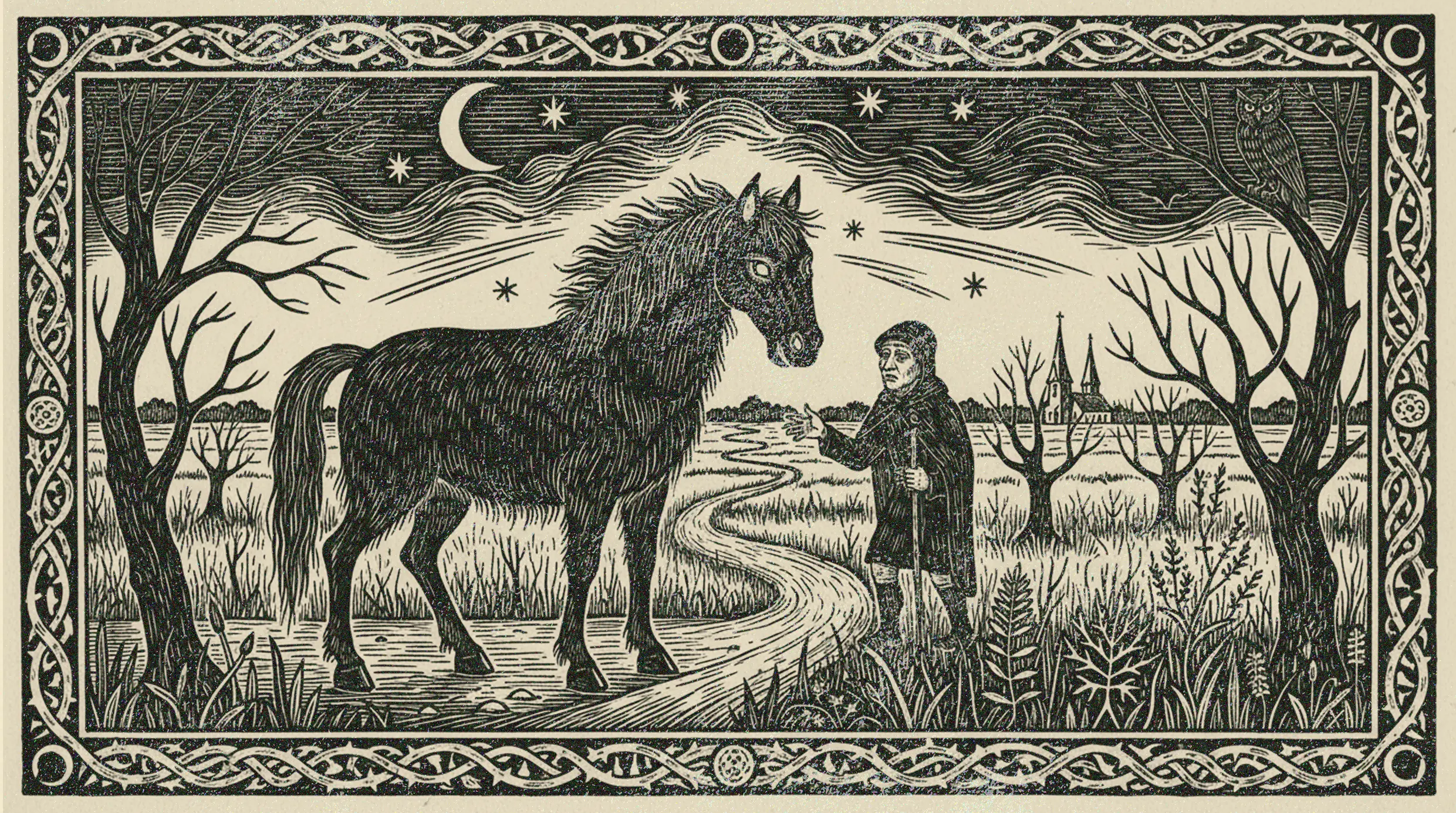
Travellers once feared a great shaggy animal that followed people along lonely roads after dark.
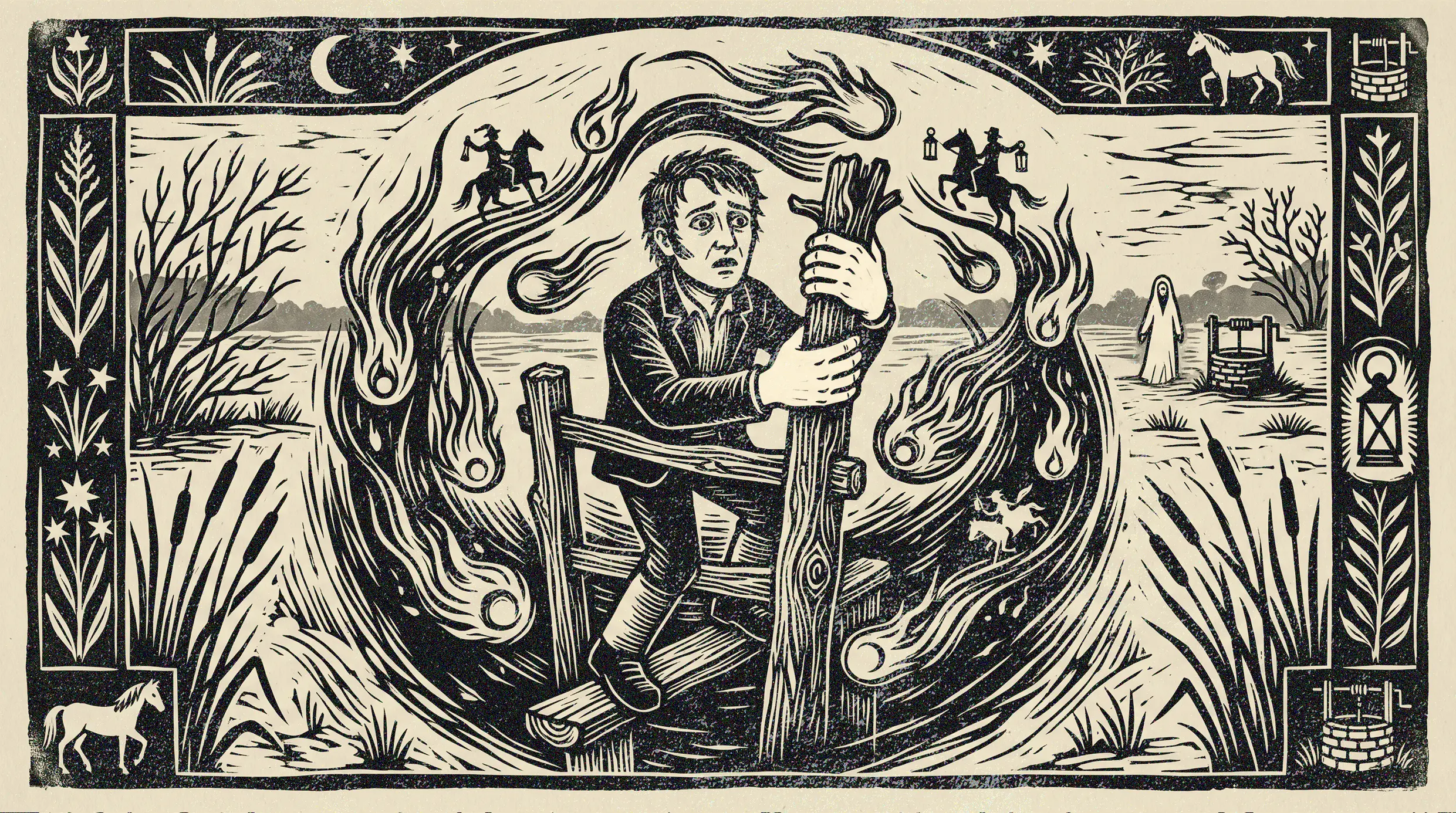
The Will o' the Wisps
John Clare doubted ghosts, but mysterious lights moving across wet ground after dark were another matter.
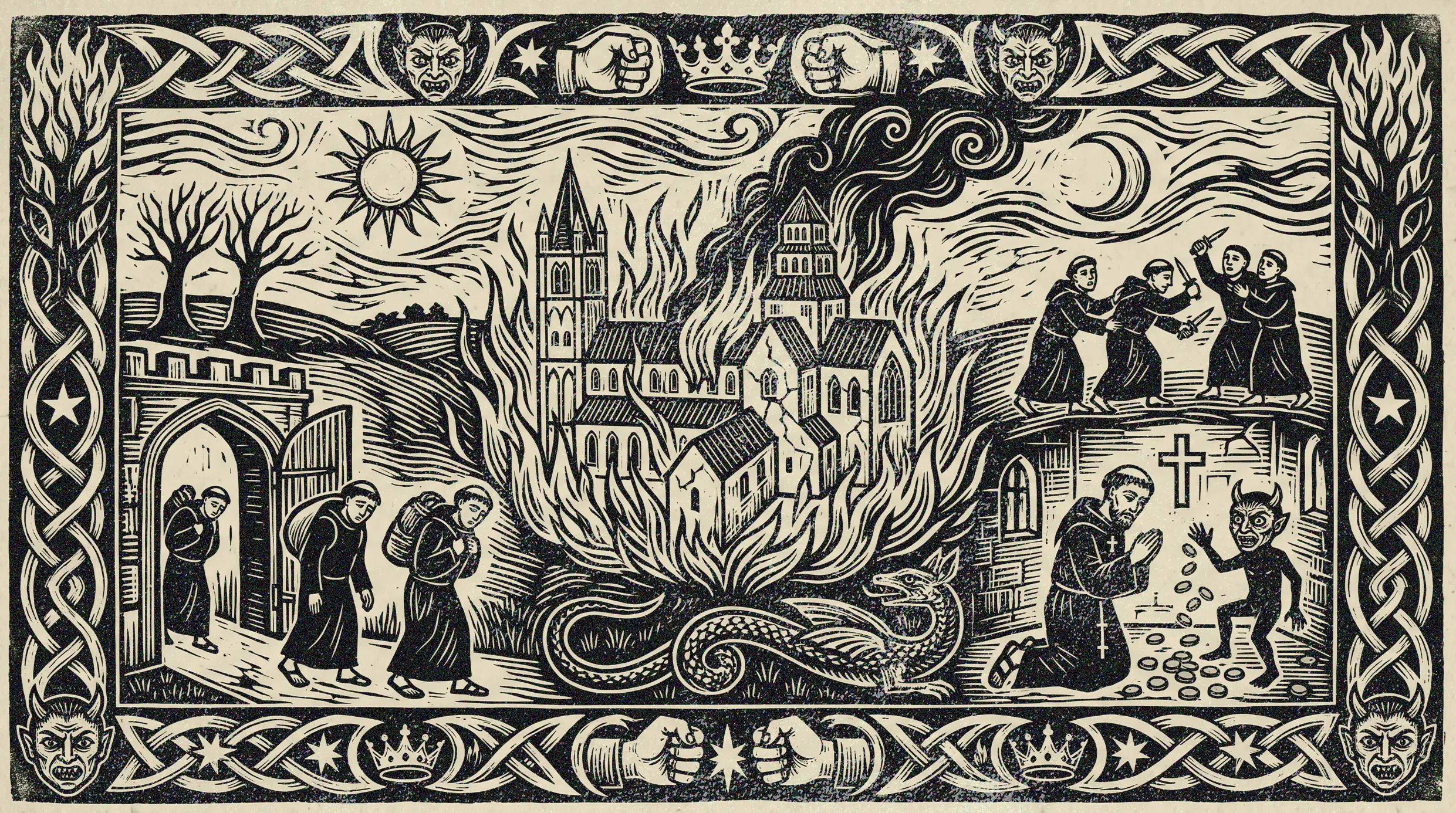
Come, Devil
A catastrophic historical fire became inseparable from a story about anger, prophecy and one disastrous invitation.
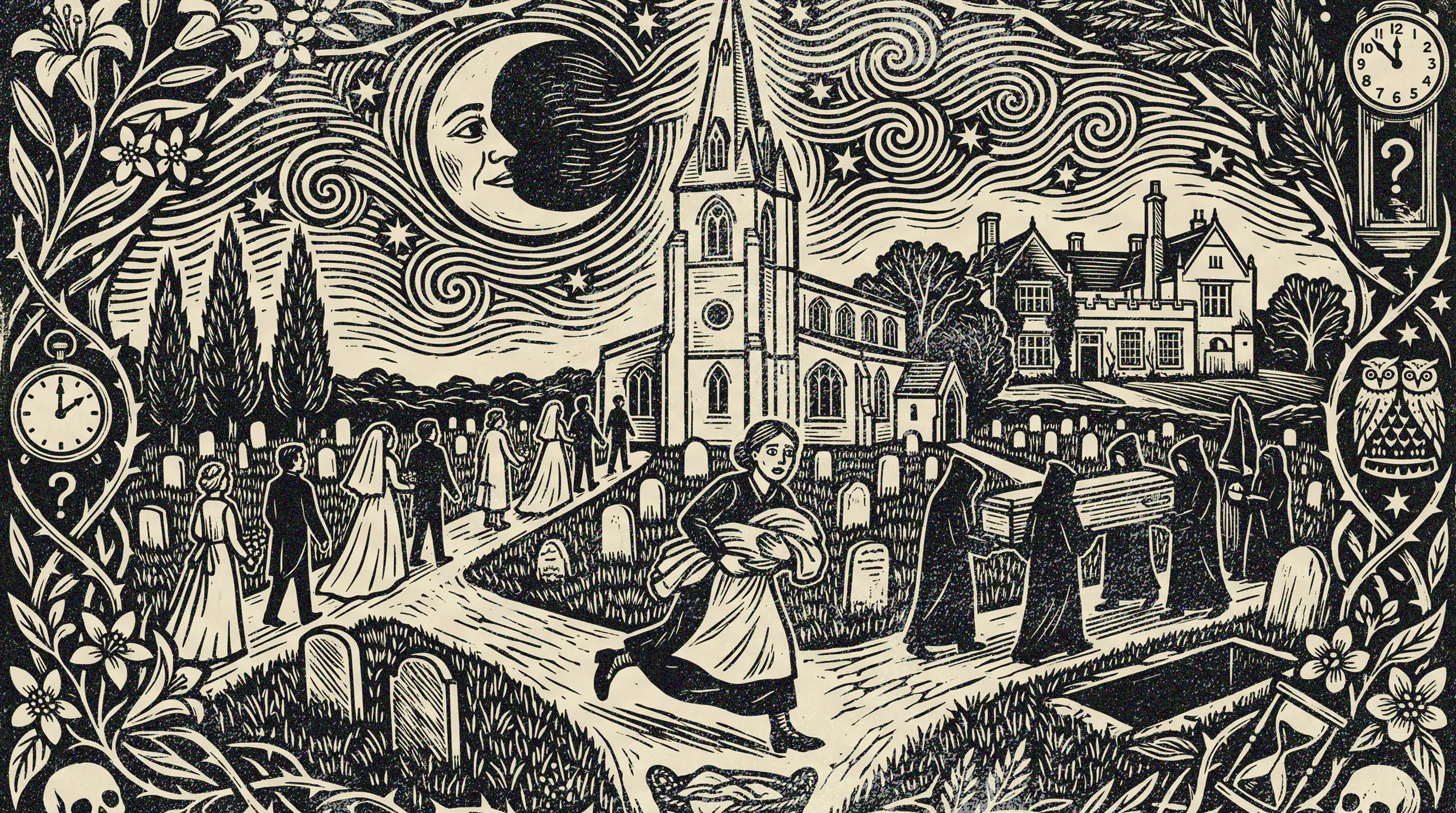
St Mark's Eve
Sit in the churchyard on the right night and tradition said the coming year's marriages and funerals might reveal themselves.
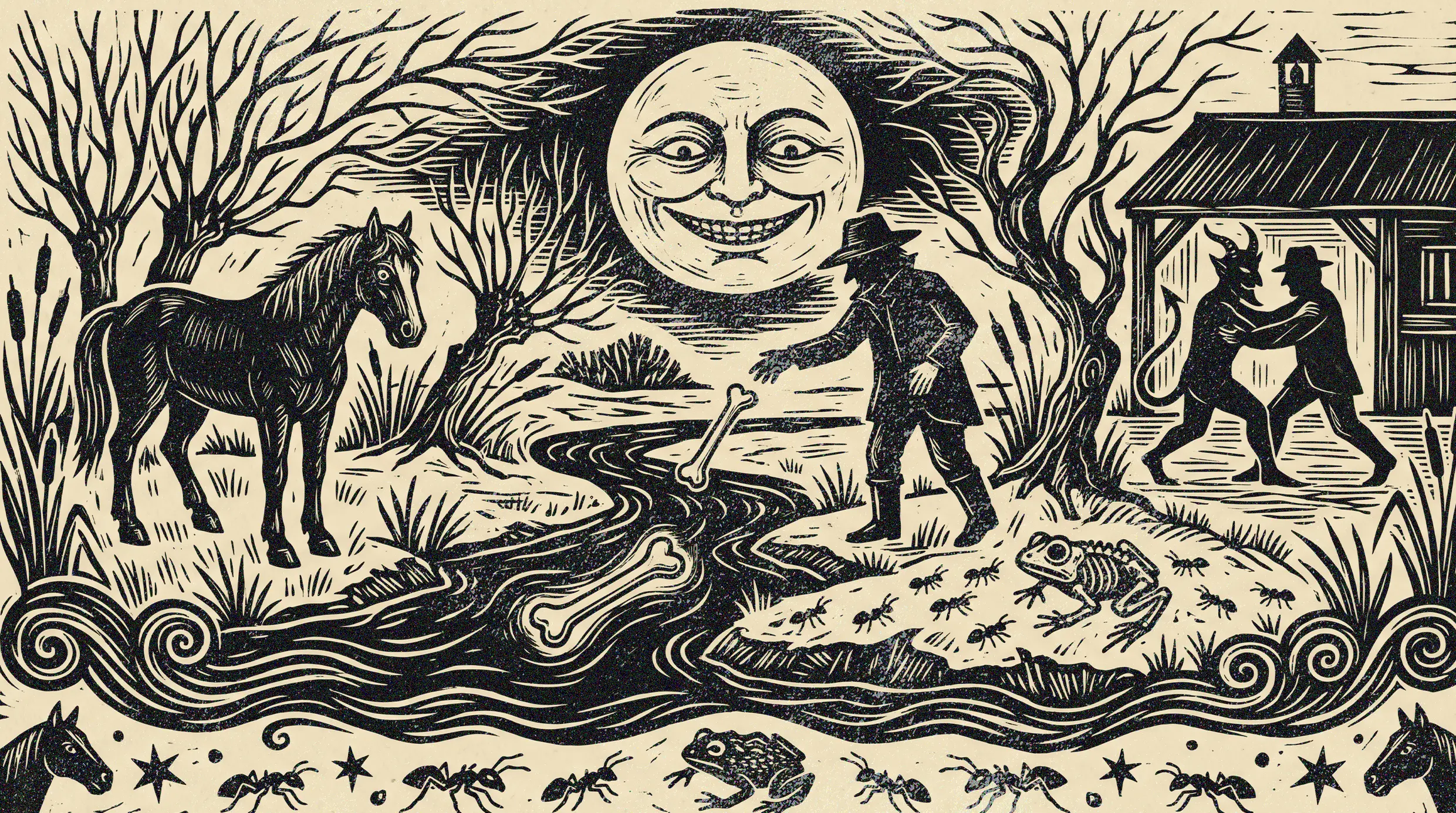
The Toadmen
Men who worked with horses were said to acquire a strange power by obtaining one particular bone from a toad.
Behind the omen
The Peterborough hare-and-fire tradition is genuinely documented in nineteenth and early twentieth-century folklore collections. The superstition itself is presented here as historical belief, not as evidence that hares predict fires.
-
Charles Dack · Weather and Folk Lore of Peterborough and District
Published in 1911. Dack records the Peterborough rhyme linking a hare in the Minster Close with a fire in the town and notes that coincidences had helped preserve its reputation. -
Northamptonshire Notes and Queries · Volume 1
W. D. Sweeting's nineteenth-century material records the wider Northamptonshire fire-omen tradition and the remarkable Peterborough marketplace incident of 1884. -
Joseph Pentangelo · The Grant, the Hare, and the Survival of a Medieval Folk Belief
Published in Folklore in 2019. Pentangelo examines English traditions connecting hares with fire, including the 1884 Peterborough incident, and proposes a possible relationship with the medieval Grant tradition. -
Discover Peterborough · Peterborough Cathedral History
Explore the wider history of the Cathedral precinct, including the medieval fires that repeatedly transformed the monastery and church. -
Discover Peterborough · Peterborough Folklore
The main collection of Peterborough legends, omens, hauntings and unusual historical traditions. -
Discover Peterborough · Weird Weekends
Find the Minster Close and dozens of other unusual Peterborough stories in the real places where they belong.