
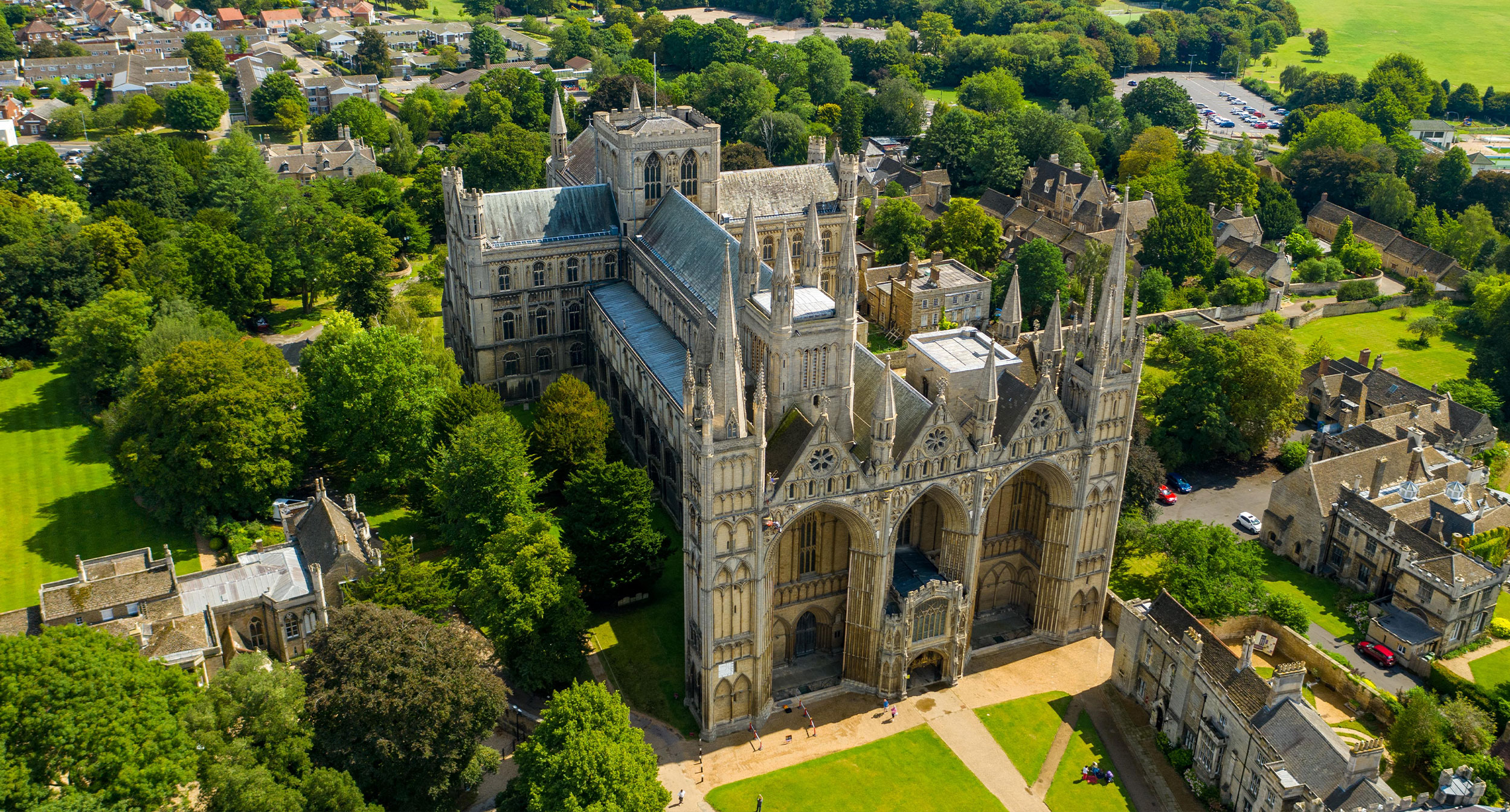


The Ghost of Barnack Rectory Button Cap
Footsteps in an empty room. Pages turning by themselves. Barrels rolling through the cellar. And a dead rector still searching for the document that might undo an old injustice.
Nobody saw him. Everybody knew him.
Of all Peterborough's supernatural characters, Button Cap may be one of the most strangely convincing.
Not because anyone claimed to have watched an apparition materialise in front of them. Quite the opposite. The ghost of Barnack Rectory was apparently heard rather than seen. Yet the household knew his clothes, his temperament, his habits and even the reason he could not rest.
He was said to be the spirit of a former rector of Barnack. In life, according to the story, he had wronged a widow and an orphan. Somewhere there had been a deed, a document that might expose what had happened or perhaps put the injustice right.
But the deed had disappeared.
And Button Cap had apparently been looking for it ever since.
At night the household heard the sound of loose slippers crossing the Great North Room. Books seemed to be disturbed. Pages turned. The invisible occupant appeared to be searching, endlessly and unsuccessfully, for the paper he could never find.
It is this detail that gives the story its peculiar power. Button Cap was not simply haunting a house.
He had unfinished business.
A rectory with a room everyone already feared.
When the Kingsley family arrived at Barnack in 1824, they inherited more than a rectory. They inherited its ghost.
Charles Kingsley was five years old. His father had been appointed rector of Barnack and the family moved into the substantial stone house beside one of the region's most remarkable ancient churches.
The building survives today as Kingsley House. Historic England describes its principal surviving historic fabric as early sixteenth century, with later alterations and a substantial nineteenth-century extension. The Kingsley family's own memoir described the old rectory as being of even earlier date.
Somewhere inside this complicated old building was the Great North Room.
By the time the Kingsleys arrived, the room already had a reputation.
Somewhere in the books was a missing deed.
The haunting had a moral attached to it. Button Cap was not remembered as the victim of murder or some Gothic catastrophe. In Kingsley's account he had himself been a rector, and his alleged wrongdoing was altogether more human.
That was why the ghost searched.
The endless turning of pages was not simply unexplained noise. Within the logic of the story it was punishment. Button Cap was looking for the deed he had lost or concealed, attempting after death to resolve something he had failed to put right in life.
It is a wonderfully English kind of haunting. There are no chains, no ruined castle and no bloodstained apparition.
Just a clergyman, a guilty conscience and paperwork that refuses to stay forgotten.

Charles Kingsley knew Button Cap.
That is what makes this story different. One of Victorian Britain's best-known writers left his own account of the Barnack ghost.
Kingsley would grow up to become a clergyman, historian, social campaigner and novelist, remembered above all as the author of The Water-Babies and Westward Ho!.
But before all of that, he was a child at Barnack.
Family recollections say that during an illness he was even moved into the haunted Great North Room. Whatever he made of the noises, the story stayed with him.
Decades later, Kingsley could still describe Button Cap with remarkable precision and a great deal of humour.
“Everybody heard him who chose. Nobody ever saw him.”Charles Kingsley · letter of 2 June 1864
That single sentence captures much of the strange quality of Button Cap. There was no apparition to describe and no spectral face to remember. The ghost existed through sound, expectation and the shared memory of the household.

Then he started on the barrels.
The story is unusually close to the historical record.
Most old ghost stories become difficult to trace. A name is attached to a building, later writers repeat the tale and, after enough retellings, nobody is quite sure where it began.
Button Cap is different.
We know that Kingsley House is the former rectory. We know that Charles Kingsley's father was rector of Barnack and that Charles lived here as a child. Most importantly, we have Kingsley's own nineteenth-century description of the ghost.
That does not prove that Button Cap walked the Great North Room. It does something more interesting for the history of folklore: it proves that the story was already part of the household tradition while somebody who had actually lived in the house could still describe it.
Kingsley himself was hardly an unquestioning witness.
As an adult, he treated the whole business with considerable scepticism. He joked that perhaps ghosts disappeared when people stopped believing in them.
Or perhaps there was an altogether more ordinary explanation for the noises.
“He was rats!”
It is a perfect conclusion from the man who had actually slept in the haunted room.
Yet Kingsley's scepticism did not kill the story. It became part of it.
Was Button Cap a supernatural penitent? Rats moving through an old house? Timber shifting in the night? Childhood imagination? A family story repeated until every creak acquired meaning?
Folklore does not always require us to choose.
Button Cap belongs to Barnack.
The landscape around this story is not imaginary.
Barnack remains one of the most historically distinctive villages in the Peterborough area, shaped by ancient stone, medieval buildings and centuries of religious history.
The old rectory survives as Kingsley House, carrying the name of the family who made its ghost famous.
Nearby stands the remarkable Church of St John the Baptist, whose Anglo-Saxon fabric predates almost everything in the Button Cap story.
That physical survival matters.
Folklore is at its most powerful when it remains attached to a real landscape. Button Cap is not simply a generic English ghost transplanted onto Peterborough. His story has a particular village, a particular house and, according to generations of telling, a particular room.
Perhaps somebody finally found the deed.
The nineteenth-century account is not quite the end of Button Cap's story.
A much later local tradition carries the haunting into the twentieth century. Soldiers are said to have been billeted at the old rectory during the Second World War.
According to the tale, somebody eventually decided to address the restless old rector directly.
You're wasting your time.
We have found the papers.
This episode belongs to the later tradition surrounding Button Cap rather than to Kingsley's nineteenth-century account.
Whether anyone ever wrote those words is less important than what their appearance in the story tells us.
Button Cap had become so familiar that later generations could talk back to him.
Peterborough folklore is history remembered differently.
Button Cap is funny, eerie and oddly sympathetic. Beneath the ghost story, however, is something much older: the idea that wrongdoing leaves a mark, that injustice demands correction and that a guilty conscience can outlive the person who carried it.
It is also a story about the way places acquire memory.
A room becomes associated with a sound. A child grows up and remembers it. The child becomes a famous writer. His words are published. Villagers keep telling the tale. Later generations add another ending.
Somewhere along the way, the haunting becomes part of Barnack itself.
Peterborough found his story.
More Peterborough Folklore
Spectral riders, Fenland magic, impossible animals and stories that have survived for centuries. Button Cap is only one part of Peterborough's strange landscape.
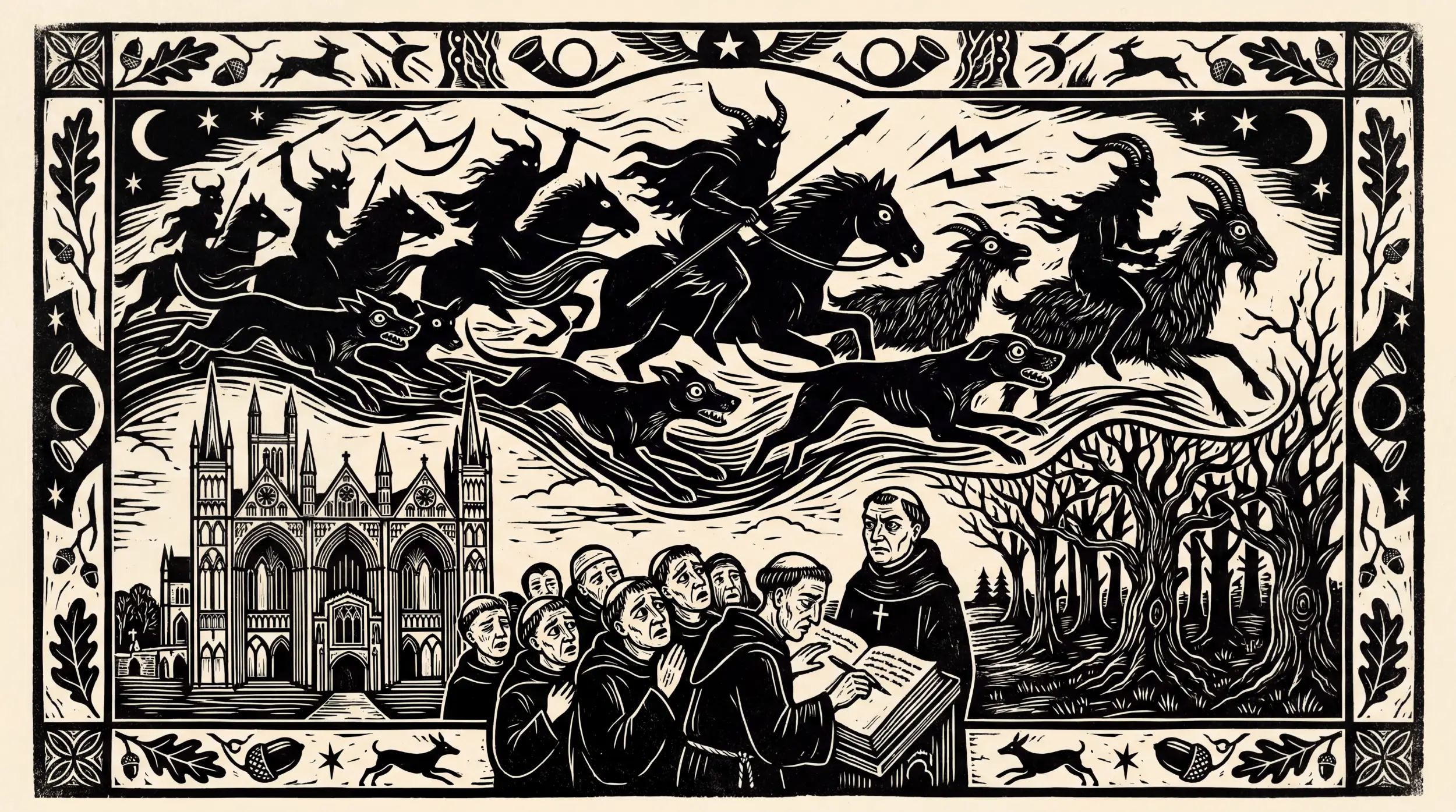
The Wild Hunt
Black riders, unnatural hounds and hunting horns heard through the woods after the arrival of an unpopular abbot.
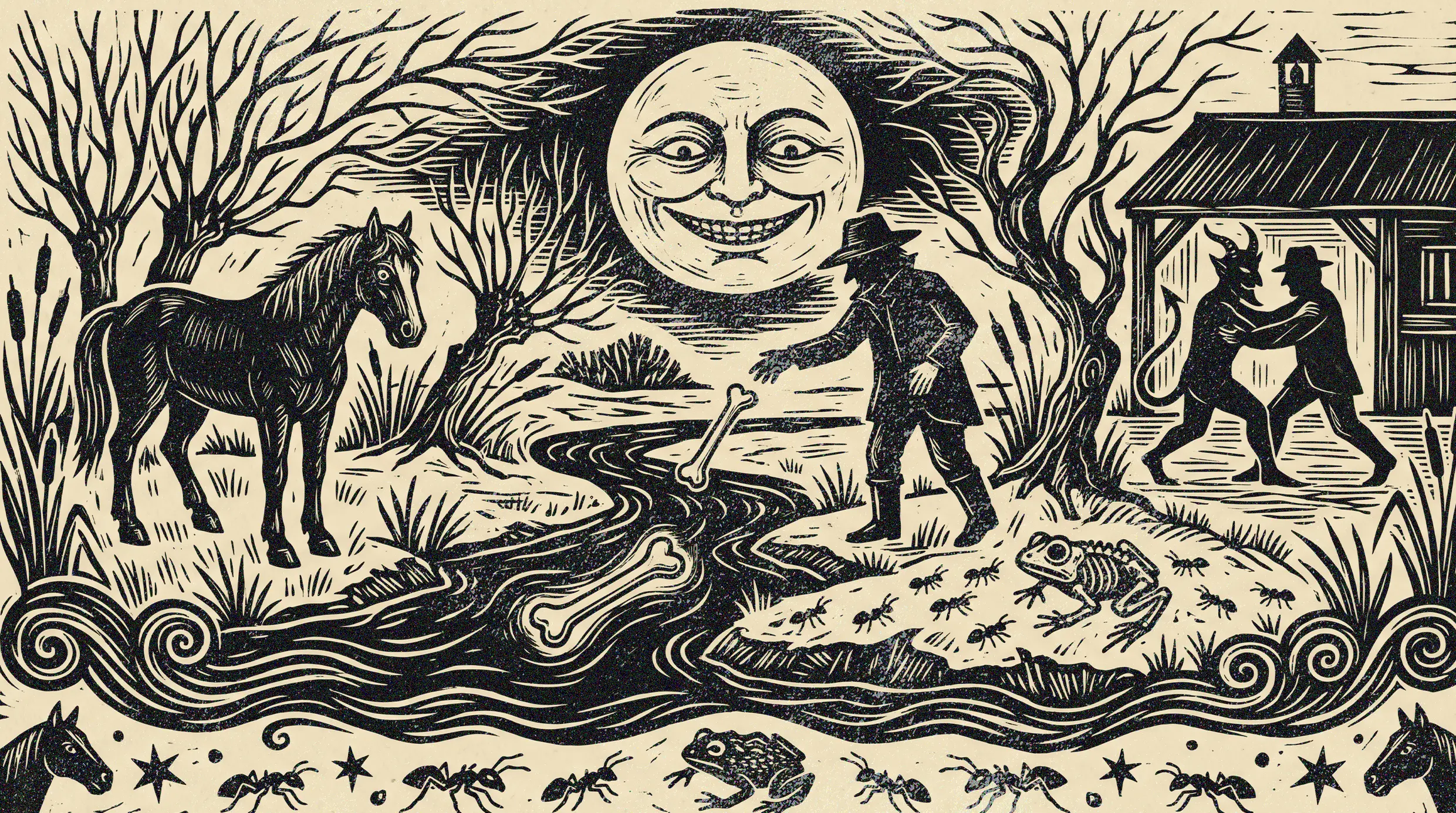
The Toadmen
Men said to possess a secret bone capable of mastering horses and giving its owner extraordinary power.
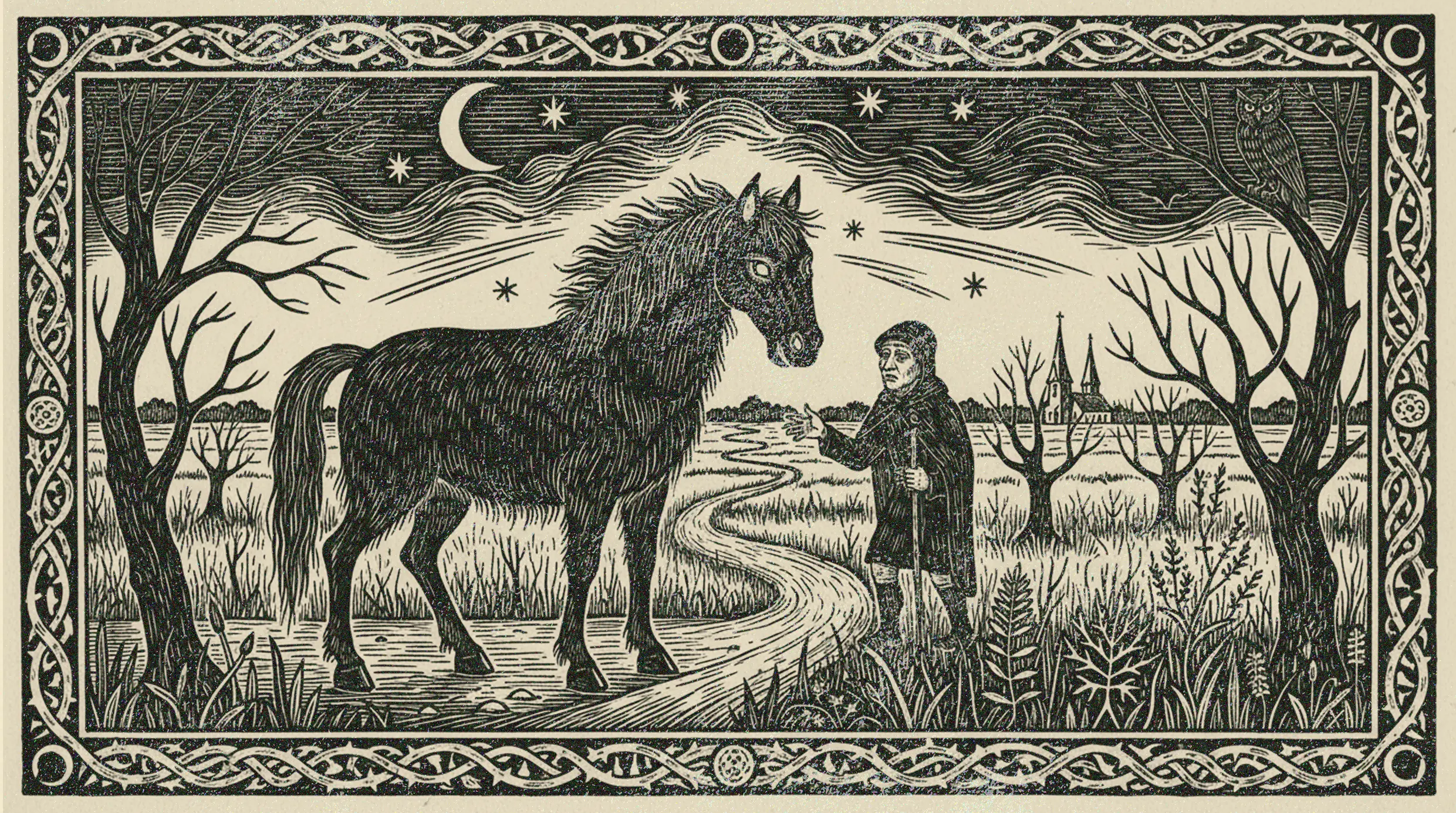
The Shag Foal
Around Barnack and Helpston, travellers once feared a huge shaggy creature encountered after dark.
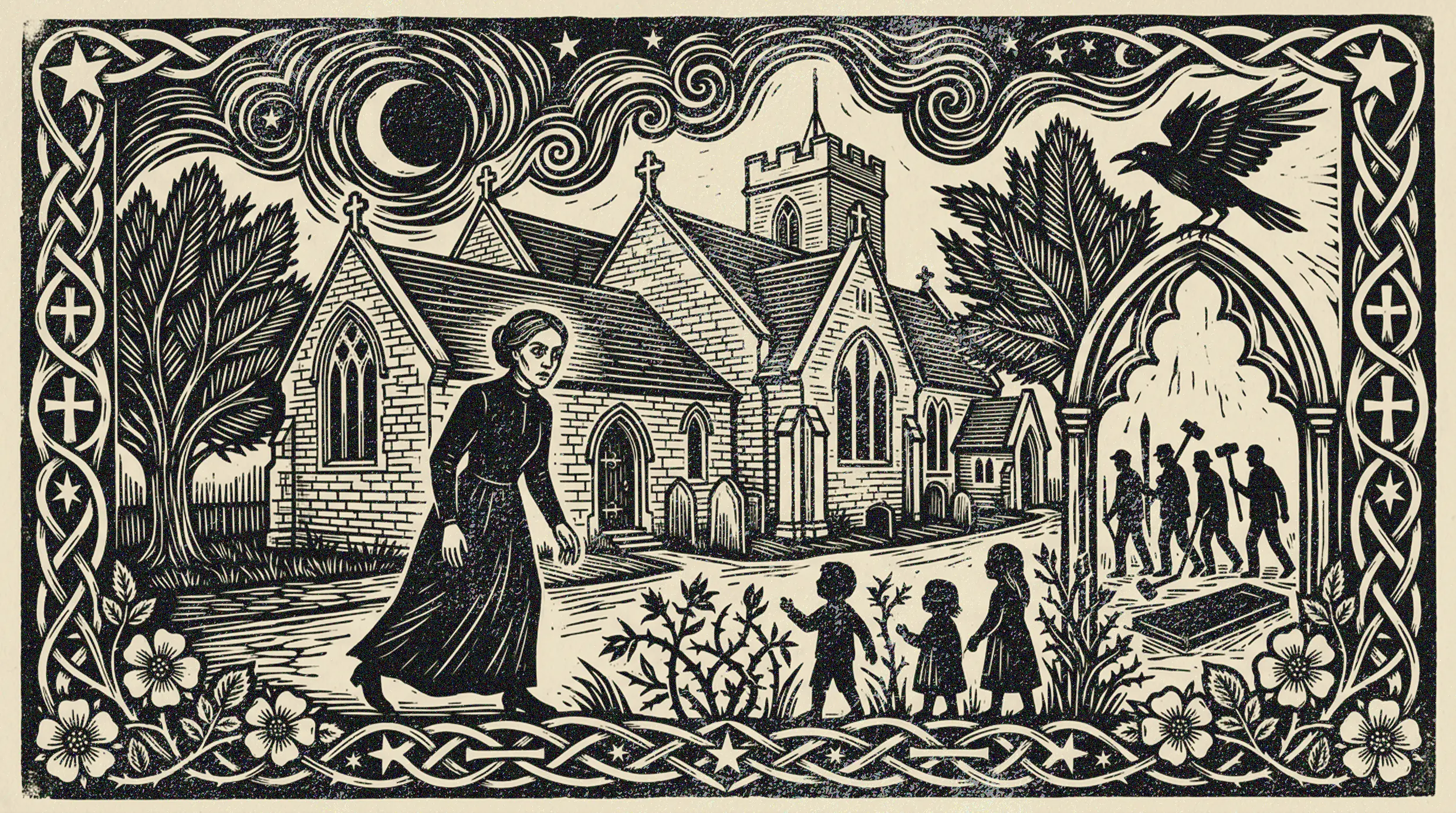
The Woman in Black
A Peterborough haunting first reported in 1908 and still discussed by local witnesses decades later.
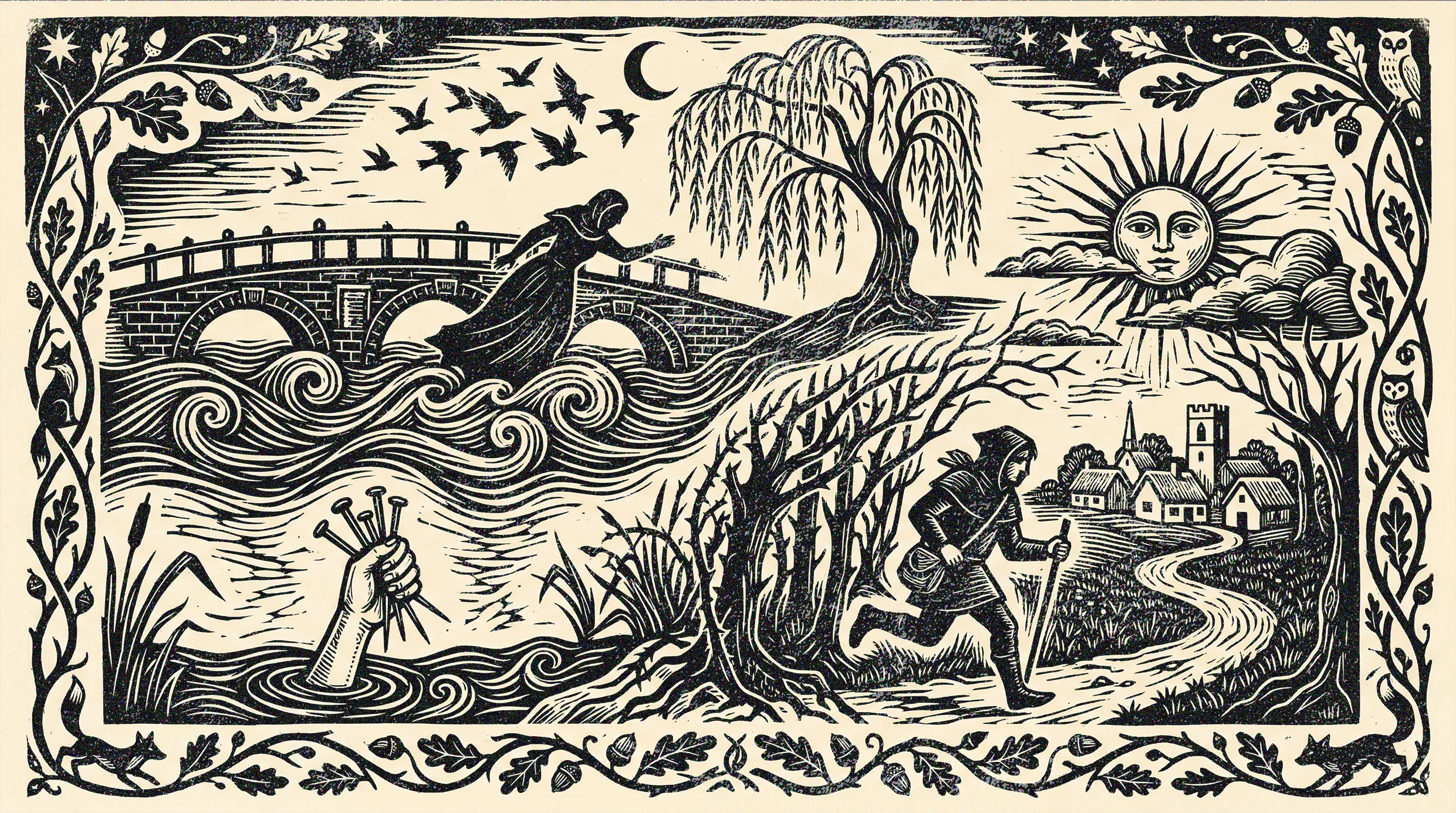
The Witch of Ailsworth
A disturbing tenth-century accusation involving a widow, her son, iron pins and a royal land charter.
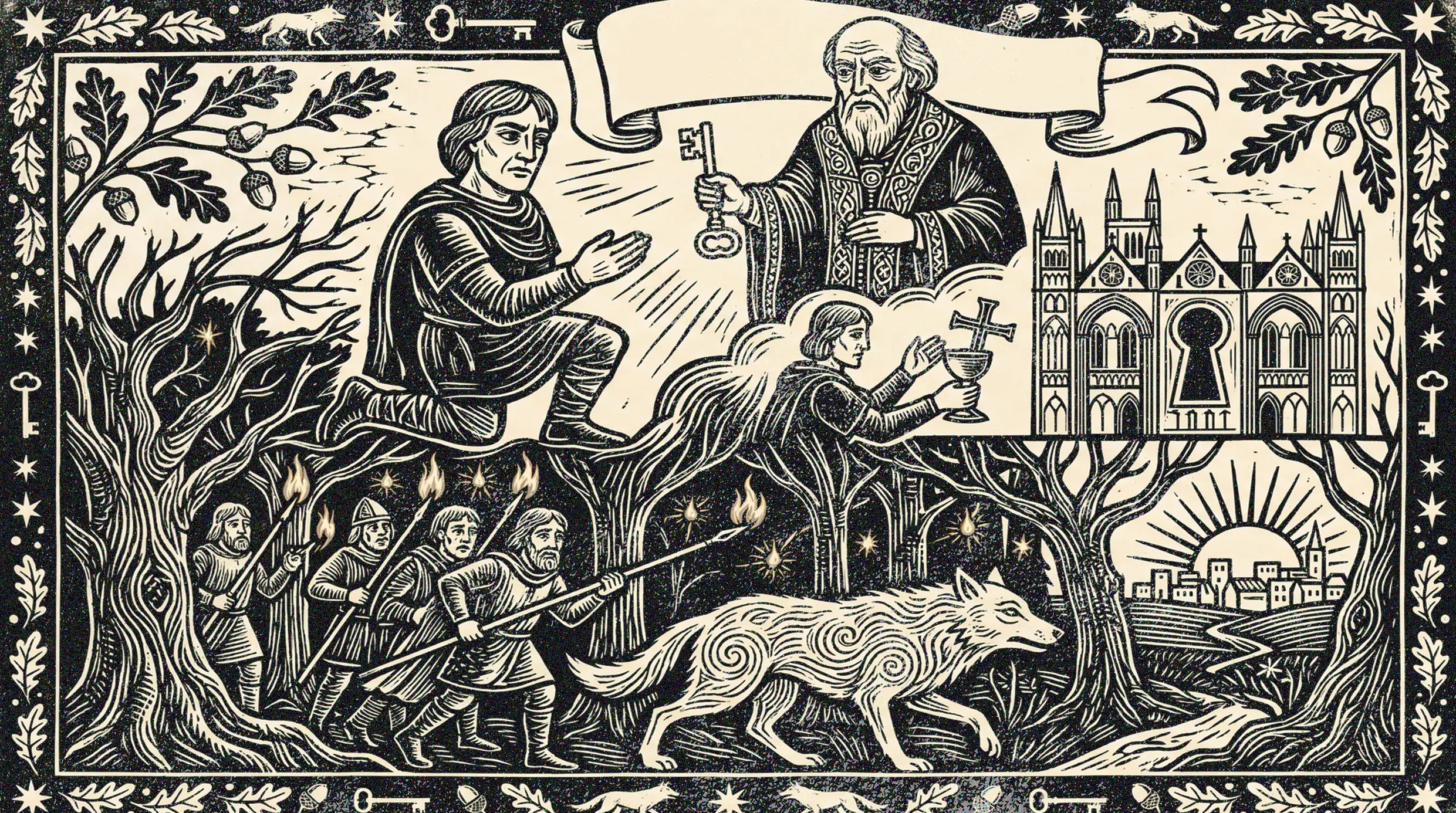
Hereward & the White Wolf
A dream, strange fire and a great white wolf guide Hereward's men through the dark landscape beyond Peterborough.
Behind the folklore
Folklore changes as it is retold. This page distinguishes where possible between Charles Kingsley's nineteenth-century account, the documented history of Kingsley House and later local tradition.
-
Charles Kingsley: His Letters and Memories of His Life
Includes Kingsley's letter of 2 June 1864 describing Button Cap, the Great North Room, the missing deed, the slippers and the cellar disturbances. -
Historic England · Kingsley House
Listing information for the former Barnack Rectory and its surviving historic fabric. -
Later Barnack tradition
The wartime conclusion belongs to subsequent retellings of the Button Cap story rather than Kingsley's nineteenth-century account.