A bestselling spy novelist in Castor, a Roman excavation in his garden, experimental radio broadcasts, a literary trail towards James Bond and an Egyptian collection he believed was cursed. William Le Queux had an extraordinary life.
A life in dates
- 1864 William Tufnell Le Queux is born
- 1902 Takes part in archaeological excavation at The Cedars in Castor
- 1903 The Tickencote Treasure and The Three Glass Eyes are published
- 1906 The Invasion of 1910 becomes a publishing sensation
- 1909 Publishes Spies of the Kaiser during the height of Edwardian spy fever
- 1919 Begins establishing an experimental wireless station at Guildford
- 1921 Broadcasts speech and music using the call sign 2AZ
- 1922 Publishes Tracked by Wireless
- 1923 Publishes the memoir containing his extraordinary account of sending his Egyptian collection to Peterborough Museum
- 1924 Becomes first President of the Hastings, St Leonards and District Radio Society
- 1927 Dies aged 62
The writer at Castor
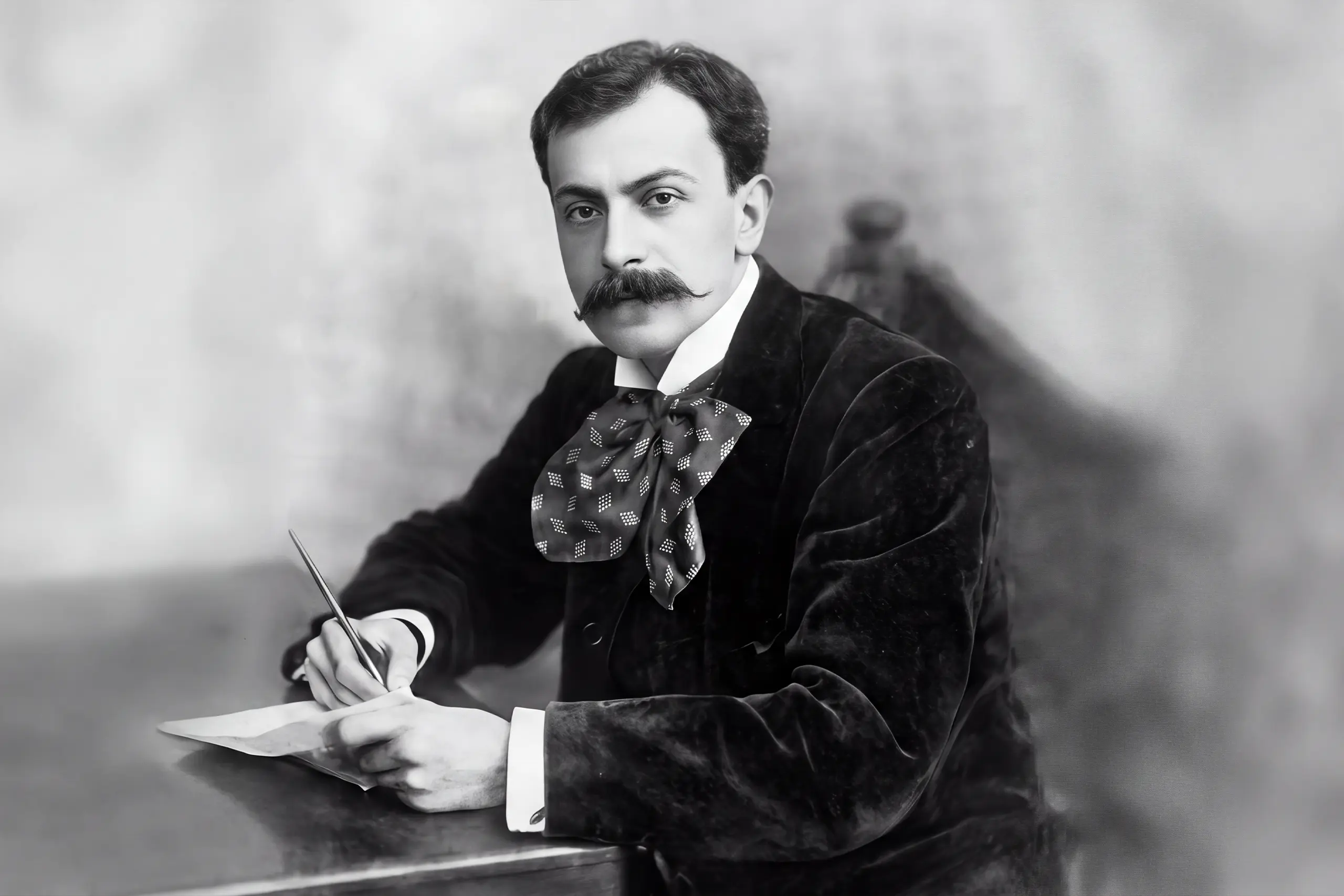
William Tufnell Le Queux was one of the bestselling popular novelists of Edwardian Britain, but one of the most intriguing chapters in his extraordinary life took place in Castor, just outside Peterborough.
At the beginning of the twentieth century he owned The Cedars on Peterborough Road, an early eighteenth-century house which survives today and is Grade II listed.
It was a particularly appropriate home for a writer fascinated by hidden histories, secret documents and buried treasure. Beneath Castor lie the remains of an enormous and important Roman complex traditionally known as the Praetorium.
In 1902 Le Queux and Captain S. Walker took part in excavations in the grounds of The Cedars. Archaeological records describe the discovery of a Roman floor of square red tiles in the south-east corner of the lawn, associated with the bath complex previously explored by the pioneering Peterborough antiquarian Edmund Artis.
One of Britain's great writers of buried secrets was, quite literally, excavating Roman archaeology from his own garden.
Castor and the surrounding landscape also found their way into Le Queux's fiction. The Tickencote Treasure takes its name from nearby Tickencote, while other works contain references to Peterborough and the wider area.
Spies, invasion and panic
Le Queux made his name writing a form of fiction that would become one of the defining genres of the twentieth century: the spy thriller.
His novels were packed with secret agents, stolen documents, international conspiracies, clandestine organisations and threats to Britain from hostile foreign powers.
He was particularly associated with the wave of invasion literature that flourished during a period of growing European tension before the First World War.
His most notorious success was The Invasion of 1910, which was serialised by the Daily Mail in 1906. It imagined a German invasion of Britain and became a publishing phenomenon.
Le Queux did not always keep a comfortable distance between fiction and reality. He publicly warned that German agents were already operating throughout Britain and became one of the most recognisable voices in the phenomenon historians have called Edwardian spy fever.
Before James Bond
There is also a tantalising literary line between William Le Queux and Britain's most famous fictional secret agent.
Long before Ian Fleming wrote Casino Royale, British writers had already created a popular world of foreign agents, secret intelligence, conspiracies, exotic locations and threats to national security.
Historian Andrew Cook identifies Le Queux among the thriller writers Ian Fleming read as a schoolboy, alongside John Buchan and “Sapper”.
Fleming would ultimately create something distinctly his own, shaped by his wartime intelligence experience and the world of the Cold War, but he grew up reading a British espionage and adventure tradition that writers such as Le Queux had helped establish decades earlier.
Le Queux did not create James Bond. But he belongs to the literary prehistory of 007.
A wireless pioneer
Le Queux was not merely fascinated by the technologies of his age. He experimented with them.
He became an enthusiastic early wireless operator and a member of the Institute of Radio Engineers. Writing in Popular Wireless in 1922, he described himself as having experimented with wireless for around fifteen years.
At the end of 1919 he began developing an experimental transmitting station at Guildford. The process was hardly straightforward: his account describes damaged equipment, failed components and the difficulties of making the new technology work reliably.
During 1921 Le Queux said that he transmitted speech and music almost every evening for seven months.
He reported receiving feedback from around one hundred amateur listeners around Britain on the strength and quality of his signal.
His enthusiasm inevitably entered his fiction. In 1922 he published Tracked by Wireless, using mysterious transmissions, new communications technology and wireless operators as material for crime and adventure stories.
Le Queux later became the first President of the Hastings, St Leonards and District Radio Society. At its inaugural lecture in 1924, the speaker was a local inventor experimenting with the transmission of moving pictures.
His name was John Logie Baird.
Le Queux became an enthusiastic supporter of Baird and the emerging possibilities of television. The novelist who had made his name imagining secret communications was now watching another communications revolution begin.
The Egyptian collection
Le Queux's interests extended into archaeology, manuscripts and Egyptology, and his own memoir contains one of the strangest stories associated with Peterborough Museum.
In Things I Know About Kings, Celebrities, and Crooks, published in 1923, he recalled visiting Egypt and being introduced to an antiquities dealer at Luxor by the distinguished Egyptologist Gaston Maspero.
Le Queux described acquiring a remarkable collection of Egyptian objects.
The collection included
- Strings of beads
- Amulets
- Ushabti figures
- An alabaster canopic jar
- A lapis-lazuli eye
- A gilded mummy mask
He believed the gilded mask had belonged to a priestess of Isis and said it had been found near Aswan.
According to Le Queux's account, after the collection was displayed at his home a series of misfortunes followed, including deaths, financial losses and the death of his pet collie. He eventually became convinced that the Egyptian objects were somehow responsible.
“I packed up the whole of my Egyptian collection, including the mummy-mask, and sent it to the Peterborough Museum.”
There is no evidence that an ancient curse was responsible for the events Le Queux described, and he was a gifted storyteller with a reputation for embellishment.
The important Peterborough connection is less supernatural but no less intriguing: Le Queux's own published memoir explicitly records Peterborough Museum as the destination of his Egyptian collection.
The books
Le Queux was extraordinarily prolific, producing scores of novels and collections during a career that stretched across the late Victorian and Edwardian periods and into the 1920s.
- 1894 The Great War in England in 1897 Invasion fiction
- 1903 The Tickencote Treasure Local connection
- 1903 The Three Glass Eyes Peterborough references
- 1904 The Closed Book
- 1905 The Czar's Spy
- 1906 The Invasion of 1910 Bestseller
- 1909 Spies of the Kaiser Spy fiction
- 1922 Tracked by Wireless Wireless fiction
- 1923 Things I Know About Kings, Celebrities, and Crooks Memoir
His place in the story
William Le Queux is difficult to fit neatly into a single category. He was novelist and journalist, traveller and collector, amateur archaeologist and technologist, enthusiast and tireless self-publicist.
Some of his claims need to be treated with caution, but that is part of what makes him such a fascinating figure. His life occupied the blurred territory between journalism, adventure, technological change, popular fiction and performance.
A bestselling spy writer living over Roman ruins in Castor, transmitting music across Britain and packing up a supposedly cursed mummy mask for Peterborough Museum.
His connection with Peterborough brings together an extraordinary collection of stories: the Roman past beneath Castor, the birth of modern spy fiction, early wireless broadcasting, the beginnings of television and the strange afterlife of an Egyptian collection.
Few Peterborough People can have inhabited quite so many different worlds.