
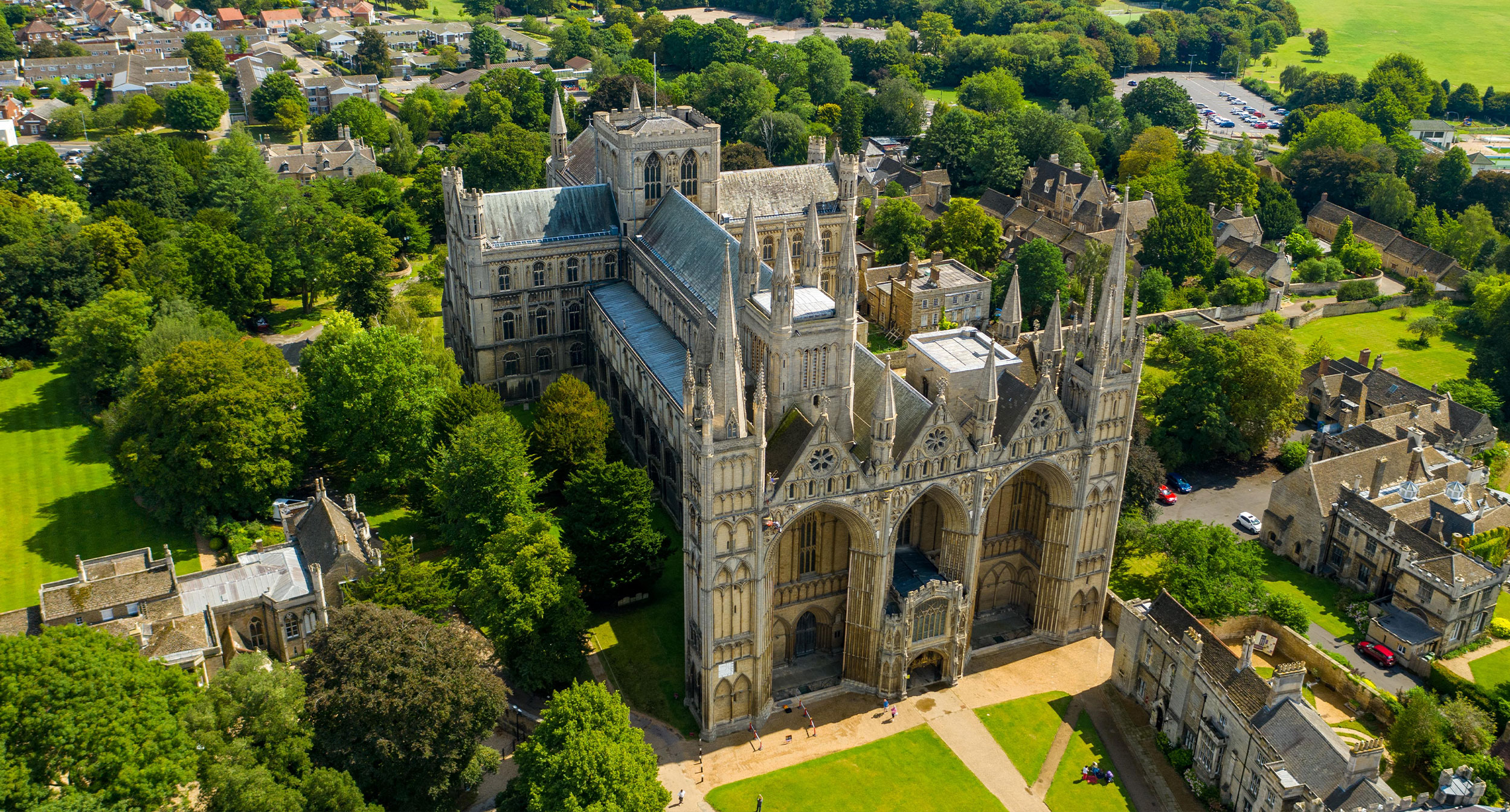


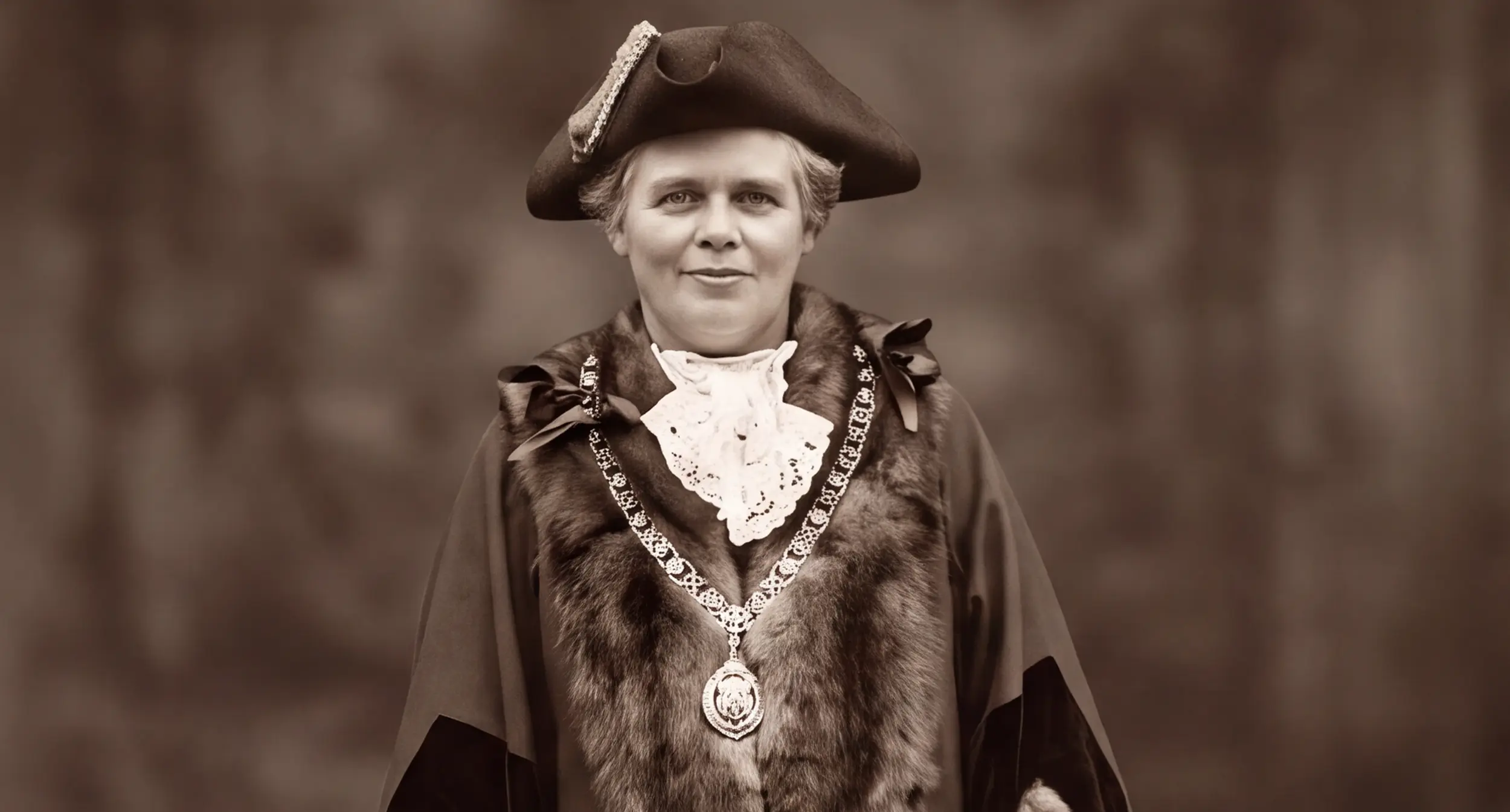
Lily Violet Bryant was the woman who broke two of the most visible barriers in Peterborough civic life. In 1930 she became the city's first woman councillor. Eight years later she became its first woman mayor, leading Peterborough as Britain prepared for war and using public office to champion children, housing, maternity and community welfare.
Life and career in dates
- 1882 Born Lily Violet Hickes at Hornsey, Middlesex, on 10 June
- 1890s Receives part of her education in Dresden after attending school in Chiswick
- 1902 Marries engineer Charles William Bryant
- 1900s The Bryant family settles in Peterborough through Charles's connection with Peter Brotherhood
- 1916 Family moves to Westwood House, which becomes their Peterborough home for almost twenty years
- 1930 Elected Peterborough's first woman councillor for West Ward with 2,620 votes
- 1935 Husband Charles and son John die within six months of each other
- 1938 Elected the first woman Mayor of Peterborough
- 1939 Leads the city as Britain enters the Second World War
- 1940 Completes her mayoralty in November after two extraordinary years
- 1960 Leaves Peterborough to live permanently with family in Australia
- 1965 Dies suddenly in Australia on 23 February
A very different beginning
Lily Violet Hickes was born on 10 June 1882 at her grandparents' home in Hornsey, Middlesex, into a prosperous Victorian family whose world was a long way from council chambers and municipal politics.
Known throughout her adult life as Violet, she was one of the children of William Hickes and Louisa Keller.
Her maternal grandfather Leopold Keller was a successful diamond and pearl merchant and goldsmith. The family valued education and possessed the resources to provide it.
After attending school in Chiswick, Violet was sent as a teenager to Dresden, where her older sister was already at boarding school.
On returning to England she faced the restricted range of respectable occupations available to women of her social background and worked for a time as a governess.
Yet the young Violet appears to have been unusually independent.
She embraced travel, moved comfortably through a wide social world and was associated with motoring when cars themselves were still a novelty.
Coming to Peterborough
On 6 October 1902 Violet married Charles William Bryant.
Charles was an engineer whose career ultimately connected the couple with one of the great names in Peterborough's industrial story: Peter Brotherhood.
The Brotherhood engineering business relocated from London to Peterborough during the first decade of the twentieth century. Charles became one of its senior figures, and the family's life became increasingly rooted in the city.
The Bryants settled first at Charnwood in Fletton.
Their household occupied a striking position between industrial and social Peterborough. Charles worked within a major engineering company while Violet entertained visitors at home, including figures moving through the city's increasingly important commercial and professional networks.
One particularly memorable visitor was the Antarctic explorer Sir Ernest Shackleton.
Their children grew up with the extraordinary industrial landscape of Fletton almost on the doorstep, where brick pits, railways, engineering and rapidly expanding suburbs were transforming Peterborough.
Violet Bryant arrived in an industrialising Peterborough as an engineer's wife. She would eventually become the first woman to lead its civic life.
Life at Westwood
After several years in Fletton and Stanground, the Bryant family moved to Westwood House in 1916.
They remained there for nearly twenty years.
The Peterborough surrounding them looked very different from the modern city. Westwood still lay close to countryside, with family walks leading towards Thorpe Park, Longthorpe and the Nene.
The house became a busy family home.
Education mattered greatly to Violet and Charles. Their son went on to study at Cambridge before entering engineering, while their daughters received extensive education at schools and colleges around Britain.
The family's life also illustrates the extraordinary social transformation occurring around them.
Peterborough was moving rapidly from Victorian railway and market town towards an industrial centre with major engineering, brickmaking and manufacturing interests.
Violet increasingly turned her attention towards another part of that changing city:
the people whose lives were not nearly as comfortable as her own.
Entering public life
Bryant's route into politics grew from welfare and public service.
She served on the Board of Guardians and became particularly interested in issues affecting women and children.
Child welfare, education, maternity provision and housing would remain among her central concerns.
These were not marginal questions.
Britain between the wars still contained profound poverty and poor housing conditions, while responsibility for welfare was distributed across councils, voluntary organisations, hospitals, churches and charitable bodies.
Bryant argued that women's experiences gave them knowledge that local government could not afford to exclude.
The argument may seem unremarkable today.
In Peterborough in 1930, it was revolutionary enough that no woman had yet sat on the city council.
Peterborough's first woman councillor
On 1 November 1930, Violet Bryant stood as a Conservative candidate for Peterborough's West Ward.
She received 2,620 votes.
It was a record-breaking total.
More importantly, it carried Bryant across a barrier that had survived the extension of women's political rights after the First World War.
She became the first woman elected to Peterborough City Council.
Peterborough civic first
1930Lily Violet Bryant became the first woman elected to Peterborough City Council.
The Peterborough Standard recognised the significance immediately, praising her for breaking what it described as the city's exclusively male tradition.
Bryant's election was not merely symbolic.
She proved sufficiently popular with voters to defend the seat successfully twice.
The council chamber had always been male. In 1930, Peterborough's voters changed that.
Peterborough's first woman mayor
Eight years after entering the council, Bryant broke another barrier.
In November 1938 she was elected Mayor of Peterborough.
It was the first time a woman had occupied the city's highest civic office.
The occasion was understood to be historic at the time. At her installation, General Strong described the appointment as a significant departure from precedent.
There had previously been uncertainty about whether Peterborough's male civic establishment was ready to appoint a woman.
When the moment came, however, Bryant was chosen without opposition.
Two barriers broken
Her mayoralty would have been historically important under any circumstances.
Events made it considerably more consequential.
Less than a year after she took office, Britain was at war.
Women, welfare and housing
Bryant repeatedly argued that women brought essential perspectives to local administration.
She was particularly concerned with children.
Contemporary welfare statistics reveal the scale of deprivation confronting local organisations. In 1933 alone, the Peterborough branch of the NSPCC dealt with hundreds of children requiring assistance.
Housing conditions could be deeply inadequate, particularly among poorer families in parts of the rapidly expanding urban area.
Bryant's concerns therefore included child welfare, education, maternity services and decent housing.
She was also involved with the Stanground Social Service Association, which campaigned for improved local welfare and better housing conditions.
Her civic priorities
Bryant also connected Peterborough with wider women's organisations.
She participated in national and international women's networks and attended conferences overseas.
Her politics were therefore simultaneously local and international: potholes, housing and children's welfare in Peterborough on one hand, women's representation and civic participation on the other.
A city prepares for war
Bryant's mayoralty coincided almost exactly with Peterborough's preparations for the Second World War.
Council minute books reveal the range of decisions with which the city grappled.
Air-raid shelters had to be located.
Sirens had to be installed.
Emergency ambulances had to be acquired.
First-aid provision had to be organised.
Arrangements were considered for gas masks, civil defence, blackouts, food control, allotments, evacuees and emergency mortuaries.
Local government was suddenly preparing for the possibility that Peterborough itself might become a battlefield from the air.
Peterborough, September 1939
The city at warWhen Britain declared war on Germany, Peterborough's first woman mayor was already presiding over the civic preparations intended to protect its people.
The symbolism is striking.
Only nine years after Peterborough first allowed a woman into its council chamber, a woman was sitting in the mayor's chair while councillors confronted some of the most serious decisions in the city's modern history.
Doing the work herself
Bryant did not confine her wartime contribution to council meetings and ceremonial duties.
She undertook practical training with St John Ambulance and passed an examination in home nursing.
She became sister in charge of a first-aid post in St Martin's Street.
She worked with Air Raid Precautions, the Women's Voluntary Service, food control and the Ministry of Information.
She assisted the Women's Services Canteen and was active in the women's section of the British Legion.
She was also closely involved with Peterborough's Memorial Hospital.
The 1939 National Register provides a remarkable snapshot.
Where most people have a trade or occupation recorded beside their name, Lily Violet Bryant's entry identifies her as:
Mayor of Peterborough
1939 National Register
It is a small archival detail with enormous resonance.
A position that had been exclusively male throughout Peterborough's modern civic history was now, quite literally, her occupation.
Later life
Bryant handed over the mayoralty in November 1940.
Her colleagues thanked her for the efficient, faithful and zealous service she had given the city.
Peterborough would wait another twelve years before choosing another woman mayor.
Her life had already been marked by considerable personal loss. In March 1935 her husband Charles died, and only six months later their son John died after a long illness.
Family connections increasingly carried Bryant far beyond Peterborough.
Her daughters settled in Australia and Canada, giving Violet opportunities to travel extensively. Her journeys themselves became part of her public persona, with local newspapers reporting her travels and local organisations inviting her to speak about them after her return.
In 1960, aged 77, she finally left Peterborough to live permanently with her daughter Phyllis at Mittagong in New South Wales.
At her farewell, the city's mayor summarised her importance in just a few words:
“She had put women on the map in city life.”
Lily Violet Bryant died suddenly in Australia on 23 February 1965.
Although she died thousands of miles away, her connection with Peterborough remained strong. She is commemorated with her husband and son at Eastfield Cemetery, and a memorial service was held at St John's Church.
Bryant and Peterborough
Lily Violet Bryant's importance lies partly in being first.
First woman councillor.
First woman mayor.
But simply listing those achievements risks making her sound like an entry in a municipal record book.
Her real significance is what she did once the doors opened.
Bryant argued that local government needed women's knowledge and experience. She brought issues affecting children, mothers, housing and welfare into civic decision-making and remained closely involved with practical community organisations.
Then history placed her in the mayor's chair as Europe moved towards war.
A Peterborough pioneer
1930First woman elected to the city council.
↓ 1938First woman elected Mayor of Peterborough.
↓ 1939Leads the city's civic response as Britain enters war.
↓ A changed cityWomen would never again be absent from Peterborough's civic leadership.
Her story also belongs to the wider transformation of twentieth-century Britain.
Bryant was born when married women had only just begun to gain basic rights over their own property.
She reached adulthood before women could vote in parliamentary elections on equal terms with men.
Yet by the end of the 1930s she was presiding over the council of a growing industrial city.
Lily Violet Bryant did more than become Peterborough's first woman mayor. She proved that women belonged at the centre of the city's public life.