
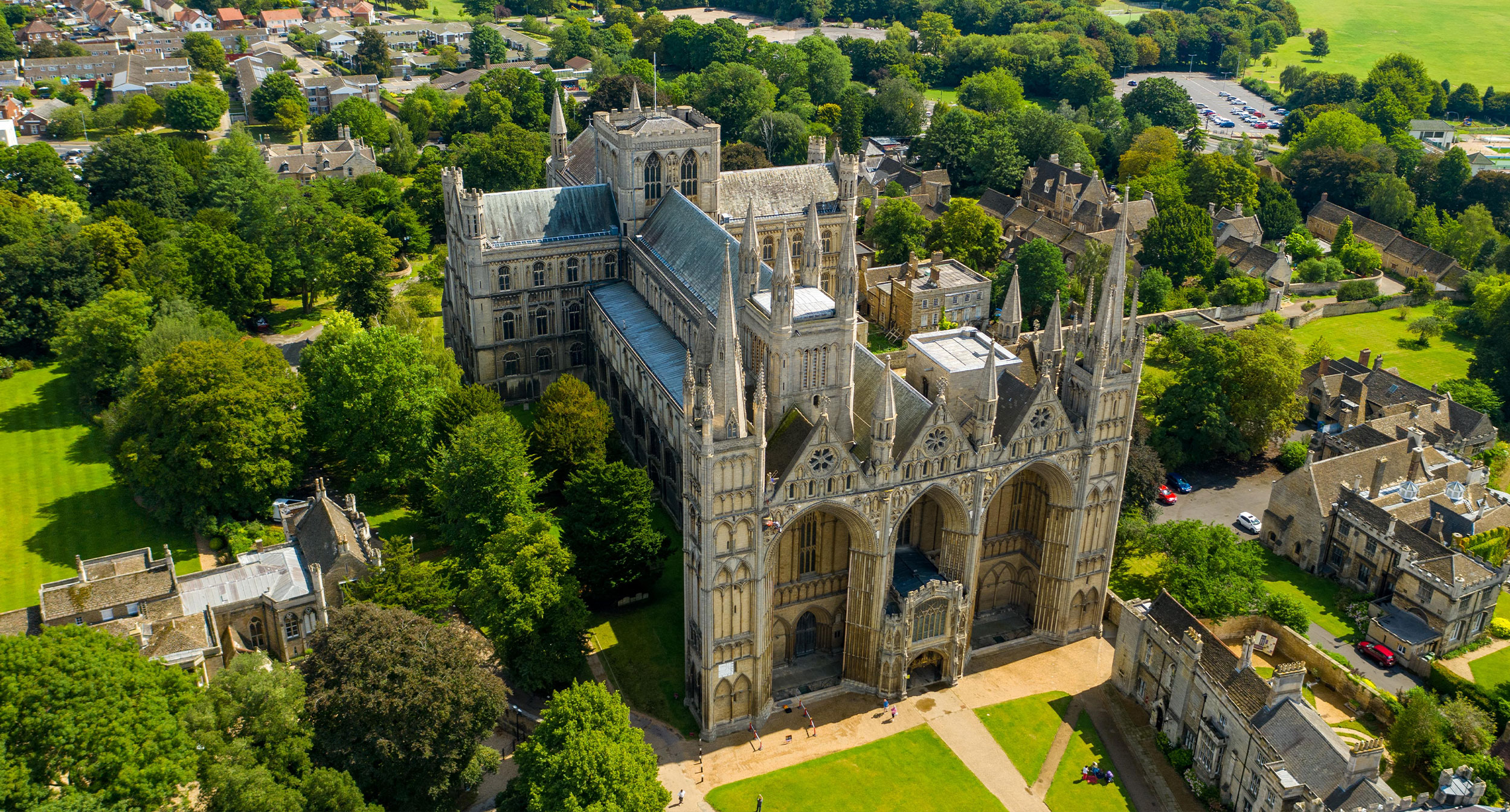

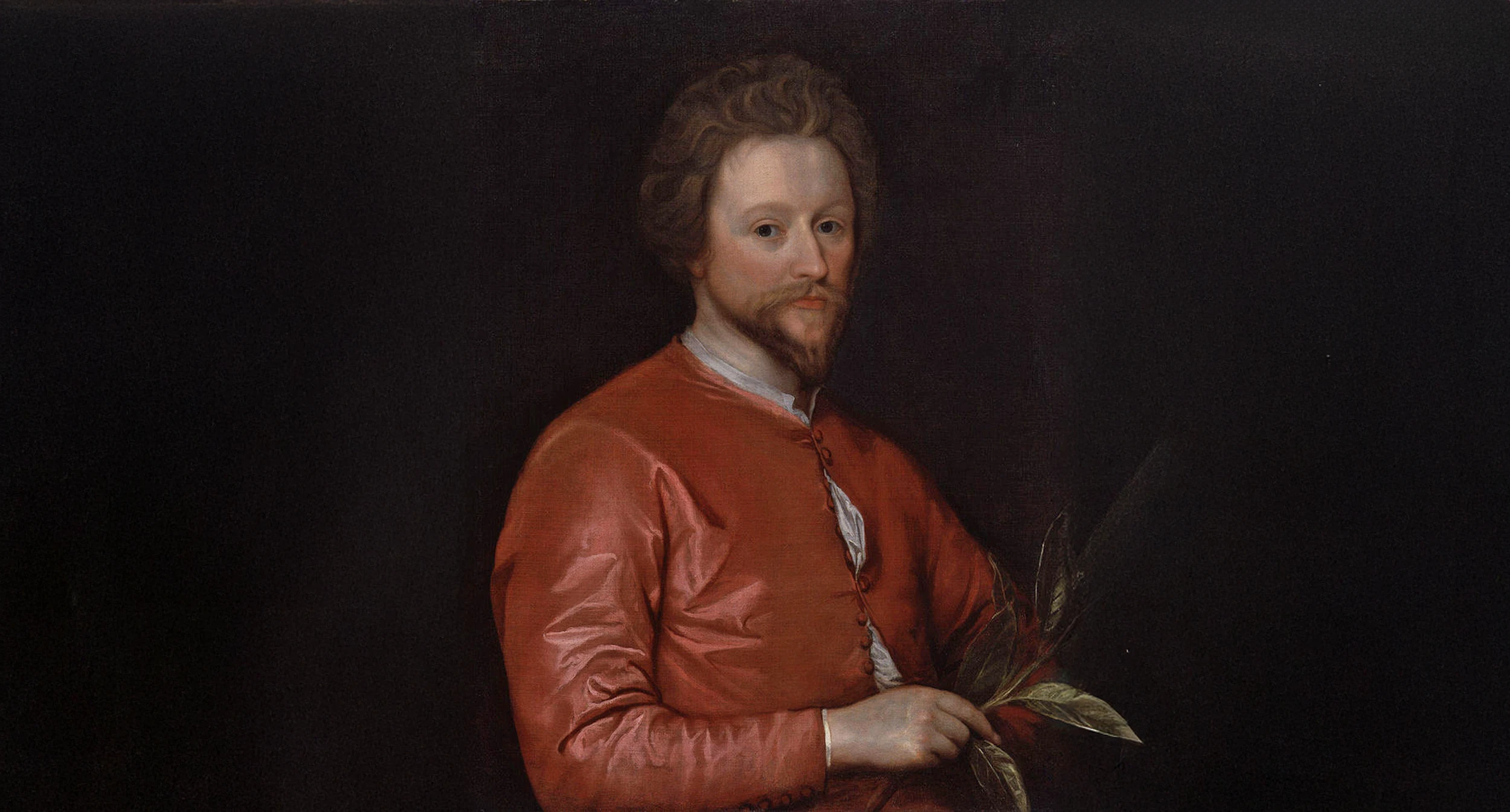
Raised for part of his childhood within Peterborough’s Cathedral precincts, John Fletcher became the leading dramatist of the King’s Men after Shakespeare and one of the most successful playwrights of the Jacobean stage.
Life and career in dates
- 1579 Born in Rye, Sussex, and baptised on 20 December
- 1583 His father becomes Dean of Peterborough and the family moves to the Cathedral precincts
- 1587 Richard Fletcher officiates at the execution and Peterborough funeral of Mary, Queen of Scots
- 1589 The family leaves Peterborough when Richard becomes Bishop of Bristol
- 1591 John enters Benet College, now Corpus Christi College, Cambridge
- c. 1608 The Faithful Shepherdess establishes his theory of tragicomedy
- c. 1609 Philaster, written with Francis Beaumont, becomes an early success
- 1611 The Maid’s Tragedy and A King and No King reach the stage
- 1612–13 Collaborates with Shakespeare during the final phase of Shakespeare’s career
- 1613 Becomes Shakespeare’s successor as principal dramatist of the King’s Men
- 1624 Rule a Wife and Have a Wife is performed by the King’s Men
- 1625 Dies during a London plague outbreak and is buried at St Saviour’s, Southwark
- 1647 The first Beaumont and Fletcher folio helps preserve the theatrical partnership’s reputation
A Peterborough childhood
John Fletcher was born in the Sussex port of Rye in December 1579 and baptised there on 20 December. His connection with Peterborough began a few years later, when his father, Richard Fletcher, was appointed Dean of Peterborough Cathedral in 1583.
The Fletcher family is believed to have lived at the Deanery on the north side of the Cathedral. John therefore spent a significant part of his childhood within the precincts, probably between the ages of four and ten, and local records describe him as receiving his early education there.
This was an unusually eventful environment in which to grow up. Richard Fletcher was a prominent churchman and royal chaplain whose responsibilities placed the family close to the religious and political affairs of Elizabethan England.
In February 1587, the Dean officiated at the execution of Mary, Queen of Scots, at nearby Fotheringhay Castle. He also officiated at her funeral when she was buried at Peterborough Cathedral later that year. There is no evidence that the young John witnessed either event, but they formed part of the extraordinary historical setting surrounding his Peterborough childhood.
Richard Fletcher left the deanery when he became Bishop of Bristol in 1589. He later served as Bishop of Worcester and Bishop of London, but John’s formative years in the Cathedral precincts created his enduring connection with Peterborough.
Cambridge and the road to London
On 15 October 1591, Fletcher was admitted to Benet College, the institution now known as Corpus Christi College, Cambridge. He was only about eleven years old and became a Bible clerk in 1593.
His family background might have pointed towards a career in the Church. His uncle Giles Fletcher the Elder was a diplomat and writer, while his cousins Giles Fletcher the Younger and Phineas Fletcher became poets. John, however, does not appear to have taken a degree or followed his father into the clergy.
Richard Fletcher died in 1596. At some point afterwards, John made his way to London, although the surviving evidence reveals little about his movements during these years. By the opening decade of the seventeenth century, he had entered the capital’s literary and theatrical world.
The London theatre was not built around solitary authors working in isolation. Playwrights exchanged ideas, revised one another’s scripts and frequently divided plays between several hands. Fletcher proved particularly well suited to this collaborative culture.
Beaumont, Fletcher and the rise of tragicomedy
Fletcher’s most celebrated early partnership was with Francis Beaumont. Their names appeared together in print in 1607, when both contributed verses to Ben Jonson’s Volpone, and by the end of the decade they were working together for the London stage.
Fletcher’s early pastoral play The Faithful Shepherdess was not an immediate theatrical success. Its printed preface was nevertheless important because Fletcher used it to explain tragicomedy: a form capable of taking its characters close to disaster without ending in the deaths expected of tragedy.
With Beaumont, he transformed that idea into popular theatre. Philaster combined court intrigue, divided loyalties, threatened catastrophe and romantic restoration. It was followed by plays including The Maid’s Tragedy, A King and No King and The Scornful Lady.
Their work was especially effective at the indoor Blackfriars Theatre, where the King’s Men performed for a comparatively affluent audience. The plots moved rapidly through suspicion, betrayal, reversals of fortune and startling revelations, creating a theatrical style that other dramatists would imitate for decades.
“Beaumont and Fletcher” soon became a recognisable dramatic brand. That label later covered a complicated body of work: some plays were written jointly, some by one man alone and others with additional collaborators.
Working with Shakespeare
Fletcher’s place in literary history is inseparable from the final phase of William Shakespeare’s career. The clearest surviving evidence concerns The Two Noble Kinsmen, a tragicomedy based on Chaucer’s Knight’s Tale. Its 1634 title page names Shakespeare and Fletcher together as its authors.
Most modern scholarship also detects Fletcher’s hand in Henry VIII, originally known as All Is True, although there is no complete agreement about how the play was divided or revised. It is therefore safest to describe the work as a probable collaboration rather than assign particular scenes to either dramatist as settled fact.
Records also associate Shakespeare and Fletcher with the lost play commonly called Cardenio, apparently inspired by an episode from Cervantes’ Don Quixote. The original text has not survived, making confident reconstruction impossible.
These collaborations offer a more realistic picture of the early modern theatre than the later idea of Shakespeare as an entirely solitary genius. Fletcher was not merely copying an older master: he was working alongside Shakespeare while preparing to take a leading creative role within the same company.
Principal dramatist of the King’s Men
When Beaumont withdrew from professional writing around 1613, Fletcher’s association with the King’s Men grew still more important. He succeeded Shakespeare as the company’s principal dramatist and remained its leading playwright until his death.
The King’s Men was the most prestigious theatrical company of the period. Its players performed at the Globe, at the indoor Blackfriars Theatre and before the royal court. Writing for the company placed Fletcher at the centre of Jacobean theatrical life.
He continued to work collaboratively. His most important later partner was Philip Massinger, with whom he wrote at least twelve plays, including The Custom of the Country, The Beggar’s Bush and The Prophetess. He also worked with writers including Nathan Field, Thomas Middleton and William Rowley.
Fletcher’s distinctive habits of vocabulary, rhythm and verse construction have allowed scholars to identify portions of his writing within collaborative plays. Even so, many attributions remain debated, reflecting a theatrical culture in which authorship was often shared rather than individually owned.
The plays and Fletcher’s dramatic voice
Fletcher had a hand in approximately fifty surviving plays, perhaps fifteen of which were written by him alone. His output ranges across tragicomedy, comedy, pastoral drama, historical tragedy and courtly romance.
The Woman’s Prize, or The Tamer Tamed offers a particularly striking response to Shakespeare. Fletcher imagines Petruchio remarried after the death of Katherine, only to encounter a new wife, Maria, who organises the women around her and refuses to submit to his authority. The play reverses the sexual politics of The Taming of the Shrew and can be read as an early dramatic sequel as well as an argument with its predecessor.
Bonduca reworks the rebellion of the British queen now commonly called Boudica. The Faithful Shepherdess, The Mad Lover, The Wild Goose Chase, The Island Princess and Rule a Wife and Have a Wife demonstrate the breadth of Fletcher’s theatrical imagination.
Spanish literature was an especially important influence. Fletcher and his collaborators adapted plots and situations from writers including Lope de Vega and Cervantes, using distant locations, concealed identities, family conflicts and improbable reversals to create fast-moving drama.
His plays can be troubling as well as entertaining to modern audiences. Their treatment of gender, political power, sexual coercion and overseas cultures reflects the assumptions and inequalities of their period. At the same time, their unstable relationships and contests for control continue to invite reinterpretation in performance.
Plague, publication and legacy
Fletcher died during the London plague outbreak of 1625. The precise date of his death is not known, but his burial was registered at St Saviour’s Church in Southwark on 29 August. The church later became Southwark Cathedral.
His death brought an exceptionally productive career to an abrupt end. The plays nevertheless remained an important part of the theatrical repertoire, while the collected Beaumont and Fletcher folios of 1647 and 1679 preserved dozens of works associated with the two names.
Fletcher’s reputation eventually became overshadowed by Shakespeare’s, and the complexities of collaborative authorship made his individual contribution difficult to describe. Modern editors, attribution scholars and theatre companies have helped recover his importance as a dramatist in his own right.
His most lasting achievement may be the part he played in determining what English theatre became after Shakespeare. Fletcher helped make tragicomedy one of the dominant dramatic forms of the seventeenth century and demonstrated how successfully plays could be created through sustained collaboration.
A schoolboy raised in Peterborough’s Cathedral precincts went on to share authorship with Shakespeare and shape the next generation of the English stage.