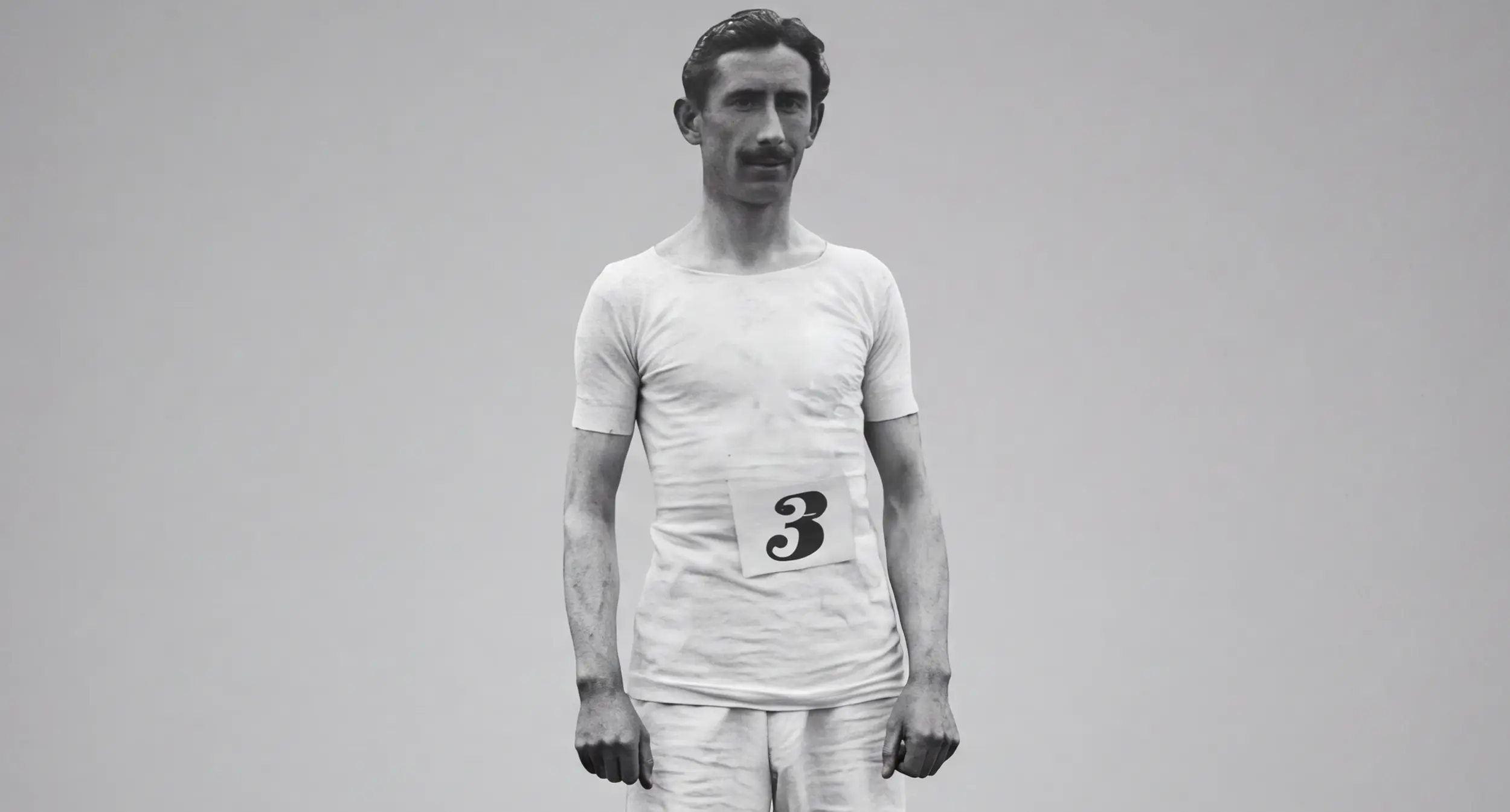
Arthur James Robertson was a Peterborough schoolboy, cyclist and sportsman who became one of the outstanding distance runners of his generation. In a remarkably short athletics career he won Olympic gold and silver at the 1908 London Games, became international cross-country champion and set a world record over 5,000 metres before returning to Peterborough and a life in the city's sporting community.
Life and career in dates
- 1879 Born at Harthill in Yorkshire on 19 April
- 1893 Joins The King's School in Peterborough aged 14
- 1894 Wins the school mile in record time
- 1895 Leaves school and becomes involved in the Robertson cycle business in Peterborough
- c.1904 Turns seriously to athletics after a cycling injury
- 1906 Moves from Peterborough Athletic Club to Birchfield Harriers
- 1907 Establishes himself among Britain's leading distance runners
- 1908 Wins the English and International Cross-Country Championships
- 1908 Wins Olympic gold in the three-mile team race and silver in the 3,200m steeplechase
- 1908 Sets a 5,000 metres world record of 15:01.2 in Stockholm
- 1909 Retires from serious athletics at only 30
- 1920s Develops the family cycle and sports business in Peterborough
- 1957 Dies in Peterborough, one day before his 78th birthday
- 2004 Inducted posthumously into the Scottish Sports Hall of Fame
Coming to Peterborough
Arthur James Robertson was born at Harthill in Yorkshire on 19 April 1879, but Peterborough became the place in which his sporting ability first announced itself.
He was the son of Dr John Alexander Robertson, a Glasgow doctor, and had previously attended Kelvinside Academy in Glasgow.
In September 1893, aged 14, Arthur entered The King's School in Peterborough. His family was then living at Stilton and later moved to Woodston.
Robertson was an exceptional all-round sportsman.
Within months of arriving at King's, he won the school's Mile Handicap in record time. The school mile record he established in 1894 stood for many years.
Yet running was not the sport around which the young Robertson initially intended to build his life.
He preferred a bicycle.
The future Olympic champion began not as a runner, but as one of Peterborough's enthusiastic young racing cyclists.
A cyclist first
Arthur left The King's School in 1895 and became involved with his brother David in the family's Peterborough cycle business.
Cycling was enjoying enormous popularity during the 1890s. Improvements in bicycle design had created the recognisably modern safety bicycle and opened riding to a rapidly expanding public.
The Robertson brothers did more than sell bicycles.
They raced them.
Arthur and David joined Peterborough Athletic Club as cyclists, and competitive cycling became Arthur's main sporting focus during his early adult life.
Sport appears to have run through the family. Arthur's brothers were accomplished cyclists themselves, and David would eventually represent Britain at the same Olympic Games as Arthur.
Then an accident changed everything.
Discovering running
A cycling injury forced Robertson away from his preferred sport.
He turned seriously to running at about 25.
By the standards of elite athletics, this was extraordinarily late.
Robertson nevertheless improved with startling speed.
Representing Peterborough Athletic Club, he finished fifth in the mile at the 1906 Amateur Athletic Association Championships.
At the end of that season he transferred to Birchfield Harriers in Birmingham, already one of Britain's leading athletics clubs.
In 1907 he competed across an extraordinary range of distances. He was successful over four and ten miles and finished second in the steeplechase at the AAA Championships.
Robertson was emerging as something unusual.
He possessed enough speed to compete seriously over a mile, the endurance required for ten miles and cross-country, and the strength and technique demanded by the steeplechase.
A remarkable range
The extraordinary year of 1908
Everything came together in 1908.
In March, Robertson won the English Cross-Country Championship.
He then travelled to France for the International Cross-Country Championship at Colombes and won again, taking both individual and team honours.
A runner who had only begun serious athletics a few years earlier was now an international champion.
His performances on the track were equally impressive.
A second-place finish over four miles at the AAA Championships helped secure Robertson's selection for the British team at the London Olympic Games.
The timing was perfect.
Britain was hosting the Olympics for the first time.
Robertson was about to have the greatest week of his sporting life.
Olympic glory
The athletics competition took place at the newly built White City Stadium in London.
Robertson entered three events: the five miles, the 3,200 metres steeplechase and the three-mile team race.
He finished fifth in the five miles.
The medals followed.
In the steeplechase final Robertson spent much of the race behind the leaders. At the bell he began a powerful late challenge, passing the American John Eisele and closing rapidly on fellow Briton Arthur Russell.
Robertson ran out of track.
Russell won by only two yards.
Arthur Robertson had an Olympic silver medal.
His next major event went one better.
London Olympic Games, 1908
The three-mile team competition was scored according to the finishing positions of each nation's runners.
Britain's team included Robertson, Joe Deakin, William Coales, Norman Hallows and Harold Wilson.
British runners dominated the race, filling the first three individual positions.
Robertson crossed the line second.
The result gave Great Britain the team title and Arthur Robertson an Olympic gold medal.
The Scottish Sports Hall of Fame recognises Robertson as the first Scot to win Olympic gold.
A boy who had broken the school mile record in Peterborough was now an Olympic champion.
Two brothers, one Olympics
Arthur & David RobertsonArthur was not the only Robertson competing at London 1908. His brother David represented Britain in cycling and reached the final of the 100-kilometre race.
A world record in Stockholm
Robertson's Olympic medals were not the end of his extraordinary season.
In September he travelled through Scandinavia for a series of races.
On 13 September 1908 he competed over 5,000 metres in Stockholm.
The race took place not on a modern athletics surface, but on a banked concrete cycle track.
Robertson finished in:
5,000 metres world record
15:01.2Stockholm, 13 September 1908
It was a new world record.
The following day he attempted another extraordinary challenge, running for one hour and trying to surpass Walter George's world record for distance covered.
Robertson missed it by only 83 yards.
He also established a Scottish four-mile record which survived for 45 years.
For a runner whose serious athletics career had barely begun four years earlier, his transformation was extraordinary.
Walking away at the top
Robertson continued competing during 1909.
He finished second in both the mile and four-mile events at the AAA Championships and remained capable of competing with Britain's best runners.
Then he stopped.
At only 30, after a serious track and cross-country career lasting roughly four years, Robertson retired from athletics.
It was not because he could no longer compete.
His final performances demonstrated that he remained among the country's leading athletes.
He simply returned to the sport he had loved first.
Cycling.
Four years of serious running had been enough for national titles, an international championship, two Olympic medals and a world record.
Robertson's All-Sports
Retirement brought Robertson back fully into Peterborough life.
He returned to cycling and also played football for Peterborough Town Football Club, the predecessor of the modern professional club.
He later became a director of Peterborough Town.
Business remained centred on sport too.
The Robertson family operated a cycle dealership in Peterborough, and from the 1920s Arthur increasingly took responsibility for the business.
Premises included 39–41 and later 97–99 Bridge Street.
In the 1950s the business developed into Robertson's All-Sports in Cowgate.
It was eventually run by Arthur's son and retained the Robertson name long after the Olympic champion himself had died.
From Olympian to Peterborough shopkeeper
There is something wonderfully grounded about the story.
One of the fastest distance runners in the world became a familiar Peterborough businessman selling the equipment through which other local people could discover sport for themselves.
Robertson and Peterborough
Arthur Robertson died in Peterborough on 18 April 1957, one day before his 78th birthday.
His international reputation was later rediscovered and celebrated.
In 2004 he was posthumously inducted into the Scottish Sports Hall of Fame.
Birchfield Harriers continued to remember him as the club's first Olympic medallist, and his name was later given to a Birmingham pub close to the club's historic home.
Peterborough has its own memorial.
A Peterborough Civic Society blue plaque at 50 Cowgate marks the former home of Robertson's All-Sports and commemorates the cyclist, runner and Olympic gold medallist who spent most of his life connected with the city.
Four years at the top
Cross-country championEnglish and international champion in 1908.
↓ Olympic championGold and silver at the London Games.
↓ World record holder5,000 metres in 15:01.2.
↓ Peterborough sportsmanSchoolboy, cyclist, businessman and football club director.
His connection with Peterborough is deeper than a famous athlete merely having lived here.
It was at The King's School that one of his earliest recorded running achievements took place. It was with Peterborough Athletic Club that his serious competitive career developed. It was in Peterborough that his cycle and sports businesses operated. And it was Peterborough that remained his home after the international crowds had disappeared.
Arthur Robertson went from a Peterborough school mile to Olympic gold and a world record, then came home and spent the rest of his life helping sport remain part of the city.