

It is small enough to hold in two hands and ordinary enough to disappear into a wall. Yet the Fletton brick transformed Peterborough, created one of Britain’s great industrial landscapes and became part of millions of homes across the country. Pressed into its surface is a name that tells the whole story: Phorpres.
From Peterborough clay to national industry
- Jurassic Organic-rich Oxford Clay forms beneath a warm sea millions of years before Peterborough exists.
- 1877 James McCallum Craig acquires Fletton Lodge and brickmaking begins on the site.
- 1880s Brickmakers exploit deeper Lower Oxford Clay and develop the semi-dry Fletton process.
- 1889 John Cathles Hill acquires a Fletton brickyard and expands the industry dramatically.
- 1900 The London Brick Company is incorporated.
- Early 1900s The Phorpres name becomes associated with London Brick’s four-pressure manufacturing process.
- 1923 London Brick and B. J. Forder combine, accelerating the growth of one of Britain’s largest brickmaking businesses.
- 1920s-30s Inter-war housebuilding creates enormous demand for Fletton bricks.
- 1950s The industry draws workers to Peterborough from Britain and overseas, helping reshape the city’s communities.
- 1969 King’s Dyke works opens near Whittlesey as brick production becomes increasingly automated.
- Today London Brick remains in production and Fletton bricks survive in millions of buildings across Britain.
One ordinary brick
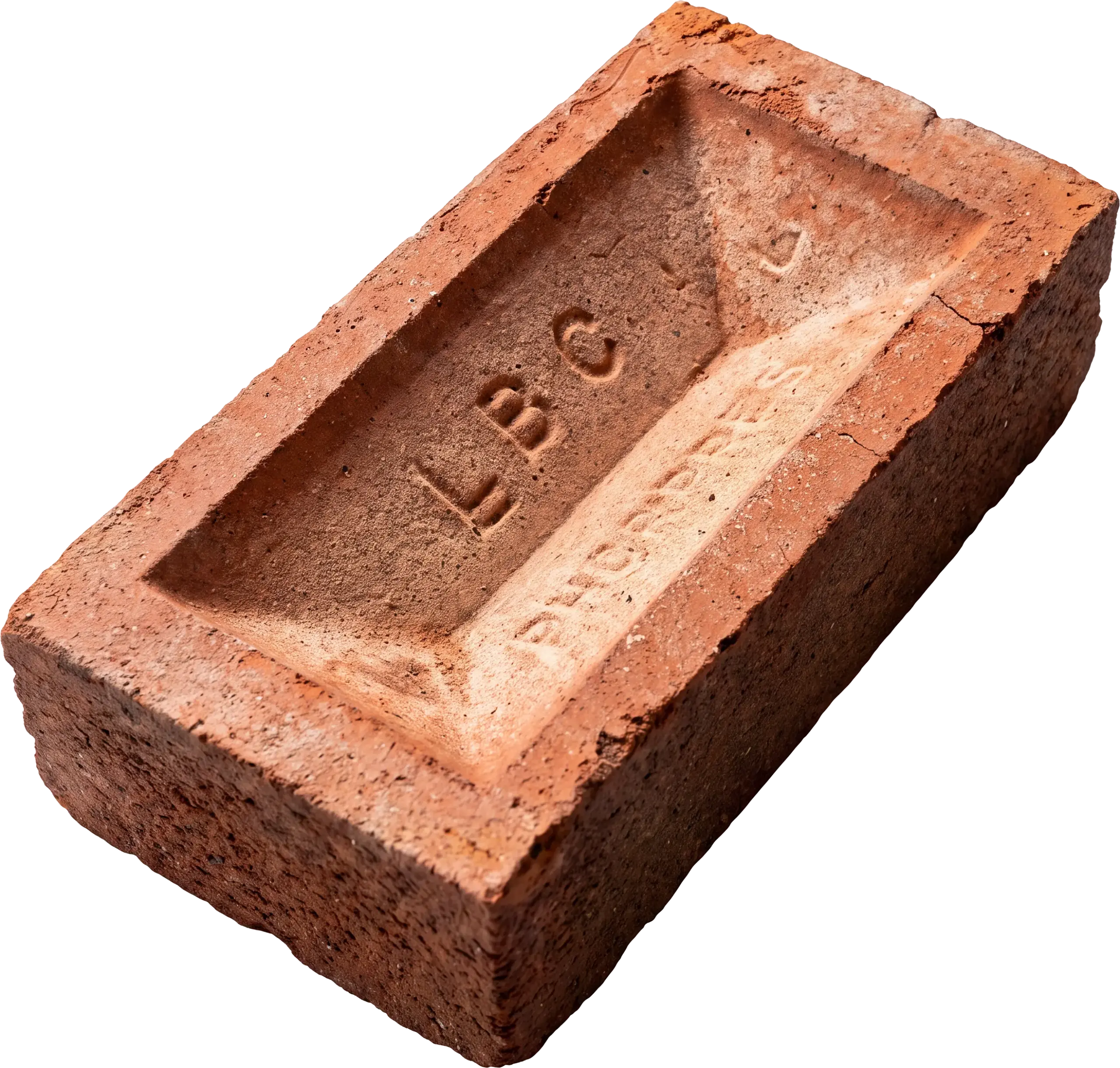
Pick it up and there seems to be almost nothing remarkable about it.
It is rectangular.
Heavy.
Rough.
A reddish-brown building brick with a deep indentation, or frog, pressed into its upper surface.
Inside that frog is a word:
One trade name. An entire industrial system.
Thousands upon thousands of similar bricks disappeared into walls.
That was the point.
A brick succeeds by becoming almost invisible.
But put enough of them together and you get houses, schools, factories, streets and entire suburbs.
Peterborough did not simply manufacture bricks. Peterborough became part of the physical fabric of Britain.
Explore the complete story on Peterborough’s Brick Industry.
The remarkable thing is the name Fletton
The word Fletton began as the name of a place.
It became the name of a product.
And eventually it became an industrial term recognised far beyond Peterborough.
The original village lies immediately south of the River Nene.
Brickmaking had existed around Peterborough long before the late nineteenth century, but traditional production relied mainly on surface clays and was comparatively slow and seasonal.
Then manufacturers began digging deeper.
What they found changed everything.
A Peterborough place-name became a recognised type of British brick.
It is the industrial equivalent of Peterborough Ware.
In one case, archaeology carried Peterborough’s name across Britain.
In the other, industry did.
The clay that burns
The real breakthrough was geological.
Beneath Fletton and the wider landscape south and east of Peterborough lies the Oxford Clay.
This sediment was deposited beneath a Jurassic sea millions of years before humans existed.
Some of its lower layers are unusually rich in organic material.
That made the clay extremely useful to brickmakers.
Carbonaceous material inside the clay helped provide some of the energy needed during firing.
When a Fletton brick entered the kiln, the organic material within the clay contributed to its own firing.
Less external fuel was required.
That reduced cost.
And when production is measured not in tens of bricks but in millions, a small saving on every brick becomes economically enormous.
Follow that much older story through Peterborough’s Jurassic Fossils.
How do you turn Jurassic mud into a brick?
The Fletton process was radically different from the old image of a brickmaker moulding wet clay by hand.
The deeper clay could be exploited using a semi-dry process.
Oxford Clay is dug from the enormous pits around Peterborough.
The clay is broken down and prepared for manufacture.
Prepared clay is compressed mechanically into a brick mould.
Organic material within the clay contributes heat during firing.
Finished bricks leave the works by rail and road.
Mechanisation changed the scale of the industry.
Brickmaking could operate continuously rather than remaining dependent on the seasonal preparation of traditional surface clay.
Machines could produce consistent bricks at extraordinary speed.
And then London Brick added a name that made the manufacturing process part of the product itself.
Four press became Phorpres
The word looks peculiar until you say it aloud.
London Brick’s pressing method applied pressure through four movements.
The company turned that manufacturing feature into a memorable trade identity.
Four press.
Phorpres.
The word was impressed directly into bricks, printed across advertising and painted onto company vehicles.
It became so closely associated with the business that a major surviving Fletton building still carries the name Phorpres House.
The brick in this page therefore tells us how it was made before we even begin to examine the clay.
The London Brick Company was born at Fletton
The company name can disguise the geography.
London Brick was a Peterborough industrial story.
Its development was closely associated with John Cathles Hill, a builder and developer who recognised the extraordinary possibilities of Fletton brickmaking.
Hill acquired a brickworks at Fletton in 1889.
The London Brick Company was incorporated in 1900.
The name London made commercial sense.
London was one of the great markets for the product.
Peterborough supplied the raw material and the manufacturing landscape.
The railway connected the two.
Clay, pits, kilns and production.
Millions of heavy bricks moved economically.
Housing, factories, schools and infrastructure.
By the twentieth century, London Brick had become one of the dominant names in British brickmaking.
Peterborough became Brickopolis
The scale is difficult to reconstruct today.
This was not one picturesque brick kiln standing beside a village.
It was an industrial landscape.
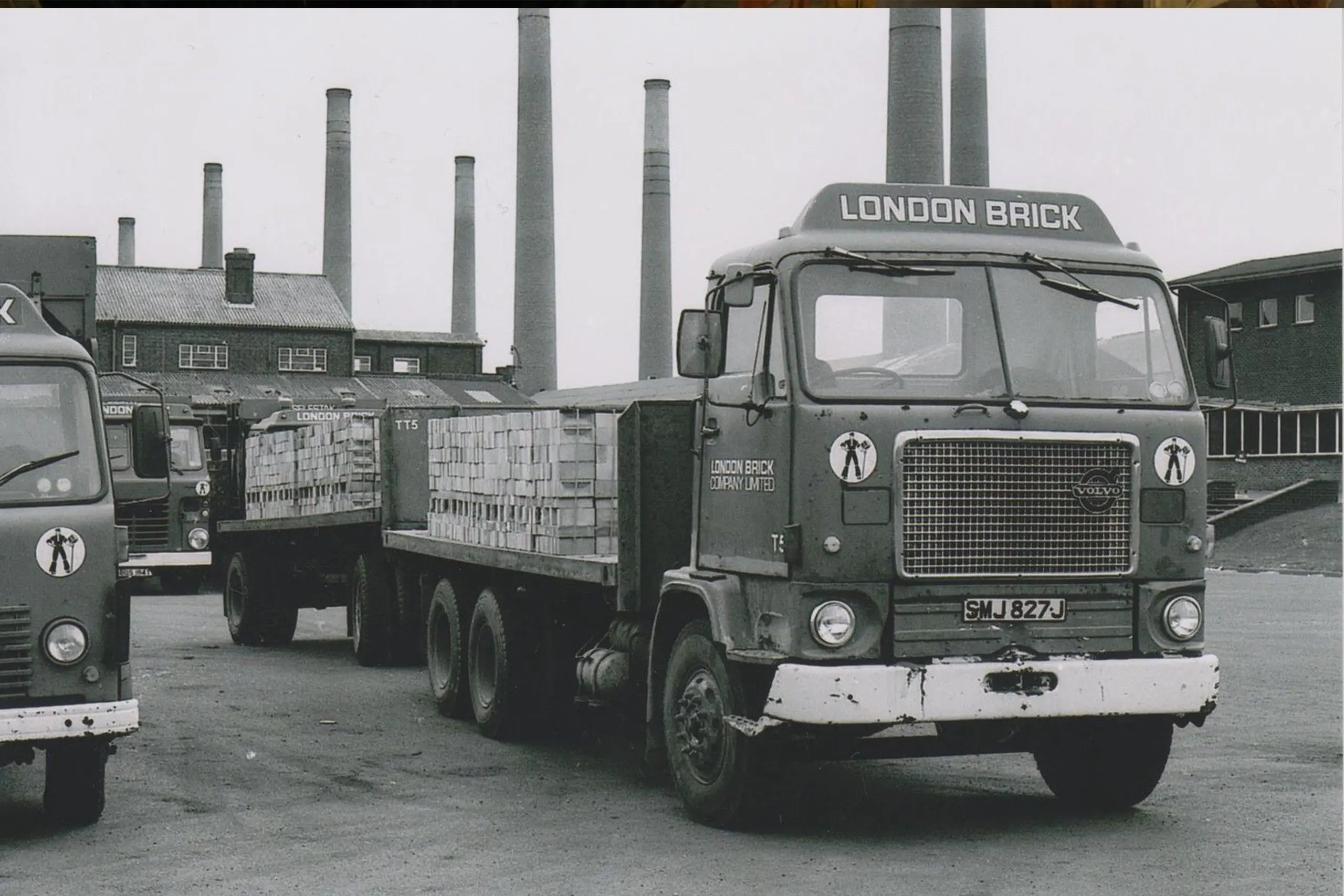
Across Fletton, Woodston, the Ortons, Yaxley and east towards Whittlesey, clay extraction cut vast holes into the landscape.
Beside them stood kilns, presses, workshops, conveyor systems and enormous stacks of finished bricks.
Tall chimneys became part of Peterborough’s horizon.
Industrial railways crossed the works.
Main-line sidings carried the finished product away.
Millions of tonnes of Jurassic sediment removed from beneath the landscape.
Presses, machinery, conveyors, workshops and brick stacks.
A new industrial skyline visible for miles around Peterborough.
Finished bricks carried from Peterborough into a national building boom.
The brickworks did not merely occupy Peterborough’s landscape. For generations, they defined it.
The railway made the brick possible at national scale
A brick has one enormous disadvantage as a product.
It is heavy.
A single brick is manageable.
A million bricks are a transport problem.
Peterborough had already become one of Britain’s great railway junctions by the time the Fletton industry exploded in the late nineteenth century.
That changed the economics.
Bricks could be transported in enormous quantities to London and other rapidly growing towns and cities.
That is why Peterborough’s industrial stories cannot be separated neatly.
The railway supported brickmaking.
Brickmaking created freight.
Industry created jobs and population growth.
Population growth created more demand for building materials.
Explore the connection through Peterborough’s Railway Story.
Then Peterborough clay disappeared into Britain
The great triumph of the Fletton brick was also what made it easy to overlook.
Once it left Peterborough, it disappeared into buildings.
The inter-war housing boom created extraordinary demand.
New suburbs expanded around London and across Britain.
Factories, schools, public buildings and houses all required huge quantities of inexpensive, reliable bricks.
London Brick says its Fletton products have been used in more than five million homes across Britain.
That means Peterborough’s industrial history is not confined to Peterborough.
It can be found in streets across the country.
Millions of people live inside the legacy without ever knowing where the material came from.
Peterborough’s greatest industrial export became so common that Britain stopped noticing it.
Every brick also represents work
The scale of production depended on people.
Clay had to be extracted.
Machinery maintained.
Kilns operated.
Bricks moved and stacked.
Rail wagons loaded.
Factories managed.
For generations, brickmaking became part of family life across southern and eastern Peterborough.
After the Second World War, labour shortages also drew new workers into the district.
Among them were significant numbers of Italian men recruited into the brick industry.
Many stayed.
The industry therefore helped change not only Peterborough’s landscape but its population, culture, family names and identity.
Every pit was also cutting through a Jurassic sea
Brickmaking produced an extraordinary unintended consequence.
To make bricks, the companies had to remove clay.
To remove clay, they had to expose geology.
And inside that geology were fossils.
Marine reptiles, ammonites, fish and other creatures emerged as industrial machinery cut through the Oxford Clay.
Workers learnt to recognise bones in the pits.
One man became particularly good at understanding what was being revealed.
Alfred Nicholson Leeds, the farmer and fossil collector from Eyebury, built one of the world’s great collections of Jurassic marine vertebrates from material exposed by the local clay industry.
The giant fish Leedsichthys carries his name.
His discoveries can also be followed through The City That Looked Harder.
Where the brickmaker saw raw material, the fossil collector saw a vanished sea.
Then the brick pits filled with water
Industries can vanish surprisingly quickly from landscapes they once dominated.
Many of Peterborough’s great brickworks have now closed.
Chimneys disappeared.
Factories were demolished.
Railway sidings were lifted.
But the pits could not simply disappear.
Jurassic sediment beneath fields.
Industrial extraction remakes the ground.
Former workings flood after extraction ends.
Nature colonises the industrial landscape.
Some former workings became lakes and nature reserves.
Others became development land.
Parts of modern Peterborough now stand inside landscapes excavated and reconstructed by the brick industry.
The city south of the Nene therefore contains several landscapes at once.
A Jurassic seabed.
A Victorian and twentieth-century industrial landscape.
A modern city.
And in places, new wetlands created by the disappearance of the industry itself.
Explore the wider area through Discover Peterborough and its Kiln Quarter story.
Why this is a Peterborough object
A Phorpres brick looks almost aggressively ordinary.
That is what makes it such a powerful Peterborough object.
It tells us that history does not have to be made from gold, silver or illuminated parchment.
Sometimes history weighs a few kilograms and gets hidden behind plaster.
The brick connects Peterborough to geology.
To the railway.
To mass manufacturing.
To migration.
To fossils.
To suburban Britain.
To the transformation of the landscape.
And to the millions of people who lived inside buildings made from Peterborough clay.
The clay begins as sediment beneath an ancient sea.
Pits, presses, kilns and railways turn geology into mass production.
The finished brick disappears into millions of buildings.
Fletton became more than the name of a Peterborough village. It became the name of a brick.
That distinction puts the Fletton brick alongside some of Peterborough’s most remarkable names.
Peterborough Ware carries the city into prehistoric archaeology.
The Peterborough Chronicle carries it into the history of English writing.
The Fletton brick carries Peterborough into the streets and houses of modern Britain.
And unlike many historic objects, millions of examples still survive exactly where they were put.