
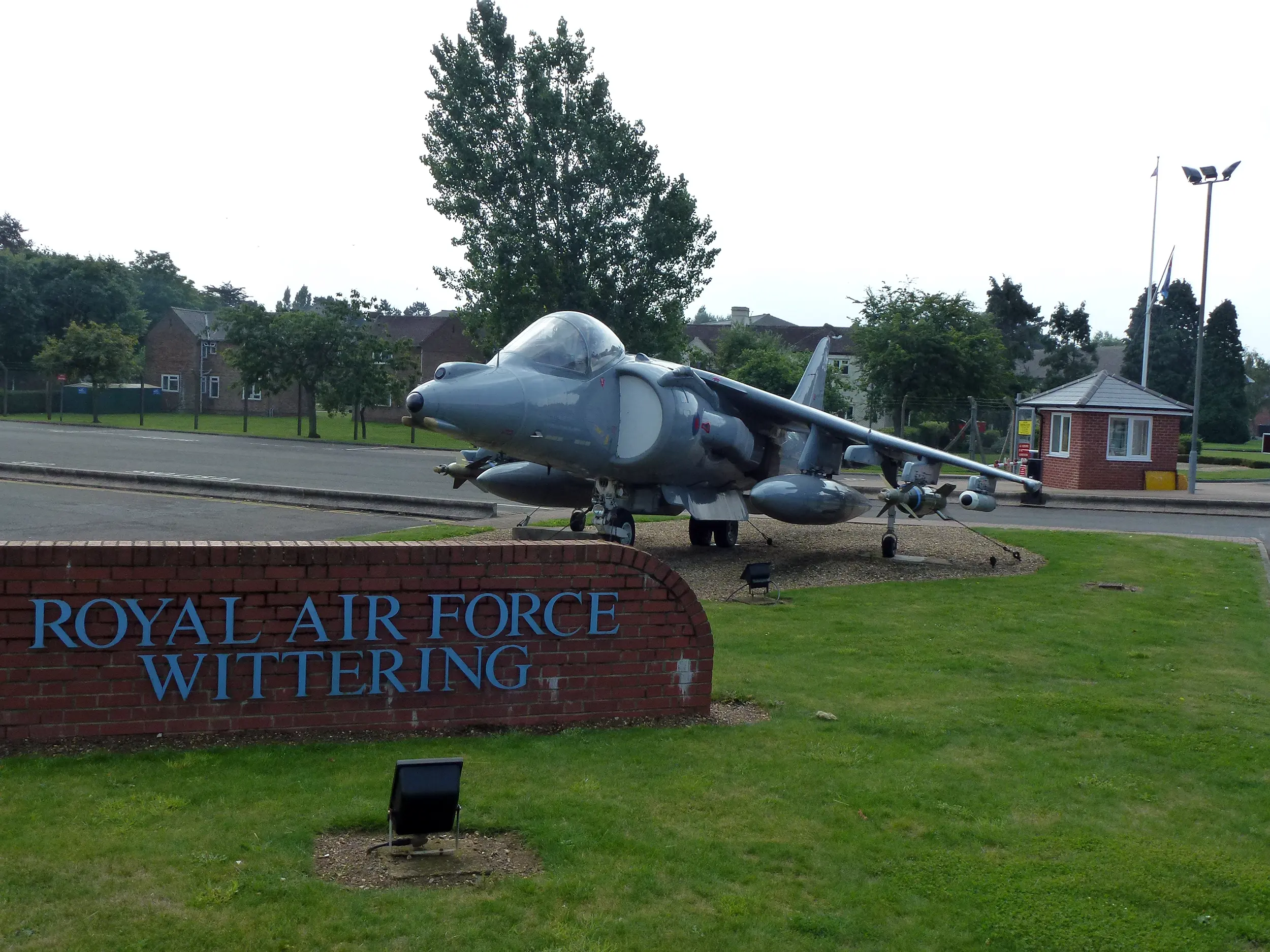
For more than forty years, the shape of a Harrier meant RAF Wittering. Aircraft flew from here to war, pilots learnt to master one of aviation’s strangest machines and generations of engineers kept its Pegasus engines and swivelling nozzles working. Today one Harrier remains permanently at the gate, standing watch over the station that became known simply as the Home of the Harrier.
Wittering and the Harrier
- 1918 Wittering is formally established as a Royal Air Force station.
- 1969 The Harrier enters RAF service at Wittering, beginning an association lasting more than four decades.
- 1982 No. 1 Squadron Harrier GR3s and Wittering engineering personnel prepare for deployment to the Falklands.
- 1983 RAF Wittering is granted the Freedom of the City of Peterborough during the station’s era as the Home of the Harrier.
- 1990 The future gate guardian, ZD469, makes its first flight as a second-generation Harrier.
- 2005 ZD469 is badly damaged during a rocket attack on Kandahar airfield in Afghanistan.
- 2008 The damaged aircraft is allocated for ground instructional use at RAF Cottesmore.
- 2010 Britain’s Harrier force is withdrawn from service, ending Wittering’s operational Harrier era.
- Apr 2011 ZD469 replaces the earlier GR3 gate guardian at RAF Wittering.
- 2014 RAF Wittering’s airfield is reactivated and flying gradually returns in new training roles.
- Today The Harrier remains at the gate as the most visible reminder of the station’s defining aircraft.
Why does an RAF station put an aircraft at its gate?
A gate guardian is not simply an aeroplane that has nowhere else to go.
It is an emblem.
Across the Royal Air Force, retired aircraft are positioned at station entrances to represent something important about the place behind them.
The connection may be to a squadron.
A campaign.
An aircraft type.
Or generations of people who served there.
At RAF Wittering, there could hardly be a more appropriate choice than a Harrier.
The gate guardian does not merely say that Harriers once flew here. It says that Wittering and the Harrier became part of each other’s identity.
The Royal Air Force itself describes station gate guardians as retired aircraft chosen because they symbolise the station in some way.
At Wittering, the symbolism is unusually powerful.
What made the Harrier so extraordinary?
Most jet aircraft need a runway.
The Harrier challenged that assumption.
At the centre of the design was the Rolls-Royce Pegasus turbofan engine.
Instead of simply exhausting thrust backwards, the Pegasus used four rotating nozzles positioned around the aircraft.
Point the nozzles backwards and the engine pushes the aircraft forwards.
Rotate them downwards and the same thrust contributes to lift.
Additional reaction-control jets helped control the aircraft when conventional aerodynamic surfaces were ineffective at very low speed.
The result was one of the most recognisable capabilities in aviation:
Harriers could operate from short strips and austere locations impossible for many conventional fast jets.
Roadways, temporary pads and dispersed operating sites could become air bases.
1969: Wittering becomes the Home of the Harrier
The story begins with the first generation of Harriers, not with ZD469.
In 1969, the new aircraft entered Royal Air Force service at RAF Wittering.
No. 233 Operational Conversion Unit trained pilots to operate the revolutionary machine.
No. 1 Squadron became the RAF’s first operational Harrier squadron.
The association changed Wittering’s identity.
Operational squadrons, conversion training, engineering and support made the station synonymous with Britain’s V/STOL force.
It also changed the landscape.
Harrier operations did not depend entirely upon conventional runway flying.
Training could involve dispersed sites and specialised pads, reflecting the aircraft’s original Cold War purpose of continuing to operate even if major NATO airfields were attacked.
For people living around Wittering, Stamford and Peterborough, the Harrier became part of the soundscape as well as the skyline.
In 1982, Wittering’s Harriers went to war
The Falklands Conflict became one of the defining chapters in the Harrier story.
The aircraft most famous from the campaign is the Royal Navy’s Sea Harrier.
But RAF Harrier GR3s also played a significant role.
No. 1 Squadron was based at Wittering.
When Argentina invaded the Falkland Islands in April 1982, the squadron was rapidly prepared for carrier operations thousands of miles from its normal operating environment.
Wittering’s Harrier engineering organisation was tasked with preparing aircraft for operations from ships in the South Atlantic.
The modifications were urgent.
Aircraft needed adaptations for shipboard operation, new weapons and defensive equipment.
Pilots who had not previously operated from aircraft carriers had to learn quickly.
Six Harrier GR3s of No. 1 Squadron left Britain aboard Atlantic Conveyor in May.
RAF Harriers subsequently flew strike and reconnaissance missions from HMS Hermes.
The Harrier had been designed to operate when conventional assumptions broke down. The Falklands demanded exactly that.
The conflict became embedded in RAF Wittering’s institutional memory, and the station continues to commemorate the personnel who served in the campaign.
But the aircraft at the gate belongs to a later generation
ZD469 is not one of those first-generation Falklands GR3s.
It is a second-generation Harrier.
The original Harrier concept was radically redesigned during the 1980s in collaboration between British Aerospace and McDonnell Douglas.
The new aircraft had a substantially redesigned wing, increased payload, better range and increasingly sophisticated electronics.
The aircraft that established Wittering as the Home of the Harrier and fought in the Falklands.
A larger and substantially redesigned Harrier for a new era of ground attack and expeditionary operations.
ZD469 was built as part of this second generation.
The A in GR7A is significant.
GR7 aircraft were upgraded with the more powerful Rolls-Royce Pegasus Mk 107 engine, particularly improving performance in demanding hot conditions and during carrier operations.
Aircraft receiving that engine became GR7As.
Then ZD469 went to Afghanistan
The gate guardian has a real operational history.
In 2005 it was deployed to Afghanistan with No. 3 Squadron.
British Harriers were operating from Kandahar Airfield in support of coalition operations.
On 14 October 2005, the airfield came under rocket attack.
ZD469 was struck or badly damaged by debris during a rocket attack on the air base.
The aircraft survived.
But the damage was severe.
It was returned to Britain for assessment and judged beyond economical repair.
That effectively ended its flying career.
In 2008, the airframe was allocated for ground instructional use at RAF Cottesmore.
The aircraft at Wittering’s gate is not a replica. It is a veteran whose operational career ended because of damage sustained in Afghanistan.
2011: a damaged veteran comes to Wittering
Britain withdrew the Harrier fleet from service in December 2010.
After more than forty years, Wittering’s defining aircraft had stopped flying.
ZD469 was externally restored.
Then, in April 2011, it was placed at RAF Wittering’s main gate.
A frontline combat aircraft begins its RAF career.
Operational service ends after the Kandahar attack.
The airframe becomes a ground instructional aircraft.
ZD469 becomes Wittering’s gate guardian.
The aircraft now wears No. 1 Squadron markings.
That does not mean those markings represent the precise configuration in which it ended its operational life.
They represent something larger.
No. 1 Squadron was inseparable from Wittering’s Harrier history, from the aircraft’s first operational introduction in 1969 to the Falklands and beyond.
The paint scheme therefore turns the aircraft into institutional memory.
It was not Wittering’s first Harrier guardian
ZD469 inherited the job.
Before 2011, the main gate was guarded by an earlier Harrier GR3, XV779.
That aircraft represented the first generation of Harrier that had made Wittering famous.
Hawker Siddeley Harrier GR3 representing Wittering’s original Harrier era.
British Aerospace Harrier GR7A representing the later operational generation.
Together, the two aircraft span the extraordinary technological evolution of the type.
One represented the aircraft with which the RAF entered the V/STOL age.
The other represents the sophisticated second generation that operated into the twenty-first century.
The Harrier also belongs in Peterborough’s civic story
RAF Wittering sits outside the urban centre, but its relationship with Peterborough is unusually strong.
Service personnel have lived in and around the city for generations.
Families have attended its schools, used its businesses and become part of its communities.
Peterborough formally recognised that relationship in 1983.
Granted to RAF Wittering during the era in which the station was known nationally as the Home of the Harrier.
The Freedom was first exercised on 23 April that year.
It allows RAF Wittering personnel to parade through the city with drums beating, colours flying and bayonets fixed.
The tradition continued long after the Harriers stopped flying.
When RAF Wittering exercised the Freedom again in 2019, the Royal Air Force explicitly described Peterborough and the station as longstanding friends.
The Harrier stood at Wittering. The people who flew, maintained and supported it became part of Peterborough.
Discover Wittering’s wider place in the area through Peterborough’s villages.
What happened to Wittering after the Harrier?
The retirement of the Harrier did not mean the end of RAF Wittering.
But it did transform it.
The station had already developed an important new role as a hub for deployable engineering and logistics.
After Harrier flying ended, the runway temporarily fell quiet.
Then flying returned.
Fast jets define the station.
Deployable engineering and logistics become increasingly central.
The airfield is reactivated for training and other flying activity.
Wittering continues as an operational RAF station.
Today RAF Wittering hosts the headquarters of the RAF Support Force and supports elementary flying training for future Royal Air Force pilots.
The gate guardian therefore performs an important job.
It makes the previous identity visible while the station continues to evolve.
And then Hollywood came to Wittering
The airfield acquired another remarkable connection in November 2014.
An Airbus A400M Atlas accelerated along RAF Wittering’s runway.
Attached to the outside of it was Tom Cruise.
One of modern cinema’s most recognisable practical stunts was filmed on Peterborough’s doorstep.
The sequence became the opening of Mission: Impossible – Rogue Nation.
Cruise performed the stunt for real, secured to the exterior of the four-engined transport aircraft as it took off from Wittering.
The Harrier gate guardian belongs to a very different chapter of the airfield’s story, but the connection is irresistible.
A site once known worldwide because of an extraordinary British aircraft later became a filming location for one of the world’s largest action franchises.
Explore that story through Peterborough on Screen.
Why this is a Peterborough object
The Harrier gate guardian presents the same interesting question as several objects in this collection.
Was it made in Peterborough?
No.
Was its entire operational career spent here?
No.
Does that make it less of a Peterborough object?
Not at all.
Because places are not defined only by things they manufacture.
They are also defined by the institutions, people and technologies around which life becomes organised.
A revolutionary British aviation technology.
The station that became its operational home.
Pilots, engineers, logisticians and families connected with Peterborough.
A name recognised far beyond the local area.
The aircraft also connects several versions of Peterborough.
The ancient city and its surrounding villages.
The twentieth-century military landscape.
The engineering culture of the wider area.
The modern city’s civic relationship with the armed forces.
Even its unexpected life as a film location.
For forty years, people across Britain heard RAF Wittering and thought Harrier. One aircraft at the gate keeps that connection visible.
And there is something especially appropriate about the particular aircraft standing there.
ZD469 was not retired gently at the end of an uneventful career.
Its flying life ended after operational damage in Afghanistan.
It survived because it could no longer do the job for which it had been built.
That failure gave it a new purpose.
Not flying.
Remembering.