


Henry Penn was an early eighteenth-century bellfounder whose Peterborough workshop sent bells ringing across churches, towns and villages throughout England. He lived for only 44 years, but in that short life became one of the most prolific craftsmen of his age and created a sound that can still be heard in Peterborough today.
Life and work in dates
- 1685 Baptised at All Saints' Church, Middleton Cheney, Northamptonshire
- 1703 Takes over the Ecton bellfoundry at only 18 and casts a ring of six bells for Lymm
- 1708 Penn's bells are already appearing in churches around the Peterborough region
- 1709 Wins the formidable commission to recast ten bells for Peterborough Cathedral
- 1710 Marriage licence issued for Henry Penn and Dinah Ashton of Peterborough
- 1714 Bells at Wrangle proudly record that all six were made in Peterborough
- 1710s The Peterborough foundry supplies churches across the Midlands, East Anglia and northern England
- 1723 Contracts to recast the bells of St Ives, beginning a long-running dispute
- 1729 Casts the original ring of six bells for Bourne Abbey
- 1729 Wins his legal case concerning the St Ives bells but dies shortly afterwards, aged 44
Born into the bellfounding world
Henry Penn was baptised at Middleton Cheney in Northamptonshire on 8 May 1685, the third of eight children born into a family already closely connected with one of England's established bellfounding dynasties.
His mother Sarah was a member of the Bagley family. Her brother Henry Bagley was a master bellfounder at Ecton, near Northampton, where an extraordinary mixture of craftsmanship, metallurgy, engineering and musical judgement was required to create bells capable of surviving for centuries.
Bellfounding was a highly specialised trade. A large church bell might contain hundreds of kilograms of molten bronze. Its proportions determined not simply whether it would ring, but how it would sound alongside every other bell in the tower.
Mistakes were expensive. A badly cast or badly tuned bell might have to be broken up, melted and made again.
This was the world in which the young Henry Penn learnt his craft.
Learning the craft
Penn worked under his uncle Henry Bagley at Ecton, inheriting knowledge from a bellfounding tradition with experience of exceptionally ambitious commissions.
The Bagley foundry had been involved in casting a ring of ten bells for Lichfield Cathedral. Such a project represented the very highest level of the bellfounder's art: creating a complete family of enormous bronze instruments capable of sounding together in musical sequence.
When Henry Bagley died in 1703, Penn was only 18.
Remarkably, the teenager appears to have taken control of the Ecton operation. That same year he cast six bells for St Mary's Church at Lymm in Cheshire, demonstrating that he was already capable of undertaking substantial commissions in his own name.
Other early Penn bells appeared at places including Holcot and Faxton. Within only a few years his work was spreading across the region.
Henry Penn was only 18 when he became a bellfounder in his own right. At 24 he would attempt one of the greatest commissions of his career.
The Peterborough commission
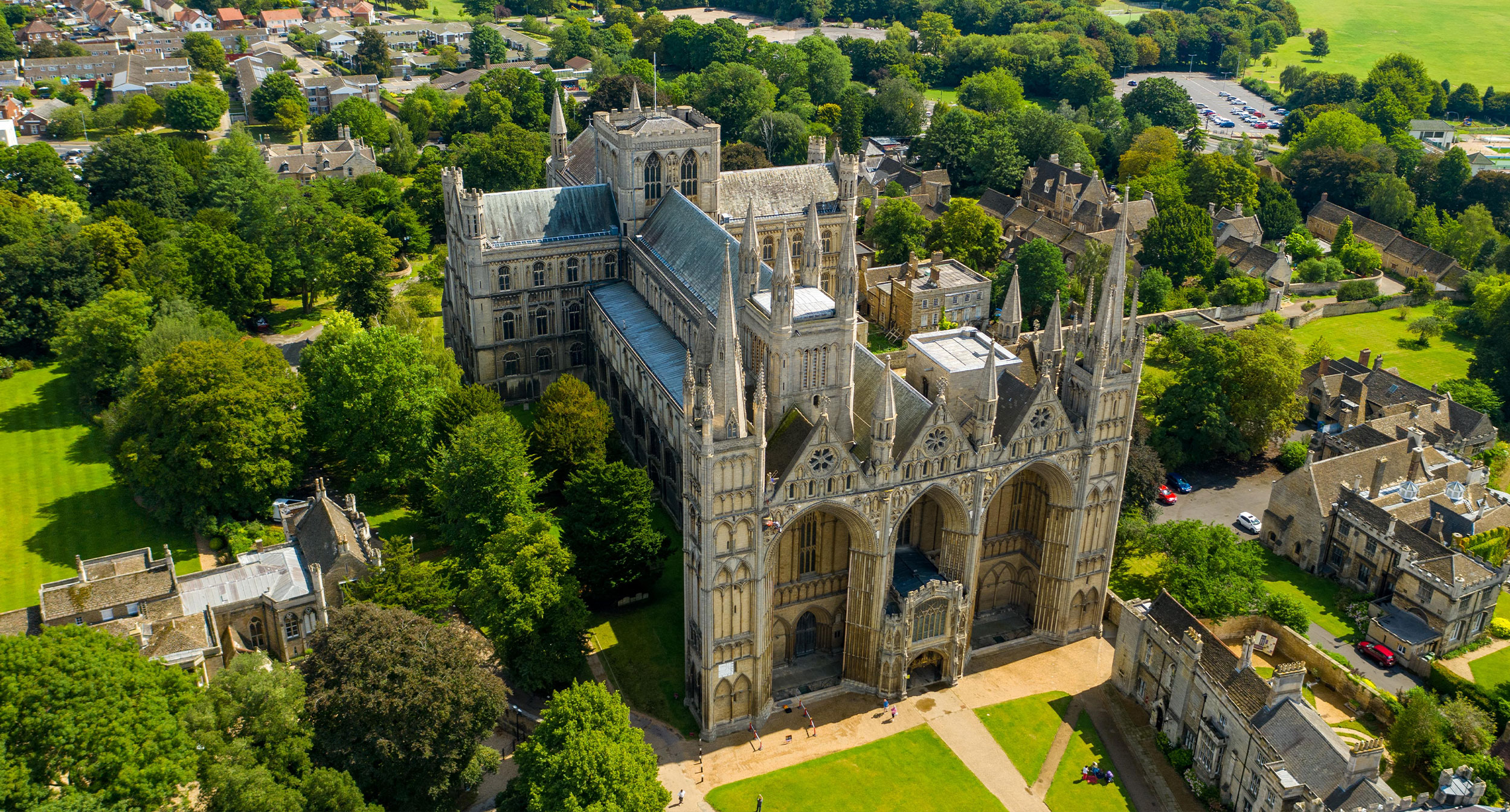
In 1709 Peterborough Cathedral presented Penn with an extraordinary opportunity.
The Dean and Chapter wanted its existing bells recast into a new ring of ten. Penn was only 24 and had been working independently for just six years, yet somehow he convinced the Cathedral authorities that he could undertake the job.
It was a formidable challenge.
The Cathedral's old bells were enormous. They had to be taken down, weighed, broken up and their valuable bronze reused. New moulds had to be prepared and immense quantities of metal melted before each bell could be cast.
Most difficult of all, the ten completed bells had to work together musically.
The surviving Cathedral accounts reveal that the project was far from straightforward. Some of the bells required repeated recasting and there were continuing arguments about weight, metal and tuning.
Penn nevertheless persisted.
The commission occupied him for several years and ultimately produced the first ring of ten bells in Northamptonshire.
Peterborough Cathedral gave a 24-year-old craftsman the commission that would help turn him into one of the leading bellfounders of his generation.
The foundry by Bell Dyke
The Cathedral commission helped bring Penn permanently into Peterborough.
His foundry developed close to Bridge Street, near the southern edge of the Cathedral precincts and approximately where the Magistrates' Court and Rivergate area stand today.
It was an exceptionally practical location for a bellfounder.
Running beside the works was a watercourse known as Bell Dyke. It joined the River Nene only a short distance away, giving Penn access to one of the easiest ways of moving objects that could weigh hundreds of kilograms or even several tons.
Bells could be taken from the foundry towards the river and transferred to boats or barges before beginning their journey to customers.
For an eighteenth-century industrial business, Peterborough's position was valuable. Rivers, roads and a landscape filled with parish churches placed potential customers in almost every direction.
An inscription cast into six bells for St Mary and St Nicholas at Wrangle in Lincolnshire in 1714 leaves no doubt about the identity Penn was now promoting:
ALL SIX WERE MADE IN PETERBOROW BY HENRY PENN FOUNDER 1714
Bells across England
From Peterborough, Penn built a remarkable business.
More than 250 bells have been attributed to his foundry, supplied to around 100 churches, houses, schools and other buildings across as many as 13 English counties.
His geographical reach was extraordinary for a craftsman operating in an age before railways or modern roads.
Penn travelled on horseback, following the towers and spires that rose above the landscape. Each might represent another parish needing a cracked bell recast, an existing ring enlarged or an entirely new set made.
His work can be traced through Northamptonshire, Lincolnshire, Huntingdonshire, Cambridgeshire, Rutland, Leicestershire and considerably further afield.
Bells associated with Penn were supplied to places including Lincoln Cathedral, Hull, Ely, Oakham, Stamford, Castor, Yaxley, Great Casterton, St Ives and Bourne.
- 1703 Lymm, Cheshire A ring of six bells made when Penn was only 18.
- 1709 Peterborough Cathedral A monumental commission for a new ring of ten bells.
- 1714 Wrangle, Lincolnshire Six bells carrying Penn's proud declaration that they were made in Peterborough.
- 1718 Great Casterton, Rutland Five Penn bells formed the historic core of the church's ring.
- 1723 St Ives, Huntingdonshire Eight bells whose casting led to the defining dispute of Penn's final years.
- 1729 Bourne Abbey Penn cast the original six-bell ring during the final year of his life.
Words cast in bronze
Penn's bells are particularly memorable because he treated their surfaces as more than a place to record his name and the date.
He cast words into bronze.
Some inscriptions were religious. Others named vicars, churchwardens or benefactors. A number had considerably more personality.
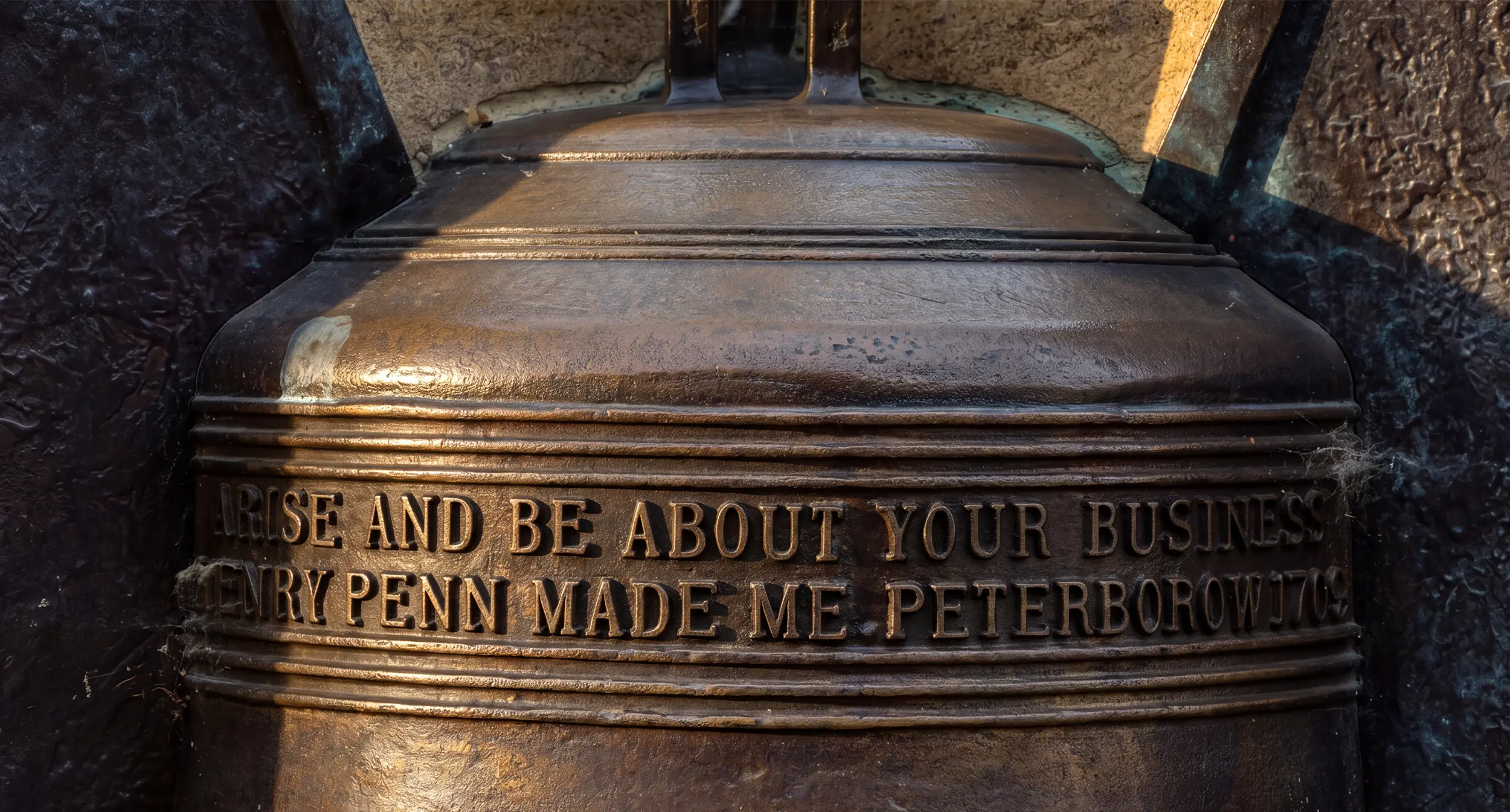
One of the most famous appears on a Penn bell made for St Ives:
ARISE AND BE ABOUT YOUR BUSINESS
Henry Penn, Founder, Peterborough, 1723
Another reflected on mortality:
When souls are from your bodies torn, 'tis not to die but to be born.
These inscriptions are one reason Penn's work has such unusual historical value. A surviving bell is not merely an eighteenth-century object. Its bronze carries names, dates, beliefs, humour and fragments of the community that commissioned it.
They are documents designed to ring.
More than a bellfounder
Penn's surviving story also reveals something of the resourcefulness expected of an eighteenth-century craftsman.
Bellfounding was demanding physical work. Penn travelled widely on horseback, climbed church towers and worked around exceptionally heavy objects using equipment that would seem rudimentary by modern standards.
Intriguingly, bellfounding was not his only business.
Newspaper advertisements record that Penn also supplied steel trusses to people suffering from ruptures and promoted treatments for the condition. In 1716, Peterborough physicians and medical practitioners publicly endorsed his work.
The overlap was perhaps less strange than it first appears. A skilled founder worked alongside blacksmiths and metalworkers and possessed detailed practical knowledge of shaping metal to individual requirements.
Penn was therefore not simply an artisan producing church bells. He was an entrepreneur operating a sophisticated metalworking business from early eighteenth-century Peterborough.
The St Ives dispute
The final chapter of Penn's life began with a major commission from St Ives in Huntingdonshire.
In 1723 the parish contracted him to take down six old bells and replace them with a new ring of eight. The old bells weighed more than three tons between them, and additional bronze was added for the new set.
By September the bells were hanging in the tower.
Then the argument began.
The churchwardens and their adviser complained that the bells were not correctly tuned and challenged the quality of some of the metal Penn had added. Penn recast bells in an attempt to satisfy them, but payment was withheld.
What followed was a legal dispute lasting years.
The case eventually reached its conclusion in 1729. Although the court found that Penn had not fulfilled every element of the original contract exactly, it also recognised that St Ives had retained and used his bells, his additional metal and his work.
The verdict went in Penn's favour.
But victory came too late to bring him much satisfaction.
“I am sick to death, my heart is broken. The whole thing will do me no good.”
According to the surviving account, Penn was already seriously ill. As he attempted to mount his horse in the yard of the Crown Inn at St Ives, he collapsed and died.
He was only 44.
The parish register of St Mary and St Benedict at Huntingdon recorded his burial with extraordinary simplicity:
HENRY PENN STRANGER. JULY 23.
Penn and Peterborough
Henry Penn's working life lasted barely a quarter of a century, yet the physical reach of what he made was extraordinary.
Bells from his Peterborough foundry were carried across a large part of England. Many survived for centuries and some continue to ring today.
His greatest local survivor is much closer to home.
From the ten bells created for Peterborough Cathedral, the great tenor survives as the City Bell. Weighing around one and a half tons, it continues to sound from the Cathedral as part of the clock.
The sound that survived
1709More than three centuries after Henry Penn cast bells for Peterborough Cathedral, his surviving City Bell still sounds above the city.
Peterborough has also reclaimed the landscape of his working life.
Foundry Walk recalls the workshop near Bridge Street. Henry Penn Walk follows part of the riverside landscape through which his bells were transported. Near the site of the old foundry, the Voice of the City sculpture evokes the shape of a great bell at the moment of casting.
Yet perhaps the most remarkable memorial is invisible.
It is sound.
More than 300 years after Henry Penn worked beside the River Nene, Peterborough can still hear something he made.
His story belongs to a Peterborough that existed long before the great engineering factories of the nineteenth and twentieth centuries, but the instinct is recognisable: specialist knowledge, skilled making, ambitious engineering and products leaving the city for customers far beyond it.
In that sense, Henry Penn can be seen as one of the earliest great industrial craftsmen in Peterborough's story.