


Elmfield Road · Black Hood · Witness Account
The Garton End
Ghost
In the spring of 1926, people on the northern edge of Peterborough began avoiding a lane after dark. A short, black-hooded figure had been seen moving along it without apparently walking. One man decided to find out what everyone was frightened of.
The unsettling part is how specific the story becomes.
Many ghost stories survive as a sentence or two. Somebody saw a woman on a staircase. A figure crossed a churchyard. Strange footsteps were heard in an empty room. The Garton End Ghost is different because one of its witnesses told a newspaper what he believed had happened.
In the spring of 1926, rumours spread around Peterborough that something was appearing after dark on the lane running between Dogsthorpe and Garton End, along the line associated today with Elmfield Road.
The description was simple enough to be frightening. The figure was short, dressed entirely in black and covered by a hood or cloak that seemed to reach almost to the ground.
Children became reluctant to use the road. Older residents avoided it after dark. Other people reacted in precisely the opposite way and went out to see whether they could find the thing for themselves.
One of them was Charles Johnson.
Peterborough was talking about a ghost.
The story reached the pages of the Peterborough Advertiser, which means the haunting can be approached as a piece of contemporary social history as well as folklore.
The newspaper did not need to decide whether ghosts existed. It had something more useful: people were prepared to describe what they thought they had seen.
That gives the story a very different texture from a legend written down centuries after the supposed event. Names, distances, times and physical details enter the account.
The witness was named.
The argument began almost immediately.
Charles Johnson appears in the surviving version of the story as the man who deliberately set out to investigate it. Rather than accidentally encountering the apparition while walking home, he spent several nights on the lane trying to prove to himself what was happening.
For several nights, nothing happened.
Then, just before Easter, something appeared.
Johnson took his retriever with him and walked the lane at night. On the Friday before Easter, at about ten minutes to ten, he finally saw what everybody had been discussing.
Ahead of him was a black figure, perhaps twenty or thirty yards away.
Johnson estimated its height at about five feet. A hood or cloak appeared to fall all the way to the ground, hiding the body beneath it.
What disturbed him most was the way it moved.
It seemed to glide.
In his account, it appeared to be several feet from the footpath rather than moving naturally along its surface.
That is the detail which changes the story from a dark figure seen on an unlit road into something much stranger.
He ran towards it.
Whatever Johnson thought he was looking at, his response was not to retreat.
He charged towards the figure.
The thing immediately moved away from him. According to his account it travelled quickly, keeping ahead of his pursuit as he tried to close the distance.
And went through it.
That was the moment which made an ordinary explanation more difficult for Johnson. A person hiding beneath a cloak could run away. A trickster could wait in the darkness. But the witness believed he had watched the figure disappear through a physical boundary rather than going around or through an opening.
He was convinced enough by the encounter to keep watching the road.
Johnson said he saw it three times.
The first encounter might be explained as darkness, expectation and an unfamiliar person on the road. Johnson's claim that he saw the figure twice again made his account harder for local discussion to dismiss.
We do not have to accept his interpretation to take the testimony seriously as folklore. What matters is that he believed the encounters were repeated and was prepared to put that belief into the public record.
Three times becomes a story.
By then the question was no longer simply whether something had been seen. Peterborough wanted to know who the figure was.
A name began circulating.
People said it was Mrs Clements.
Street gossip attached the apparition to a local woman named Mrs Clements, remembered by the period nickname “One-legged Peggy”.
She was described as a rag-and-bone woman who had been known locally and had recently died in the workhouse.
That identification should be treated as exactly what the surviving account says it was: talk circulating in the streets.
Nothing in the evidence demonstrates that an apparition was Mrs Clements, or even that the figure Johnson saw was supernatural at all. Once a community has decided that a road is haunted, however, the next question is almost always the same.
Whose ghost is it?
“One-legged Peggy” is repeated here because it belongs to the historical tradition surrounding Mrs Clements. It is a period nickname, not a modern description chosen by Discover Peterborough.
Garton End was already an old Peterborough place-name.
The name Garton End did not begin with twentieth-century suburban development.
Medieval records studied by the Northamptonshire Record Society identify a settlement called Carton, later Garton End, associated with Dogsthorpe within the estates surrounding medieval Peterborough.
That matters to the atmosphere of the 1926 story. Johnson was not walking through a fully developed modern suburb bearing a recently invented street name. He was moving through a landscape where old settlement names, developing roads and more open ground still met one another.
Garton End on the other.
A road between them after dark.
Elmfield Road did not look like this in 1926.
Today the location is an ordinary residential street, surrounded by houses, junctions, traffic and street lighting.
Peterborough Civic Society's discussion of historic maps shows how much of the wider Dogsthorpe area developed later, with older pockets such as Garton End already present while large areas around them remained comparatively open.
Modern property records tell a similar story. Some homes pre-date the haunting, but much of the housing associated with Elmfield Road belongs to the decades that followed.
The setting Johnson knew therefore had fewer of the visual certainties available today. A hedge could genuinely break the line of sight. Darkness mattered more. An unfamiliar person could be difficult to identify at twenty or thirty yards.
The evidence does not give us an answer.
Darkness, distance and expectation can transform surprisingly ordinary objects and people.
A person wearing a long coat or cloak could look much shorter or stranger when seen without good lighting. A hedge can make somebody seem to vanish. Movement over uneven ground can be difficult to judge from a distance.
By the time Johnson went looking, he also knew what people expected the ghost to look like. That does not mean he invented what he saw, but expectation inevitably affects how ambiguous experiences are interpreted.
On the other hand, none of those possibilities proves that Johnson was mistaken.
He does not give us a solution.
That is the point at which good folklore should stop trying to become bad certainty.
We know people were frightened. We know Johnson described what he believed was a repeated encounter. We know the story became associated with a recently deceased local woman.
What moved along the lane remains open.
Some people avoided the road. Others went looking.
That contradiction is one of the most recognisable parts of a haunting.
Reports that children and older residents became reluctant to use the lane show that the story had consequences beyond entertainment. For some people, the possibility of an apparition altered where they were willing to walk after dark.
Yet the same rumours generated curiosity. People who would otherwise have had no reason to spend an evening on the lane deliberately went looking for the ghost.
Every extra observer created another opportunity for a light, shadow, pedestrian, animal or movement in a hedge to become part of the story.
Then fills it with ghost hunters.
The Garton End story is therefore as much about the way a community reacts to a haunting as it is about the figure itself.
Because the ordinary road is still there.
There is no castle, ancient ruin or dramatic churchyard required for this story.
Its setting is a road thousands of Peterborough residents would now regard as completely normal. That normality is what makes the haunting work.
The landscape has changed so much that it takes effort to reconstruct the darker, less developed road of 1926. Yet the basic line through the neighbourhood remains recognisable.
You can still walk it and ask the same question Johnson asked a century ago.
What would somebody really see here at ten to ten on a dark night?
Then he chased it through a hedge.
Do not expect the landscape Johnson knew.
Elmfield Road is now part of an ordinary residential area, which makes this one of the easiest Peterborough folklore locations to encounter and one of the least obviously atmospheric.
That is precisely the challenge.
Walk it knowing that the houses, lighting and surrounding streets disguise the more open landscape of a century ago. The interest lies in comparing the completely normal road in front of you with the extraordinarily detailed experience Charles Johnson described there.
Elmfield Road is a public road but also people's home. Explore respectfully, remain on public highways and footpaths, keep noise down and do not enter gardens, driveways or private property while looking for the location.
Garton End is not the city's only haunting with witnesses.
Continue through Peterborough's better documented ghost traditions, where newspaper reports, personal testimony and historical events sit beside the supernatural explanations attached to them.
The Woman in Black of Woodston
First reported in 1908 and still being discussed in 1973, another Peterborough apparition became attached to the memory of a real local woman.
Read the story → 02 · HISTORY BECOMES HAUNTINGThe Ghost of Woodcroft Castle
A documented Civil War killing became the foundation of a haunting remembered centuries later through voices, sounds and John Clare's writing.
Enter Woodcroft's story → 03 · HOUSEHOLD WITNESSESButton Cap
A rectory ghost became familiar enough that members of the household recognised his footsteps, his slippers and his habit of turning the pages of books.
Meet Button Cap → 04 · SEEING THE FUTURESt Mark's Eve
A churchyard tradition asked watchers to sit through the night and see who would marry and who would die during the year ahead.
Enter the churchyard →More Peterborough Folklore
Apparitions, strange creatures and old beliefs that turned ordinary Peterborough landscapes into places people remembered.
The Woman in Black
First seen in 1908, this apparition was still generating witness testimony and argument more than sixty years later.
The Ghost of Woodcroft Castle
A violent death in 1648 became a haunting associated with clashing steel, voices and a man who never quite left.
Button Cap
A ghost with recognisable habits crossed the same room in loose slippers and turned book pages night after night.
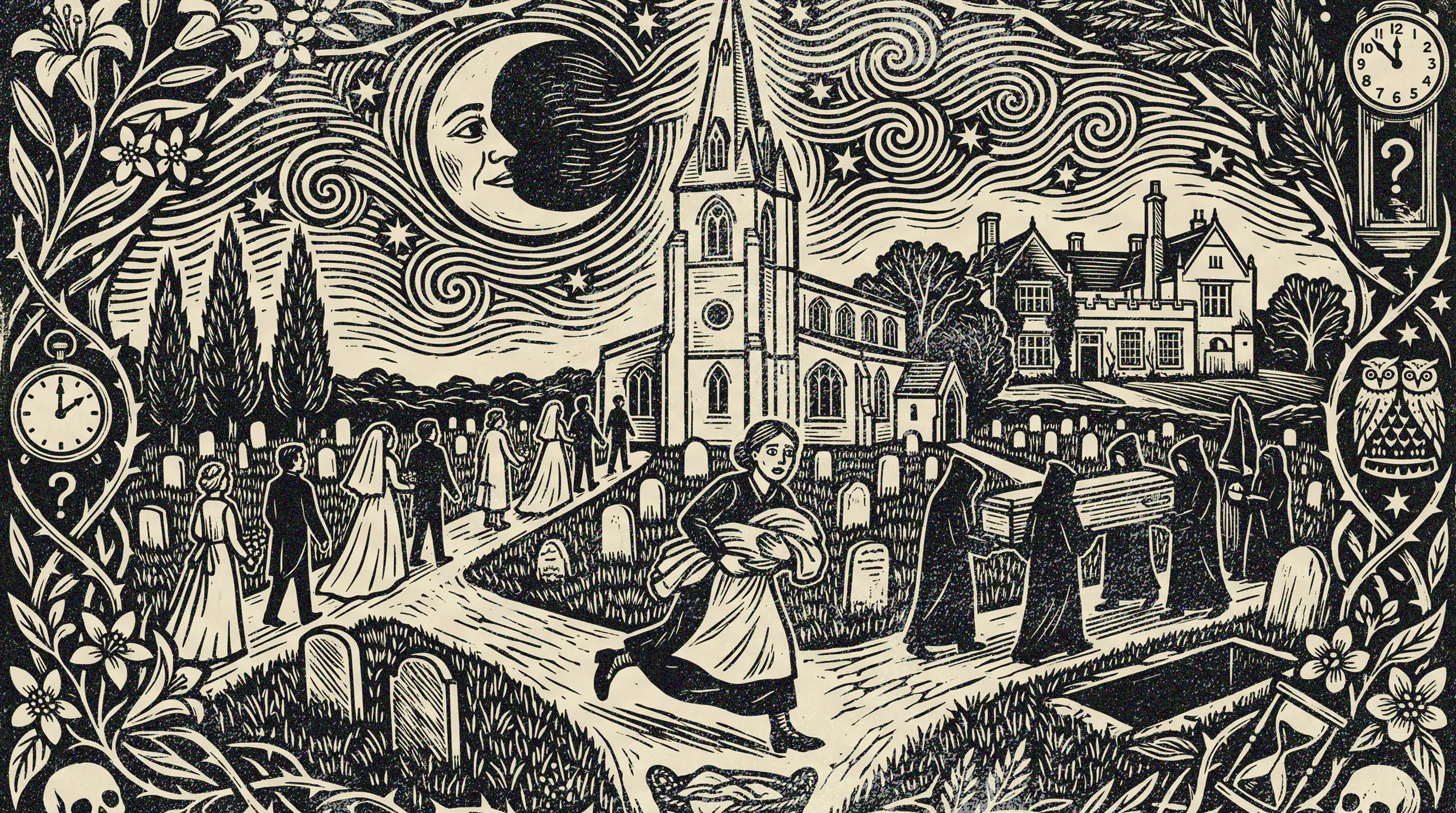
St Mark's Eve
Sit in a churchyard on the right night and tradition said the coming year's marriages and funerals would pass before you.
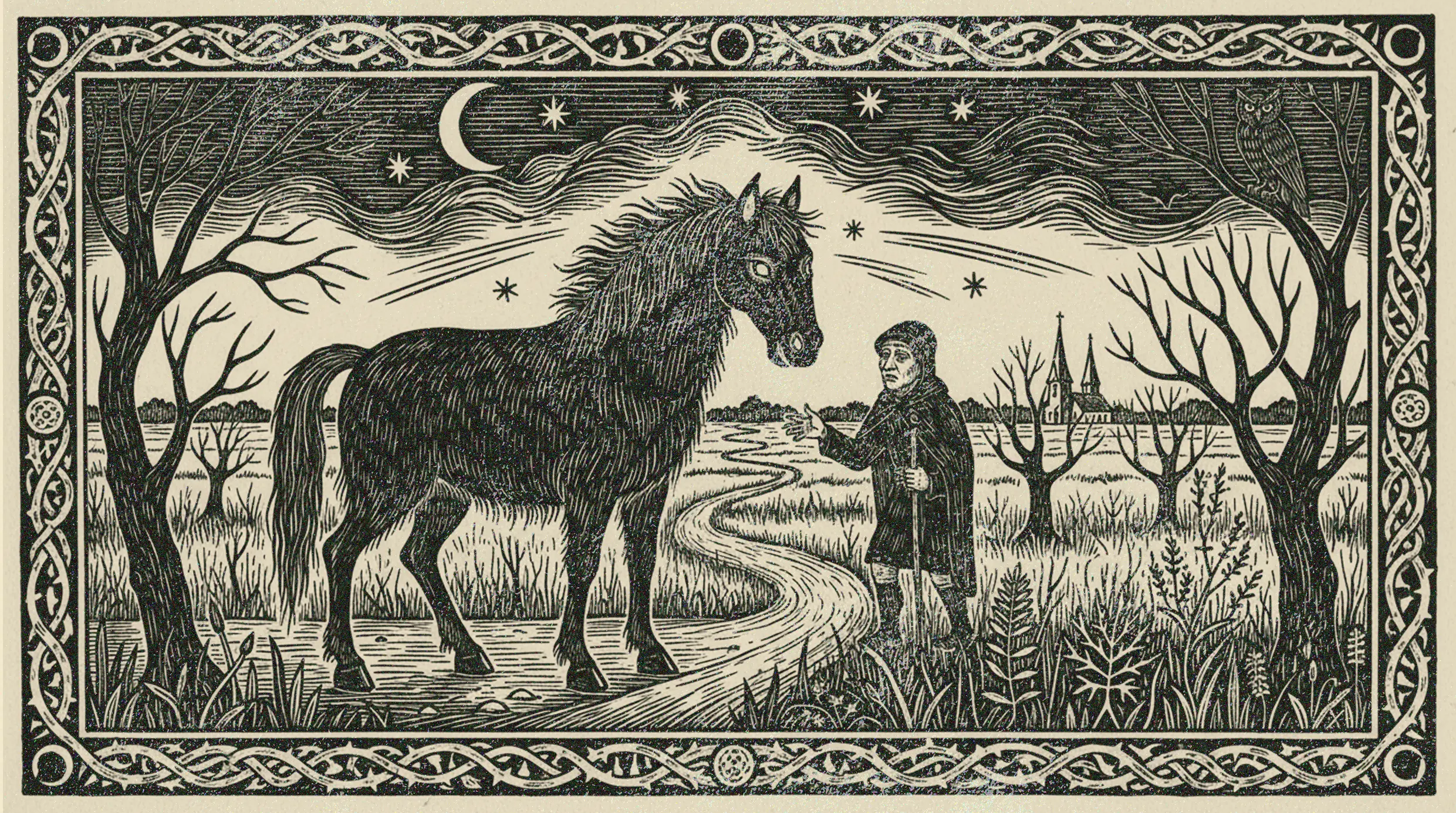
The Shag Foal
A huge black animal, neither quite horse nor bear, was said to follow travellers along lonely roads after dark.
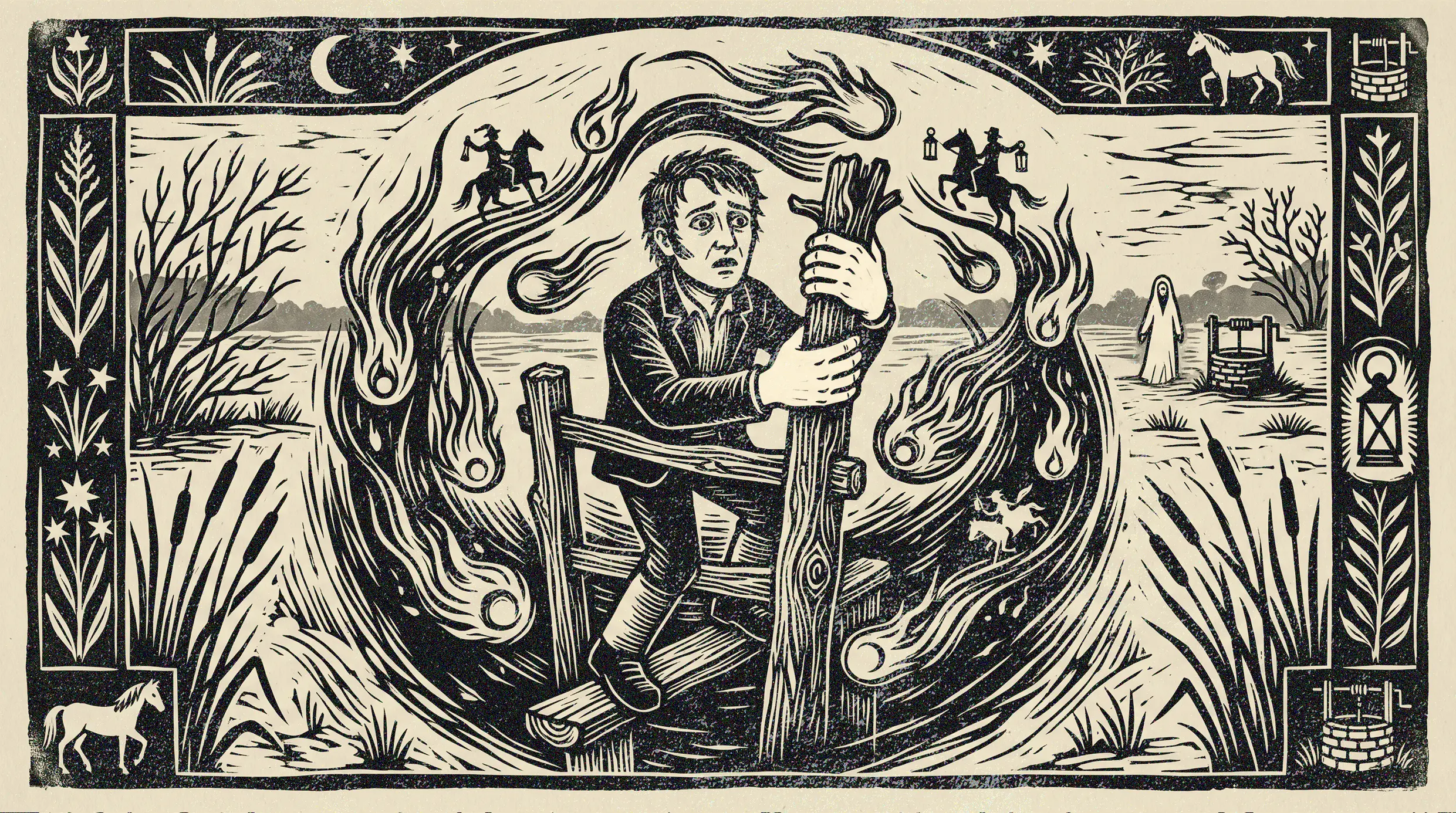
The Will o' the Wisps
John Clare doubted ghosts, but the lights moving across wet ground at night unsettled him for the rest of his life.
Behind the haunting
Unlike many older supernatural traditions, the Garton End Ghost belongs to the age of local newspapers. The surviving account preserves a named witness and unusually precise details while still leaving the nature of the experience unresolved.
-
Peterborough Advertiser · British Newspaper Archive
Digital archive of the local newspaper in which contemporary Peterborough life, witness reports and stories from the period were recorded. -
Discover Peterborough · The Garton End Ghost
The existing Discover Peterborough account preserves the core 1926 narrative: Charles Johnson's investigation, the hooded figure, the chase, the hedge and the local identification with Mrs Clements. -
Northamptonshire Record Society · Peterborough's Sacrist Manors
Historical research identifies Carton, later Garton End, as a settlement associated with Dogsthorpe within the medieval Peterborough landscape. -
Peterborough Civic Society · Peterborough Today
Discussion of historic Peterborough maps illustrating the older settlements around Garton End and the later development of the wider Dogsthorpe area. -
Discover Peterborough · Peterborough Folklore
Explore the wider collection of Peterborough ghost stories, traditions, unusual customs and historical legends. -
Discover Peterborough · Weird Weekends
The Garton End Ghost is one of the real-world curiosities that can be tracked down as part of Discover Peterborough's Weird Weekends challenge.