


Born near Peterborough in 1735, William Speechly became one of Georgian Britain’s most important practical horticulturists. As head gardener to the 3rd Duke of Portland, he combined observation, experiment and engineering to improve the cultivation of pineapples, grapes and other tender fruits in the English climate.
Life in dates
- 1735 Born near Peterborough and baptised on 25 February
- Early career Trains on the Fitzwilliam estate at Milton, near Peterborough
- Later Works at Castle Howard and becomes head gardener at Scampston Hall
- 1767 Appointed head gardener to the 3rd Duke of Portland at Welbeck Abbey
- 1771 Travels to Holland to study gardens and hot-house technology
- 1776 Prepares an account of tree planting on the Duke of Portland’s estates
- 1779 Publishes his influential treatise on pineapple cultivation
- 1790 Publishes A Treatise on the Culture of the Vine
- 1797 Commissioned to write on gardening and rural economy for the Board of Agriculture
- 1801 Leaves Welbeck and takes over the management of a family farm
- 1819 Dies at Great Milton in Oxfordshire on 1 October
- 1820 Practical Hints in Domestic Rural Economy is published posthumously
Peterborough beginnings
William Speechly was born near Peterborough in 1735 and baptised on 25 February. He was probably the second son of Ralph Speechly, a butcher and grazier associated with Orton Longueville, and his wife Sarah Blackwell.
The Speechly family belonged to the rural economy surrounding Peterborough. Livestock, orchards, kitchen gardens and productive estates were part of the landscape in which William grew up. His later career would take him into the service of some of the country’s most powerful aristocratic families, but its foundations were laid in the villages and estates immediately around his birthplace.
Accounts of his early life suggest that Speechly received a good education and showed an unusual combination of practical, scientific and artistic ability. As a young man he reportedly engraved sketches of flowers, fruit and garden designs onto copper plates.
Drawing was a valuable skill for an ambitious eighteenth-century gardener. Plans for hot-houses, heating systems, planting arrangements and methods of training fruit had to be communicated precisely. Speechly would later illustrate his published works with detailed designs, transforming knowledge acquired in gardens into information that other practitioners could use.
Learning his profession
Speechly began his horticultural training on the Fitzwilliam family’s estate at Milton, close to Peterborough. Today centred on Milton Hall, the estate contained ornamental grounds, productive gardens, woodland and agricultural land. It offered a young gardener experience of the many different skills required to maintain a substantial country estate.
Gardening at this level involved far more than decorative planting. A large household expected its gardens to supply fruit, vegetables, flowers and herbs throughout the year. Gardeners needed to understand soils, drainage, propagation, pruning, pests, weather and the increasingly sophisticated technology of heated glasshouses.
Speechly subsequently worked at Castle Howard in Yorkshire, associated with Frederick Howard, 5th Earl of Carlisle. He then became head gardener to Sir William St Quintin at Scampston Hall.
These appointments took him through some of the most ambitious designed landscapes and productive gardens in Georgian England. They also established his professional reputation. By the 1760s, Speechly was no longer simply learning established methods: he was developing the authority and confidence to test and improve them.
Head gardener at Welbeck Abbey
In 1767 Speechly was appointed head gardener to William Henry Cavendish-Bentinck, 3rd Duke of Portland, at Welbeck Abbey in Nottinghamshire. It was the defining appointment of his career.
The Duke of Portland was a wealthy landowner and senior political figure who would twice serve as prime minister. Welbeck gave Speechly access to the resources needed for ambitious horticultural experiments: land, labour, glasshouses, heating systems and an employer prepared to invest in the cultivation of rare and difficult plants.
As head gardener, Speechly occupied a position of considerable responsibility. He oversaw productive gardens designed to supply the ducal household, supervised other gardeners and labourers, managed costly plants and equipment, and reported directly to the duke.
In 1771 the duke sent him to Holland, then one of Europe’s most important centres for horticultural technology. Dutch gardeners had developed considerable expertise in glasshouse construction and the use of stoves and flues to create controlled growing environments.
Speechly studied these techniques and adapted them to conditions at Welbeck. Rather than copying a single system, he combined ideas gathered during his travels with repeated practical experiments of his own.
Surviving correspondence in the University of Nottingham’s Portland Collection shows him reporting directly to the duke about infected plants, insect control and the movement of pineapples between growing houses. A later drawing records his design for a peach-forcing frame heated by a fireplace and a flue running beneath the structure.
These records reveal a gardener who observed problems carefully, tested possible solutions and revised his methods in response to the results.
Solving the pineapple problem
In eighteenth-century Britain, the pineapple was far more than a fashionable fruit. Imported fruit often arrived in poor condition, while growing a pineapple successfully in Britain required expensive buildings, fuel, skilled labour and constant attention.
Its rarity made the pineapple a symbol of hospitality, international trade, wealth and technological sophistication. A perfectly ripened home-grown fruit demonstrated that an estate possessed both money and a highly capable gardener.
The pineapple was also one of the most difficult plants entrusted to a Georgian garden. Native to a tropical climate, it required warmth around its roots but could be damaged by excessive heat. It needed light, air and moisture, yet was vulnerable to cold, waterlogging, rot and insect infestation.
Gardeners usually placed pineapple pots in heated beds, frequently using fermenting tanners’ bark to produce steady bottom heat. Maintaining the correct temperature through an English winter was difficult and costly. A sudden change could destroy plants that had taken years to bring to fruiting size.
Speechly’s achievement was not the introduction of the pineapple to Britain. Gardeners had grown the fruit before his time. His importance lay in making its cultivation more systematic, predictable and intelligible.
He paid particular attention to avoiding excessive winter heat, maintaining suitable root conditions, managing ventilation and protecting plants from pests. He compared materials and growing environments, observed how plants responded and recorded practical instructions for every stage of cultivation.
His concern with insects was especially significant. Pests could spread rapidly through the warm, enclosed environment of a hot-house. Speechly studied the insects affecting pineapple plants, considered their life cycles and developed methods intended to remove them without sacrificing an entire collection.
A pioneering book on the pineapple
Speechly brought his experience together in A Treatise on the Culture of the Pine Apple and the Management of the Hot-House, published at York in 1779.
The full title promised not only guidance on growing the fruit but also a description of the insects infesting hot-houses and methods for destroying them. This combination made the book a detailed technical manual rather than a general celebration of exotic gardening.
Speechly explained the construction and management of growing houses, preparation of materials, propagation of plants, control of temperature and moisture, treatment of pests and the process of bringing a pineapple into fruit.
His instructions were grounded in work undertaken at Welbeck. Readers were being given access to methods tested within one of Britain’s most sophisticated aristocratic gardens, accompanied by plans and illustrations that allowed those methods to be studied elsewhere.
The book attracted subscribers from among landowners, gardeners, nurserymen, physicians and other educated readers. Its appeal across professional and social boundaries reflected the changing status of horticulture. Gardening was increasingly understood as a field in which experiment, accurate observation and published evidence could improve practical results.
A second edition, enlarged with additional material, appeared in 1796. Its republication demonstrated that Speechly’s methods remained valuable well beyond their first appearance.
The culture of the vine
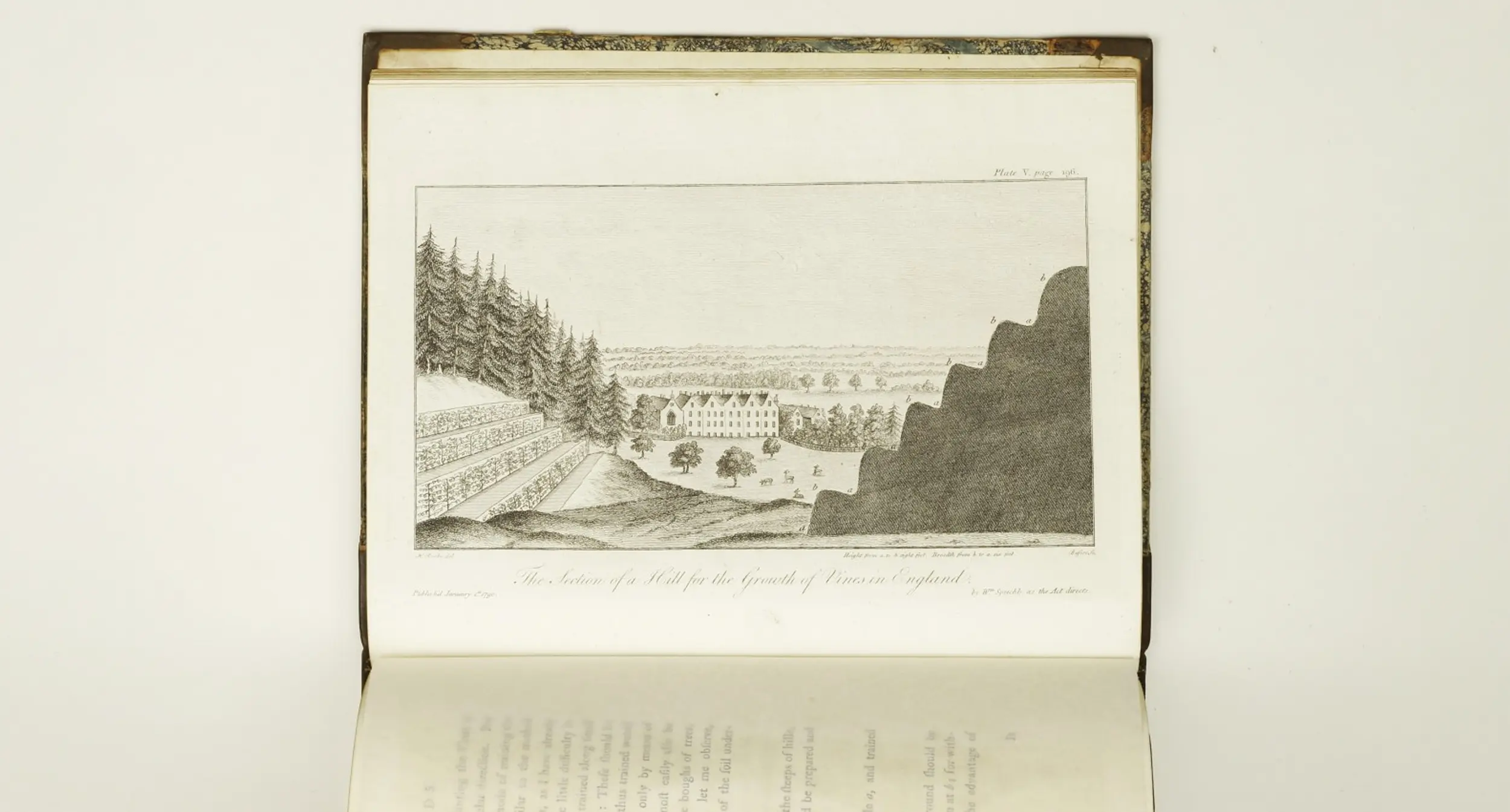
Speechly next turned his attention to another crop associated with warmer climates: the grapevine. In 1790 he published A Treatise on the Culture of the Vine, presenting what its title described as new and advantageous methods of propagating, cultivating and training vines.
The work considered around 50 grape varieties, discussing differences in growth, ripening, colour, flavour and suitability for particular conditions. Speechly addressed vines grown under glass as well as the possibility of establishing vineyards in the open air.
His advice covered the design and management of vineries, preparation of borders and soils, planting, pruning, watering, grafting and training. He also considered insects, disease and the effects of the English climate.
Speechly understood that successful cultivation depended upon the relationship between the plant and its constructed environment. The angle of glass, position of flues, depth of soil, movement of air and timing of pruning could all influence the quality and quantity of the crop.
His discussion of vineyards was ambitious but not simply speculative. Speechly considered which varieties might ripen outdoors and examined evidence from estates where grapes had already been cultivated successfully. His work belongs to a long history of attempts to establish productive viticulture in England.
The treatise became an important reference work for later fruit growers. A combined edition of Speechly’s books on vines and pineapples was published after his death, preserving his practical knowledge for a new generation of gardeners.
Trees, gardens and rural life
Although Speechly became famous for pineapples and grapes, his interests extended across estate management, forestry, orchards and domestic food production.
In 1776 the Duke of Portland asked him to prepare an account of methods used to plant trees on the Nottinghamshire estates. The work was connected with Alexander Hunter’s edition of John Evelyn’s influential book Silva and later appeared in Hunter’s Georgical Essays.
This contribution placed Speechly within a much broader national discussion about forestry and the productive use of land. Timber was essential for buildings, tools, fuel, industry and the navy, making successful planting an economic and strategic concern as well as a matter of landscape design.
In 1797 Sir John Sinclair, president of the newly established Board of Agriculture, invited Speechly to prepare sections on gardening and domestic rural economy for a comprehensive agricultural publication.
The larger project was abandoned, but Speechly recovered his manuscript and continued developing it. His attention increasingly moved from expensive hot-houses towards the practical value of fruit gardens, kitchen gardens, cottage plots and orchards.
This later work reveals an important dimension of his thinking. The gardener who had perfected exotic fruit for an aristocratic household also believed that well-managed land could improve everyday domestic life. Productive gardens could provide families with food, make better use of limited space and contribute to greater rural self-sufficiency.
His completed ideas were published posthumously in 1820 as Practical Hints in Domestic Rural Economy. The volume included advice on the formation and management of fruit, kitchen and cottage gardens and orchards, together with agricultural essays.
Family, loss and later years
Speechly married Mary Chell at St George’s, Hanover Square, London, on 22 May 1771. They had at least four children: two sons and two daughters.
Their sons continued the family’s connection with horticulture and land. William Griffin Speechly became involved in a nursery business at Newark, while John was associated with Woodborough Hall in Nottinghamshire.
The family endured considerable loss. John died in 1800, and Speechly left Welbeck soon afterwards to take over the management of his son’s farm at Woodborough. William Griffin died in 1804.
Speechly’s departure from Welbeck ended more than three decades of service to the Duke of Portland. He was succeeded there by Joseph Thompson, a gardener associated with his professional circle.
After his period at Woodborough, Speechly retired to King’s Newton near Melbourne in Derbyshire. He continued revising and enlarging his writing on gardening and rural economy before eventually moving to Great Milton in Oxfordshire.
His wife Mary died at Great Milton in November 1818. William died there on 1 October 1819 while living with his daughter Sarah and her husband, the surgeon John Stevenson.
A lasting horticultural legacy
William Speechly belonged to a generation that transformed the status of the professional gardener. Horticultural knowledge had often been transmitted through apprenticeship, personal experience and guarded estate practice. Speechly helped convert that knowledge into detailed, illustrated and testable written guidance.
His work joined traditional gardening skill with a developing culture of experiment. He observed plants closely, documented failures as well as successes, altered structures and growing conditions, and communicated the results to other practitioners.
His surviving correspondence is particularly revealing because it shows that his published authority emerged from everyday problems. Insects appeared unexpectedly, heat fluctuated, plants had to be moved and designs needed revision. Innovation came through repeated attention to these practical difficulties.
Speechly’s pineapple and vine treatises were among the most significant British works devoted to those crops during the eighteenth century. Their later republication ensured that his methods continued to circulate after his death.
His final work on cottage gardens and domestic rural economy widened that legacy. It connected the advanced practices of the great estate with the more modest but essential task of helping households make productive use of gardens and orchards.
Speechly’s career also gives the Peterborough area an important place in the history of horticultural science. His origins at Orton Longueville and his early training at Milton link the local landscape to innovations developed at Welbeck and subsequently shared through books read across Britain.
From the gardens of Milton near Peterborough to the experimental hot-houses of Welbeck Abbey, William Speechly helped turn horticulture into a discipline founded upon observation, evidence and the sharing of practical knowledge.