
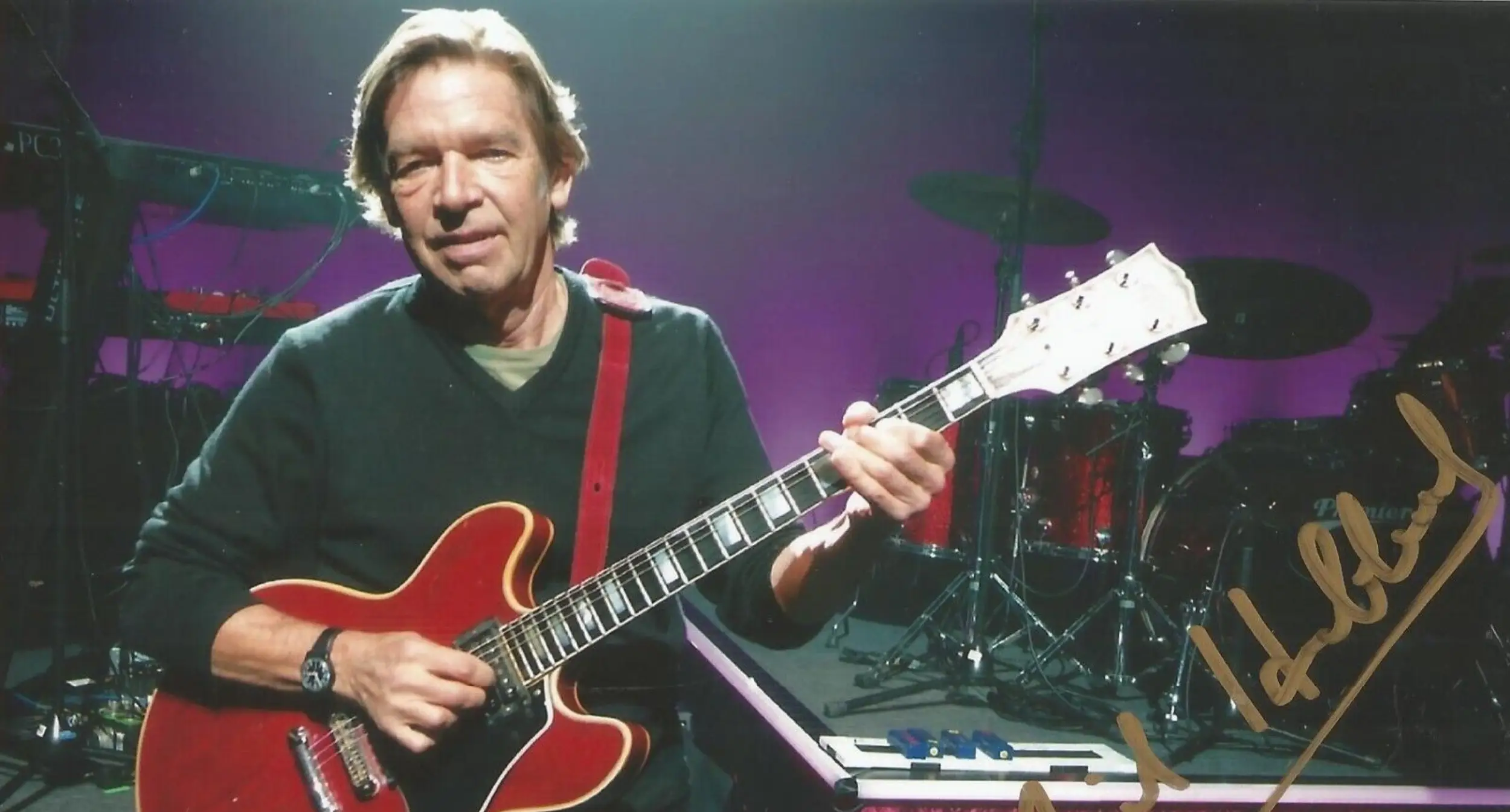
Neil Hubbard is one of British popular music’s most respected guitarists. From his formative years as a Peterborough Cathedral chorister and King’s School pupil, his precise, soulful playing carried him into Bluesology, Juicy Lucy, the Grease Band, Kokomo, Roxy Music and an exceptional catalogue of session work.
Life and career in dates
- 1948 Born on 24 February
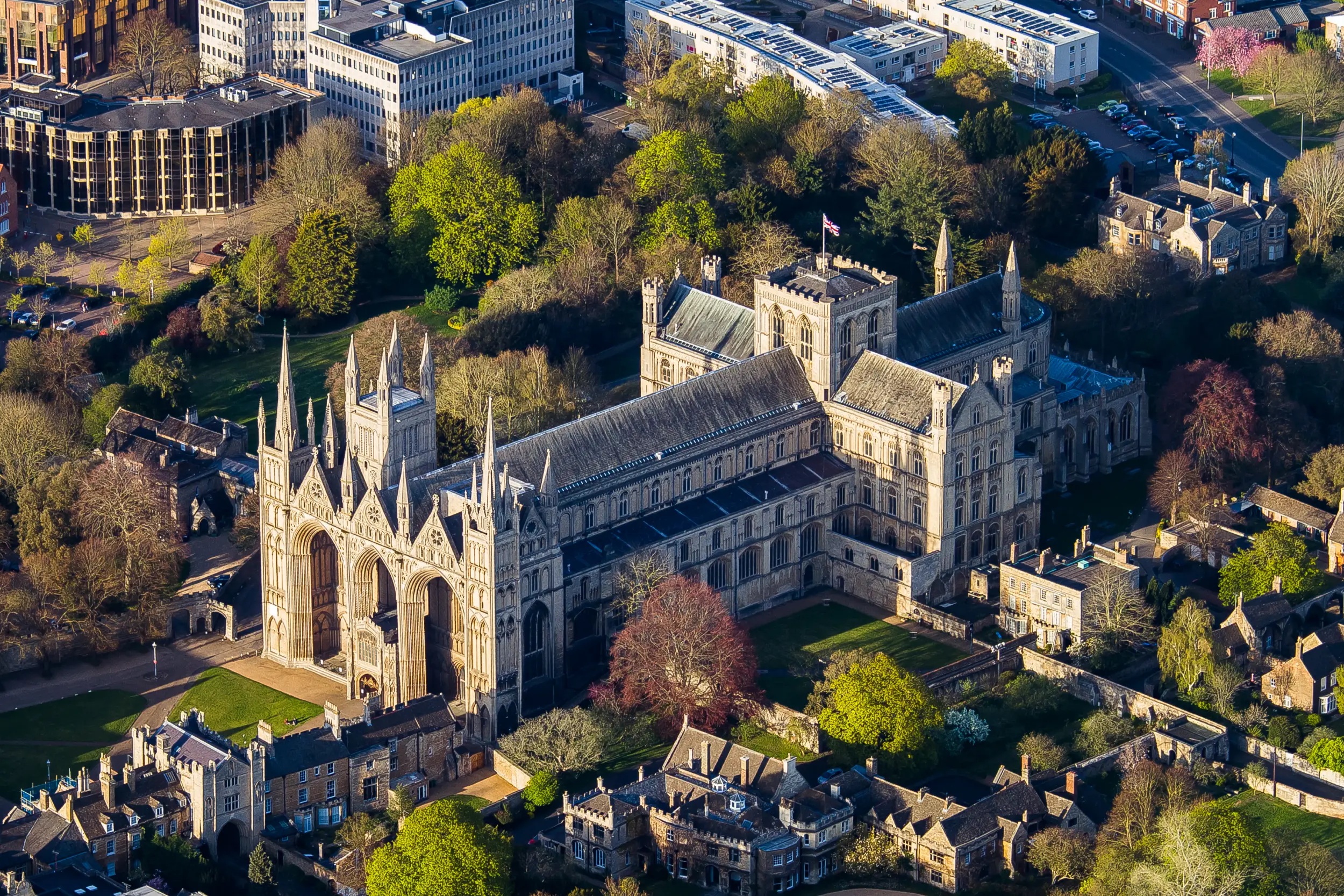
- 1959–62 Sings as a chorister at Peterborough Cathedral
- 1966 Joins a later line-up of Bluesology
- 1968 Records with Wynder K. Frog
- 1969 Becomes a founding member of Juicy Lucy
- 1970 Plays on the original Jesus Christ Superstar album
- 1973 Joins the original line-up of British soul band Kokomo
- 1975 Records with Kokomo and at sessions for Bob Dylan’s Desire
- 1976 Begins his long recording association with Bryan Ferry
- 1980 Plays on Roxy Music’s Flesh + Blood
- 1982 Contributes to Avalon and tours with Roxy Music
- 1985 Records Slave to Love and performs with Bryan Ferry at Live Aid
- 1997 Records with B.B. King on Deuces Wild
- 2012 Appears on Dexys’ comeback album One Day I’m Going to Soar
- 2026 Musicians gather for the Lewy Body Society fundraiser A Night for Neil
Peterborough Cathedral and King’s School
Neil Terrence Hubbard was born on 24 February 1948. His lasting connection with Peterborough began during childhood when he became a pupil at The King’s School and a chorister at Peterborough Cathedral.
Hubbard sang in the Cathedral choir from 1959 until 1962 and lived as a boarder at Madeley House. This meant that his early musical education was rooted in the discipline of choral singing, rehearsals and regular Cathedral services.
At the same time, rock and roll was transforming British youth culture. Hubbard and another King’s School pupil began teaching themselves guitar. With the help of fellow boarder David Wright, who provided the technical plans, they constructed their own amplifiers.
The young musicians entertained their school friends with songs including Buddy Holly’s Peggy Sue and Tommy Roe’s Sheila. These informal performances at Madeley House mark the beginning of a professional journey that would eventually connect Hubbard with some of the most influential performers and recordings in British music.
British blues and rock
By the middle of the 1960s, Hubbard had developed into a highly capable rhythm and lead guitarist. One of his earliest significant professional engagements came in a later line-up of Bluesology in 1966.
The group brought him into contact with singer Long John Baldry and keyboard player Reg Dwight, who would later become internationally famous as Elton John. It also placed Hubbard within the network of blues, soul and rhythm-and-blues musicians then reshaping British popular music.
After Bluesology, he joined keyboard player Mick Weaver’s jazz and blues group Wynder K. Frog. Hubbard appeared on Out of the Frying Pan in 1968 and developed important working relationships with bassist Alan Spenner and drummer Bruce Rowland.
In 1969 Hubbard became part of the original line-up of Juicy Lucy. The band’s heavy interpretation of Bo Diddley’s Who Do You Love? reached number 14 on the UK Singles Chart in 1970. Hubbard played on the group’s self-titled debut album before moving into the next phase of his career.
The Grease Band and Jesus Christ Superstar
Hubbard reunited with Alan Spenner and Bruce Rowland in the Grease Band, sharing guitar duties with Henry McCullough. The musicians had previously established their reputation as Joe Cocker’s backing group, including at the Woodstock festival, although Hubbard joined the subsequent independent line-up.
One of the group’s first major assignments was the original 1970 concept recording of Andrew Lloyd Webber and Tim Rice’s Jesus Christ Superstar. Hubbard’s guitar became part of an album that preceded the stage production and helped turn the rock opera into an international phenomenon.
The Grease Band then recorded its own self-titled album. Its mixture of rock, blues, gospel and soul relied upon collective discipline rather than instrumental display, making Hubbard’s controlled rhythm playing particularly valuable.
He also worked again with Joe Cocker, appearing on the 1972 album released in Britain as Something to Say. Session credits soon followed with musicians including Eddie Harris, Donovan, Alexis Korner, Alvin Lee and Pete Wingfield.
Hubbard later returned to the world of Lloyd Webber and Rice, playing guitar on the original concept album of Evita in 1976.
Kokomo and the sound of British soul
In 1973 Hubbard and Alan Spenner joined the original line-up of Kokomo, a ten-piece group bringing together experienced musicians from the British rock, soul and jazz scenes.
Kokomo became known for exceptionally accomplished live performances and an unusually authentic approach to American soul and funk. Its sound was built around several featured vocalists, a powerful rhythm section and the complementary guitar playing of Hubbard and Jim Mullen.
Hubbard’s contribution was central to the group’s groove. His rhythm playing was economical, precise and responsive, creating space for Kokomo’s singers while holding together its layered arrangements.
The group’s self-titled debut album appeared in 1975. During an American visit that year, members of Kokomo were invited to take part in early recording sessions for Bob Dylan’s Desire. Hubbard can be heard among the large ensemble on Romance in Durango.
Although Kokomo never achieved the commercial success its musicianship appeared to promise, the band developed an enduring reputation among performers and soul enthusiasts. Hubbard returned for later reunions, including a revival beginning in 2008 and further concerts during the following decade.
Roxy Music and Bryan Ferry
Hubbard’s long association with Bryan Ferry began during sessions collected on the 1976 album Let’s Stick Together. His first contributions included guitar on Ferry’s reworking of the Roxy Music song Casanova.
Further Ferry albums followed, including In Your Mind, The Bride Stripped Bare, Boys and Girls, Taxi, Mamouna and Olympia.
Hubbard was also brought into Roxy Music for Flesh + Blood in 1980 and Avalon in 1982. His warm, soulful approach added another texture alongside Phil Manzanera’s guitar, contributing to the elegant and spacious sound of the band’s later recordings.
He joined Roxy Music’s 1980 and 1982 tours. Performances from this period were preserved through releases including The High Road and Heart Still Beating.
One of Hubbard’s most familiar recordings is Bryan Ferry’s 1985 single Slave to Love, which reached number ten in the UK. Ferry later recalled that Hubbard’s wonderfully soulful tone was recorded early in the process and that the track was built around it.
The featured guitar passage combines interwoven playing by Hubbard, David Gilmour and Keith Scott. It is therefore more accurate to understand Hubbard as a crucial part of the recording’s distinctive guitar arrangement rather than the sole performer of its solo.
Hubbard also performed in Ferry’s band at Live Aid in July 1985 and returned for later tours during the 1980s and 1990s.
A guitarist trusted by musicians
Hubbard’s reputation rests not only upon the famous names in his discography but upon the qualities that made so many musicians want to work with him. He could deliver expressive lead passages, but his particular strength was rhythm guitar: playing exactly what a song needed without crowding the arrangement.
His recording credits extend across rock, blues, soul, jazz-funk and musical theatre. They include work with Robert Palmer, Alvin Lee, Buddy Guy, B.B. King, Jimmy Smith, Paul Young and many others.
When Hubbard recorded with B.B. King on the 1997 album Deuces Wild, King reportedly praised his timing by saying that “you could set your watch by him”. The description captures the accuracy and reliability behind Hubbard’s apparently effortless playing.
His career continued into the twenty-first century. Alongside further work with Bryan Ferry and Kokomo, he played on Dexys’ 2012 album One Day I’m Going to Soar, the group’s first studio album for 27 years.
A Night for Neil
In 2022 Hubbard was diagnosed with Lewy body dementia, a progressive neurological condition affecting thinking, movement, behaviour and memory. Kokomo subsequently shared the diagnosis publicly and explained that, despite its effects, he retained his ability to play guitar.
In March 2026, friends and former collaborators assembled at Bush Hall in London for A Night for Neil, a sold-out concert celebrating his career and raising money for the Lewy Body Society.
The performers included members of Kokomo, Hamish Stuart, Paul Carrack and Roxy Music musicians Andy Mackay and Phil Manzanera. Hubbard was unable to attend in person, but a filmed performance showed him playing the introduction to Bill Withers’ Lovely Day before the musicians onstage continued the song.
The evening demonstrated the depth of affection and professional respect Hubbard had earned. It also placed his understated contribution to British music at the centre of the story, celebrated by musicians whose work he had supported across six decades.
Peterborough’s place in the story
Neil Hubbard’s Peterborough connection belongs at the beginning of his musical story. The Cathedral choir gave him a disciplined early musical environment, while The King’s School boarding house provided the setting in which he began experimenting with guitars and homemade amplifiers.
His subsequent career demonstrates how a musician need not always occupy the foreground to shape the sound of an era. Hubbard’s guitar sits within landmark recordings by Roxy Music, Bryan Ferry, Joe Cocker, Bob Dylan and many others, valued for its timing, restraint and unmistakably soulful character.
From singing in Peterborough Cathedral and playing Buddy Holly songs at Madeley House to recording with some of the defining names in British and international music, Neil Hubbard became a true guitarist’s guitarist: expressive when required, perfectly measured when restraint mattered more.