



Peterborough Abbey produced and collected books for centuries, but few travelled as far, dazzled as many powerful owners or carried the city’s name so magnificently as the Peterborough Psalter. Written in shimmering gold and blue and filled with miniature worlds, it left the Abbey in 1318 and entered the libraries of popes, queens, kings and dukes.
The Psalter through time
- c.1300 The lavish manuscript is created in England and becomes associated with Geoffrey of Crowland, Abbot of Peterborough.
- 1318 Geoffrey gives the Psalter to the visiting papal representative Gaucelin d’Eux.
- 1318+ The manuscript passes to Pope John XXII at the papal court.
- 14th c. It passes to Clementia of Hungary and then into the French royal collection.
- Later medieval French fleurs-de-lis and later Burgundian heraldry become part of the manuscript’s changing appearance.
- 1794 French troops remove the manuscript from Brussels to Paris.
- 1815 It is returned to Brussels after the fall of Napoleon.
- Today The Peterborough Psalter is preserved by KBR, the Royal Library of Belgium.
A book made to astonish
Imagine opening a book in Peterborough seven hundred years ago and finding the words themselves gleaming back at you.
Not black ink.
Gold and blue.
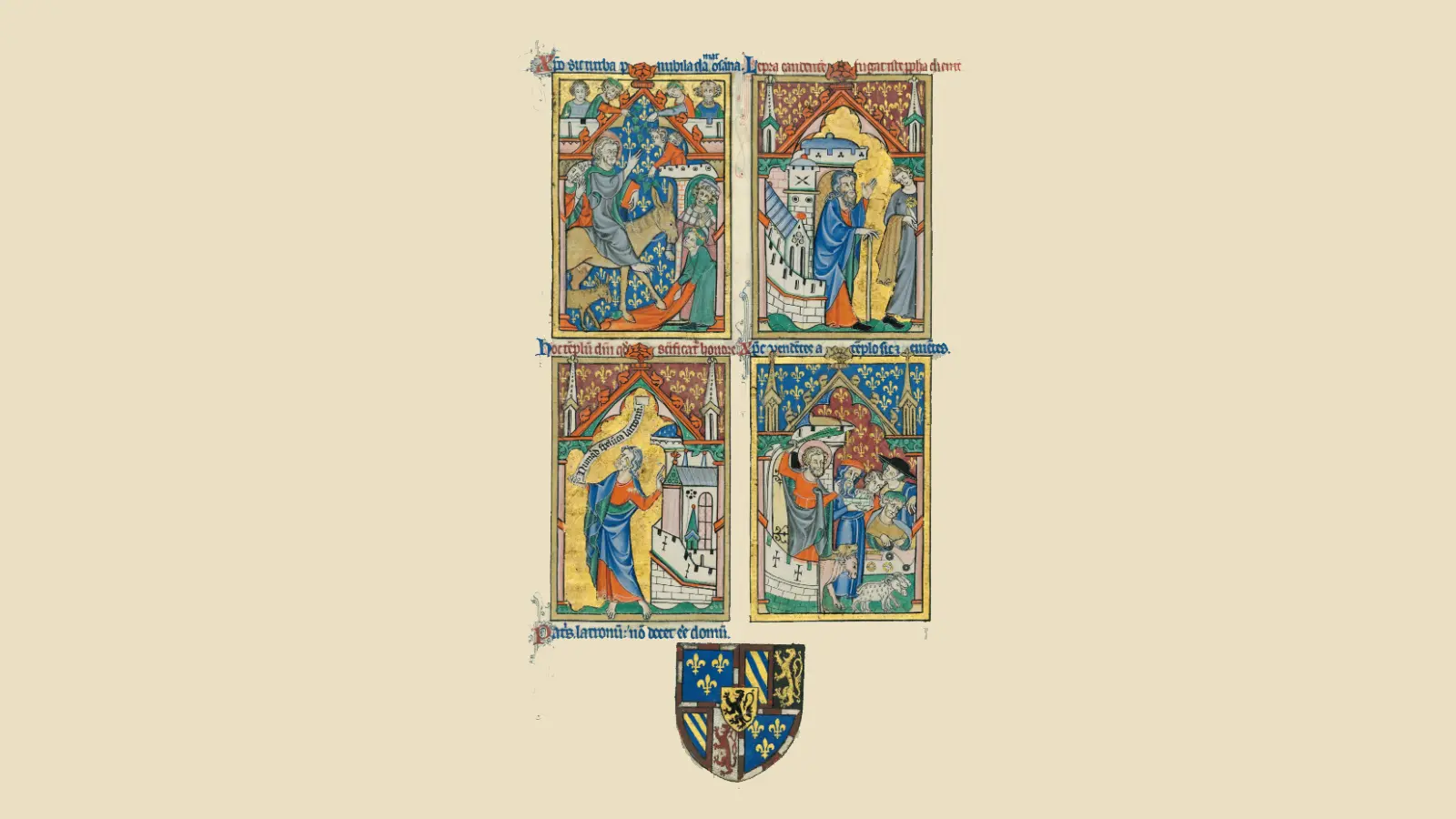
Across the Peterborough Psalter, lines of richly coloured script sit beside illuminated initials, marginal creatures, biblical scenes and great panels of miniature painting.
The surviving manuscript consists of 141 leaves, around 282 pages, measuring roughly 30 by 19.5 centimetres.
Its decoration includes more than a hundred miniatures, calendar medallions, historiated initials and densely inhabited margins.
This was not simply a book to read. It was an object designed to make sacred words physically precious.
Its splendour belongs to the same medieval Peterborough that produced the Peterborough Chronicle and preserved its institutional memory in the Black Book of Peterborough.
What exactly is a psalter?
A psalter is a manuscript built around the 150 Psalms of the Old Testament.
For medieval Christians, the Psalms were everywhere.
They were sung in monasteries, recited in prayer, used in worship, memorised, studied and returned to throughout the religious day.
A psalter could therefore be devotional book, liturgical tool, teaching text and work of art at the same time.
The biblical songs traditionally associated with King David formed the heart of the manuscript.
Calendars helped organise the religious year and the cycle of saints and feast days.
The Psalms were among the most important texts in medieval private and communal prayer.
Pictures could interpret sacred history and transform reading into a visual experience.
Producing an ordinary manuscript already required expensive parchment, trained scribes and enormous quantities of labour.
Producing a book like the Peterborough Psalter was something else entirely.
Why is it called the Peterborough Psalter?
The answer is both straightforward and complicated.
The manuscript became closely associated with Peterborough Abbey and its abbot, Geoffrey of Crowland, who ruled the monastery from 1299 until 1321.
Older scholarship often described Geoffrey as the man who commissioned the book.
That remains possible, and KBR itself records the manuscript as his property and notes that it may have been commissioned by him.
More recent study has been cautious about assuming that every stage of its manufacture took place inside Peterborough Abbey itself. The professional artists responsible for the book may have worked elsewhere in England, perhaps in a major artistic centre.
This distinction matters.
A great medieval abbey did not need every craftsman to live permanently inside its walls in order to command extraordinary artistic resources.
Peterborough Abbey was wealthy, connected and powerful enough to participate in precisely this world.
Explore the institution behind it through Peterborough Cathedral: 1,350 Years of History.
Geoffrey of Crowland and the power of an abbot
Geoffrey of Crowland became Abbot of Peterborough in 1299.
An abbot of medieval Peterborough was not simply the spiritual leader of a group of monks.
Peterborough Abbey controlled extensive estates, administered property, entertained important visitors and operated within networks stretching through royal government and the international Church.
Geoffrey belonged to that world.
The man who carried the Peterborough Psalter from a monastic setting into one of the most extraordinary chains of ownership in medieval Europe.
One image in the manuscript has been interpreted as Geoffrey himself, accompanied by a Benedictine monk and praying before an altar.
Whether or not every detail of the book was conceived specifically for him, he is the figure who anchors its story securely to Peterborough.
A manuscript written in gold and blue
Most medieval manuscript text was written in dark ink.
The Peterborough Psalter does something far more extravagant.
Gold and blue lettering runs through the manuscript, making the text itself part of the illumination.
This feature was so remarkable that Peterborough’s own medieval chronicling tradition remembered it.
When Geoffrey gave the manuscript away, the record specifically noted a psalter written in golden and azure letters and magnificently illuminated.
Seven hundred years ago, the thing Peterborough remembered about this book was exactly what still astonishes us now: it glittered.
The gold was not one single effect.
The makers manipulated different forms and treatments of gold across the pages, creating variation in texture and reflected light.
Against intense blue, red, green and patterned backgrounds, the pages would have changed as the manuscript moved in the reader’s hands.
A Bible told in miniature worlds
The Peterborough Psalter is packed with images.
Its great miniature sequences do more than decorate the biblical text.
They interpret it.
Medieval artists frequently connected episodes from the Old Testament with events in the life of Christ. An older biblical story could be presented as a prefiguration of something that would happen later.
Earlier biblical people and events are presented as anticipations.
Episodes from Christ’s life are visually paired with their supposed precedents.
The result is a manuscript in which pages become theological arguments.
But sacred history does not occupy the margins alone.
There are animals. Musicians. Monsters. Hybrid creatures. Human figures. Scenes of everyday activity and imagery drawn from secular culture.
Some decoration even touches the world of chivalric romance.
1318: Peterborough gives the book away
The key moment in the manuscript’s biography came in 1318.
Papal representatives had come to England during attempts to secure peace between England and Scotland.
Peterborough Abbey received important ecclesiastical visitors with the elaborate hospitality expected of a great Benedictine house.
Geoffrey of Crowland gave the Psalter to the papal representative Gaucelin d’Eux.
A book from Peterborough entered the highest circles of European Christianity.
Gaucelin subsequently presented it to Pope John XXII.
From that moment, the manuscript began a journey almost as remarkable as its illumination.
One gift transformed an English monastic book into a European royal treasure.
Popes, queens, kings and dukes
The Peterborough Psalter did not disappear into a forgotten ecclesiastical library.
It repeatedly passed into some of the most prestigious collections in Europe.
Associated with Abbot Geoffrey of Crowland.
Presented through Gaucelin d’Eux to Pope John XXII.
Widow of Louis X of France and Queen Dowager.
The manuscript entered the royal library and was kept at the Louvre.
It later became part of the magnificent Burgundian library.
Its owners did not always leave the manuscript unchanged.
Gold fleurs-de-lis were added to some miniature backgrounds during its French royal history.
Later, the heraldry of Philip the Good and the Burgundian territories was added to the manuscript.
Its appearance therefore became a physical record not only of who made it, but of who subsequently wanted to claim it.
There are actually two Peterborough Psalters
This is where the name can become confusing.
The spectacular Brussels manuscript is not the only medieval book known as the Peterborough Psalter.
An earlier manuscript, now at the Fitzwilliam Museum in Cambridge, was produced for Peterborough Abbey around 1220–1225.
Made specifically for the Benedictine Abbey of Peterborough and now Fitzwilliam Museum MS 12.
Earlier · Peterborough-madeThe spectacular gold-and-blue manuscript associated with Geoffrey of Crowland and now KBR MS 9961-62.
This Peterborough ObjectThe existence of two major illuminated manuscripts carrying Peterborough’s name is itself significant.
It demonstrates that Peterborough Abbey was not an isolated provincial monastery whose history begins and ends with its building.
It belonged to a sophisticated culture of writing, collecting, scholarship, liturgy and art.
The Peterborough Chronicle, Liber Niger and these psalters reveal different aspects of the same intellectual institution.
How did a Peterborough book end up in Brussels?
The answer is essentially the history of Europe written through one object.
After its French royal ownership, the Psalter entered the great Library of the Dukes of Burgundy.
That collection ultimately formed one of the foundations of the great manuscript collections preserved in Brussels.
Then came the French Revolutionary Wars.
In 1794, French forces carried the manuscript from Brussels to Paris.
For more than twenty years it remained in France.
After Napoleon’s defeat, the Psalter was returned to Brussels in 1815.
Today it is preserved as KBR MS 9961-62.
KBR · Royal Library of Belgium
The original manuscript is preserved in Brussels, but KBR has digitised it, allowing Peterborough to see one of its most extraordinary medieval books again more than seven centuries after it left the Abbey.
Why this is a Peterborough object
The Peterborough Psalter is not in Peterborough.
That is part of its story.
Many of the most important objects created, copied, owned or preserved by Peterborough Abbey eventually left the city.
The Peterborough Chronicle is in Oxford.
The Black Book of Peterborough is in London.
The Peterborough Psalter travelled further still.
Yet all three reveal the extraordinary intellectual reach of the medieval Abbey.
A monastery records England and the English language changing.
An institution records its estates, privileges and a remarkable Magna Carta text.
Sacred words become one of the most dazzling objects associated with the Abbey.
The Psalter also tells us something profound about Peterborough’s place in medieval Europe.
A manuscript owned by the Abbot of Peterborough was considered appropriate as a gift for the papal world.
A pope kept it.
A queen owned it.
French kings incorporated it into their collections.
Burgundian rulers added their arms.
Armies carried it away.
Governments returned it.
Peterborough gave away a book in 1318. Europe spent the next seven centuries refusing to forget it.
That is why it belongs in Peterborough’s story.
Not because the object never left.
Because the name travelled with it.