William Le Queux
Spy scares. Secret codes. Roman ruins. And a supposedly cursed Egyptian mummy mask sent to Peterborough.
Meet the bestselling Edwardian thriller writer whose extraordinary life connected Castor, Peterborough with international espionage, Egyptology, archaeology, early radio and even the literary world that eventually gave us James Bond.
Enter the story ↓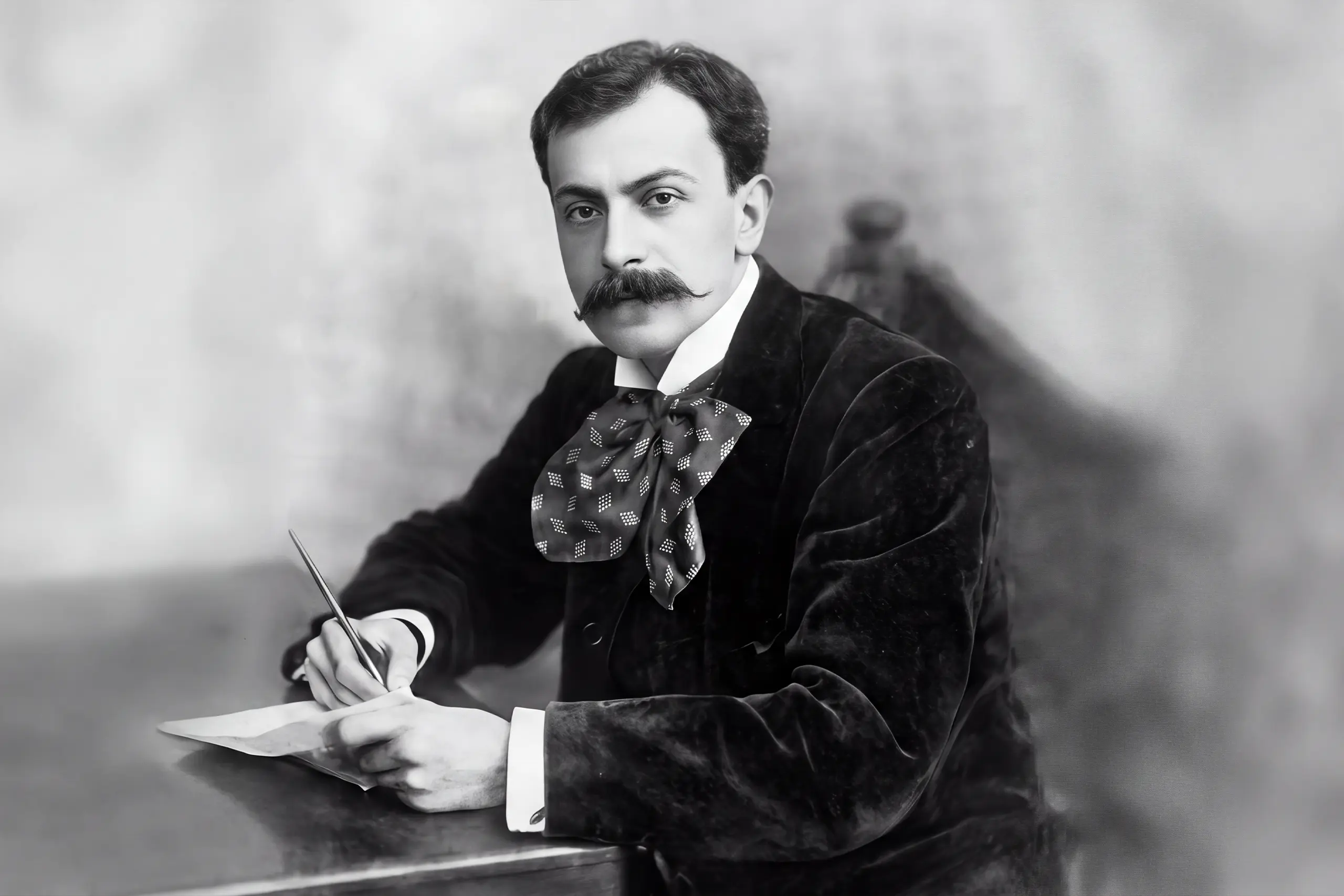
A Peterborough story hiding in plain sight
f you wrote William Le Queux as a fictional character, an editor might tell you to tone him down.
He was a novelist, journalist, traveller, diplomat, amateur archaeologist, Egyptology enthusiast, collector of medieval manuscripts, early radio experimenter and one of Edwardian Britain's most enthusiastic promoters of the idea that foreign spies were everywhere.
He wrote sensational stories of secret agents, hidden documents, international conspiracies and impending invasion, then frequently behaved as though he were living inside one of them.
Castor, Peterborough
The thriller writer
on top of Roman Britain
At the beginning of the twentieth century, Le Queux owned The Cedars on Peterborough Road in Castor, an early eighteenth-century house which still survives and is now Grade II listed.
Castor was an extraordinarily appropriate place for a writer obsessed with buried secrets.
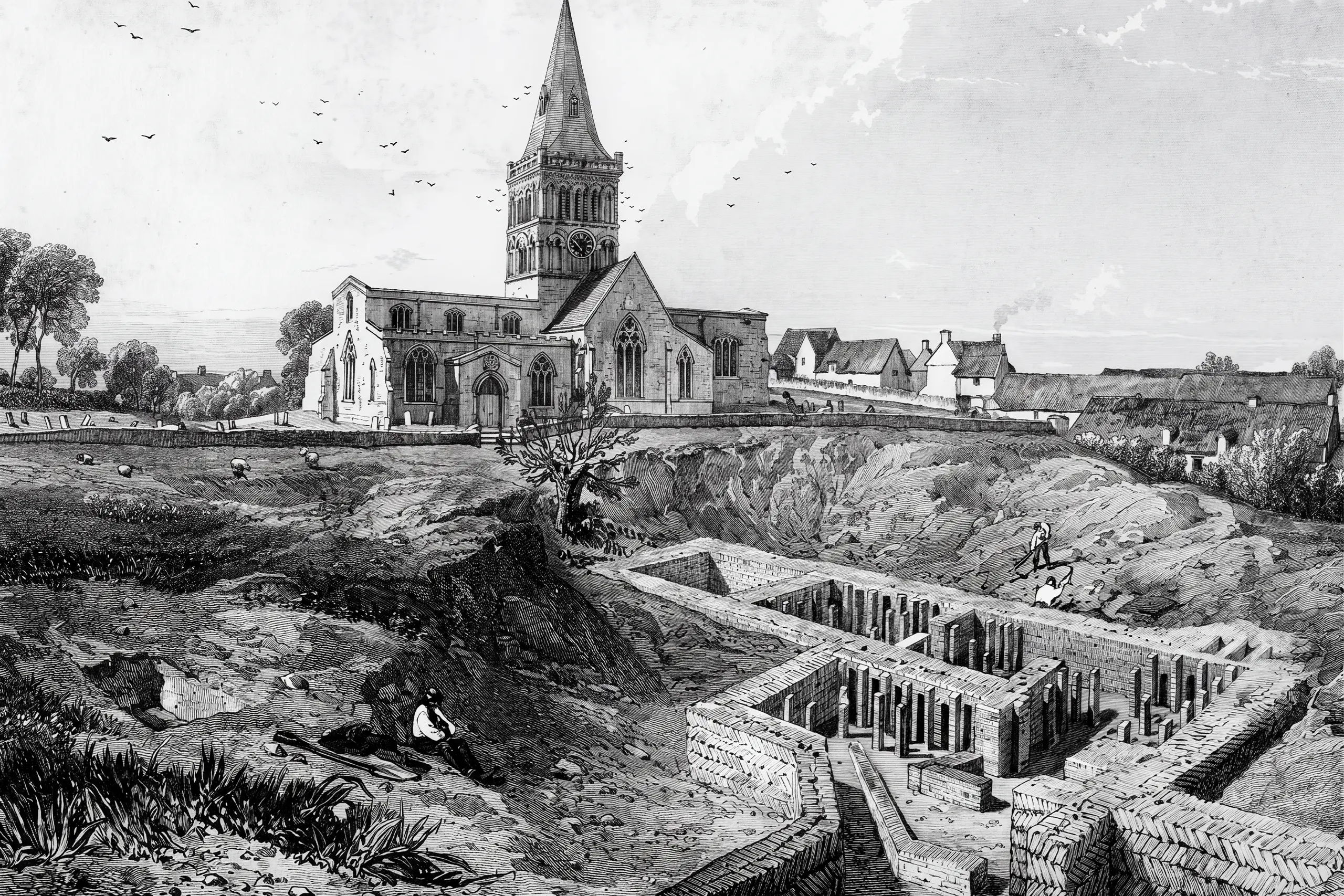
Beneath the village lie the remains of a vast Roman complex, traditionally known as the Praetorium.
In 1902, archaeological records describe Le Queux and Captain S. Walker carrying out excavations. In the south-east corner of the lawn at The Cedars they uncovered a remarkably preserved Roman floor paved with square red tiles, associated with the bath complex previously investigated by pioneering Peterborough antiquarian Edmund Artis.
One of Britain's great writers of buried treasure and secret manuscripts was literally digging Roman archaeology out of his own garden.
Then the story gets stranger.
The Egyptian
collection
Years later, Le Queux would tell one of the most extraordinary stories associated with Peterborough Museum.
In his 1923 memoir Things I Know About Kings, Celebrities, and Crooks, Le Queux recalled visiting Thebes and Luxor, where the celebrated Egyptologist Gaston Maspero introduced him to an antiquities dealer.
Le Queux bought a collection of Egyptian objects which, he said, included a gilded mask from the mummy of a priestess of Isis, supposedly discovered in a tomb near Aswan.
He brought the collection back to Britain and displayed it in a large glass case at his house overlooking Dartmoor.
THE OBJECT AT THE CENTRE OF THE STORY
A gilded
mummy mask
The mask had
fallen to pieces.
Le Queux had it repaired.
Then, according to his own account, things began to go badly wrong.
financial loss
died
died suddenly
died unexpectedly
died
financial loss
I packed up the whole of my Egyptian collection, including the mummy-mask, and sent it to the Peterborough Museum.William Le Queux, Things I Know About Kings, Celebrities, and Crooks, 1923
History, with a warning label
This is Le Queux's own account of events. There is no evidence that an Egyptian curse caused the tragedies he described, and Le Queux had an undeniable gift for dramatisation.
What is particularly significant for Peterborough is that his published memoir explicitly records him sending the collection to Peterborough Museum.
Spies. Invasion. Panic.
The man who helped
make Britain nervous
Le Queux became one of the biggest names in a wildly popular Edwardian genre: invasion fiction.
His stories imagined Britain threatened by foreign agents, secret networks and sudden attack.
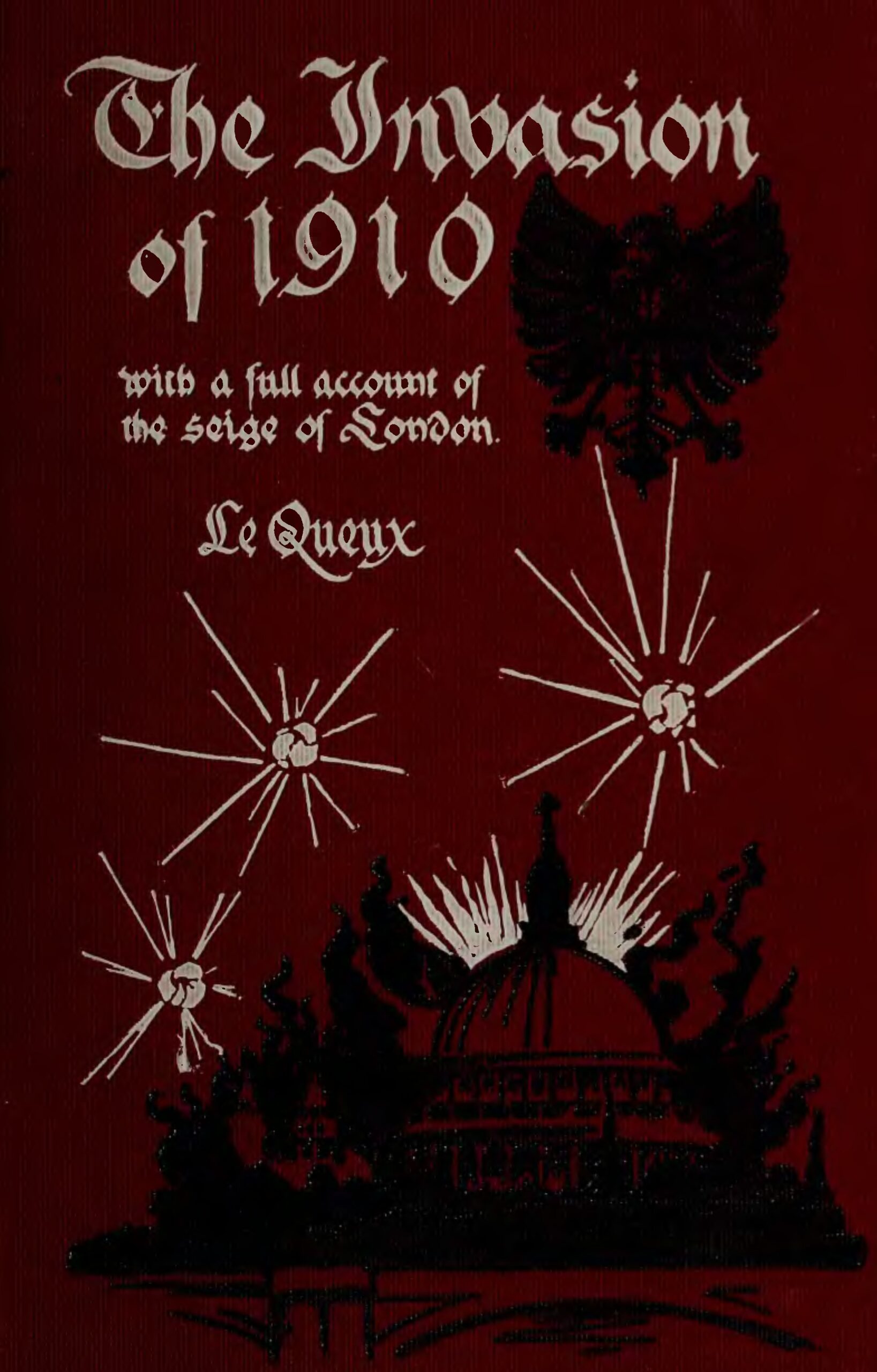
The Invasion of 1910, serialised in the Daily Mail in 1906, became a publishing sensation. Le Queux blurred the line between thriller and political warning, encouraging the idea that German agents might already be operating throughout Britain.
Britain established the Secret Service Bureau, whose home and foreign sections ultimately became the ancestors of MI5 and MI6.
Modern historians are far more sceptical of Le Queux's claims about vast German spy networks. Yet there is little doubt that he became one of the most visible voices in the wave of Edwardian “spy fever” which formed part of the political atmosphere in which Britain's modern intelligence organisations emerged.
From Edwardian spy fever to 007
A literary trail
to James Bond
William Le Queux did not create James Bond. But there is a fascinating line connecting the Peterborough-linked writer with the most famous British spy in fiction.
When Ian Fleming sat down at Goldeneye in Jamaica in January 1952 to begin Casino Royale, he was creating something new, but he was also drawing upon an established British tradition of adventure and espionage fiction.
Historian Andrew Cook, writing about the origins of Bond for The History Press, identifies William Le Queux among the thriller writers Fleming had read as a schoolboy, alongside John Buchan and the writer known as “Sapper”.
These earlier writers had already helped establish many of the ingredients of popular British thriller fiction: dangerous conspiracies, foreign enemies, patriotic heroes, sudden reversals, secret information and a world in which international politics could become personal adventure.
Bond was Fleming's creation, shaped by his own wartime intelligence experience, real people he encountered and the world of the early Cold War.
But Le Queux belongs to the literary prehistory of 007.Decades before Bond ordered his first martini, Le Queux had already filled British popular fiction with enemy agents, secret intelligence, exotic locations, advanced technology and threats to national security.
The British spy thriller had a history before James Bond. William Le Queux was part of it.Before Britain tuned in
The novelist
on the airwaves
Long before radio became part of everyday British life, William Le Queux was already experimenting with voices and music travelling invisibly through the air.
This was not simply another subject he read about. Le Queux became an enthusiastic amateur radio experimenter and a member of the Institute of Radio Engineers.
Writing in Popular Wireless in 1922, Le Queux said that he had been experimenting with radio for around fifteen years. At the end of 1919 he began establishing an experimental transmitting station at Guildford.
There were blown transmitting valves, damaged condensers, ruined microphones and even a failed generator. But eventually the experiments worked.
During 1921, Le Queux said that he broadcast speech and music almost every evening for seven months.
His signal was not simply disappearing unnoticed into the ether. Le Queux recalled receiving reports from around one hundred amateur listeners across Britain, commenting on transmissions from station 2AZ.
In 1922, Popular Wireless presented him not simply as a famous novelist but as a long-standing wireless experimenter and one of the early broadcasters of music.
And naturally...
he turned it
into a thriller.
Le Queux did what Le Queux always seemed to do when he encountered an exciting new technology: he imagined how criminals and secret agents might exploit it.
In 1922 he published Tracked by Wireless, a collection in which crime, mysterious signals, radio engineers, clandestine transmissions and the possibilities of wireless collide.
Then Le Queux crossed paths with John Logie Baird.
In 1924, Le Queux became the first President of the Hastings, St Leonards and District Radio Society. The speaker at its inaugural lecture was a local inventor experimenting with another extraordinary idea: transmitting moving pictures.
His name was John Logie Baird.
Le Queux became an enthusiastic supporter of Baird's work and wrote about the emerging technology of television. The man who had built his reputation imagining spies, invasions and secret messages was now watching another communications revolution begin.
Le Queux did not merely write about the future.
He repeatedly found himself remarkably close to technologies that were about to change the world.And there was still more
Welcome to the
world of Le Queux
Traveller
Europe, North Africa, the Balkans, Russia and beyond: travel fed directly into his taste for international intrigue.
Manuscript collector
Le Queux was described as an ardent collector of medieval manuscripts, codices and historic documents.
A link to Bond
Ian Fleming had read Le Queux as a schoolboy, placing the Peterborough-linked novelist within the literary tradition that preceded James Bond.
Wireless pioneer
An early radio experimenter and broadcaster whose fascination with wireless eventually brought him into the orbit of television pioneer John Logie Baird.
Flying enthusiast
He was fascinated by aviation and became involved in Britain's pioneering flying meetings as powered flight captured public imagination.
Reliable narrator?
Le Queux was notorious for embellishment. Some adventures occupy the fascinating territory between autobiography, publicity, fiction and performance.
The stories
A life measured
in mysteries
Le Queux produced an astonishing volume of fiction. Start with these if you want to enter his strange, paranoid and endlessly adventurous world.
The Tickencote Treasure
Treasure, secrecy, manuscripts and ancient mystery.
The Three Glass Eyes
A strange mystery with notable references to Peterborough and the surrounding area.
The Closed Book
Ancient writings, secrets and historical intrigue.
The Czar's Spy
International intrigue from an early master of popular spy fiction.
The Invasion of 1910
The sensational invasion novel that made Britain take notice.
Spies of the Kaiser
Le Queux's obsession with German espionage distilled into fiction.
Tracked by Wireless
Crime, mysterious transmissions and the possibilities of wireless.
Things I Know About Kings, Celebrities, and Crooks
His extraordinary memoir and the source of the Peterborough Museum story.
Why this story belongs here
William Le Queux is not simply a curious footnote.
His Peterborough connections bring together several strands of the area's heritage in one remarkable life.
A nationally successful writer with a tangible connection to Castor.
An owner of The Cedars, one of the village's surviving historic buildings.
A participant in the investigation of Roman Castor.
A writer who helped establish the British spy-thriller tradition later encountered by Ian Fleming.
An early experimenter in wireless broadcasting who later championed John Logie Baird's pioneering work.
And the owner of one of the strangest collections ever recorded as being sent to Peterborough Museum.
Somewhere behind all the espionage, technology, publicity and Edwardian melodrama is an irresistible image:
William Le Queux packing away a gilded Egyptian mummy mask, ushabtis, amulets, beads and a lapis-lazuli eye because he believed an ancient force might be making his life miserable... ...and sending the lot to Peterborough.WILLIAM LE QUEUX
Novelist.
Archaeologist.
Spy-fiction pioneer.
Wireless experimenter.
Peterborough character.
Sometimes the strangest stories about Peterborough are the ones that really happened.
Sources & further reading +
This story draws upon William Le Queux's own published works, archaeological research concerning Roman Castor, Historic England records, contemporary wireless publications and historical research into the development of British spy fiction.