

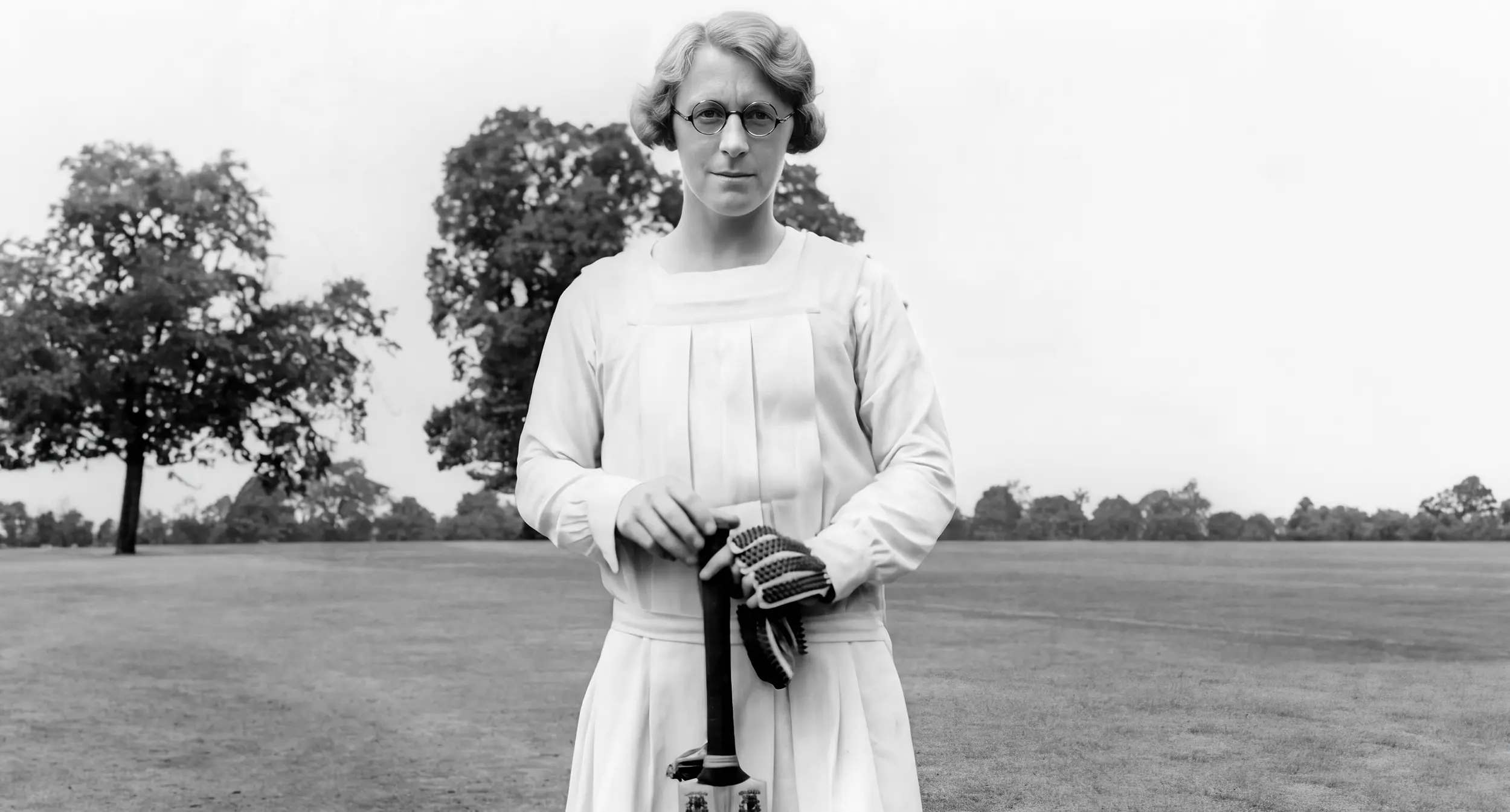
Marjorie Pollard OBE was one of the great pioneers of British women's sport. Raised and educated in Peterborough, she became an outstanding England hockey player, helped establish organised women's cricket, wrote and edited influential sports publications and became the first woman to commentate on sport for the BBC.
Life and career in dates
- 1899 Born in Rugby, Warwickshire, on 3 August
- c.1905 The Pollard family moves to Peterborough
- 1910 Enters Peterborough County Grammar School for Girls
- 1917 Leaves school and begins training for a career in teaching
- 1921 Selected to represent England at hockey
- 1926 Scores 13 goals against Wales and helps found the Women's Cricket Association
- 1930 Begins editing the new Women's Cricket magazine
- 1935 Makes her first BBC sports commentary
- 1937 Commentates on the England v Australia women's cricket Test
- 1938 Films an England hockey international in colour alongside BBC television cameras
- 1946 Takes over the editorship of Women's Hockey Field
- 1965 Appointed OBE for services to sport, particularly hockey
- 1970 Completes more than two decades as editor of Hockey Field
- 1982 Dies at Bampton in Oxfordshire, aged 82
- 2020 Peterborough Civic Society unveils a blue plaque in her honour
Growing up in Peterborough
Marjorie Anne Pollard was born in Rugby on 3 August 1899, but Peterborough became the landscape of her childhood and the place in which her extraordinary sporting life began.
Her father, James Rowland Pollard, was a railway engine driver. The family had moved to Peterborough by about 1905, part of a city whose rapid growth was closely connected with the railways and engineering.
In 1911 the family was living at Nene View, close to Peterborough's Great Eastern railway station.
Marjorie entered Peterborough County Grammar School for Girls in 1910, while the school was still based at Park Lane. The following year she moved with it into its new premises in Cobden Avenue.
Sport became central to her life.
Hockey in particular gave Pollard an arena in which an unusual combination of strength, skill and relentless competitiveness could flourish.
She played locally for Peterborough and went on to represent Northamptonshire.
Peterborough gave Marjorie Pollard the playing fields from which one of Britain's great careers in women's sport would emerge.
A remarkable hockey talent
Women's hockey was already remarkably well organised by the time Pollard emerged as a player.
The All England Women's Hockey Association had been established in 1895, creating a national structure in an era when women were still excluded from many areas of organised sport.
Pollard developed into a centre-forward of exceptional power and scoring ability.
Her performances for Northamptonshire brought selection for England in 1921.
It began an international career extending across much of the 1920s and 1930s.
Women's international hockey of the period attracted substantial interest, but its history has often received far less attention than the equivalent men's game.
Pollard was one of its genuine stars.
England's great goalscorer
Pollard's defining gift was scoring goals.
In 1926 England defeated Wales 20–0.
Pollard scored thirteen of them.
England v Wales
13 goalsMarjorie Pollard scored thirteen times in England's extraordinary 20–0 victory over Wales in 1926.
In another international against Germany, she scored every goal in an 8–0 England victory.
Similar performances against Scotland, Ireland and South Africa established her reputation as one of the most dangerous forwards of her generation.
Yet Pollard's significance to hockey eventually stretched far beyond anything she accomplished with a stick.
She became a coach, administrator, writer, editor, historian and advocate for the women's game.
Building women's cricket
Hockey was only part of Pollard's sporting life.
She was also a talented cricketer at a time when women who wanted to continue playing after leaving school or college had few organised opportunities.
In 1926 Pollard joined a group of sportswomen in establishing the Women's Cricket Association.
Its purpose was transformational.
The Association created matches, clubs, touring opportunities and eventually a framework through which women's cricket could develop independently.
Pollard understood that a sport could not grow simply by providing opportunities to play.
It also needed to be written about.
In 1930 the Association's new magazine, Women's Cricket, appeared under Pollard's editorship.
Building a sport
Women's cricket was no longer merely an informal collection of school, college and private-club matches.
People such as Pollard were creating the institutions from which the modern women's game would eventually grow.
A voice for women's sport
Pollard understood something that remains central to sport today.
If nobody reports a sport, photographs it or tells its stories, it becomes much harder for audiences to discover it.
She therefore developed a second career as a journalist.
Pollard wrote about women's sport for newspapers and magazines at a time when mainstream sports pages were dominated overwhelmingly by men writing about men's competitions.
Her position was unusual because she was not an outside observer.
She had played international sport herself.
She knew the tactics, personalities, institutions and pressures from inside the game.
Journalism gave Pollard an opportunity to make women's sporting achievement visible to audiences far beyond the touchline.
Breaking into broadcasting
The next frontier was radio.
In 1935 Pollard made what is recognised as the first sports commentary by a woman for the BBC.
Her subject was cricket.
The significance is easy to underestimate today. Sports broadcasting itself was still relatively young, and the authoritative voice describing a match to millions of listeners was assumed almost automatically to be male.
Pollard crossed that boundary.
A broadcasting first
1935Marjorie Pollard became the first woman recognised as providing sports commentary for the BBC.
By 1937 she was behind the microphone for one of the most important matches in early women's cricket history, providing BBC commentary on the women's Test between England and Australia.
A woman who had spent years trying to win serious media attention for women's sport was now helping broadcast it.
Pollard did not wait for women's sport to be given a media platform. She helped build one.
The woman behind the camera
Pollard was interested in another emerging medium too.
She became an enthusiastic amateur filmmaker during the 1930s, using cine cameras to record matches and create coaching material.
The films could be lent to hockey clubs and schools, allowing players to see techniques demonstrated rather than relying entirely upon written instruction.
One film is especially remarkable.
In 1938 England played Wales in a women's hockey international at the Oval.
BBC television cameras were there for a pioneering live broadcast.
Pollard was filming beside them.
The BBC's pictures were transmitted in black and white.
Pollard's film was in colour.
Decades later, surviving reels from her collection were digitised by The Hockey Museum, preserving not only sporting history but fragments of twentieth-century social life captured through Pollard's own camera.
1938: two cameras at the Oval
Player to leader
Pollard's influence continued long after her international playing career ended.
She became a prominent figure within the All England Women's Hockey Association and eventually served in its senior leadership.
She also wrote extensively about the game.
Her books included coaching and instructional works as well as Fifty Years of Women's Hockey, published in 1946, which documented the remarkable development of the women's game since the creation of its national association.
That same year Pollard became editor of Women's Hockey Field.
She remained associated with the publication for more than two decades, chronicling a sport she had helped shape as player, administrator and journalist.
In the 1965 New Year Honours she was appointed an Officer of the Order of the British Empire for services to sport and particularly hockey.
It was recognition not simply of a great player, but of a lifetime spent creating opportunities, institutions and visibility for women's sport.
Pollard and Peterborough
Marjorie Pollard eventually settled in Bampton, Oxfordshire, where she died on 21 March 1982 at the age of 82.
Her sporting archive survived her.
She left an important collection of hockey material and cine films that became part of The Hockey Museum's collections, while other Pollard material survives within archives dedicated to women's hockey and cricket.
Peterborough has also reclaimed her place within its own story.
In 2020 Peterborough Civic Society installed a blue plaque on Cobden Avenue at Lincoln Gate, occupying the site of the former County Grammar School for Girls.
It is an appropriate location.
Pollard was not born in Peterborough, but she grew up here, went to school here and first developed the sporting ability that would take her onto international playing fields.
One Peterborough schoolgirl, many firsts
England internationalOne of the outstanding hockey forwards of her generation.
↓ Cricket pioneerA founding member of the Women's Cricket Association.
↓ Sports journalistHelping women's competitions secure sustained media coverage.
↓ BBC pioneerThe first woman recognised as commentating on sport for the BBC.
Her career also makes an intriguing companion to that of another pupil of the same Peterborough school, Daphne Jackson, who would later become Britain's first female Professor of Physics.
Two women educated on the same Peterborough site, in different generations, went on to cross boundaries in fields overwhelmingly dominated by men.
Marjorie Pollard did not simply excel at women's sport. She helped create the institutions, journalism and broadcasting through which women's sport could be taken seriously.