
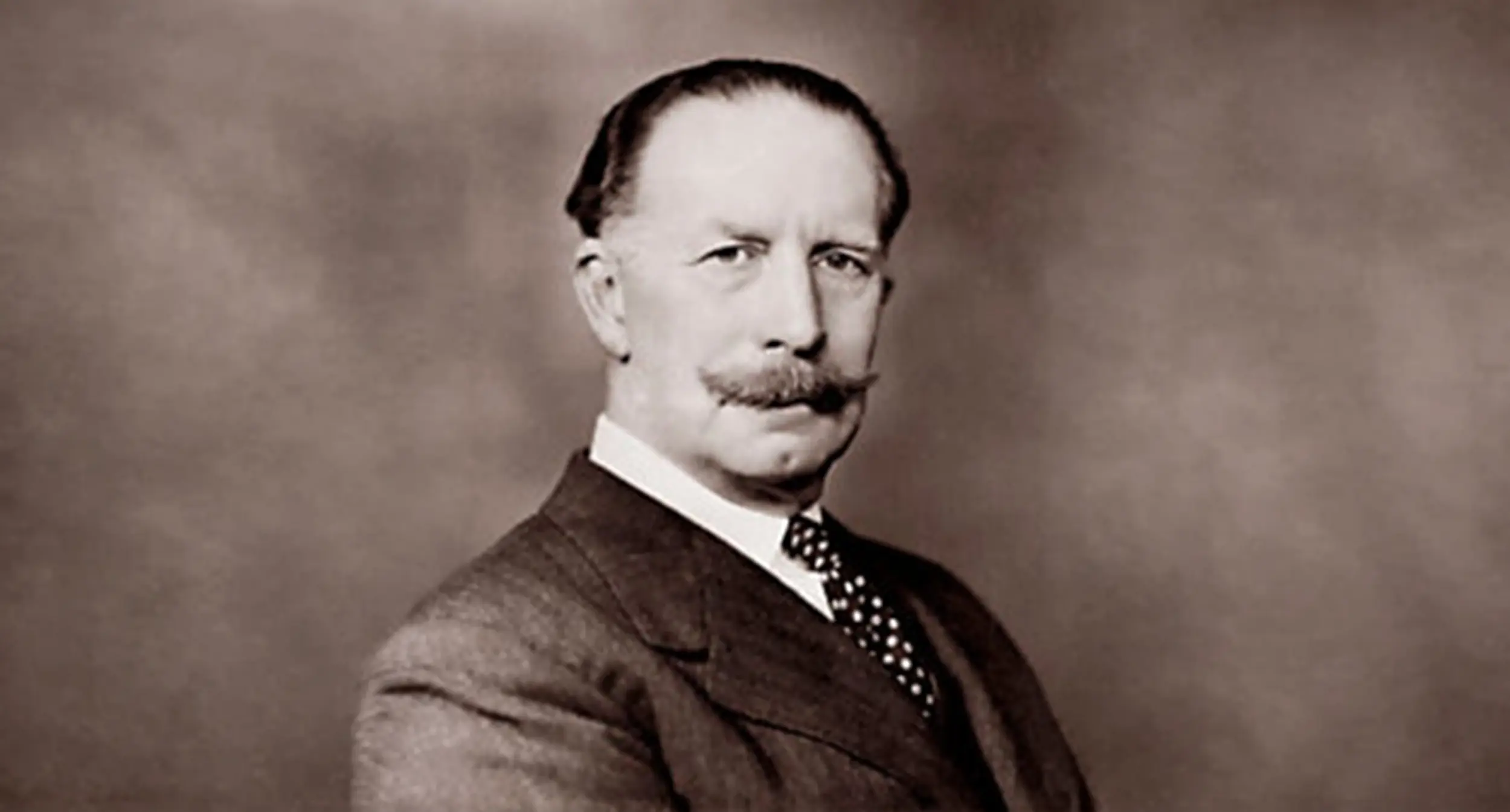
Frank Perkins was a Peterborough-born engineer, entrepreneur and industrialist whose belief that diesel engines could be smaller, lighter and faster helped turn a tiny city-centre business into one of the great names of British engineering.
Life and career in dates
- 1889 Born in Peterborough into a family of agricultural engineers
- 1910 Completes his studies at Emmanuel College, Cambridge
- 1914 Joins the Royal Engineers following the outbreak of the First World War
- 1929 Becomes works director at Aveling and Porter, where he meets Charles Chapman
- 1932 Co-founds F. Perkins Ltd in Queen Street, Peterborough
- 1933 The Wolf diesel engine is accepted for use in Commer vehicles
- 1936 Perkins establishes six world diesel speed records at Brooklands
- 1937 The P4 and celebrated P6 engines are launched
- 1947 Production moves to the new Eastfield site in Peterborough
- 1951 Perkins becomes the world's largest producer of diesel engines in its 50–70 hp class
- 1959 Retires from active management following the Massey Ferguson takeover
- 1962 Made an honorary freeman of Peterborough
- 1967 Dies after a lifetime that helped make Peterborough an international centre of engine manufacture
Born into engineering
Francis Arthur Perkins was born in Peterborough in 1889 into a family for whom engineering was already part of everyday life.
His father and grandfather were agricultural engineers, and the Perkins name was associated with the Peterborough firm Barford and Perkins, manufacturers of agricultural machinery, road rollers and other heavy equipment. Frank therefore grew up in a city where ironworking, machinery and practical engineering were already reshaping both industry and agriculture.
He was educated at Rugby School and Gresham's School in Norfolk before studying engineering at Emmanuel College, Cambridge. Yet his first instinct after university was not to enter the family business. He chose farming instead.
It was an early indication of something that would remain important throughout his life. Perkins understood machinery, but he also understood the people who needed machinery to work reliably, economically and under difficult conditions.
War, farming and industry
The First World War interrupted Perkins's agricultural career. He volunteered for the Army in 1914 and served with the Royal Engineers in the Dardanelles, Palestine and Europe, eventually leaving military service with the rank of major.
After the war he returned to farming, but eventually came back to Peterborough and entered the family engineering world. At the business that had grown from Barford and Perkins, by then part of the Agricultural and General Engineers group, he was involved in developing dairy and sterilising machinery.
By 1929 he had become works director at Aveling and Porter in Rochester. It was there that he met the man whose engineering ability would combine with Perkins's extraordinary commercial energy to create something much bigger.
Meeting Charles Chapman
Charles Wallace Chapman was a gifted diesel engineer. Frank Perkins was an engineer too, but his greatest strengths lay elsewhere: vision, persuasion, organisation and an instinct for where a market was going before everybody else could see it.
Their talents were complementary.
In the early 1930s diesel engines had an image problem. They were economical and dependable, but also heavy, slow-revving and associated principally with large industrial and agricultural machinery. Petrol was the obvious choice for cars and most road vehicles.
Perkins and Chapman believed this distinction did not have to exist.
Chapman could see how diesel technology might be redesigned into a compact, high-speed engine. Perkins could see the market that would open if he succeeded. A diesel engine small and light enough for cars, vans and lorries could offer manufacturers something genuinely new: petrol-like practicality with considerably lower running costs.
They were not simply trying to build another diesel engine. They were trying to change what a diesel engine could be.
A company born in Peterborough
In June 1932, Frank Perkins and Charles Chapman established F. Perkins Ltd in Peterborough. Their first base was modest: rooms and workshop space in Queen Street, close to the centre of the city.
Peterborough was not simply Frank's home town. It made commercial sense.
The city possessed an established pool of skilled engineering labour, while its railway connections gave the young company rapid access to customers and manufacturers in London and the Midlands. Those transport links would become part of the logic behind building an international engineering business from Peterborough.
Their first engine was the four-cylinder Vixen. It was followed by the more powerful Wolf, which became the company's first significant commercial breakthrough when it was adapted for Commer vehicles.
Frank took responsibility for finding customers and convincing manufacturers that the new technology was worth taking seriously. This relationship between the engine maker and the manufacturer became one of the principles on which Perkins would build its reputation.
“Where there is no vision, the people perish.”
The biblical words Frank Perkins had inscribed above the entrance to the company's original offices were an unusually appropriate motto for the business he was building.
Proving diesel could be different
Selling a new idea required more than engineering drawings and promises. Perkins needed to demonstrate that the high-speed diesel really could perform.
Brooklands provided the answer.
In 1936 a Perkins-powered car established six world diesel speed records at the famous Surrey racing circuit. It was a spectacular piece of engineering publicity. Diesel was no longer simply the slow workhorse of industry. A Peterborough company had demonstrated that it could deliver speed as well as economy.
The following year brought one of the defining engines in the company's history. Designed under Charles Chapman's technical leadership, the P4 and six-cylinder P6 were compact and remarkably light for their power.
The P6 was promoted as the world's lightest diesel engine and rapidly found customers among major vehicle manufacturers. Within months it was available as a standard power unit for names including Albion, Bedford, Commer, Dennis and Thornycroft.
It was the engine that helped establish Perkins as a serious force in diesel manufacture.
Eastfield and global growth
The young company survived financial crises and then the enormous disruption of the Second World War. Charles Chapman left the business in 1942, leaving Frank Perkins to continue as chairman and managing director.
Frank's ambitions for the company had already outgrown its original city-centre premises. Land had been acquired at Eastfield before the war, and in 1947 Perkins moved production to the site that would become synonymous with the company.
Eastfield changed the scale of the operation.
The post-war years brought expanding production, new applications, overseas licensing and an increasingly international market. Perkins engines went into agricultural machinery, road vehicles, industrial equipment, boats and countless other machines.
By 1951 Frank Perkins could announce that his company had become the world's largest producer of diesel engines in the 50–70 horsepower range.
What had begun less than twenty years earlier in a handful of rooms in Queen Street had become one of Britain's important engineering manufacturers.
The engines that built the name
Frank Perkins's achievement was not the work of one inventor acting alone. It was the creation of a company in which engineers, designers, machinists and production workers could repeatedly turn ambitious ideas into engines manufactured at scale.
- 1932 Vixen The company's first high-speed four-cylinder diesel engine.
- 1933 Wolf A more powerful development that secured an important early production agreement for Commer vehicles.
- 1937 P4 and P6 Designed under Charles Chapman's technical leadership, these compact engines established the company as a major diesel manufacturer.
- 1960 6.354 Developed at the end of the Frank Perkins era, this celebrated Peterborough-designed engine became a foundation of the company's worldwide growth.
The industrialist
Frank Perkins eventually became much more than the founder of a successful Peterborough company. He emerged as a nationally significant figure in British manufacturing, serving first as vice-president and then president of the Society of Motor Manufacturers and Traders.
His leadership style combined engineering knowledge with relentless commercial instinct. He understood that a technically impressive engine was of little value unless manufacturers could be persuaded to specify it, factories could build it reliably and customers could obtain parts and support wherever the machinery was working.
That combination of engineering, manufacturing and customer relationships became central to the Perkins model.
In 1959 the company was acquired by Massey Ferguson, one of its most important customers. Frank retired from active management but continued his association with the business as chairman of the board.
Perkins and Peterborough
Few industrial names have become as closely identified with Peterborough as Perkins.
Frank Perkins did not merely establish a factory in the city. The company he helped create became part of Peterborough's identity, employing generations of local people, developing specialist skills and carrying the city's name into markets around the world.
Its significance also belongs to a much wider Peterborough engineering story. This was a city of iron founders, agricultural machinery manufacturers, precision engineers and innovators. Frank Perkins inherited that tradition and helped push it into a new technological age.
He remained closely connected with Peterborough outside business. He farmed locally, supported charitable work including the Peterborough Council of Boys' Clubs, served as High Sheriff of Cambridgeshire and Huntingdonshire and in 1962 was made an honorary freeman of the city.
He died in 1967. The company that carried his name continued to grow.
From a small Peterborough workshop came an engine company whose name would be recognised across the world.
More than ninety years after F. Perkins Ltd was founded, engines bearing the Perkins name have been manufactured in their millions. The Eastfield site remains part of Peterborough's engineering landscape, while the Frank Perkins Parkway carries his name through the city.
His legacy is therefore unusually tangible. It can be found in the history of the machines themselves, in the international company that grew from his idea, and in the lives of generations of Peterborough people who designed, built, tested and exported engines to the world.