
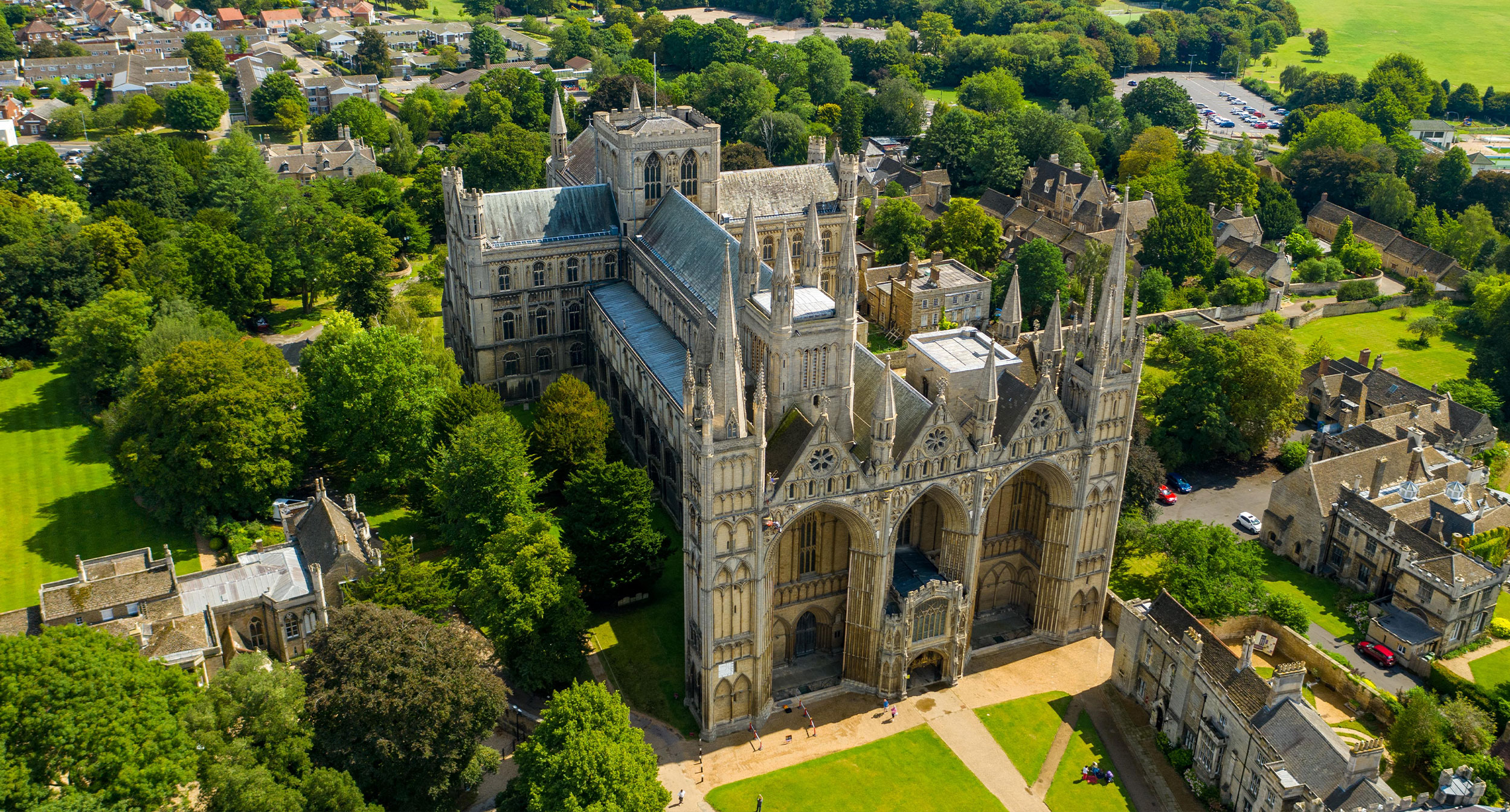


Lions cure themselves by eating apes. Elephants carry castles. Dragons fight monsters in the sea. A bull-like creature defeats hunters with flaming dung. The Peterborough Bestiary opens a door into a medieval world where animals were not simply animals. They were lessons, warnings, symbols and clues to the meaning of creation itself.
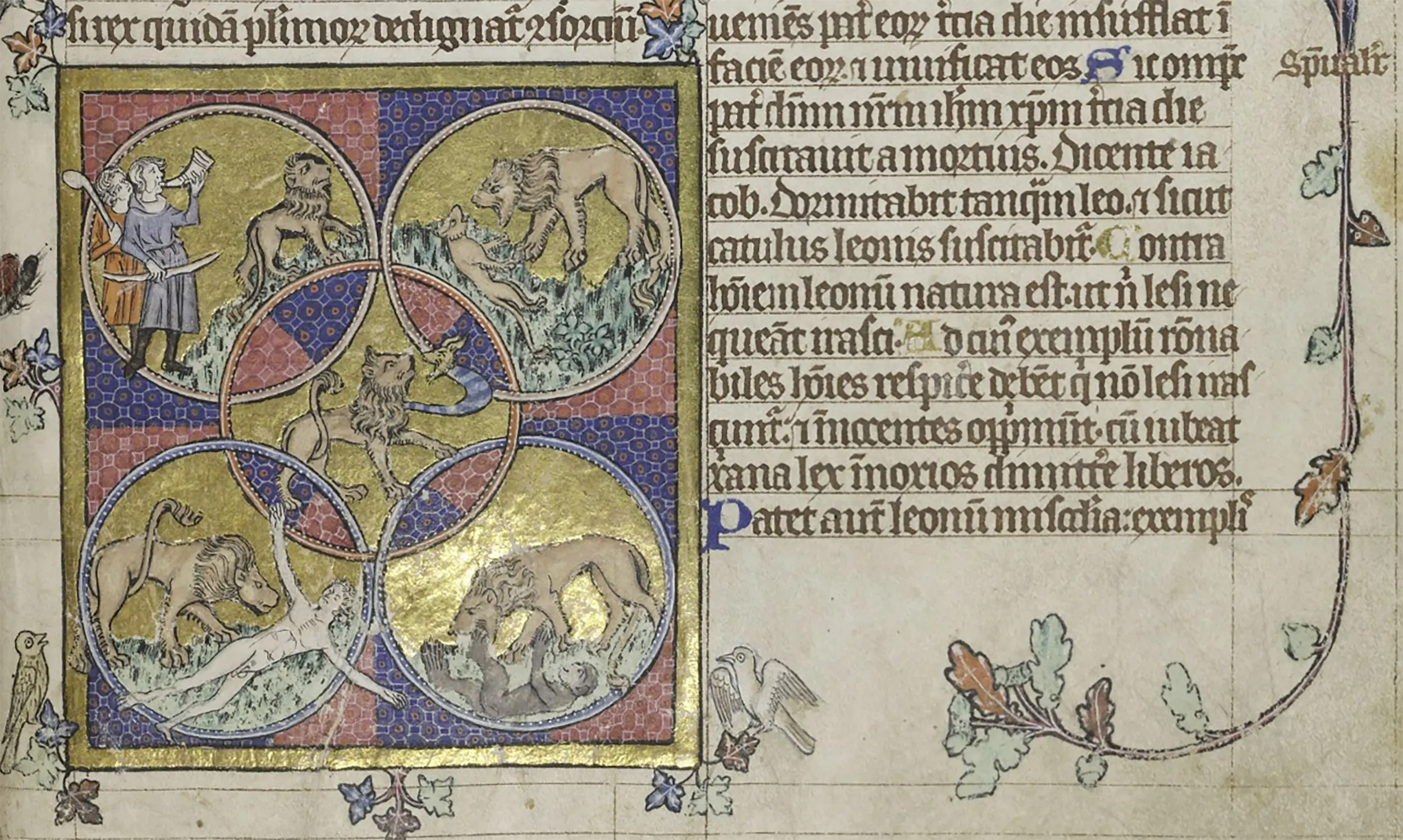
The Bestiary through time
- Ancient world Stories about the behaviour and meaning of animals circulate through classical and early Christian texts.
- c.2nd–4th c. The Greek Physiologus becomes one of the great foundations of the later medieval bestiary tradition.
- 7th c. Isidore of Seville’s Etymologies becomes another major source for medieval writing about animals.
- c.1300–1310 The manuscript now known as the Peterborough Bestiary is produced in England.
- c.1310–1320 The Psalter with which it is now bound is adapted for Peterborough Abbey and later associated with Prior Hugh de Stukeley.
- 16th c. The composite manuscript enters the collection of Archbishop Matthew Parker after the Reformation.
- 1575 Parker leaves his great manuscript collection to Corpus Christi College, Cambridge.
- 2018–19 The Peterborough Bestiary returns to the city for Peterborough Museum’s Treasures exhibition.
- Today It remains one of the great treasures of the Parker Library at Corpus Christi College.
Welcome to a world full of beasts
The first mistake is to think of the Peterborough Bestiary as a medieval wildlife guide.
It certainly contains animals.
Lots of them.
Lions, wolves, elephants, camels, deer, apes, birds, serpents and creatures of the water appear throughout its pages.
But beside them are unicorns, satyrs, dragons and fabulous animals whose biology becomes increasingly difficult to defend.
That was not a problem.
The purpose of the book was not simply to answer the modern question, “What is this animal really like?”
Its more important question was:
What can this creature teach us about God, human behaviour and the world?
The answer could turn almost any animal into a sermon.
What exactly is a bestiary?
A medieval bestiary was a collection of descriptions and stories about animals, birds and other creatures, normally accompanied by moral and religious interpretation.
Its roots stretched far beyond medieval England.
One of the most important sources was the Physiologus, an early Christian collection that took stories about animals and transformed them into Christian allegories.
Another was the great seventh-century encyclopaedia of Isidore of Seville, whose Etymologies collected inherited knowledge about the natural world.
A description might explain the animal’s appearance, habitat or supposed behaviour.
Ancient authorities, travellers and inherited traditions supplied extraordinary claims.
An animal could stand for Christ, the Devil, purity, temptation, courage or sin.
The creature’s behaviour became a way of talking about how humans ought to live.
Nature was therefore read almost like another book.
If Scripture revealed God through words, creation could reveal meaning through animals.
So why is it called the Peterborough Bestiary?
This is where the story becomes more complicated.
The name can easily give the impression that we know the Bestiary was written and illuminated inside Peterborough Abbey.
We do not.
Modern examination of the manuscript indicates that the Bestiary was originally a separate book, produced in England around 1300–1310.
It is now bound with a spectacular Psalter and other texts in a much larger manuscript known as Corpus Christi College MS 53.
The Psalter was adapted for the use of Peterborough Abbey. Peterborough saints and other material were added to its calendar, the Abbey’s litany and Office of the Dead were included, and a chronicle connected with Peterborough was inserted into the volume.
The book was also associated with Hugh de Stukeley, Prior of Peterborough in the 1320s.
That does not make the name meaningless.
It makes the object’s biography more interesting.
Medieval books could change, grow, travel and be rebound. A manuscript was not always a frozen object made once and left untouched forever.
Twenty-two leaves packed with an entire animal kingdom
The Bestiary occupies only the final section of a much larger manuscript.
It begins at folio 189 and extends across just over twenty leaves of parchment.
Yet those pages are extraordinarily dense.
More than one hundred miniature paintings fill the text.
Animals appear against glowing gold and patterned grounds, enclosed by coloured frames. Elaborate initials interrupt the columns. Tendrils extend into the margins. Small creatures and human faces inhabit the decoration.
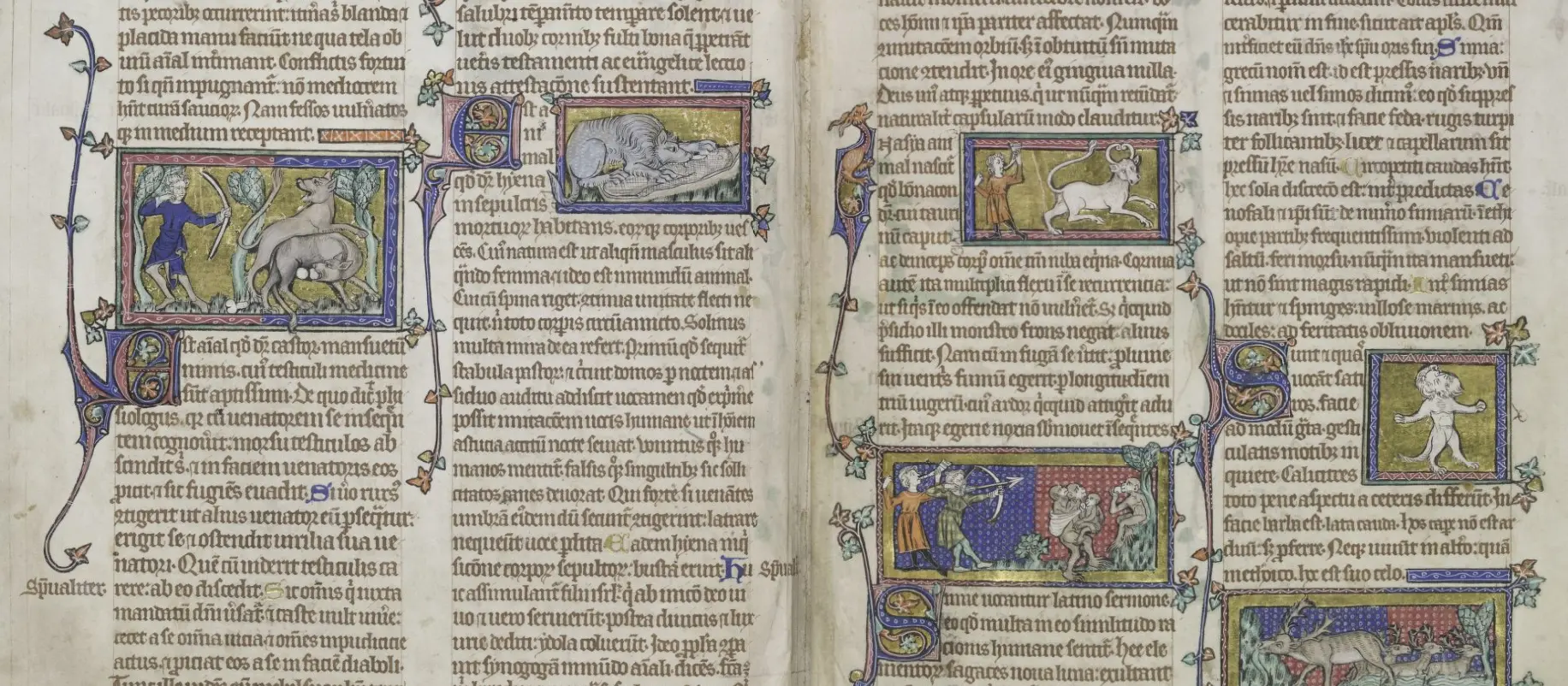
Lions, mammals and other land creatures open the Bestiary.
The manuscript then turns upwards to the creatures of the air.
Snakes, dragons and related creatures occupy their own section.
The final chapters move into fish and aquatic creatures.
Its scale matters too.
At around 35 centimetres high, the Bestiary is unusually large and imposing.
This is not a pocket notebook.
It is a luxury object.
An elephant carries a castle
One of the manuscript’s most memorable creatures is entirely real.
The problem is what the book does with it.
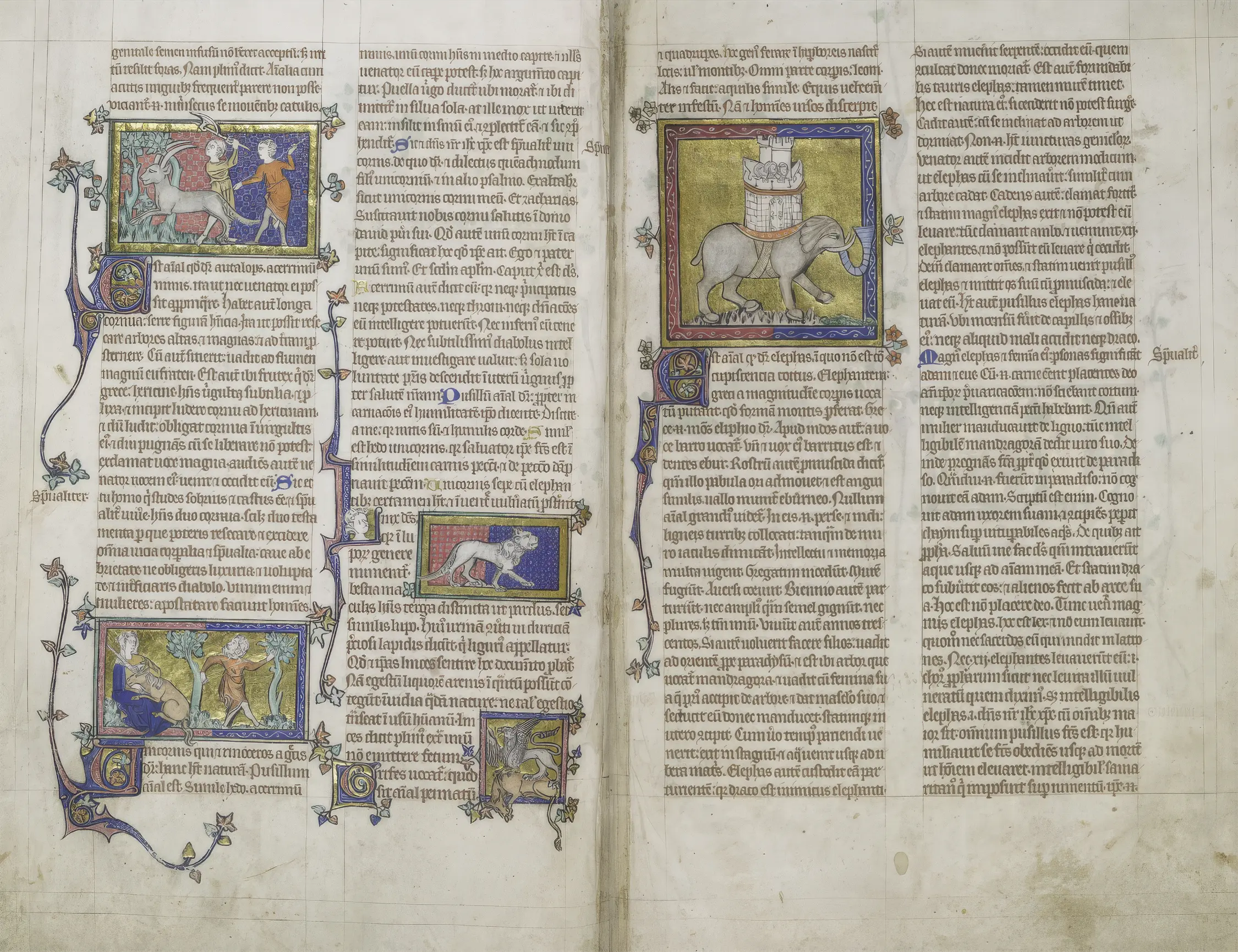
The elephant is shown with a tower strapped to its back.
That imagery had a basis in knowledge of war elephants, which could carry protected structures containing soldiers.
For an English reader who had almost certainly never encountered an elephant in ordinary life, the resulting animal belonged to a world simultaneously real, distant and astonishing.
The accompanying tradition praises elephants for qualities including intelligence and memory, while also repeating stories that modern zoology would not recognise.
That mixture is typical of the Bestiary.
Accurate observation could sit beside folklore, ancient authority, symbolic interpretation and complete fantasy without requiring the neat boundaries we expect today.
And then there is the bonnacon
Some bestiary creatures are harder to explain politely.
The bonnacon was supposed to resemble a bull.
Its horns curved inwards and were therefore useless for fighting.
This would normally be a serious evolutionary disadvantage.
The bonnacon, however, had another defence.
With horns said to curve uselessly back towards its head.
The creature supposedly fled rather than confronting pursuers directly.
Its legendary weapon was a stream of burning excrement projected behind it.
But irresistible to medieval artists and apparently to audiences ever since.
Unlike some bestiary animals, the bonnacon did not need an elaborate Christian allegory to justify its inclusion.
Sometimes a spectacular story was enough.
Medieval culture was perfectly capable of being learned, devout and extremely funny at the same time.
One word tells us how to read the book
Among the most revealing details in the manuscript is a Latin word written repeatedly beside the text:
“spiritually”
The word signals the moment when an account of an animal turns towards its spiritual meaning.
That matters because it tells us something about how the manuscript could be used.
A cleric preparing to teach, preach or meditate could move quickly from an animal story to its moral interpretation.
Read what is said about the creature.
Identify the spiritual or moral meaning.
Turn the animal into a lesson about human life.
This is why calling a bestiary a medieval zoology textbook misses its point.
The animal is often the beginning of the argument, not the end.
Did medieval people really believe all this?
This is one of the questions modern readers immediately ask.
Did somebody in Peterborough really believe a unicorn could be captured by placing a virgin in a forest?
Did they think dragons lived somewhere beyond the horizon?
Did they believe the bonnacon?
The most useful answer is: medieval belief was more complicated than a simple yes or no.
Knowledge came through respected texts and authorities as well as experience.
Some exotic animals that sounded fantastical were real.
Elephants existed.
Crocodiles existed.
Lions existed.
If reliable books described those unfamiliar creatures beside unicorns and dragons, the boundary between distant zoology and inherited marvel was not always obvious.
But symbolism could work whether literal belief was total, partial or absent.
A dragon could represent evil without anybody needing to encounter one on the Great North Road.
The strange thing is that Peterborough still has a bestiary on its walls
The world of the Bestiary was not confined to books.
Just a few miles from Peterborough Abbey, another extraordinary medieval picture-world survives at Longthorpe Tower.
The tower was built around 1290–1300.
Its remarkable wall paintings followed around 1330, astonishingly close in date to the Peterborough Bestiary.
Among saints, kings, musicians and moral allegories are animals derived from the bestiary tradition.
And above a doorway is something unmistakable.
The bonnacon.
A mythical bonnacon appears among the illuminated creatures of the manuscript tradition.
A hunter confronts the same extraordinary creature on a wall in medieval Peterborough.
English Heritage describes Longthorpe’s painted room as containing numerous animals drawn from bestiary sources.
The family responsible for the tower also had close connections with Peterborough Abbey.
We should not claim that the surviving manuscript was literally carried from the Abbey to Longthorpe and copied onto the wall.
There is no evidence for that.
But both reveal the same intellectual environment.
In medieval Peterborough, fantastic beasts were not hidden in books. They climbed onto the walls.
You can still enter that world today at Longthorpe Tower.
The Bestiary is actually part of three books in one
Open Corpus Christi College MS 53 from the beginning and you do not immediately reach the animals.
The volume as it survives today is a composite manuscript.
A richly illuminated book of Psalms adapted for the use of Peterborough Abbey.
Historical material including a chronicle associated with Peterborough Abbey.
The extraordinary illuminated animal book occupying the final leaves.
The Bestiary was trimmed to make its pages fit those of the Psalter.
That physical alteration is one of the clues showing that the sections were not originally conceived as a single object.
The different parts were also illuminated by different artists.
Matthew Parker helped save it
Peterborough Abbey was dissolved in 1539.
Its great medieval library was dispersed.
Some books disappeared entirely.
Others travelled into private collections, libraries and institutions across Britain.
MS 53 eventually entered the extraordinary library of Matthew Parker, Archbishop of Canterbury under Elizabeth I.
Parker was one of the great collectors of manuscripts from England’s dissolved religious houses.
When Parker died in 1575, he left his great collection to Corpus Christi College, Cambridge.
The Parker Library remains its home.
That same collecting story preserved many works that might otherwise have vanished after the dissolution of England’s monasteries.
Then, after centuries away, the beasts came home
For several months in 2018 and 2019, Peterborough residents could see the manuscript in their own city again.
Corpus Christi College lent the Peterborough Bestiary to Peterborough Museum & Art Gallery for the major Treasures exhibition.
The exhibition ran from 25 August 2018 to 6 January 2019 and brought together nationally important objects connected with Peterborough from museums and libraries around the country.
For the first time in generations, one of the great manuscripts carrying Peterborough’s name could be seen again in the city.
The Bestiary subsequently travelled much further.
In 2019 it crossed the Atlantic for the J. Paul Getty Museum’s major exhibition Book of Beasts: The Bestiary in the Medieval World in Los Angeles.
A manuscript once associated with Peterborough Abbey had become an international ambassador for medieval art.
Why this is a Peterborough object
The Peterborough Bestiary presents an interesting challenge.
We cannot confidently say it was created by monks sitting in Peterborough Abbey.
Yet removing it from the city’s history because of that would misunderstand how medieval objects acquired identities.
Books travelled.
They were collected.
Rebound.
Combined.
Adapted.
Inherited.
The Bestiary became part of a volume shaped by Peterborough Abbey and associated with one of its priors.
More importantly, its strange intellectual world has a remarkable parallel in the surviving medieval art of Peterborough itself.
At Longthorpe Tower, animals, allegories and even the ridiculous bonnacon still occupy the walls.
At the Cathedral, manuscripts formed part of a culture of learning stretching through centuries.
The Peterborough Chronicle recorded history.
The Black Book of Peterborough recorded institutional memory and property.
The Peterborough Psalter transformed prayer into extraordinary visual art.
The Bestiary did something different again.
It turned the entire animal kingdom into a way of thinking.
How Peterborough remembered events.
How the Abbey remembered rights and possessions.
How sacred words became precious images.
How animals became moral and spiritual ideas.
The stranger the beast, the more clearly the manuscript reveals the people looking at it.
That may be the real fascination of the Peterborough Bestiary.
It appears to be a book about animals.
Seven centuries later, it has become a book about us.