

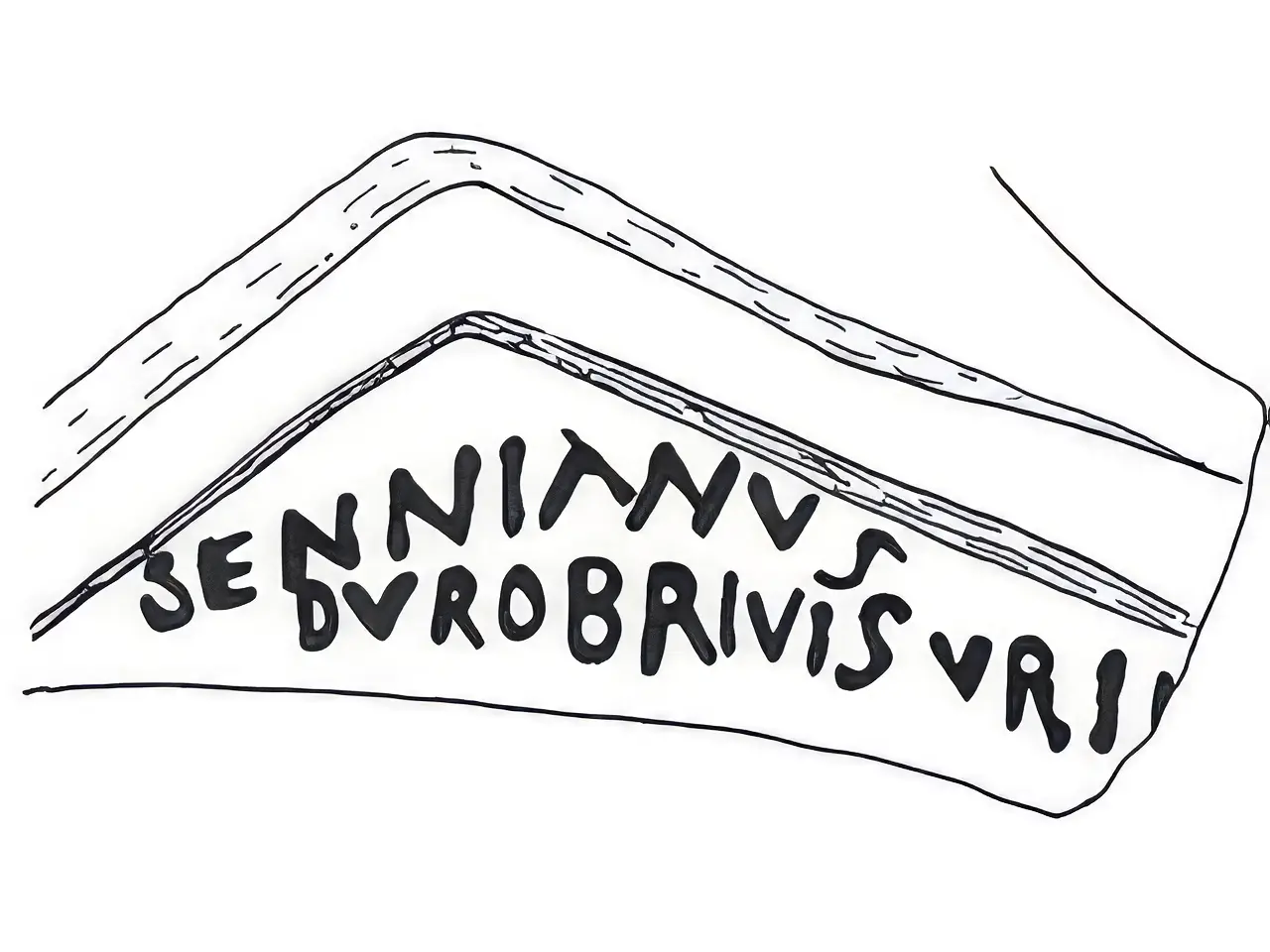
It is a fragment of ordinary Roman kitchenware, but somebody wrote something extraordinary around its rim. Sennianus gave us his name, his trade and the name of the town where he worked. Nearly 1,800 years later, his mortarium still says, in effect: I made this at Durobrivae.
The object in context
- AD 43 Roman armies begin the conquest of Britain.
- 1st c. Military activity and settlement develop around the River Nene crossing at Durobrivae.
- c.AD 120 Large-scale pottery manufacture expands around Durobrivae and the lower Nene Valley.
- c.AD 150+ Nene Valley colour-coated pottery becomes an increasingly important regional product.
- Late 2nd–3rd c. Sennianus works within the Durobrivae pottery industry and his name is painted on a mortarium.
- 3rd–4th c. Durobrivae remains an important manufacturing and distribution centre.
- Today The surviving fragment is held in the Peterborough Museum collections.
A Roman potter signs his work
Most people who lived around Roman Peterborough disappeared without leaving us their names.
We recover their houses, pots, roads, graves, coins and rubbish. We can reconstruct the industries in which they worked and sometimes even what they ate.
But individuals are harder to find.
Then there is Sennianus.
On the rim of a mortarium found in the Water Newton area is a painted inscription generally reconstructed as:
Sennianus of Durobrivae fired this.
The surviving final word is incomplete, so the familiar reading urit, meaning that Sennianus fired or heated the vessel, is a reconstruction. It is nevertheless the interpretation generally used by Peterborough Museum and local archaeological sources.
In a few painted letters, an industrial landscape suddenly acquires a human being.
Roman Peterborough does not only give us pottery. One pot gives us the potter.
First, what is a mortarium?
A mortarium was one of the characteristic working vessels of the Roman kitchen.
Imagine something between a mixing bowl and a large mortar.
Mortaria were thick, heavy vessels with broad rims. Their interiors were deliberately roughened with hard grit so that ingredients could be crushed, ground and blended against the abrasive surface.
The heavy flange gave the user something substantial to grip and often carried a maker’s stamp.
Hard particles embedded inside turned the bowl into an effective grinding surface.
Many mortaria included a pouring lip so mixed ingredients could be transferred once prepared.
Wooden pestles were probably commonly used, which helps explain why the bowls survive more often than their tools.
They could be used for grinding herbs, spices and foods, but archaeological evidence suggests similar vessels were also useful for preparing substances such as pigments and cosmetics.
Three words that tell us an enormous amount
The inscription is valuable because each part answers a different question.
A named individual connected with pottery production.
The Roman settlement centred on modern Water Newton.
The usual reconstruction connects Sennianus directly with producing the vessel.
That is why the mortarium matters far beyond the history of Roman cooking.
The Roman settlement is known as Durobrivae from written geographical sources including the Antonine Itinerary, but references to its name on objects found locally are rare.
Sennianus places the name on something made in the landscape itself.
DVROBRIVIS turns a broken piece of pottery into a label for a vanished Roman town.
Who was Sennianus?
Almost everything we know about Sennianus comes from these few letters.
His name appears to belong to the Celtic naming tradition of Roman Britain. Linguistic research connects its first element with the Celtic root seno-, meaning “old”.
That matters because Roman Britain was not populated only by immigrants arriving from Italy and speaking textbook Latin.
It was a society in which local people, inherited names, Roman markets, Latin literacy and continental trading systems mixed together.
His name appeared on a mortarium associated with Durobrivae.
He was connected closely enough with its manufacture to identify himself with the firing of the vessel.
He belonged to the enormous pottery economy operating around the Nene crossing.
His age, family, legal status, workshop arrangements or what happened to him.
It is tempting to turn him into a modern entrepreneur with a workshop and a personal brand.
We cannot go that far.
But his inscription does make him something precious: a named worker from Roman Peterborough.
Made at Durobrivae
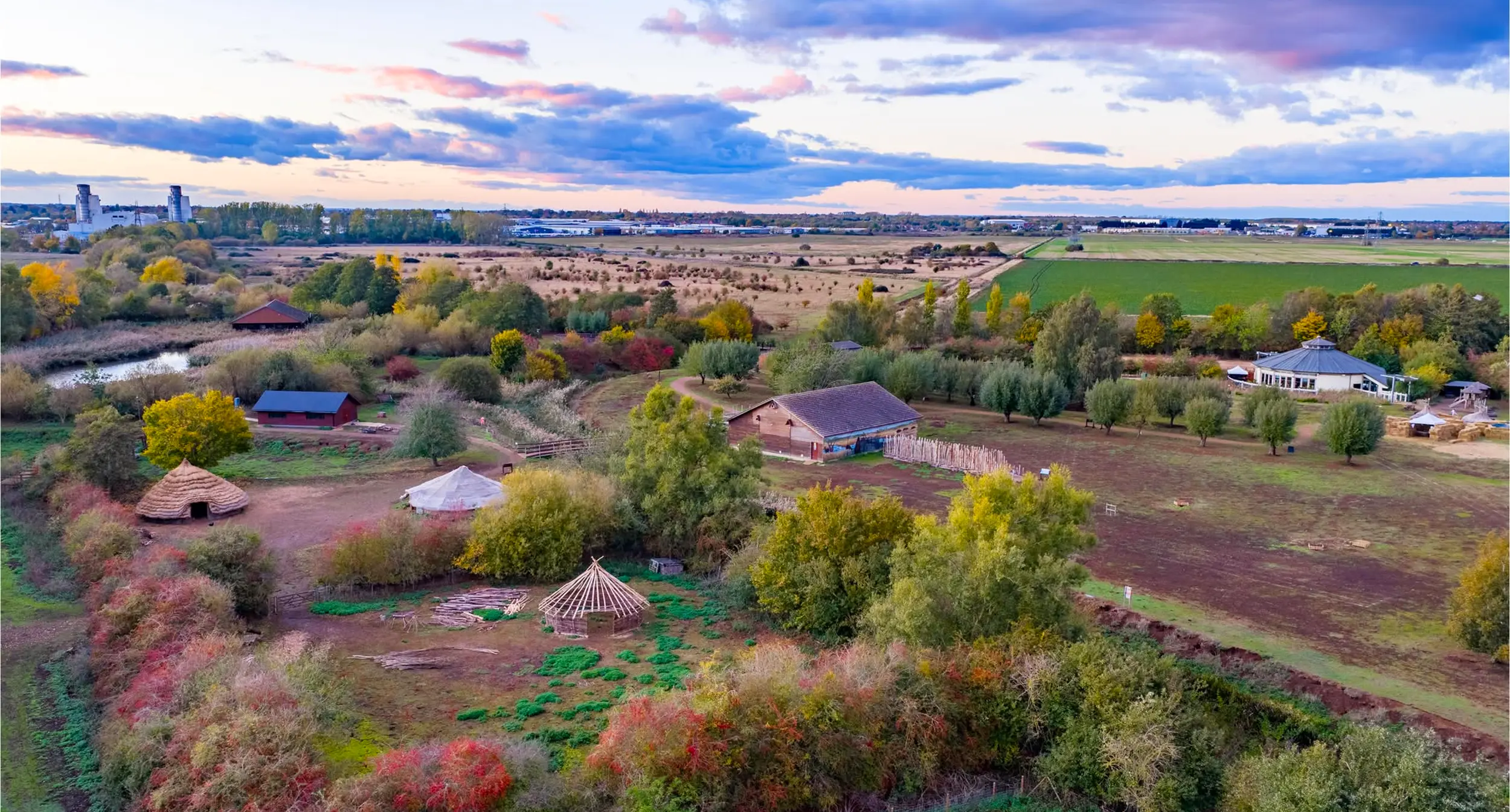
Sennianus worked in one of the greatest pottery-producing landscapes in Roman Britain.
Durobrivae stood beside the River Nene and Ermine Street, around seven kilometres west of the modern Peterborough city centre.
The name is commonly translated as something like “fort by the bridge”, reflecting the settlement’s origin beside a strategic crossing of the river.
What began around a military and transport landscape developed into an unusually large Roman town surrounded by suburbs, workshops, cemeteries, villas and industrial sites.
Explore that whole landscape in Roman Peterborough: Durobrivae, Roads, Pottery & Power.
The lower Nene Valley provided raw material for enormous ceramic production.
Workshops around the town transformed clay into industrial quantities of pottery.
Ermine Street and the Nene connected Peterborough-made pottery with distant markets.
Across the river around Castor and Normangate Field lay further industrial activity and substantial Roman buildings. Pottery production extended into a much wider area including Water Newton, Sibson and Stibbington, with related sites stretching still further through the Nene Valley.
Modern fields hide what was once an industrial landscape of smoke, kilns, fuel, clay, workshops and transport.
Made in Peterborough. Sold across Roman Britain.
Roman pottery production around Durobrivae was not a cottage industry.
Large-scale manufacturing developed from the later first and early second centuries and continued for generations.
By around AD 150 the area was producing the distinctive ceramics now grouped under names such as Nene Valley colour-coated ware.
These included beakers, bowls, jugs, flagons and other tablewares, often made with a pale body beneath a darker surface coating.
Mortaria formed another important part of the industry.
The geography explains much of that success.
The Nene provided water and transport. Ermine Street linked the settlement to major markets north and south. Local clay provided raw material. The surrounding countryside provided fuel and food for a large working population.
The same combination of river, road and industry would recur again and again in Peterborough’s later history.
More than sixteen centuries later, railways, engineering and brickmaking would once again turn geography into manufacturing power.
Sennianus was not the only potter who spoke
Another mortarium from the Durobrivae industry preserves a second remarkable maker’s inscription.
Unlike Sennianus’s painted text, maker’s stamps on mortaria were a recognised practice. The Cunoarus example is particularly valuable because it again preserves the name Durobrivae and describes it as a vicus, a term used for a settlement or small town.
Two apparently mundane kitchen vessels therefore give archaeologists something remarkably valuable.
A painted inscription identifies a potter and Durobrivae as the place associated with firing his vessel.
A stamped mortarium again identifies Durobrivae and helps illuminate the character of the settlement.
The grand buildings of Roman Britain tell us about power.
These pots tell us about work.
From a smoky kiln to somebody’s kitchen
Once Sennianus’s mortarium left the kiln, it became an object to be used.
Somebody bought it or received it.
Somebody carried it into a house, kitchen, workshop or commercial food-preparation space.
Someone poured ingredients into it and ground them against the roughened surface.
Raw material gathered and prepared in the Nene Valley.
The vessel was formed and finished by skilled pottery workers.
The kiln transformed soft clay into durable ceramic.
The mortarium became an everyday working tool.
There is a wonderful contrast here with another great Water Newton object.
The Water Newton Treasure gives us precious silver, Christian worship and people wealthy enough to dedicate valuable metalwork.
Sennianus gives us clay, grit, smoke and work.
Together, the silver and the pottery show two completely different faces of the same Roman town.
Back home in Peterborough
Unlike the Water Newton Treasure, whose original silver is now held by the British Museum, the Sennianus fragment belongs to the local archaeological collections.
It is held by Peterborough Museum & Art Gallery.
The Museum preserves a major collection of material from Durobrivae and the wider Nene Valley pottery industry, giving the modern city an unusually direct connection with the people who manufactured objects here during Roman rule.
Peterborough Museum & Art Gallery
The Sennianus mortarium forms part of Peterborough’s Roman archaeology collections. The Museum’s Roman material is the best place to begin exploring Durobrivae and the extraordinary pottery industry of the lower Nene Valley.
Why this is a Peterborough object
The Sennianus Mortarium is almost the opposite of a treasure.
It is not gold. It is not silver. It was not made for a king, a temple or a wealthy household.
It was a tool.
And yet it tells us something some far more spectacular objects cannot.
It tells us who made it.
Sennianus emerges for a few seconds from the anonymity of Roman industry. His name is attached directly to Durobrivae and to the physical process of making pottery.
He becomes one individual standing inside an enormous economic system.
A system that extracted clay from this landscape, fed kilns, employed craftspeople and merchants, supplied homes across Roman Britain and used the same road and river geography that would continue shaping Peterborough for centuries.
The inscription also gives Peterborough something more fundamental.
It gives the buried Roman town its name in its own material culture.
Before Peterborough existed, someone working beside the Nene wrote the name of his town on a pot.
Placed alongside the Water Newton Treasure, the mortarium helps turn Roman Peterborough from an archaeological landscape into a human one.
There were manufacturers and customers. Wealthy Christians and working potters. Roads and shops. Kilns and kitchens.
There was Sennianus.