
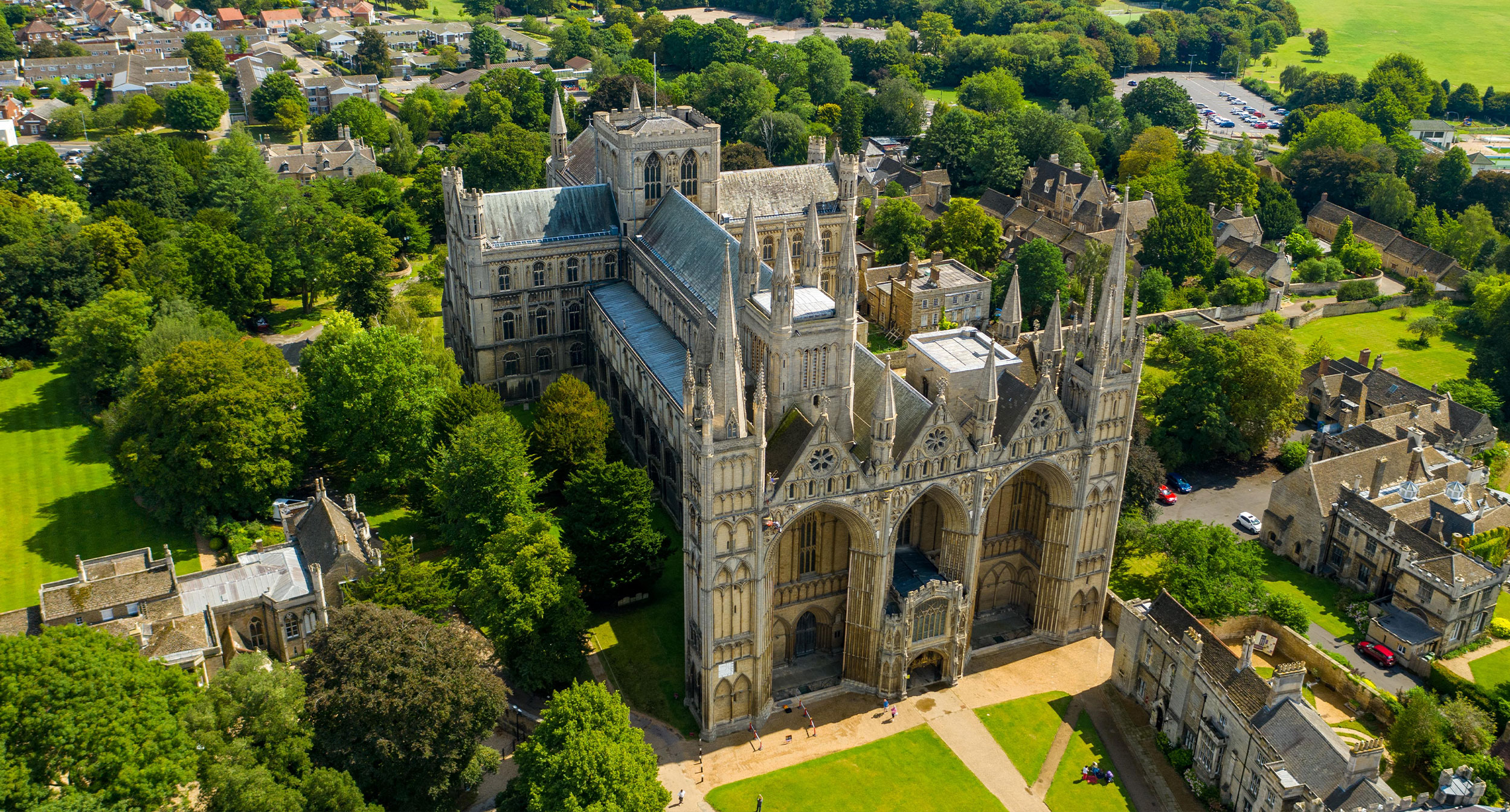


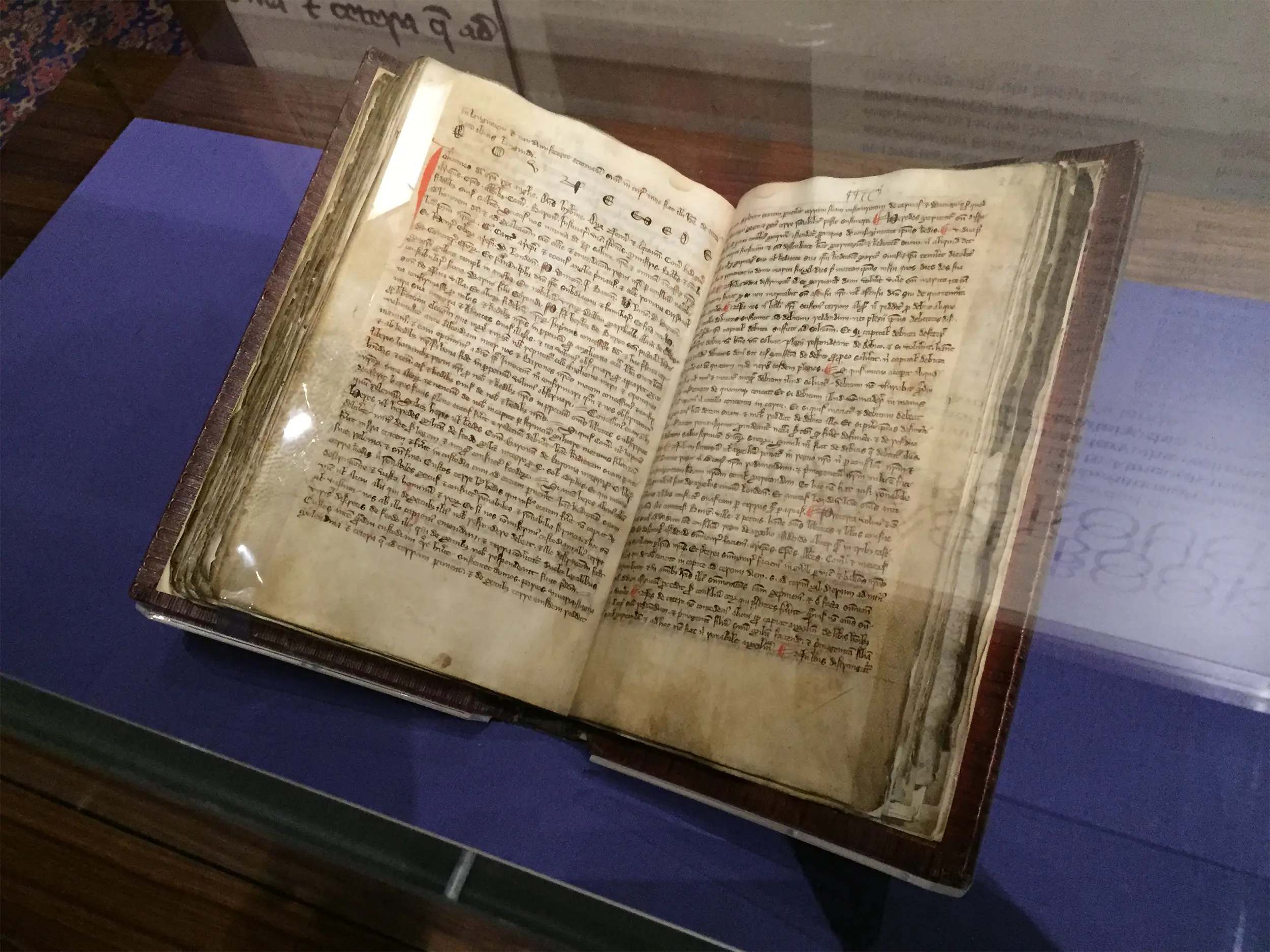
For medieval Peterborough, power was not only built in stone. It was written down. The Black Book of Peterborough preserved the abbey’s lands, rights, privileges and memory for centuries, and hidden among its pages is something extraordinary: a rare near-contemporary text of the 1215 Magna Carta.
The Black Book in dates
- From 664 The book preserves copies of charters and records whose original documents reached back into Peterborough’s Anglo-Saxon past.
- Early 1100s The core of the Black Book is copied and compiled at Peterborough Abbey.
- 1215 Magna Carta is agreed at Runnymede. A version preserving material from the drafting process reaches the Peterborough manuscript tradition.
- 1216 King John stays at Peterborough Abbey during his final military campaign.
- 1200s–1400s Successive hands continue adding charters, surveys and records to the manuscript.
- 1539 Peterborough Abbey is dissolved and its great medieval archive begins to disperse.
- 1778 Brownlow Cecil, 9th Earl of Exeter, presents the manuscript to the Society of Antiquaries of London.
Peterborough on parchment
The Black Book of Peterborough is not a single story written by a single author. It is something perhaps even more revealing: the institutional memory of one of medieval England’s great monasteries.
Known in Latin as the Liber Niger, the manuscript was created at Peterborough Abbey, the Benedictine monastery whose church later became Peterborough Cathedral.
Its earliest core was compiled in the early 12th century. Further documents were copied into it over the 13th and 14th centuries, with additions continuing into the 15th.
That means the object we see today is not simply a medieval book. It is a book that accumulated Peterborough’s history over generations.
Royal charters. Land grants. Surveys. Lists. Agreements. Property rights. Obligations. Records reaching back towards the monastery’s Anglo-Saxon origins.
All of them helped answer a question that mattered enormously in the Middle Ages:
What belongs to Peterborough, and how can we prove it?
What is a cartulary?
A cartulary was essentially an archive in book form.
Medieval monasteries accumulated huge numbers of individual charters and legal documents. These recorded gifts, purchases, boundaries, rents, privileges, obligations and agreements that could determine who owned land and who had the right to use it.
The originals mattered, but they could be lost, damaged or scattered. Important documents were therefore copied together into books.
A manuscript containing copies of charters, deeds and other documents recording the rights and property of an institution.
For a wealthy monastery such as Peterborough, whose estates extended far beyond the immediate city, this was practical administration on an enormous scale.
The abbey controlled manors, farms, fisheries, mills and rights across a wide area. Discover more about that extraordinary medieval institution in Peterborough Cathedral: 1,350 Years of History.
A monastery remembers itself
The oldest material copied into the Black Book reached much further back than the physical manuscript itself.
The Society of Antiquaries describes land grants and charters whose original texts date from as early as 664. The surviving book also contains Old English documents, Latin charters, surveys and lists.
Among its contents are records associated with the great 10th-century refoundation of Peterborough by Bishop Æthelwold, including lists of books, lands and vestments associated with gifts to the monastery.
In other words, 12th-century monks were copying documents that connected their own Peterborough with the Anglo-Saxon institution that had preceded the Norman Conquest.
Manors, estates, fields and property could be traced through written grants and agreements.
Royal and ecclesiastical privileges helped establish what Peterborough Abbey was entitled to do.
Copies of older documents connected medieval Peterborough with the monastery’s Anglo-Saxon past.
This culture of remembering through writing also produced the Peterborough Chronicle, the city’s extraordinary version of the Anglo-Saxon Chronicle.
Another Peterborough monk, Hugh Candidus, wrote a Latin history of the abbey in the 12th century. Together these manuscripts reveal an institution deeply conscious of its past.
Peterborough Abbey did not simply possess history. It organised it, copied it and used it.
Then there is Magna Carta
Deep inside the Black Book is one of its greatest surprises.
From folios 225v to 228v is a text of the 1215 Magna Carta.
Magna Carta emerged from the confrontation between King John and rebellious barons that culminated at Runnymede in June 1215. It was not originally the timeless constitutional monument it later became. It was an attempt to resolve an immediate political crisis by defining obligations, privileges and limits on royal action.
Four engrossed copies of the 1215 charter bearing King John’s seal survive today.
Peterborough’s text is different.
The Peterborough manuscript does not head its text “Magna Carta”. Instead, a medieval hand gives it the remarkable title ROVNEMEDE.
The Society of Antiquaries describes the Black Book version as a rare near-contemporary copy that contains differences from the authorised text.
Most importantly, it appears to preserve material deriving from drafts produced during the negotiations at Runnymede.
That makes the Peterborough copy important for more than the history of the city. Its variations give historians evidence for the process by which Magna Carta itself was negotiated and developed.
A piece of Runnymede in Peterborough
The Magna Carta section was not part of the Black Book’s original early 12th-century compilation. It was added later as a separate group of leaves.
Its presence raises an irresistible question.
How did a text so closely connected with the negotiations of 1215 end up in Peterborough Abbey?
We do not know for certain.
A long-standing possibility is that an early or discarded draft reached the monastery and was subsequently copied. Peterborough’s connections with King John make the possibility particularly intriguing, but the precise route by which the text arrived cannot now be reconstructed with confidence.
The manuscript can show us that an unusual 1215 text was preserved here. It cannot tell us exactly who carried it through the abbey gates.
King John comes to Peterborough
What we do know is that Peterborough was not remote from royal politics.
Its abbey was wealthy, strategically placed and accustomed to receiving monarchs. Kings repeatedly stayed here during the Middle Ages.
And in 1216, just a year after Magna Carta, King John himself came to Peterborough.
He used the monastery as a base during the final military campaign of his reign, part of the civil conflict that followed the collapse of the 1215 settlement.
John died later that year at Newark Castle.
The Black Book therefore sits within a striking local context. Peterborough Abbey preserved a text connected with the most famous political crisis of John’s reign, and the king himself was physically present at the monastery during the crisis that followed.
Explore Peterborough’s wider connections with medieval monarchs, abbots and national events in the complete history of Peterborough Cathedral.
A book that kept growing
One of the most interesting things about the Black Book is that Peterborough never really finished it.
The earliest substantial section belongs to the 12th century. Later scribes added further charters and records in the 13th and 14th centuries. Some additions continued into the 15th.
Different hands therefore occupy the same physical object.
The main cartulary brings together older charters, estate records and documents associated with Peterborough Abbey.
Further material enters the manuscript, including the extraordinary text associated with Magna Carta.
Successive generations continue using the book to preserve information important to the monastery.
It is therefore better understood as an evolving archive than as a conventional book.
Peterborough’s documentary culture continued elsewhere too. Medieval monks and chroniclers produced histories, charters and records that help reconstruct the extraordinary intellectual life of the abbey.
The Black Book belongs to the same remarkable tradition explored through Peterborough Writers and Poets and the city’s wider history collection.
How did it survive?
The survival of the Black Book is remarkable in itself.
Peterborough Abbey was dissolved in 1539 as part of Henry VIII’s dissolution of the monasteries. Its church survived, becoming Peterborough Cathedral in 1541, but the monastery’s possessions and archives were dispersed.
The Black Book left Peterborough.
It was at one stage owned by Sir Robert Wingfield of Upton. The manuscript later passed into the possession of the Cecil family, whose seat at Burghley lay only a short distance from Peterborough.
That connection may have reflected the Cecil family’s acquisition of former monastic estates after the Dissolution, although the precise path of the manuscript through its early modern owners is not completely certain.
Then, on 25 June 1778, Brownlow Cecil, 9th Earl of Exeter, presented the Black Book to the Society of Antiquaries of London.
It remains in the Society’s collection today as MS 60.
Society of Antiquaries of London
The Black Book is preserved at Burlington House in London. The Society has also digitised its Magna Carta text, allowing this extraordinary Peterborough manuscript to be studied online.
Why this is a Peterborough object
The Black Book is easy to underestimate.
It does not glitter like a medieval reliquary. It was not created primarily as a work of art. Its pages contain the kind of information that can initially look dry: property, agreements, grants, obligations and administrative records.
But that is exactly why it is so powerful.
It allows us to see how medieval Peterborough actually functioned.
The great abbey whose surviving church dominates the modern city was not merely a collection of monks living behind walls. It was a landowner, employer, economic power, religious institution, political actor, archive and centre of administration whose influence stretched across a substantial part of eastern England.
The Black Book was one of the tools through which that power was remembered and defended.
Then, among those records of local land and institutional rights, we encounter Runnymede and Magna Carta.
A book created to remember Peterborough ended up preserving evidence for one of the most famous documents in world history.
Placed beside the Peterborough Chronicle, the history of Hugh Candidus and the surviving fabric of Peterborough Cathedral, the Black Book reveals something fundamental about medieval Peterborough.
This was not simply a place where history happened.
Peterborough wrote history down.