Discover Peterborough · Deep History
c.165 million years ago
Peterborough's Jurassic Fossils
Long before the city, the Cathedral or even the dinosaurs had disappeared, Peterborough lay beneath a warm Jurassic sea. Its muddy floor became one of Britain's greatest fossil archives, preserving giant fish, marine reptiles, ammonites and the discoveries of one extraordinary Peterborough collector: Alfred Nicholson Leeds.
Peterborough before Peterborough
There was no city here.
There was a sea.
Around 165 million years ago, during the Middle Jurassic, the ground beneath modern Peterborough lay beneath a shallow, productive sea. Mud settling on its floor became the Oxford Clay: a geological formation whose Peterborough Member would eventually preserve one of Britain's richest records of Jurassic marine life.
The creatures preserved in that clay make the familiar landscape suddenly strange. Plesiosaurs propelled themselves through the water on four paddles. Ichthyosaurs hunted with streamlined bodies. Pliosaurs carried huge predatory skulls. Marine crocodilians cruised the same sea. Ammonites, belemnites, shellfish, sharks and bony fish filled the food web. Somewhere among them swam Leedsichthys problematicus, one of the largest bony fishes known to science.
This is not a distant geological story imported into Peterborough. The fossil record comes from the clay beneath the city and its surrounding brickfields. Peterborough's industrial expansion exposed the Jurassic world layer by layer, and generations of clay workers, collectors and palaeontologists turned accidental discoveries into science.
Callovian seas covered the Peterborough area.
Organic-rich marine mudstone with exceptional fossils.
A famous Peterborough Leedsichthys tail is almost three metres high.
Alfred Nicholson Leeds recovered fossils from the district for almost half a century.
Middle Jurassic · Callovian
A sea over Peterborough
Warm water.
Dark mud.
An extraordinary archive.
The Oxford Clay was deposited offshore in comparatively quiet marine water.
British Geological Survey descriptions of the formation record an environment in which mud accumulated continuously on the sea floor. In the Peterborough Member, alternating organic-rich dark shales and paler, more thoroughly burrowed mudstones record changing conditions on that seabed.
At times, high biological productivity and restricted mixing left the deeper water depleted in oxygen. That mattered enormously for palaeontology. Carcasses and organic remains reaching a poorly oxygenated seabed could escape some of the scavenging and disturbance that normally destroys them. Fine sediment then entombed bones, shells, wood and other remains.
The combination of abundant marine life, fine-grained mud, episodically low oxygen at the seabed and later industrial-scale clay extraction produced a remarkable fossil record.
The sea was shallow on a geological scale, probably only tens of metres deep in parts of the basin, but biologically rich. Microscopic plankton supported invertebrates and fish; fish supported larger predators; and the mud beneath them captured the evidence.
The Peterborough Jurassic Sea
Not dinosaurs in a swamp.
A marine ecosystem.
Peterborough's most spectacular Jurassic fossils are predominantly marine. The clay pits preserve animals from several very different evolutionary lineages living together in the same sea.
Plesiosaurs
Four-flippered marine reptiles, including long-necked forms such as Cryptoclidus. Peterborough specimens helped make the Oxford Clay internationally important for plesiosaur research.
Pliosaurs
Short-necked, large-headed marine predators armed with formidable teeth. Oxford Clay specimens include animals such as Simolestes and Pliosaurus.
Ichthyosaurs
Streamlined reptiles convergent in body shape with modern dolphins. Fossils include Ophthalmosaurus, famous for its enormous eyes.
Marine crocodilians
Long-snouted thalattosuchians lived fully or largely marine lives. Peterborough material has been central to the study of several species.
Fish
Sharks, rays, chimaeras and bony fishes ranged from small predators to the colossal suspension-feeding Leedsichthys.
Ammonites & belemnites
Cephalopods were abundant. Ammonites such as Kosmoceras are so useful that geologists use their changing species to divide the Oxford Clay into time zones.
The giant in the clay
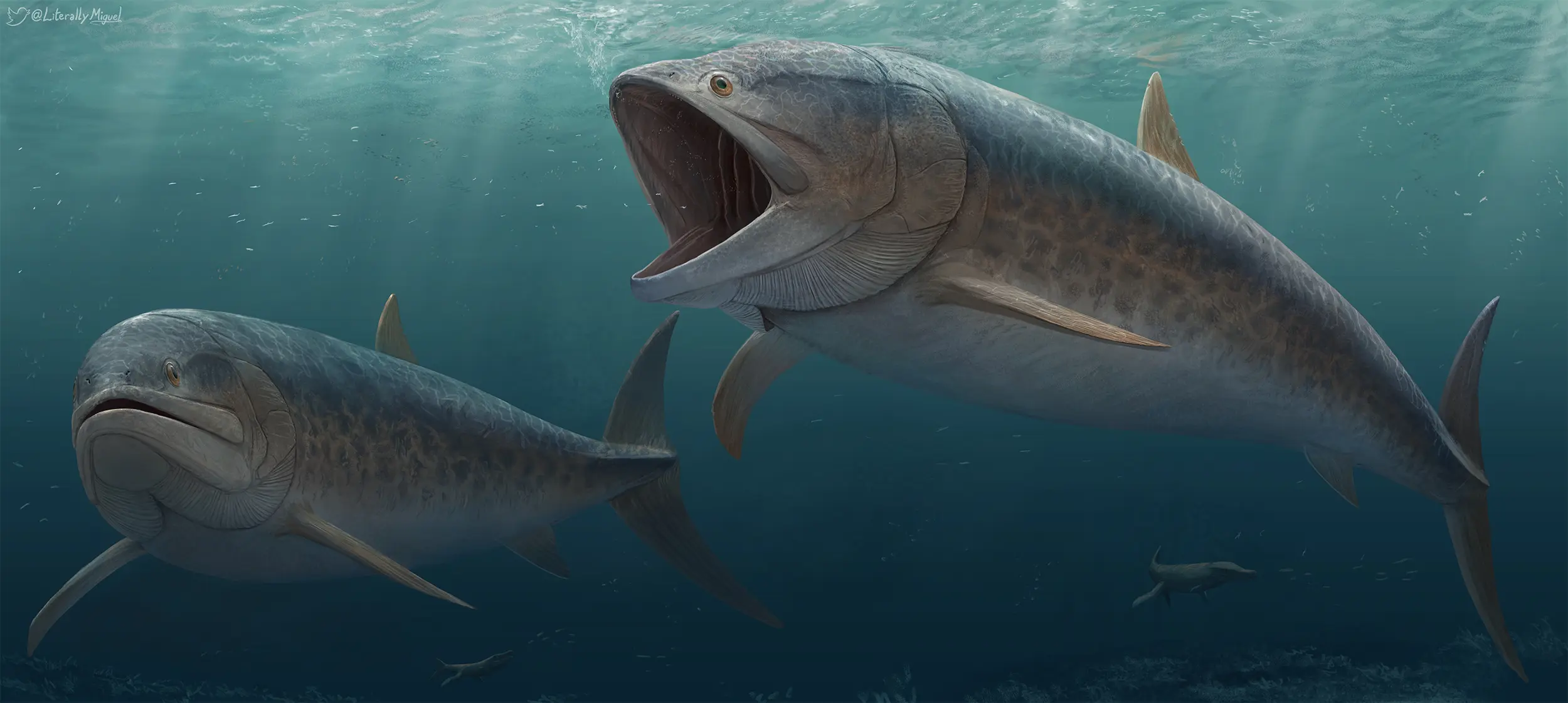
Leedsichthys problematicus
A fish on a scale that still challenges the imagination, named for the Peterborough collector whose fossils first brought it to science.
1880s–1890
A Peterborough giant
The largest bony fish ever known?
Alfred Nicholson Leeds recovered the remains of an enormous and deeply puzzling fish from the Oxford Clay brick pits around Peterborough.
Its bones were so unlike a conventional fish skeleton that early researchers struggled to understand what they were looking at. In 1889 Arthur Smith Woodward discussed material from Leeds's collection, and the name Leedsichthys problematicus was established for the extraordinary animal. The name was apt twice over: it honoured Leeds, while problematicus acknowledged just how difficult the fragmentary skeleton was to interpret.
Leedsichthys belonged to the pachycormids, an extinct group of ray-finned fishes. Unlike the great marine reptiles around it, it was not a giant predator. Its delicate gill rakers formed a filtering apparatus capable of straining small organisms from seawater. In ecological terms it occupied a niche more comparable with a whale shark or baleen whale than with a pliosaur.
The famous Leeds-collected tail in the Natural History Museum measures about 2.74 metres from tip to tip.
So how big was it?
Size estimates have changed dramatically because no complete skeleton exists and much of the skeleton was poorly ossified. Older extrapolations produced spectacular estimates above twenty metres. Modern work has generally been more conservative. The Natural History Museum notes that the Peterborough tail suggests an animal around 16 metres long, while other specimens demonstrate that individuals varied greatly in size.
The important point is not a single headline number. Leedsichthys was unquestionably an enormous suspension-feeding bony fish, and some of the fossils most important to understanding it came directly from Peterborough's clay.
1847–1917
The collector of Eyebury
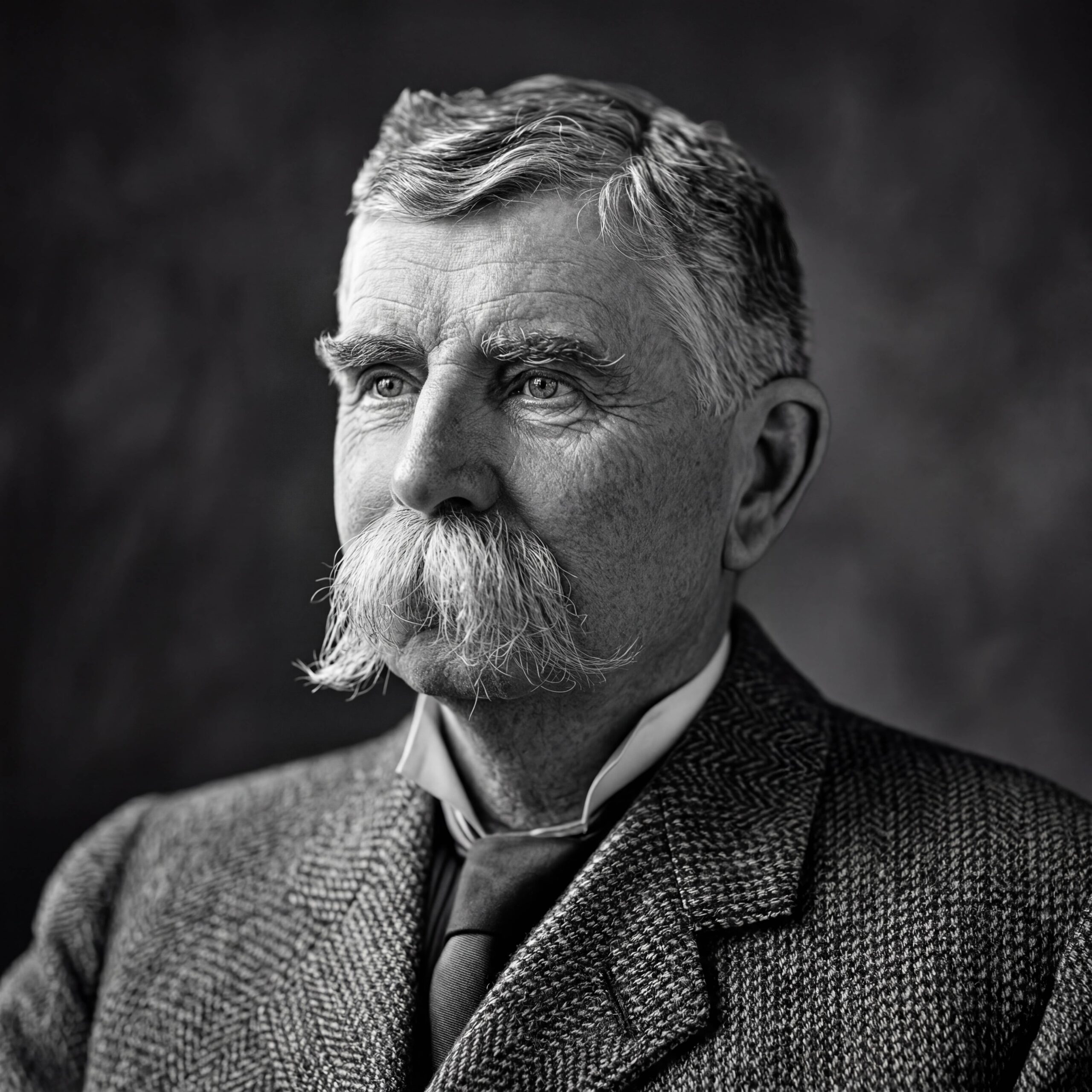
Alfred Nicholson Leeds
A gentleman farmer from just outside Peterborough became one of the most important fossil vertebrate collectors of his age.
Alfred Nicholson Leeds was born at Eyebury, east of Peterborough, in 1847. He had hoped to pursue medicine, but family circumstances led him to manage Eyebury Farm from 1868. At almost exactly the same moment, the district's Oxford Clay was being opened on an ever greater scale.
His elder brother Charles had already been encouraged by Oxford geologist John Phillips to collect the fossils appearing locally. Alfred joined him. Together they improved methods for recovering skeletons from soft clay, where bones might be fragile, crushed, scattered or broken into hundreds of pieces.
Their relationship with brickfield workers was crucial. Rather than allowing an interesting skeleton to be hacked out hurriedly, the brothers encouraged workers to send word to Eyebury when bones appeared. Alfred could then excavate systematically, recording the association of fragments and preparing them with unusual care.
The brick industry opened the Jurassic archive. Leeds learned how to read it before the clay disappeared into bricks.
Charles eventually emigrated to New Zealand. Alfred continued collecting for decades, assisted by his family. Historical research also highlights the contribution of his wife, Mary Ferrier Fergusson, who helped clean, assemble and conserve the enormous quantities of fragile material kept at Eyebury.
Read Alfred Nicholson Leeds' story →Eyebury to the world
A Peterborough collection became international science.
By the late nineteenth century, the fossils gathered around Peterborough were attracting the attention of Britain's leading palaeontologists.
Alfred Leeds corresponded with scientists at the British Museum (Natural History), now the Natural History Museum. From around 1890 the museum acquired major parts of his collection. Its holdings today include spectacular Peterborough fishes and marine reptiles, while other Leeds material travelled to museums elsewhere in Britain, Ireland, continental Europe and beyond.
The collection was scientifically transformative because it did not consist merely of attractive isolated teeth or vertebrae. Leeds recovered associated skeletons, skulls and articulated elements that allowed anatomists to reconstruct whole animals and compare species.
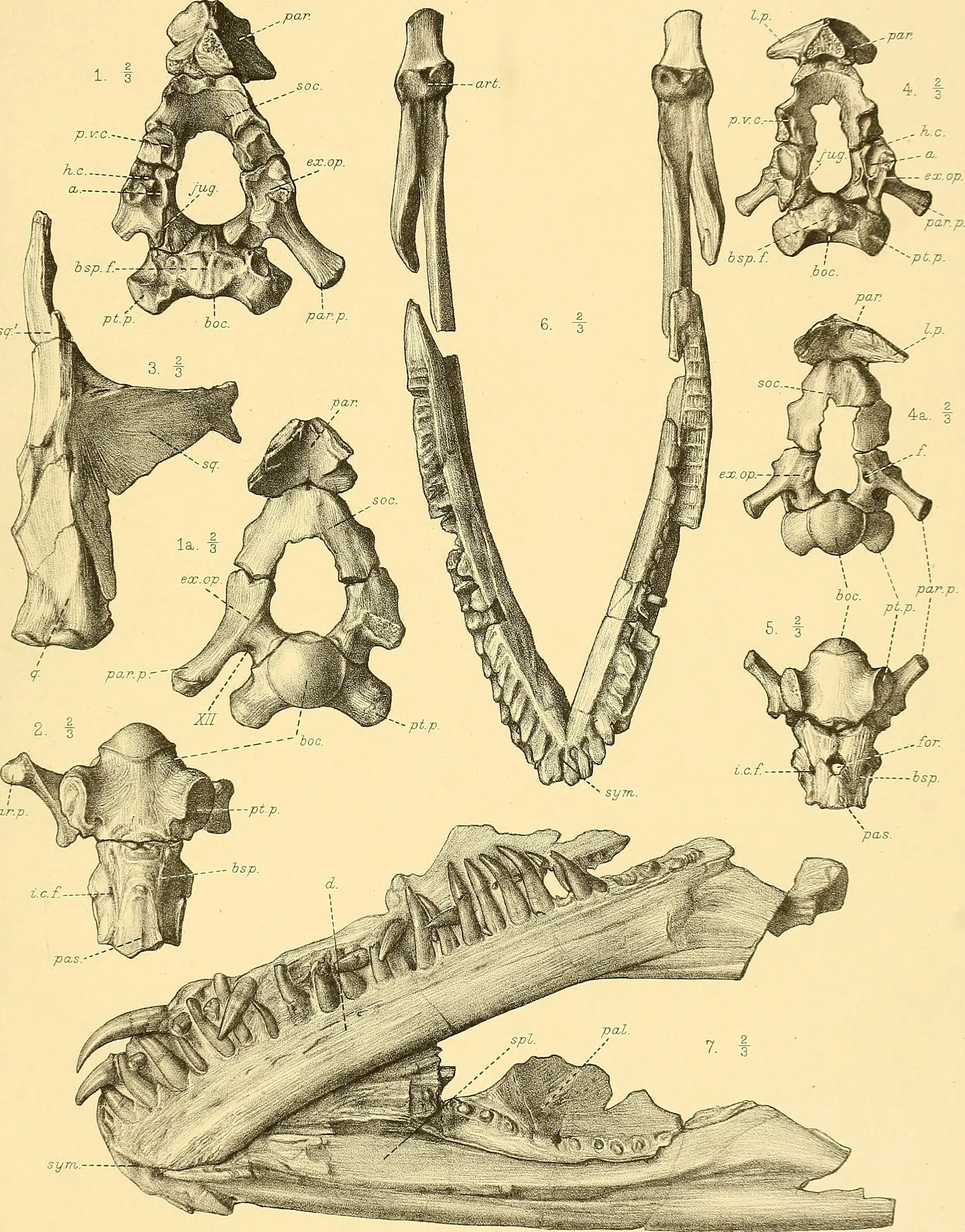
Its importance was such that C. W. Andrews's monumental A Descriptive Catalogue of the Marine Reptiles of the Oxford Clay, published by the British Museum in 1910–13, was explicitly based on the Leeds Collection.
The Leeds Collection in print
Peterborough fossils became reference specimens.
The British Museum's catalogue turned fossils extracted from local brick pits into a permanent anatomical reference for Jurassic marine reptiles. More than a century later, researchers still revisit Leeds specimens, reinterpret their anatomy and use archival letters to reconstruct exactly how particular fossils were discovered.
Leeds's achievement therefore lies in more than the number of bones he collected. It lies in the quality of the associations he preserved and the information that survived with them.
19th–20th centuries
Industry meets deep time
Peterborough's bricks exposed its Jurassic sea.
The fossil story and Peterborough's brick story are inseparable.
Oxford Clay had been worked locally for centuries, but the development of the Fletton brick process in the late nineteenth century transformed extraction. The organic-rich Peterborough Member could be dry-pressed and fired economically, helping to create an enormous brickmaking landscape south and east of the city.
Every pit was effectively an enormous geological trench. Clay extraction cut through millions of years of sediment and repeatedly exposed bones. Workers learned to recognise the hard interruption of fossil material against soft clay. Fossil collecting therefore became embedded in the everyday industrial landscape.
Industrial quarrying destroyed geological layers to make bricks, but it also exposed fossils that might otherwise have remained inaccessible beneath fields and Fen deposits.
The great collections from Peterborough exist because science, local knowledge and heavy industry happened to intersect in exactly the same landscape.
Explore Peterborough's brick industry →Four paddles through the Oxford Clay sea
Cryptoclidus
Long-necked plesiosaurs are among the most recognisable animals from the Oxford Clay. Leeds Collection material provided unusually complete skeletons, allowing researchers to study proportions, paddles, vertebral columns and skull anatomy in far greater detail than isolated bones could provide.
A celebrated later Peterborough find, the roughly four-metre “Dogsthorpe plesiosaur”, was excavated in 1987. It demonstrates that the city's fossil story did not end with Alfred Leeds: the same clay continued to produce exceptional vertebrates throughout the twentieth century.
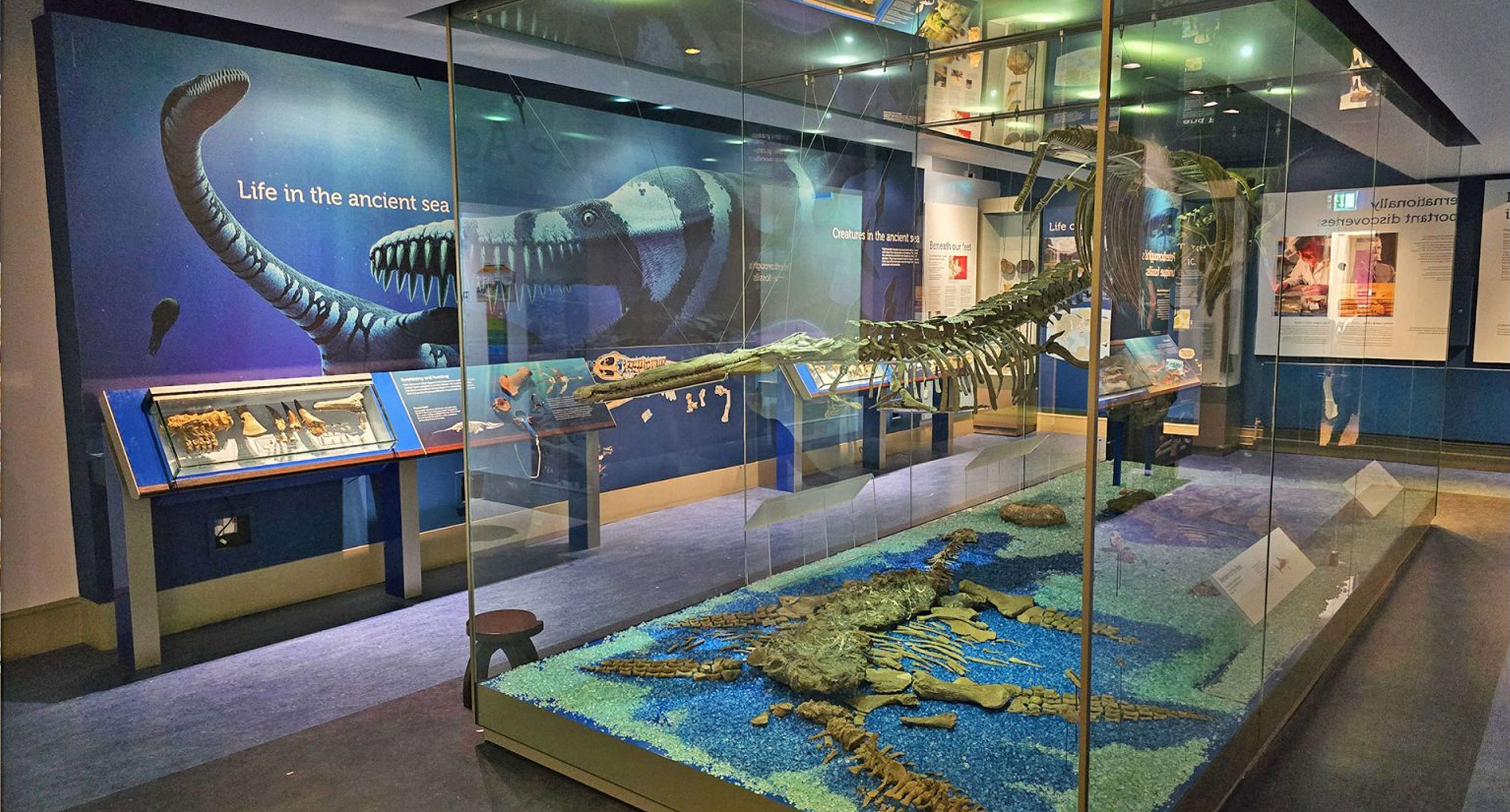
See Peterborough's Jurassic fossils for yourself. The permanent Jurassic Gallery explores Peterborough under the sea and displays internationally important marine reptile material from the local Oxford Clay.
Visit the Jurassic Gallery →Beyond Leedsichthys
A world-class fossil district.
British Geological Survey records show the range and quality of vertebrate fossils recovered from Peterborough and neighbouring Whittlesey.
A marine crocodilian
A roughly 4.9-metre skeleton historically identified as Steneosaurus durobrivensis was found in the Fletton brick pits.
The Dogsthorpe plesiosaur
A near-complete Cryptoclidus skeleton about four metres long was recovered from the brick pit.
A formidable pliosaur
Material of Simolestes vorax, including an enormous skull, records one of the sea's major predators.
Pachycostasaurus
A near-complete small pliosaur skeleton from King's Dyke became the basis of the unusual species Pachycostasaurus dawni.
A juvenile ichthyosaur
A near-complete young Ophthalmosaurus from the Whittlesey area reveals another branch of the Jurassic marine reptile radiation.
Dinosaurs too
Rare land-dinosaur remains and fossil wood reached the marine basin, evidence that dry land lay within reach of the Oxford Clay sea.
2001 · Star Pit, Whittlesey
The giant returned.
More than a century after Leeds's discoveries, new Leedsichthys bones appeared in the same Oxford Clay landscape, beginning one of Britain's most ambitious modern fossil excavations.
2001–2004
The “Ariston” excavation
A Jurassic fish that seemed to go on and on.
In 2001 students Marcus Wood and Matt Riley noticed bones projecting from a face at Star Pit, Whittlesey. Specialists recognised them as Leedsichthys. Surveying the layer revealed more bones spread across the cliff, suggesting a substantial associated individual rather than a few isolated fragments.
The excavation became a major undertaking. More than 10,000 tonnes of overburden had to be removed before fine excavation could begin. Thousands of fragile elements were recovered during successive seasons, producing a specimen nicknamed “Ariston” because the bones seemed to continue endlessly through the clay.
This modern excavation transformed understanding of Leedsichthys. It allowed researchers to compare associated parts of one animal, reassess older material and challenge some of the enormous size estimates that had grown up around the species.
It also produced a striking continuity: Star Pit was a place Alfred Leeds himself had collected fossils roughly ninety years earlier. Peterborough's nineteenth-century collecting tradition and twenty-first-century palaeontology met in the same clay face.
Look beyond the monsters
The small fossils tell the sea's story too.
Giant vertebrates make headlines, but the Oxford Clay is scientifically powerful because the surrounding ecosystem is preserved too.
- Ammonites provide exquisitely sensitive geological clocks. Rapid evolutionary change lets geologists correlate beds across large distances.
- Belemnites, squid-like cephalopods with hard internal guards, are common components of Jurassic marine assemblages.
- Bivalves form shell beds and sometimes occur as dense crushed layers across bedding planes.
- Sharks and rays are represented by teeth, spines and other resistant skeletal parts.
- Fossil wood records vegetation washed or floated from nearby land into the marine basin.
- Microfossils preserve evidence of planktonic and seabed communities invisible at the scale of museum monsters.
Together these fossils allow palaeontologists to reconstruct not merely individual animals, but the water chemistry, food web, seabed conditions and geography of a vanished sea.
From Jurassic mud to museum cases
Peterborough's fossil timeline.
The Oxford Clay sea
Marine mud accumulates across the Peterborough area during the Callovian.
The Leeds collecting tradition begins
Charles Leeds begins collecting locally and Alfred soon joins him.
Alfred takes over Eyebury Farm
Farming and fossil collecting become the parallel occupations of his adult life.
A giant fish emerges
Extraordinary bones collected around Peterborough prove to belong to an enormous and unfamiliar fish.
Leedsichthys enters science
Arthur Smith Woodward describes material from Leeds's collection and the genus is named in his honour.
The British Museum acquires major Leeds material
Peterborough fossils enter the national collection.
The Leeds Collection is catalogued
C. W. Andrews publishes the monumental British Museum catalogue of Oxford Clay marine reptiles.
Alfred Nicholson Leeds dies
His collection has already changed the scientific understanding of Jurassic marine vertebrates.
Fletton marine crocodilian
A large thalattosuchian skeleton is recovered from the brick pits.
Dogsthorpe plesiosaur
A near-complete Cryptoclidus demonstrates the continuing richness of the district.
King's Dyke pliosaur
The unusual Pachycostasaurus dawni is recovered from the Oxford Clay.
“Ariston”
A major new Leedsichthys specimen is excavated at Star Pit, renewing scientific interest in the giant fish.
A global scientific legacy
Peterborough fossils remain in active research collections and continue to reshape interpretations of Jurassic life.
Peterborough's deepest history
Look beneath the modern city.
Peterborough's heritage is often told through abbeys, queens, railways, bricks and engineering. Yet beneath all of them lies another landscape: a sea floor more than 160 million years old.
Its fossils connect a local industrial city with global palaeontology. Animals extracted from Peterborough clay sit in major museum collections. Species were named from them. Generations of scientists have re-examined them. And the name of a Peterborough farmer, Alfred Nicholson Leeds, remains permanently attached to one of the largest fishes ever to have lived.
Research sources
Evidence behind the story.
This page draws on geological surveys, museum collections, historical publications and modern palaeontological research. Popular size claims and older taxonomic names have been treated cautiously where subsequent research has revised them.
- British Geological Survey — British Regional Geology: East Anglia
- British Geological Survey — Peterborough district geological memoir
- Geological Conservation Review — Peterborough Brickpits
- Natural History Museum — Fossil Fish Collection: Alfred Nicholson Leeds Collection
- Natural History Museum Archives — Alfred Nicholson Leeds biographical record
- Geological Magazine — Obituary of Alfred Nicholson Leeds
- A. Smith Woodward — early scientific account of Leedsichthys
- Liston & Noè — the Peterborough Leedsichthys tail and historical records
- Natural History Museum — Leedsichthys and modern size interpretation
- C. W. Andrews — A Descriptive Catalogue of the Marine Reptiles of the Oxford Clay
- Jeff Liston — historical research on Alfred Leeds, Mary Ferrier Fergusson and Leedsichthys
Image Credits
Photography & licensing.
Third-party and licensed images are credited below. The two principal Peterborough images supplied for this page are identified separately without asserting an external licence.
-
Leedsichthys image / hero
Image supplied by Discover Peterborough: discoverpeterborough.co.uk/wp-content/uploads/2026/05/Leedsichthys.jpg. -
Alfred Nicholson Leeds portrait
Image supplied by Discover Peterborough: discoverpeterborough.co.uk/wp-content/uploads/2026/05/Alfred-Nicholson-Leeds-scaled.jpg. -
Peterborough Museum & Art Gallery — Jurassic Gallery
Image supplied by Discover Peterborough: discoverpeterborough.co.uk/wp-content/uploads/2025/08/museum-header.jpg. -
Leedsichthys problematicus life reconstruction
LiterallyMiguel / Wikimedia Commons. Creative Commons Attribution 4.0 International (CC BY 4.0). -
Historic plate from the Leeds Collection catalogue
British Museum (Natural History) / C. W. Andrews / Biodiversity Heritage Library / Wikimedia Commons. 1910 publication; no known copyright restrictions / public-domain source material.
Discover Peterborough
165 million years.And the story is still being rewritten.
Continue through Peterborough's timeline, from Jurassic seas and prehistoric landscapes to the Cathedral, railways, bricks, engineering and the modern city.
Discover more Peterborough history →