

- Full name
- Thomas Hunter
- Known as
- The Lonely Anzac
- Born
- 5 May 1880
- Birthplace
- Medomsley, County Durham
- Died
- 31 July 1916
- Occupation
- Coal miner and soldier
- Service number
- 505
- Unit
- 10th Battalion, AIF
- Final rank
- Sergeant
- Campaigns
- Gallipoli and the Western Front
- Resting place
- Peterborough Old Cemetery
- Remembered for
- Peterborough’s remarkable act of remembrance
Sergeant Thomas Hunter was an Australian Imperial Force soldier who fought at Gallipoli and was mortally wounded at Pozières. He had no connection with Peterborough until a hospital train stopped there during his final journey. Yet when he died at Peterborough Infirmary on 31 July 1916, the city adopted the solitary serviceman as one of its own. Thousands attended his funeral, residents paid for his memorials, and more than a century later Peterborough still remembers him as the Lonely Anzac.
- Born at Medomsley in County Durham
- Begins working as a coal miner while still a teenager
- Emigrates from Britain to Australia
- Enlists in the Australian Imperial Force
- Leaves Adelaide aboard HMAT Ascanius
- Lands at Gallipoli with the 10th Battalion
- Evacuated to Egypt with a severe foot wound
- Returns to his battalion at Gallipoli
- Promoted to Sergeant
- Arrives at Marseilles for service in France
- Severely wounded at Pozières
- Dies at Peterborough Infirmary, aged 36
- Buried with full military honours in Peterborough
- Publicly funded grave and Cathedral memorials are completed
- His grave is restored and rededicated
- Peterborough continues to honour him on Anzac Day
A miner between two countries
Thomas Hunter was born on 5 May 1880 at Medomsley, near Consett in County Durham. Some family research gives his full name as George Thomas Hunter, although his Australian military and Commonwealth War Graves records generally identify him simply as Thomas Hunter.
He grew up in one of north-east England’s coal-mining communities. His father was a miner, and Thomas reportedly began working below ground at about the age of 13. Mining was physically punishing and dangerous work, but it gave him the endurance and familiarity with hardship that would later characterise his military service.
Hunter also recorded ten years’ previous service with the Durham Field Artillery. This experience meant that when the First World War began, he was not entirely unfamiliar with military discipline, organisation or weapons.
In 1910, at the age of 30, Hunter emigrated to Australia. He initially stayed with relatives at Kurri Kurri in New South Wales, another community shaped by coal mining, before moving to Broken Hill. There he again found work as a miner, this time in one of Australia’s most important centres of metal mining.
Hunter’s life connected two distant industrial landscapes: the mining villages of County Durham and the mines of New South Wales. He had been in Australia for only four years when the outbreak of war changed the direction of his life.
Joining the Australian Imperial Force
Britain declared war on Germany on 4 August 1914, bringing the countries of the British Empire into the conflict. Australia quickly began raising a volunteer expeditionary force for overseas service.
Hunter was among more than 50 men who travelled from Broken Hill to Adelaide to enlist. He joined the Australian Imperial Force at Morphettville, South Australia, on 24 August 1914. He was 34 years old, unmarried and working as a miner. His address was recorded as Cobalt Street, Broken Hill.
His attestation papers stated that he had no living next of kin. Instead, he supplied J. Dawson of Kurri Kurri as his contact. That detail would later contribute to the image of a soldier who had travelled and died far from family, although he was not without friends, comrades or community ties.
Hunter received service number 505 and was posted as a private to H Company of the newly formed 10th Australian Infantry Battalion. Raised mainly in South Australia, the battalion became part of the 3rd Brigade of the Australian 1st Division.
On 20 October 1914, Hunter embarked from Adelaide aboard HMAT Ascanius. The convoy travelled to Egypt, where the Australian troops trained before being committed to the Allied campaign against the Ottoman Empire.
Hunter enlisted as a private, survived the opening Gallipoli campaign, returned after being wounded and rose steadily through the ranks. He was promoted to Lance Corporal in August 1915 and became a Sergeant on 1 March 1916.
Among the first ashore at Gallipoli
The 10th Battalion formed part of the 3rd Brigade, which was selected as the covering force for the Allied landing on the Gallipoli peninsula. Its soldiers were therefore among the first Australian troops to go ashore at what became known as Anzac Cove during the early hours of 25 April 1915.
As a member of H Company, Hunter took part in the opening assault and the desperate effort to establish and defend the Anzac position. The steep terrain, confused landings and determined Ottoman resistance turned the operation into a costly struggle almost immediately.
During the first days of the campaign, Hunter suffered a severe gunshot wound to his right foot. He was evacuated from the peninsula and admitted to the 17th General Hospital in Alexandria on 1 May.
After treatment and convalescence in Egypt, he returned to duty. On 12 June 1915, little more than six weeks after being wounded, he rejoined the 10th Battalion at Gallipoli.
Hunter remained with the unit through the difficult months that followed. His promotions suggest that his superiors recognised his experience and reliability. He became a Lance Corporal on 25 August, served temporarily as a Corporal and was appointed Lance Sergeant in December.
The Gallipoli campaign failed to achieve its strategic objectives. The Anzac forces were eventually withdrawn in December 1915, and Hunter disembarked at Alexandria on 29 December following the evacuation.
Pozières and the Western Front
After returning to Egypt, the Australian Imperial Force was reorganised and prepared for a different kind of war. Hunter was promoted to Sergeant on 1 March 1916, completing a notable rise from the rank of private in less than 19 months.
On 27 March, the 10th Battalion sailed from Alexandria aboard the troopship Saxonia. It arrived at Marseilles on 3 April and moved north to join the British Expeditionary Force on the Western Front.
The battalion’s first major battle in France came at Pozières during the wider Battle of the Somme. The shattered village occupied important high ground, and its capture exposed Australian troops to relentless shelling and repeated counter-attacks.
On 25 July 1916, Sergeant Hunter suffered a gunshot wound to his back. The injury damaged his spine and left him partially paralysed. He was taken away from the battlefield and admitted to the 13th General Hospital at Boulogne two days later.
Hunter was then evacuated across the Channel aboard the hospital ship St Denis on 29 July. His intended destination was a specialist hospital at Halifax in Yorkshire. He would not complete the journey.
The last journey to Peterborough
After arriving in England, Hunter was placed aboard a hospital train travelling north. During the journey, his condition deteriorated so seriously that continuing to Halifax was judged impossible.
He was removed from the train at Peterborough and taken to the city’s infirmary. The building later became Peterborough Museum and Art Gallery, giving the story a physical connection with one of the city’s most familiar landmarks.
Hunter died at Peterborough Infirmary on Monday 31 July 1916, only six days after being wounded. He was 36 years old.
He had no known relatives in Peterborough and had arrived in the city only because of a medical emergency. To local residents, he appeared to be a solitary Australian soldier who had crossed the world to serve and had died among strangers.
Peterborough was already mourning its own losses from the Somme. Hunter’s death gave the community a single, visible figure through whom it could express grief for thousands of servicemen who had died far from home.
The funeral of the Lonely Anzac
Peterborough’s response was extraordinary. Rather than allowing Hunter to receive an anonymous or sparsely attended burial, the city organised a funeral with full military honours.
On 2 August 1916, a horse-drawn hearse carried his coffin through Peterborough to the old cemetery on Broadway. The Cathedral bell tolled, shops closed as a mark of respect and several thousand people reportedly lined the route or gathered for the service.
Soldiers, civic representatives and local residents accompanied a man most of them had never met. After the burial, his grave was covered with wreaths and flowers.
Two weeks later, the Peterborough Advertiser referred to him as “The Lonely Anzac” and launched an appeal to provide a permanent memorial. The name reflected his death far from his Australian home, but it also contained a powerful contradiction: Hunter may have arrived alone, yet Peterborough refused to let him be forgotten.
He came to Peterborough as a stranger. Within days, the city had adopted his memory as its own.
Memorials and remembrance
The Thomas Hunter Memorial Fund raised more than 100 guineas through public subscription. The response was sufficient to pay for both an elaborate grave marker and a memorial tablet inside Peterborough Cathedral.
A tall grey-granite Celtic cross was erected over Hunter’s grave in Peterborough Old Cemetery. The monument remains a conspicuous landmark within the cemetery and records his rank, unit and Australian connection.
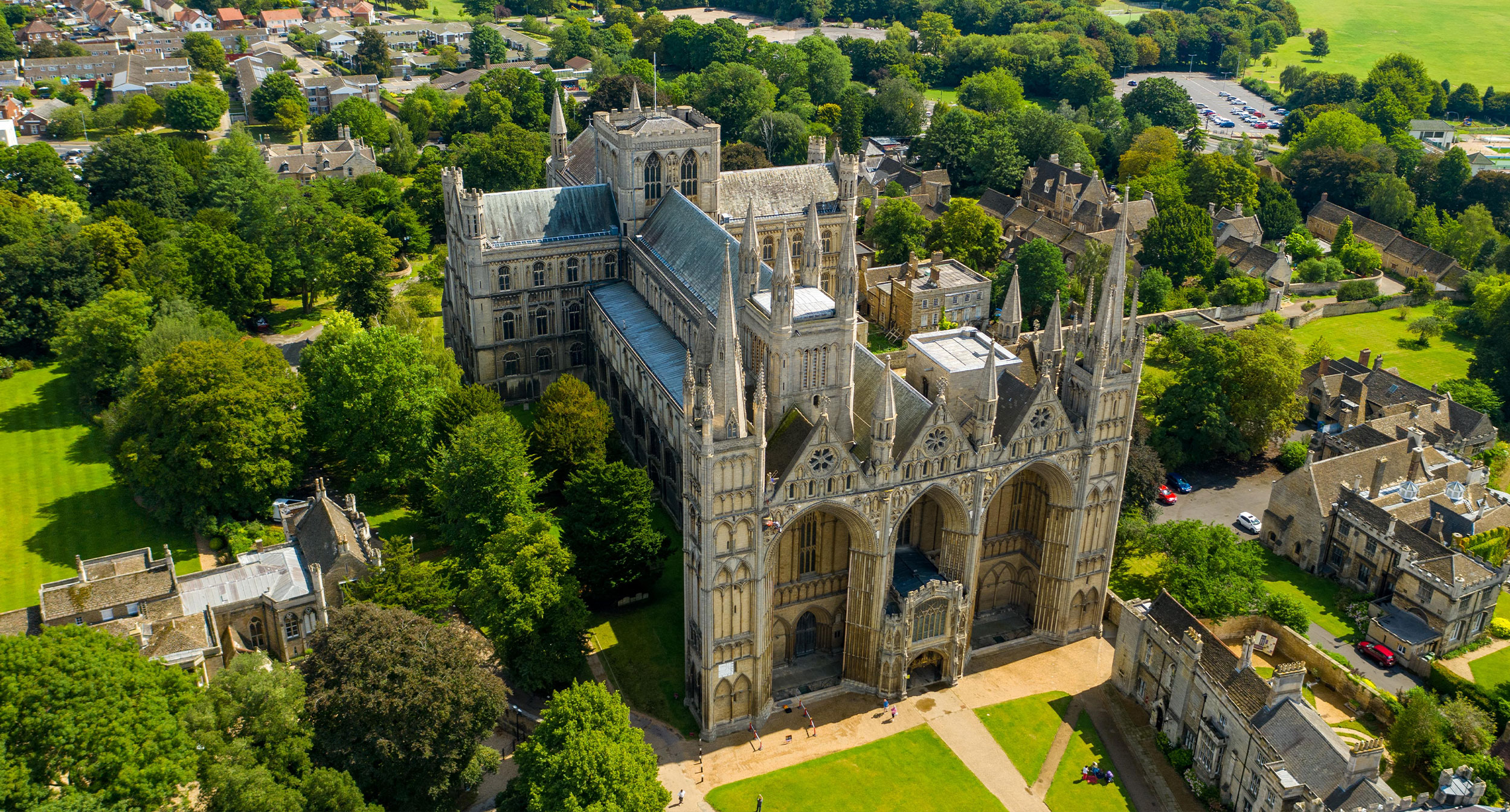
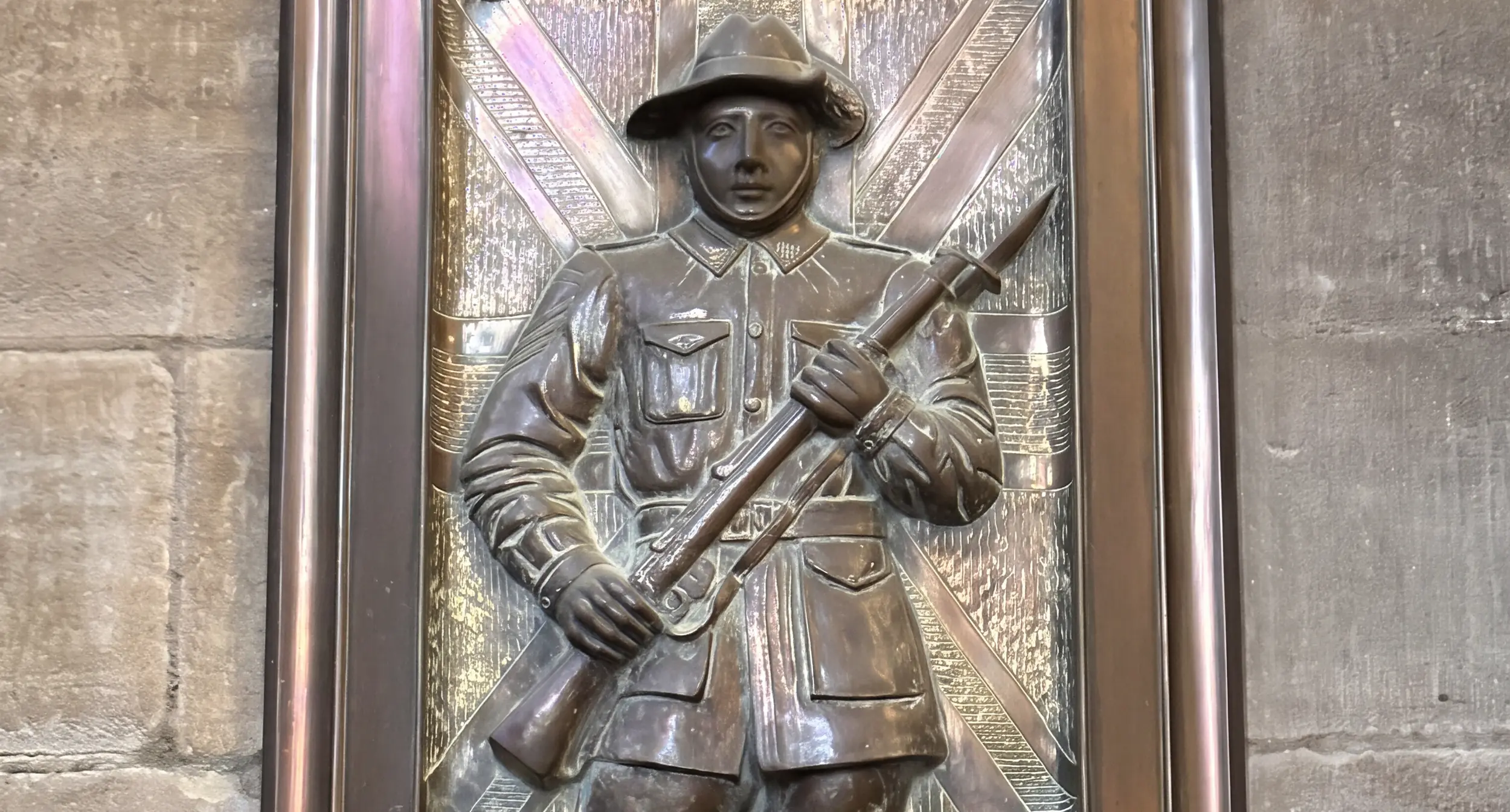
The bronze Cathedral memorial was designed with the figure of an armed Anzac sergeant standing against a Union flag. It was unveiled and dedicated on 15 December 1917 and can be found in a chapel near the Cathedral’s west end.
Its inscription describes the memorial as the gift of fellow citizens of the Empire and records that Hunter died at Peterborough Infirmary from wounds received in France. A plaster copy is also held by Peterborough Museum.
Hunter’s remembrance extended back to Australia. In 1932, the Mayor of Newcastle in New South Wales wrote to Peterborough expressing gratitude for the respect shown to him and asking that a wreath be placed on his grave.
Although the grave later deteriorated, it was restored and rededicated in 2000 through the efforts of the local Royal British Legion and community supporters. Peterborough historian John Walter Harvey subsequently brought the story to a wider audience through his 2003 book, The Lonely ANZAC: A True Son of Empire.
An Anzac Day service continues to be held at Hunter’s grave. The annual commemoration brings together local residents, school pupils, civic representatives, veterans’ organisations and members of the Australian military. In 2026, more than a century after his death, the community again gathered at Broadway Cemetery to remember him.
The “first Anzac” tradition
Peterborough accounts have frequently described Thomas Hunter as the first Anzac, or the first Australian soldier, to die on British soil. The description has become part of the traditional telling of his story, but it should not be presented as a settled historical fact.
Australian War Memorial records show that other members of the Australian Imperial Force died in Britain before July 1916. Private Hugh James Mullen of the 14th Battalion, for example, died in Birmingham on 19 May 1915.
Hunter’s importance does not depend upon an uncertain claim to have been first. What makes his story exceptional is the scale and endurance of Peterborough’s response to the death of a serviceman who had reached the city by chance.
The title “The Lonely Anzac” therefore remains meaningful when understood as a name created by local remembrance rather than a statement of chronological priority. It describes the way Peterborough saw him in 1916 and the place he has occupied in the city’s memory ever since.
The Grey Ghost
Hunter’s association with Peterborough Infirmary has also entered the city’s folklore. The former hospital, now Peterborough Museum and Art Gallery, has long been described as one of Peterborough’s most haunted buildings.
According to local legend, the apparition of a man dressed in grey or green clothing has been seen on the building’s staircases and corridors, sometimes carrying a suitcase. The figure has become known as the Grey Ghost and is frequently identified as Thomas Hunter.
There is, of course, no historical method by which that identification can be proven. The story is folklore rather than documented biography. Nevertheless, its persistence shows how closely Hunter’s memory has become attached to the building in which he spent the final hours of his life.
Why Thomas Hunter matters
Thomas Hunter’s connection with Peterborough lasted only a matter of hours, yet the city’s connection with him has endured for more than a century.
His biography links County Durham, New South Wales, Gallipoli, the Somme and Peterborough. It is a story of migration and industrial labour as well as military service: a coal miner who crossed the world, volunteered for the Australian Imperial Force, survived one campaign and was mortally wounded in another.
It is also a story about remembrance itself. Peterborough’s residents could not return Hunter to Australia or reunite him with his family, but they could give him a dignified funeral, a permanent memorial and a place within the community’s shared history.
The nickname “The Lonely Anzac” initially emphasised distance and isolation. Peterborough’s response transformed it into something else: the name of a stranger who was no longer alone.
Sergeant Thomas Hunter did not choose Peterborough as his destination. War and chance brought him to the city, but compassion ensured that his name remained here. His grave, Cathedral memorial and annual Anzac Day service continue to connect Peterborough with Australia and with the human cost of the First World War.
Thomas Hunter is buried in Peterborough Old Cemetery, commonly known as Broadway Cemetery, in plot 7.3.2249. His bronze memorial can also be seen inside Peterborough Cathedral, while the former infirmary in which he died is now Peterborough Museum and Art Gallery.