
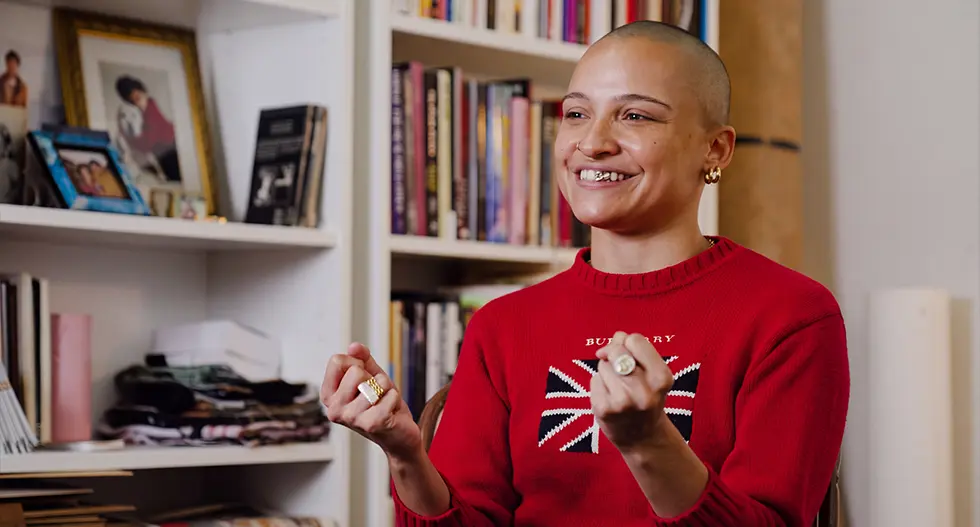
Born in Peterborough in 1997, Rene Matić is an internationally recognised artist, photographer, writer and poet whose work examines contemporary Britain through intimate images of family, friendship, subculture, faith and queer life.
Career in dates
- 1997 Born in Peterborough
- 2018 Begins the ongoing photographic series flags for countries that don’t exist but bodies that do
- 2019 Creates the film Brown Girl in the Art World III
- 2020 Graduates from Central Saint Martins and presents Born British Die British
- 2021 Included in Bloomberg New Contemporaries and presents a solo exhibition at Arcadia Missa
- 2022 Presents upon this rock at South London Gallery and soul time at Studio Voltaire
- 2023 Presents a girl for the living room at the Martin Parr Foundation
- 2024 Opens AS OPPOSED TO THE TRUTH at CCA Berlin
- 2025 Shortlisted for the Turner Prize
- 2026 Wins the Deutsche Börse Photography Foundation Prize
Peterborough beginnings
Rene Matić was born in Peterborough in 1997. Their earliest experiences of family, identity and British life were formed in a city shaped by migration, working-class culture and the meeting of different communities.
Matić has spoken openly about their mixed Black, white, Irish and Saint Lucian heritage. Their personal and family histories contain many of the questions that would later become central to their art: who is permitted to belong, how national identity is constructed, and how people create home when inherited categories cannot adequately contain them.
Peterborough appears in this story as more than a birthplace. The city is connected to the experiences of Matić’s father, Paul, whose life and family history later became the subject of one of the artist’s most personal films.
That local family history sits within a much wider British story involving race, class, religion, migration and post-war youth culture. Matić’s work repeatedly moves between these different scales, connecting a photograph of one person or household with larger questions about the country in which that life is unfolding.
Finding an artistic language
Matić moved to London as a young adult and studied at Central Saint Martins, part of University of the Arts London. Although initially interested in fashion, they increasingly recognised that fine art offered the freedom to bring photography, writing, moving image, performance and installation together.
They graduated with a BA in Fine Art in 2020. Their student years coincided with the development of an artistic practice rooted in personal experience but alert to the political forces surrounding it.
Institutional descriptions of Matić’s work frequently refer to post-Blackness, glitch feminism and subcultural theory. In practice, these ideas allow them to challenge categories that appear stable but are internally contradictory: Black and white, masculine and feminine, patriot and outsider, religious and rebellious, private and political.
Matić uses the term rude(ness) to describe the meeting place within their practice. It suggests both interruption and an insistence on occupying the spaces between identities. Rather than resolving contradiction, their work makes room for it.
This is an art of the in-between: intimate without being detached from politics, documentary without claiming complete neutrality, and personal without presenting identity as simple or fixed.
Photography as a living diary
Photography sits at the centre of Matić’s practice, although their work extends across film, sculpture, textiles, sound, found objects and poetry. Their photographs often resemble snapshots: direct, immediate images made during ordinary encounters with friends, family members, partners and strangers.
This apparent informality is carefully considered. Matić records gestures, clothing, domestic rooms, celebrations, streets, flags, tattoos, hairstyles and moments of physical closeness. When the images are placed together, relationships emerge between bodies, objects and symbols that might otherwise seem unconnected.
The ongoing series flags for countries that don’t exist but bodies that do, begun in 2018, operates as both a personal diary and a changing portrait of Britain. It documents Matić’s biological and chosen family while examining how race, nationality, gender and belonging are expressed through everyday life.
The series does not follow a conventional linear narrative. Photographs accumulate over time, forming new conversations whenever they are selected and rearranged for an exhibition. A family portrait may appear alongside a national flag, a street sign, a religious image or a moment in a club.
The resulting installations are autobiographical but never solely about the artist. They ask how individual lives are shaped by histories and systems that long predate them.
The 2019 film Brown Girl in the Art World III, now held by the Arts Council Collection, shows Matić dancing alone outside a pub in Skegness. Dance becomes a means of expressing an internal conversation between identity, body and place while also confronting the gaze of the surrounding world.
Reframing Britishness
Ideas of Britishness recur throughout Matić’s work. Flags, slogans, military commemorations, seaside towns and national rituals appear beside images of Black and queer life. The artist treats these symbols neither as neutral nor as belonging permanently to one political position.
A flag can offer solidarity and collective identity, but it can also exclude, intimidate or conceal violence. Matić uses this instability to explore the gap between the ideal of national belonging and the experience of people who are repeatedly treated as outsiders.
The phrase Born British Die British became an important element within their early work. Matić encountered the slogan through historical photographs of far-right skinheads and had it tattooed across their own back.
Placed upon the body of a queer, mixed-race British artist, the words cease to operate straightforwardly as a nationalist declaration. They instead expose the contradiction of a country that can claim people as British while continuing to question their presence, loyalty or right to belong.
Matić’s work does not offer a simple rejection of Britishness. It examines the emotional and political complexity of wanting to belong to something that can also be a source of exclusion. Love, frustration, identification and resistance coexist within the same images.
Music, dance and subculture
Music and youth culture provide Matić with alternative histories of Britain. Their work draws upon Northern soul, ska, reggae, punk, 2 Tone and the original skinhead movement, as well as queer dance and club cultures.
The first skinheads emerged during the 1960s from exchanges between Caribbean and white working-class young people. Jamaican music, rude-boy style and British working-class fashion came together within a subculture that was initially multiracial.
Parts of the movement were subsequently appropriated by racist and far-right groups, profoundly changing the public meaning of the skinhead image. Matić returns to this contested history to recover the intimacies and cultural exchange that existed before, during and alongside that appropriation.
The subject also has a family dimension. Matić’s father was involved in skinhead culture during his youth. Photographs, music and memories of that period became part of the artist’s investigation into their own inheritance.
For Matić, subculture can provide forms of knowledge and belonging that conventional institutions fail to offer. Music, clothing, dancing and collective style allow people to recognise one another, construct family and find moments of freedom.
At the same time, subcultures are not romanticised as uncomplicated refuges. They can reproduce conflict and exclusion as readily as they can create community. It is this instability that makes them so important within Matić’s work.
Family, faith and acts of care
Family is one of the most powerful threads running through Matić’s practice. Their work embraces biological relatives, partners, friends and chosen family, presenting care as something people actively create rather than simply inherit.
The 2022 exhibition upon this rock at South London Gallery brought family history into dialogue with skinhead imagery, Catholicism, persecution and spiritual belief.
At its centre was Many Rivers, a film about Matić’s father, Paul. The work explored the gaps and losses within his family history and considered how abandonment, racism and religious judgement can pass between generations.
Rather than presenting Paul merely as the subject of a documentary, Matić approached the film as a gesture of love and an attempt to give shape to a story marked by absence. It asked what might offer protection or salvation when family and social institutions have failed.
The exhibition also used the figure of the crucified skinhead, bringing a symbol of subcultural alienation into conversation with Christian suffering. Faith and youth culture appeared as parallel systems capable of offering identity, discipline and community.
Another ongoing work, Restoration, consists of Black dolls collected by Matić from second-hand shops, online sellers and other sources. Many have been damaged, neglected or discarded.
Matić cleans, dresses and cares for the dolls, but does not conceal all the evidence of damage. The work acknowledges both the necessity of care and the impossibility of completely repairing every inherited hurt.
In 2023, a girl for the living room at the Martin Parr Foundation presented a series of portraits of the writer and performer Travis Alabanza. The photographs documented a friendship becoming more intimate, shifting from public and nocturnal spaces into the softer light of domestic life.
From London to Berlin, Vienna and New York
Matić’s career developed quickly after their graduation. Early solo presentations included Born British Die British and an exhibition of flags for countries that don’t exist but bodies that do at Arcadia Missa.
They were selected for Bloomberg New Contemporaries in 2021, an important platform for emerging artists in the United Kingdom. In 2022, soul time at Studio Voltaire and upon this rock at South London Gallery established Matić as a distinctive voice within British contemporary art.
The South London Gallery exhibition subsequently travelled in a new form to Kunstverein Gartenhaus in Vienna. Matić later presented JAZZ with Oscar Murillo at Kunsthalle Wien and held exhibitions at Chapter NY in New York.
Their first institutional solo exhibition in Germany, AS OPPOSED TO THE TRUTH, opened at CCA Berlin in November 2024. It brought together newly produced photographs, installations, collected objects, flags and sound.
The exhibition examined the contrast between public declarations of compassion and the violence that political systems may continue to permit or conceal. Against a background of resurgent right-wing populism, Matić turned towards intimate relationships as places of resistance.
Photographs of friends, family, lovers and everyday encounters appeared beside damaged dolls, political language and national symbols. Care and vulnerability were not treated as retreats from politics but as ways of surviving and opposing its cruelties.
The Turner Prize and international recognition
In April 2025, Matić was shortlisted for the Turner Prize for AS OPPOSED TO THE TRUTH. At the time, they were the second-youngest artist to have been nominated for the prize, after Damien Hirst.
The shortlisted exhibition was presented at Cartwright Hall Art Gallery as part of Bradford 2025 UK City of Culture. Matić’s installation included photography, sound, flags and the collected dolls forming Restoration.
The Turner Prize brought their work to a considerably wider audience. Although Nnena Kalu was named the 2025 winner, Matić’s place on the shortlist confirmed their position among the leading artists of their generation.
A further major distinction followed in May 2026, when Matić won the Deutsche Börse Photography Foundation Prize. The £30,000 award recognised AS OPPOSED TO THE TRUTH and the artist’s fluid, experimental use of photography within a wider installation practice.
The award is one of the most significant international prizes devoted to contemporary photography. Matić’s success placed a Peterborough-born artist at the centre of international discussion about the changing possibilities of the photographic image.
Their work is now held in prominent public and private collections, including Tate, the Arts Council Collection, the UK Government Art Collection, Fondation Louis Vuitton and South London Gallery.
Rene Matić and Peterborough
Matić’s career adds an important contemporary voice to Peterborough’s cultural history. Their work is internationally exhibited, but the questions it asks about belonging, migration, family and British identity have a particular resonance in their home city.
Peterborough is one of Britain’s most diverse and rapidly changing cities. Its communities have been shaped by successive movements of people, by industrial and working-class life, and by the everyday negotiation of multiple identities.
Matić’s work resists the idea that these identities must be simplified to become understandable. Instead, they show that contradiction can itself be meaningful: a person can experience attachment and alienation, faith and doubt, vulnerability and defiance at the same time.
Their photographs are frequently tender, but that tenderness is never politically passive. By recording friendship, touch, domestic life and chosen family, Matić makes visible the relationships through which people sustain one another.
Recognition through the Turner Prize and Deutsche Börse Photography Foundation Prize has made Matić one of the most internationally prominent contemporary artists born in Peterborough. Their continuing career demonstrates that the city’s creative story does not belong solely to the past.
Through photographs of bodies, homes, friendships and contested symbols, Rene Matić creates a portrait of Britain from its edges and in-between spaces, revealing belonging not as something granted, but as something people make together.