
Belsize Avenue · a figure in black · a memory that lasted
The Woman in Black
of Woodston
In 1973, a Woodston eyewitness told a local reporter about a woman people had been seeing since 1908. Sixty-five years had passed, but the story had not disappeared. It had attached itself to an ordinary street and stayed there.
This ghost belongs to an ordinary Peterborough street.
That is what makes the Woman in Black of Woodston unsettling. There is no dramatic ruin to do the work for the story. Belsize Avenue is a residential street of houses, gardens, pavements and everyday journeys.
According to the story preserved in Woodston, sightings began in 1908. A woman dressed in black was seen in the neighbourhood and became associated with a poor local woman who had lived around Belsize Avenue.
The important surviving testimony came much later. In 1973, somebody who remembered the story spoke to a local reporter. By then two generations had passed since the first reported appearances.
Yet people were apparently still discussing who the woman had been, where she had lived and why she might have returned.
That long memory is the real heart of the story.
The date 1973 matters just as much as 1908.
The surviving version of the story is retrospective. An eyewitness was looking backwards across sixty-five years and telling a reporter what Woodston had remembered.
That does not make the testimony worthless. Oral history can preserve extraordinary details that formal records ignore. It can tell us what frightened people, which streets acquired reputations and how a community explained something it could not understand.
But memory changes.
Details become compressed. Stories heard from neighbours can merge with things personally witnessed. Later explanations can become attached to earlier sightings until nobody is quite sure which part came first.
That is particularly important here because the account apparently supplied both a ghost and a backstory for her. The woman was remembered as poor, local and associated with Belsize Avenue.
In 1973, somebody explained what it meant.
Those are not necessarily the same historical event.
The sightings may have happened exactly as remembered. The identity attached to the figure may have been correct. Or a local story may gradually have supplied a name and motive to something that originally had neither.
The evidence currently available does not allow us to choose confidently between those possibilities.
The 1973 local press account is central to the Woodston tradition. Until the original clipping and its full wording are located and checked against contemporary records from 1908, the safest description is a later eyewitness account of an older local haunting.
A poor woman became the explanation for a dark figure.
The local account linked the apparition with a woman who had lived in or around Belsize Avenue, described by the later witness as one of the poorest parts of Woodston at the time.
That description should itself be treated as memory rather than a formal judgement on the street. What matters is how the witness remembered the neighbourhood: close-knit, working, unequal and full of people who knew one another's circumstances.
In that setting a woman repeatedly dressed in black did not need to be anonymous for long.
Once people believed they recognised the figure, an unexplained sighting became a story about a particular life. The ghost was no longer simply something dark seen on the road. She had a past.
That is often the point at which a haunting becomes folklore. The apparition acquires identity, motive and memory.
Then somebody says they know who she is.
The difficulty is that the later explanation is much easier to remember than the original uncertainty.
We therefore should not present the claimed identity of the Woman in Black as proven biography. It belongs to the Woodston tradition surrounding the sightings.
That distinction does not weaken the story. It shows us how communities turn an unexplained encounter into something that can be retold.
In 1908, this part of Peterborough was changing fast.
The Woman in Black belongs to a Woodston very different from the suburban streetscape visible today.
Woodston had begun as a settlement south of the Nene with a history stretching back well before the Norman Conquest. By the late nineteenth and early twentieth centuries, however, the area was being transformed by Peterborough's industrial expansion.
Terraced housing spread through the old settlement. Industry, railways and the growing city pulled workers and families into the streets south of the river.
Belsize Avenue belongs to that changing landscape. Early twentieth-century records place working families there, and much of the surviving street is characteristic of the period when Woodston was expanding rapidly.
It is a useful reminder that a ghost story from 1908 did not happen in the picturesque rural Woodston of centuries earlier. It belongs to an urbanising working community.
New streets.
One story that refused to move on.
That setting helps explain the durability of the tale. Streets such as Belsize Avenue were social spaces as much as routes. People walked to work, shops, school, church and one another's houses. A recurring figure could quickly become part of neighbourhood conversation.
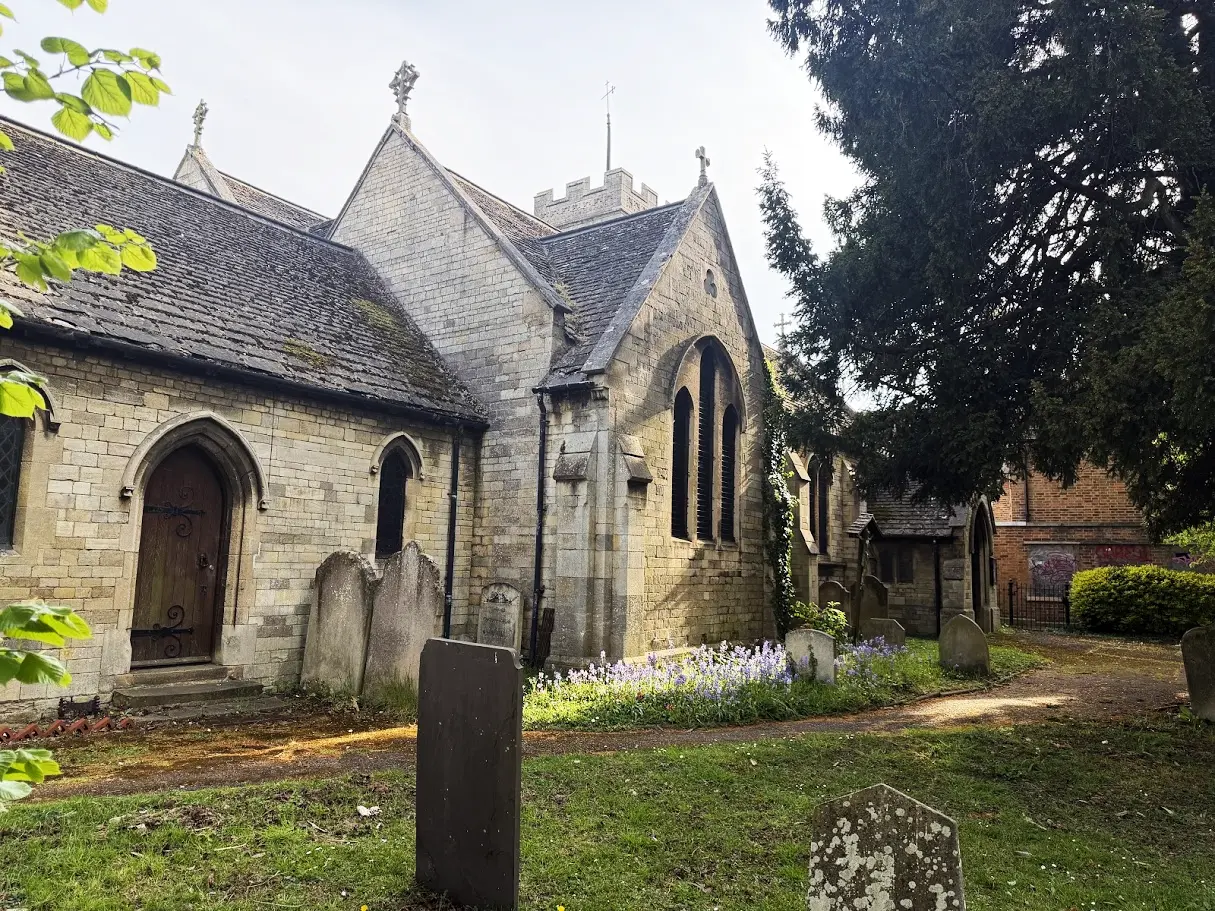
St Augustine has watched this neighbourhood change for centuries.
A short distance from Belsize Avenue stands one of Peterborough's least appreciated ancient buildings. St Augustine of Canterbury Church carries Woodston's history back far beyond the ghost story.
The church is Grade I listed. Its west tower preserves Anglo-Saxon masonry, including a small double-splayed window, while Norman twin bell openings remain above it.
A church and priest at Woodston were recorded in the Domesday landscape, and archaeological work confirms that the medieval settlement was centred around St Augustine's. Much of the later church was rebuilt during the nineteenth century, but the ancient fabric remained embedded within it.
That makes St Augustine's a useful physical anchor for the story. The Woman in Black belongs to twentieth-century Woodston, but she appeared in a neighbourhood whose memory was already many centuries deep.
Old churches naturally attract ghost stories, but there is an important distinction here.
The surviving Woodston tradition places the Woman in Black around Belsize Avenue, not inside St Augustine's Church.
St Augustine's is included because it is the outstanding surviving landmark of historic Woodston. We have not found reliable evidence linking the Woman in Black directly with the church or churchyard, so this page does not invent one.
The landscape is easier to prove than the ghost.
Woodston is unusually well documented as a place. The haunting is much harder.
We can verify the ancient settlement, the historic church, the industrial growth of Woodston and the existence of Belsize Avenue as part of its early twentieth-century residential landscape.
We can also say that the Woman in Black story was sufficiently established to be retold to a local reporter in 1973 and has remained part of Peterborough folklore since.
What we cannot currently verify is more important.
We do not have a contemporary 1908 newspaper report in front of us documenting the first appearance. We cannot securely identify the woman said to have inspired the ghost. We cannot establish how many people independently witnessed the figure, or how much of the final story had developed before the 1973 interview.
Nor can we establish a supernatural cause for any sighting.
A page like this does not need to prove that a ghost existed. Its job is to preserve the tradition accurately, identify what the evidence supports and avoid turning later explanation into documented fact.
Sixty-five years is enough time for a story to change shape.
Imagine a figure seen at dusk on a street where almost everybody walks and many people know one another. Someone mentions it at home. Somebody else has heard something similar. A third person knows exactly who it must have been.
The next sighting does not begin from zero. The witness now knows what other people saw.
A dark coat can become mourning clothes. An indistinct figure can become a woman. A woman can acquire a remembered address. Once the neighbourhood agrees on the story, new sightings are interpreted through everything already known.
None of this requires deliberate invention.
Human memory is social. We remember our own experiences beside the accounts other people tell us, and over long periods the boundary between the two can become difficult to reconstruct.
without every detail being historically exact.
That is why the 1973 witness matters so much. The testimony is evidence not only for what may have been seen, but for what Woodston still believed worth remembering.
By then the Woman in Black had survived longer than many of the buildings and people who had first known the tale.
Twenty years later, Garton End gives us a very different kind of evidence.
Peterborough's 1926 Garton End ghost is useful because the sightings reached the press while people were still seeing the mysterious black-clad figure.
Named witnesses described what they had encountered on the lane between Dogsthorpe and Garton End. Their accounts can therefore be studied much closer to the events themselves.
Woodston is different.
Its surviving story reaches us principally through memory many decades later. That means we should resist borrowing the evidential confidence of the Garton End case and applying it here.
Together, though, the two stories reveal something fascinating. Twentieth-century Peterborough generated ghost traditions not only in castles and medieval churches, but on ordinary roads through neighbourhoods people used every day.
There is nothing theatrical about Belsize Avenue.
That is precisely why it works as a folklore location. The street is still there and people still live their ordinary lives along it.
There is no official ghost marker, no surviving house we can confidently identify as belonging to the woman and no point where we can say a particular apparition definitely occurred.
Walk the street and what you find is a residential part of Peterborough shaped largely by the twentieth century.
Then continue towards Oundle Road and St Augustine's Church. The contrast is striking. Within a short walk, the landscape moves from early twentieth-century terraces back into a site containing masonry from before the Norman Conquest.
The ghost story occupies the space between those two kinds of history: the ancient settlement and the remembered lives of modern Woodston.
Walk Belsize Avenue in daylight and notice how ordinary it is. That is the point. This remains a residential street, so do not photograph residents, peer into homes or gardens, or try to identify a particular house as the ghost's home. If visiting St Augustine's, check its current access arrangements before travelling.
Perhaps the sixty-five-year gap is not a weakness. Perhaps it is the story.
Most moments in an ordinary street disappear almost as soon as they happen. This one apparently did not.
Somebody saw a figure. Other people talked about her. A local explanation developed. Children grew older. Houses changed hands. Woodston changed around them.
Then, in 1973, somebody was still willing to sit down with a reporter and tell the story.
That persistence is more historically interesting than a confident claim that the apparition was the spirit of one identifiable woman.
Folklore is often the history of what a community refuses to forget.
The Woman in Black survives because an ordinary Woodston street acquired an extraordinary memory, and because people kept passing it on long after the supposed first witness had walked home.
1973: the story is still being told.
Woodston remembers.
Not every haunting survives in the same way.
Compare Woodston's long community memory with contemporary witness reports, documented violence and older traditions preserved around Peterborough.
The Garton End Ghost
In 1926 a black-hooded figure frightened people away from a lane between Dogsthorpe and Garton End, leaving us with much closer contemporary testimony.
Enter the story → 02 · HISTORY BECOMES HAUNTINGThe Ghost of Woodcroft Castle
At Woodcroft, the supernatural tradition grew around a violent death that can be placed firmly within the Civil War history of the building.
Enter Woodcroft → 03 · A HOUSEHOLD GHOSTButton Cap
Barnack's rectory ghost was remembered through footsteps, loose slippers, turning pages and the testimony of a household that claimed to know his habits.
Meet Button Cap → 04 · SEEING THE DEADSt Mark's Eve
At Paston, an old calendar belief said that the coming year's marriages and funerals could be seen passing through a churchyard on one particular night.
Enter the churchyard story →More Peterborough Folklore
Black figures, household ghosts, old warnings and unexplained encounters from across Peterborough.
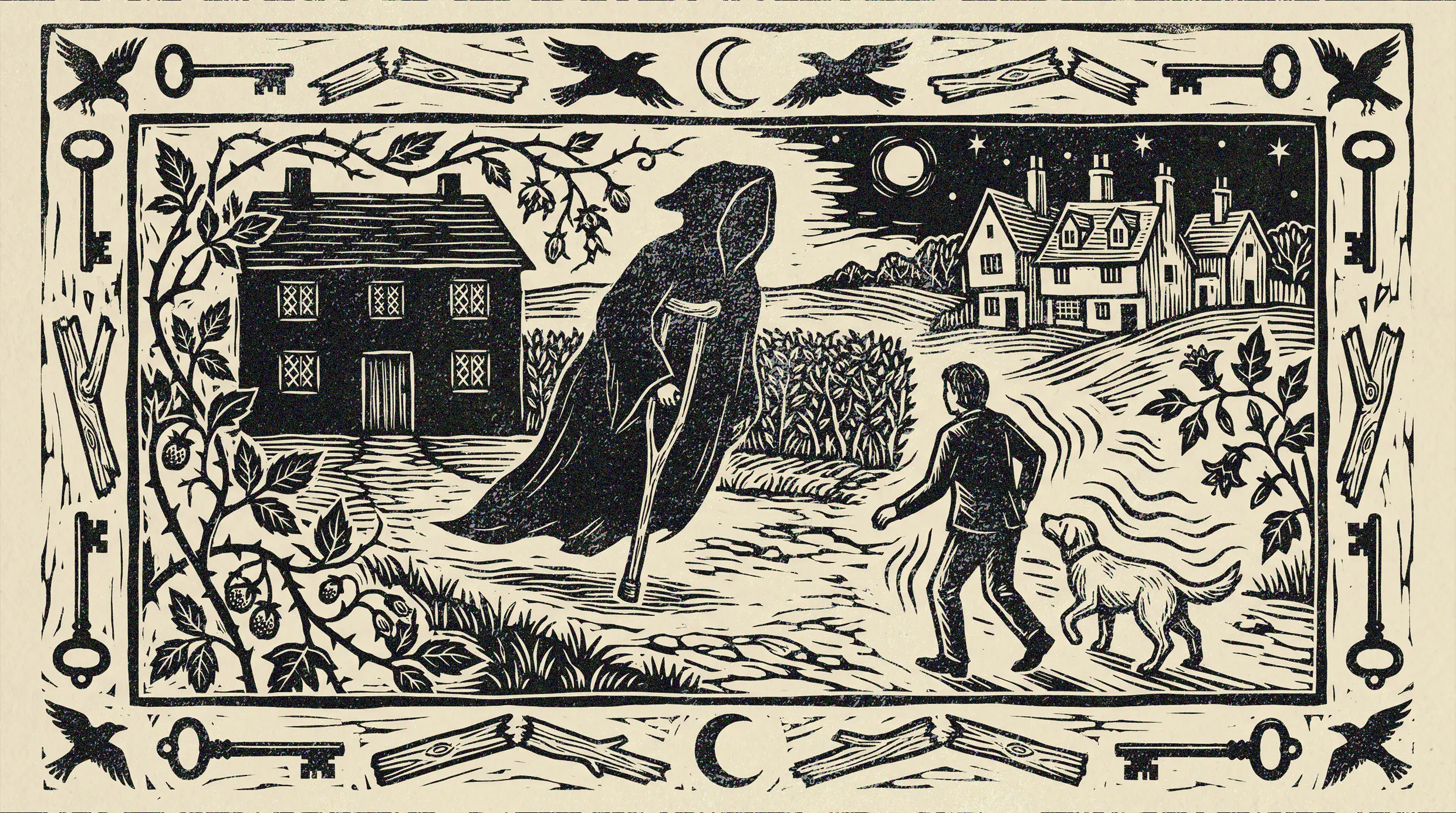
The Garton End Ghost
A black-hooded figure appeared repeatedly on an ordinary lane, frightening children and adults away from the road.
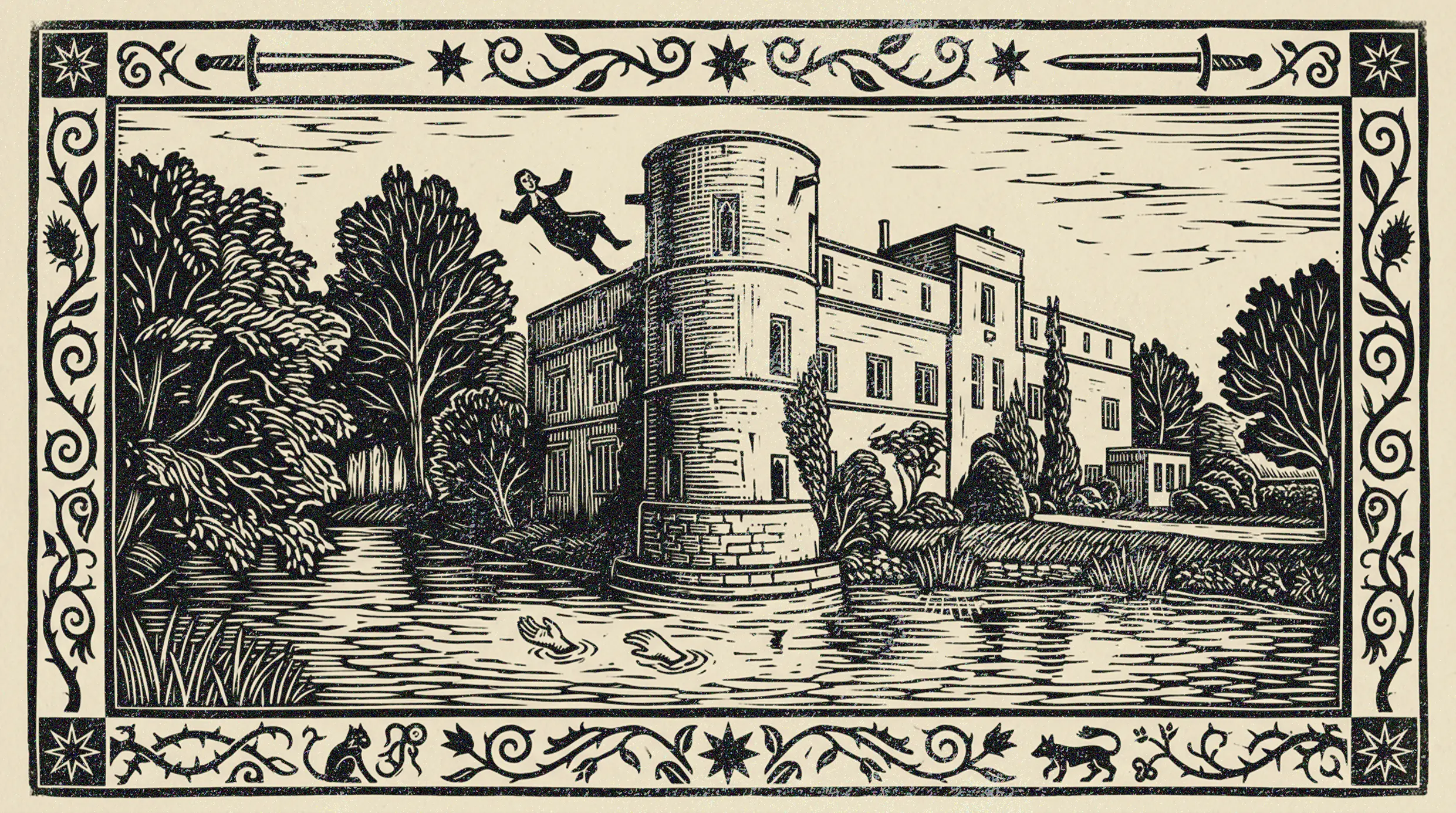
The Ghost of Woodcroft Castle
A violent death in 1648 left behind one of Peterborough's strongest traditions of cries and conflict returning to the place where they happened.
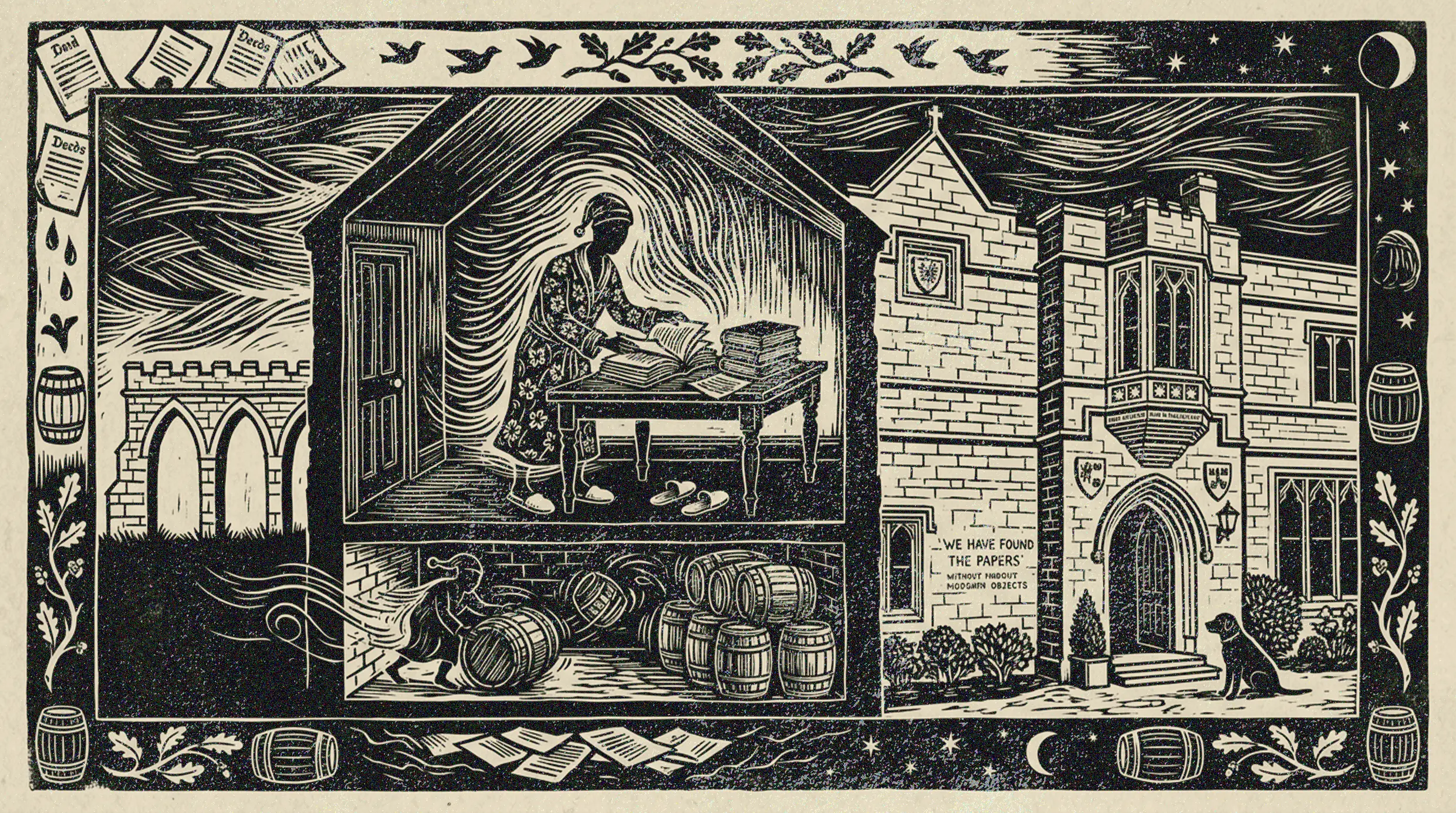
Button Cap
Loose slippers crossed the rectory floor while unseen hands turned pages in a room the household had learned to avoid.
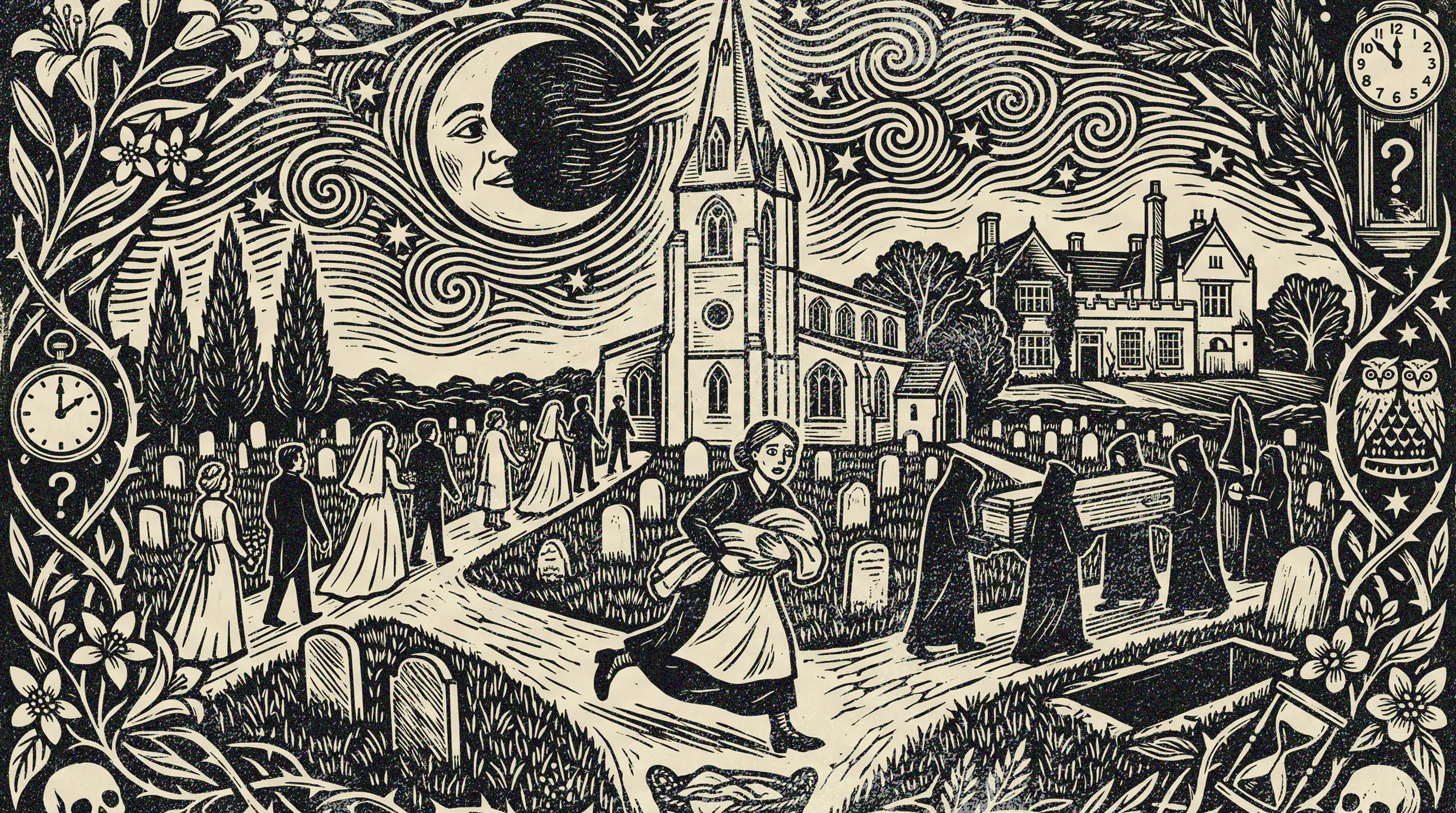
St Mark's Eve
One night each April was said to reveal who would marry and who would be buried before another year had passed.
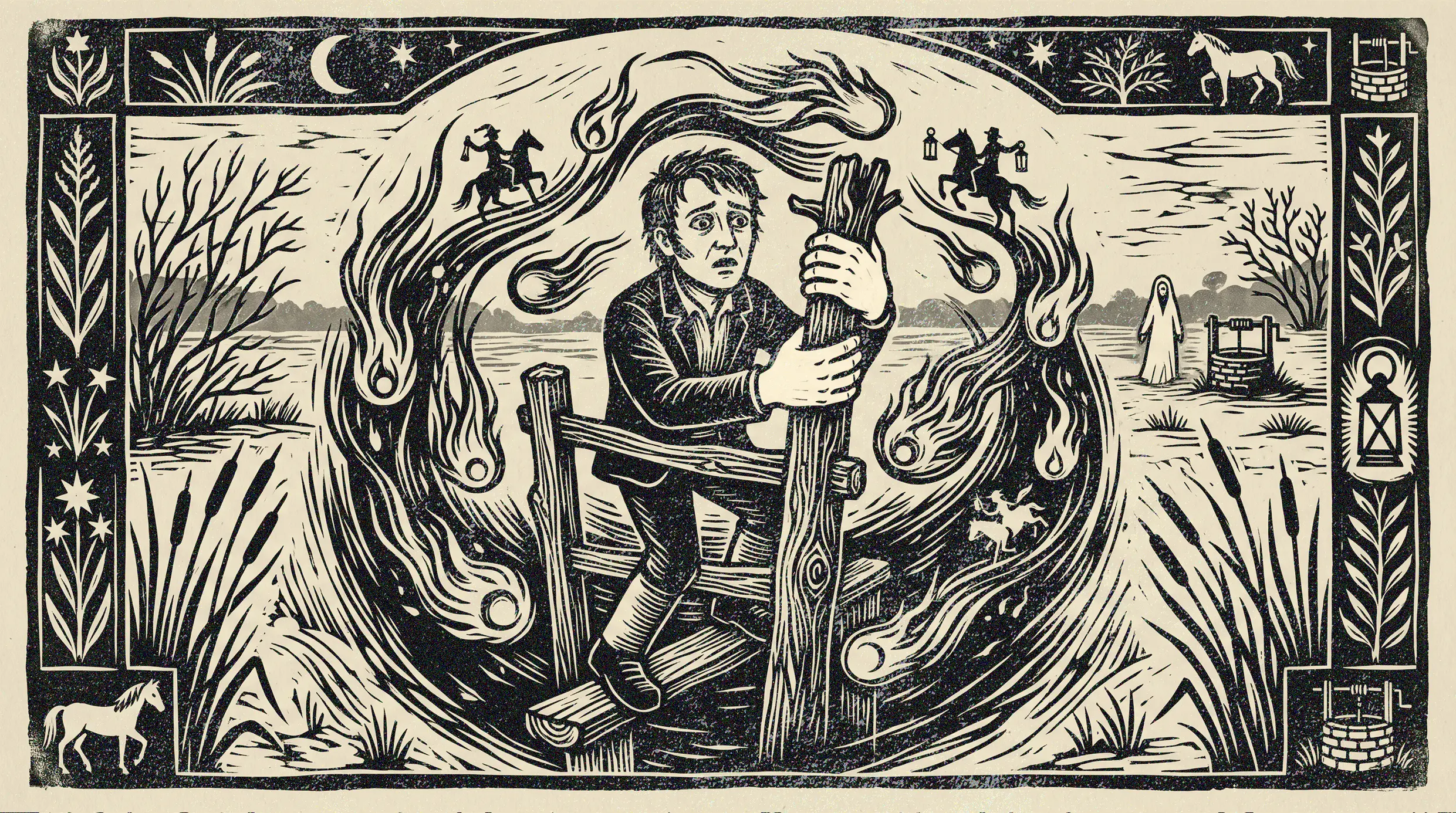
The Will-o'-the-Wisps
John Clare watched strange lights move through his familiar landscape and recorded exactly how frightening uncertainty could become.
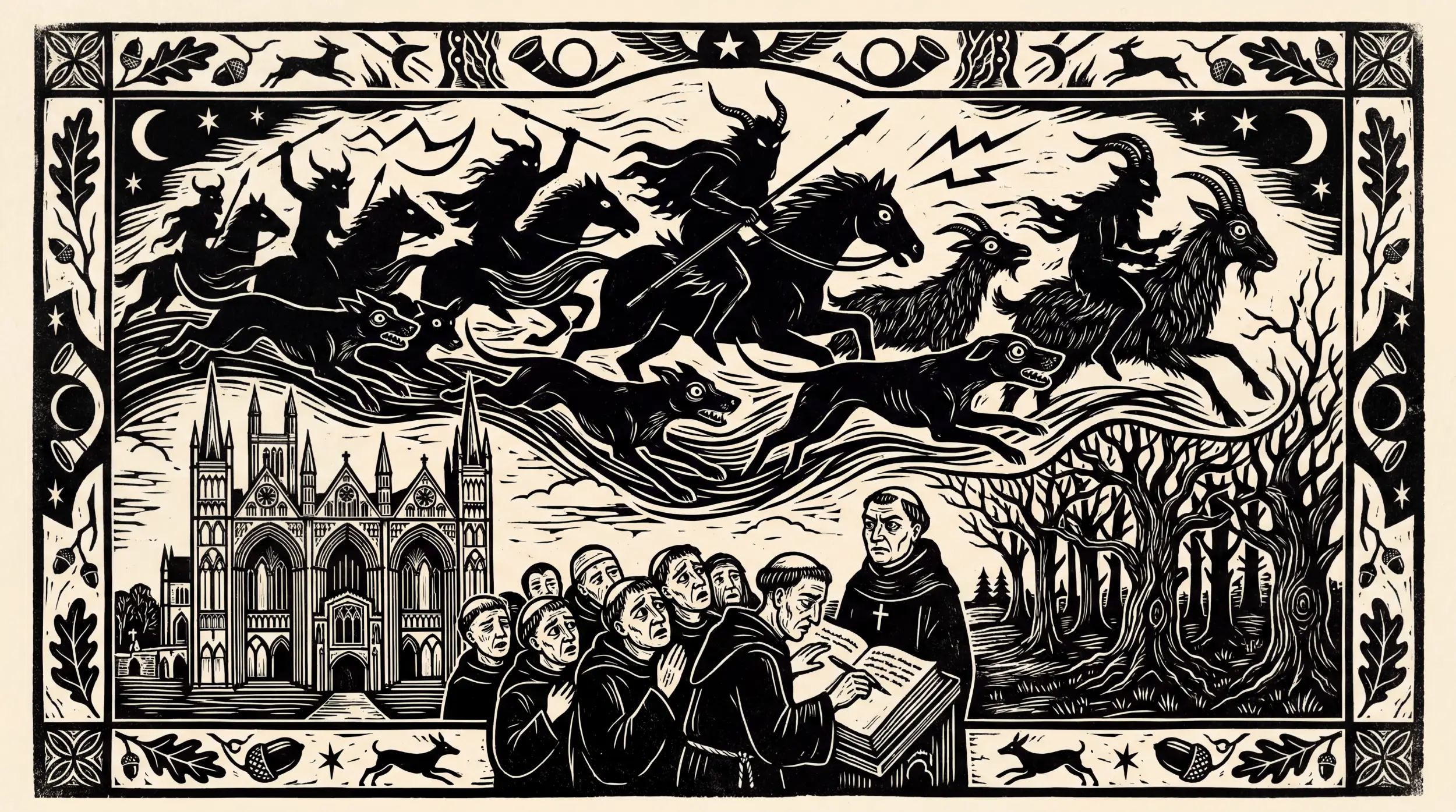
The Wild Hunt of 1127
Black riders, monstrous hounds and horns in the night were recorded by the monks of Peterborough nearly nine centuries before Woodston's ghost appeared.
Behind the Woman in Black
This page deliberately separates the later Woodston ghost tradition from independently documented history. The 1908 date and the woman's claimed identity come through retrospective local testimony, while the history of Woodston and St Augustine's can be supported through heritage and archaeological sources.
-
Local press testimony · 1973
The central source for the Woodston tradition is the retrospective account given to a local reporter in 1973, describing sightings said to have begun in 1908 and the local explanation attached to the Woman in Black. Until the original clipping is located and checked in full, this page treats it as retrospective testimony rather than a contemporary 1908 record. -
Discover Peterborough · Peterborough Folklore
The existing Discover Peterborough collection preserves the core local tradition: first sightings said to date from 1908, association with Belsize Avenue and the later eyewitness recollection recorded in 1973. -
Historic England · Church of St Augustine
Official Grade I listing record documenting the Anglo-Saxon masonry exposed in the west tower, the early double-splayed window, Norman bell openings and later phases of the church. -
Oxford Archaeology · Woodston historical background
Archaeological assessment summarising Woodston's early history, its pre-Conquest church, Domesday evidence, medieval settlement and later development south of Peterborough. -
A Vision of Britain Through Time · Woodston
Historical gazetteer evidence for Woodston before its absorption into modern Peterborough, including nineteenth-century population, settlement and parish information. -
Peterborough Images Archive · Woodston
Historic photographs and community material showing Belsize Avenue, Oundle Road and the changing twentieth-century neighbourhood in which the folklore was remembered. -
St Augustine of Canterbury · current church information
Current parish information and access status for St Augustine of Canterbury in Woodston. -
Discover Peterborough · The Garton End Ghost
A useful comparison with another twentieth-century Peterborough apparition whose reports were recorded much closer to the period of the alleged sightings. -
Discover Peterborough · Weird Weekends
Follow the Woman in Black and Peterborough's other unusual stories into the places where their traditions survive. -
Image credit
St Augustine of Canterbury Church, Woodston · Discover Peterborough.