
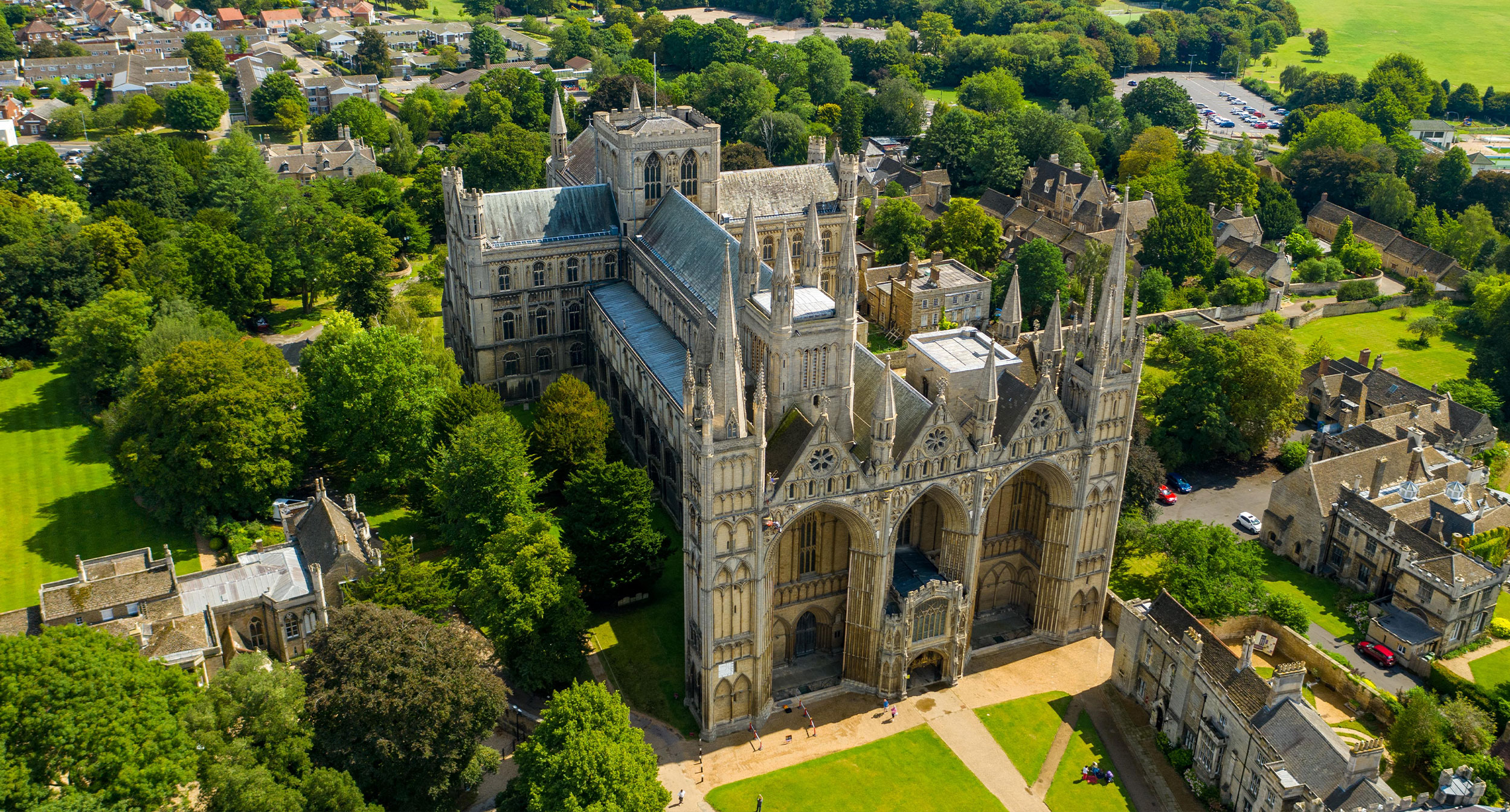


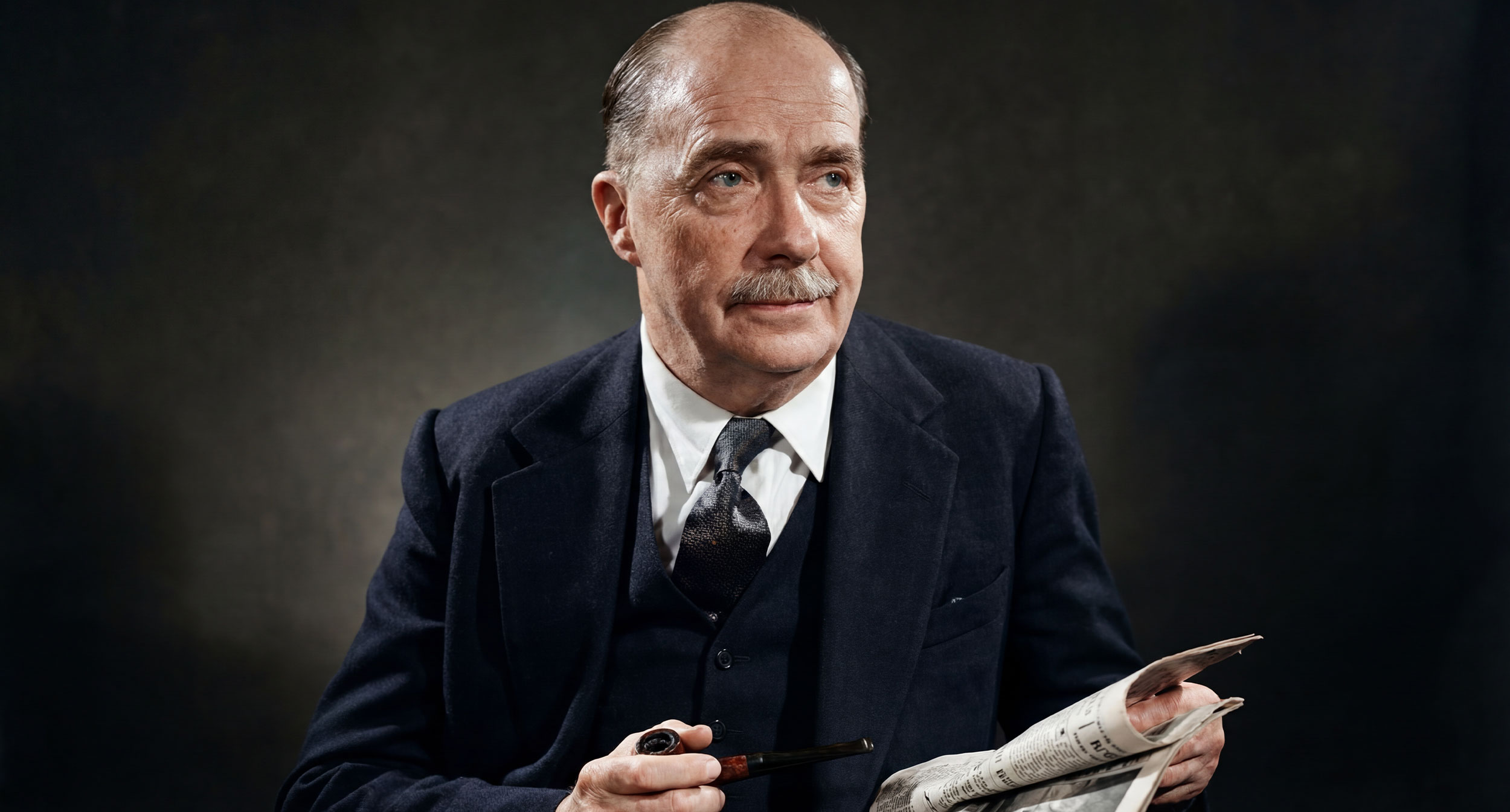
Born in Whittlesey and raised at Fletton Towers in Peterborough, L. P. Hartley became an award-winning novelist, critic and master of psychological unease. His most famous novel, The Go-Between, gave English literature one of its most enduring descriptions of the power of the past.
Life and career in dates
- 1895 Born in Whittlesey on 30 December
- 1900 The Hartley family moves to Fletton Towers in Peterborough
- 1908 Leaves home for preparatory school in Cliftonville
- 1910 Begins studying at Harrow School
- 1915 Enters Balliol College, Oxford, to read Modern History
- 1917 Commissioned as a second lieutenant in the Norfolk Regiment
- 1919 Returns to Oxford after being discharged on medical grounds
- 1924 Publishes his first story collection, Night Fears
- 1925 Publishes the Venetian novella Simonetta Perkins
- 1944 The Shrimp and the Anemone begins the Eustace and Hilda trilogy
- 1947 Eustace and Hilda wins the James Tait Black Memorial Prize
- 1953 The Go-Between establishes his international reputation
- 1956 Appointed Commander of the Order of the British Empire
- 1957 Publishes The Hireling
- 1960 Publishes the dystopian novel Facial Justice
- 1967 Publishes the critical essays The Novelist’s Responsibility
- 1971 The acclaimed film of The Go-Between wins the top prize at Cannes
- 1972 Named a Companion of Literature and dies in London on 13 December
- 1973 The film of The Hireling shares the Cannes festival’s top prize
From Whittlesey to Fletton Towers
Leslie Poles Hartley was born in Whittlesey on 30 December 1895. His father, Harry Bark Hartley, was a solicitor, magistrate, businessman and investor in the local brick industry. His mother, Mary Elizabeth Thompson, came from a farming family associated with Crowland.
Harry Hartley had purchased a legal practice in Whittlesey and opened an office in Peterborough. He also helped establish the Whittlesey Central Brick Company and became involved in the commercial and civic life of the rapidly expanding Peterborough area.
In 1900, when Leslie was four, the family moved to Fletton Towers in New Fletton. The large Tudor-style stone house had been built between 1841 and 1847 and resembled a small Victorian castle, complete with a central tower, corner turrets and high boundary walls.
Fletton Towers stood within a district being transformed by brickmaking, railway expansion and rows of new housing. Hartley therefore grew up inside an imposing and secluded house while industrial Peterborough developed immediately beyond its grounds.
It would be too simple to treat Fletton Towers as a direct model for the country houses in Hartley’s novels. Nevertheless, its contrast between protected private space and the changing world outside offers a striking real-life parallel with his later interest in class, exclusion and social boundaries.
Hartley was initially educated at home alongside his elder sister Enid. He read Edgar Allan Poe and began inventing stories while still a child, writing his first known tale at about eleven.
The relationship between Leslie and Enid became one of the formative emotional connections of his early life. Elements of their childhood would later be transformed into the relationship between the brother and sister at the centre of his Eustace and Hilda trilogy.
School, war and Oxford
In 1908, Hartley left home for Northdown Hill Preparatory School in Cliftonville, Kent. He subsequently spent a short period at Clifton College before entering Harrow School in 1910.
At Harrow he became a Leaf Scholar and won recognition for reading and English literature. He had been raised within his family’s Wesleyan Methodist faith but later became an Anglican. The Methodist emphasis on judgement, conscience and individual moral responsibility nevertheless remained visible in his writing.
Hartley entered Balliol College, Oxford, in 1915 to study Modern History. His university education was interrupted by the First World War. He joined the Army in 1916 and was commissioned as a second lieutenant in the Norfolk Regiment in February 1917.
A heart condition prevented him from serving overseas, and he was discharged without seeing active combat. He returned to Balliol in 1919 and completed his degree with second-class honours in 1921.
The war still marked Hartley’s generation profoundly. The confidence of the Edwardian world into which he had been born was shattered, and the divide between life before and after 1914 became central to his imagination. In his later fiction, childhood memory is frequently shadowed by the knowledge of what followed.
At Oxford, Hartley edited Oxford Outlook and began publishing poetry, criticism and short fiction. He also entered literary circles that included Aldous Huxley, Lord David Cecil, Lady Ottoline Morrell, Cynthia Asquith and other influential writers and patrons.
Book reviewing and elegant nightmares
Hartley’s first sustained professional work was as a literary critic. He reviewed extensively for publications including The Spectator, The Saturday Review, The Nation and Athenaeum and The Sketch.
Reviewing gave him an income and established his reputation as an informed, measured critic. It also consumed time he wanted to devote to fiction, and his progress towards becoming a novelist was comparatively slow.
His first book, Night Fears, appeared in 1924. This collection introduced a side of Hartley that can be overlooked by readers who know only The Go-Between: he was an accomplished writer of supernatural and macabre stories.
The novella Simonetta Perkins followed in 1925. Set in Venice, it explores infatuation, fantasy and emotional self-deception. Hartley had first visited Venice in the early 1920s, and the city became an important retreat and imaginative setting throughout his adult life.
Further supernatural stories appeared in The Killing Bottle in 1932 and The Travelling Grave and Other Stories in 1948. Rather than depending only on visible monsters, these tales introduce something disturbing into apparently civilised homes, social gatherings and relationships.
Hartley’s ghost stories share important qualities with his realist fiction. Both are concerned with concealed motives, guilty knowledge and the moment when a carefully maintained surface can no longer contain what lies beneath it.
The Eustace and Hilda breakthrough
Hartley was nearly fifty when the publication of The Shrimp and the Anemone in 1944 finally established him as a major novelist. It was followed by The Sixth Heaven in 1946 and Eustace and Hilda in 1947.
Together, the three books follow the emotionally dependent relationship between the sensitive Eustace Cherrington and his forceful elder sister Hilda from childhood into adult life.
The trilogy draws upon Hartley’s memories of his Edwardian upbringing and his closeness to his sister Enid without simply reproducing their lives. Its power lies in the gradual transformation of childhood attachment into a complicated mixture of love, obligation, dependence and resentment.
Hartley examines the damage caused when a person’s identity depends too heavily upon another’s approval. The siblings’ relationship becomes both a refuge and a trap, illustrating the tension between belonging and emotional independence that recurs throughout his fiction.
The final volume won the 1947 James Tait Black Memorial Prize for fiction, placing Hartley among the most highly regarded English novelists of the post-war period.
The Go-Between
Published in 1953, The Go-Between became Hartley’s defining novel. Its opening observation has passed far beyond the book itself:
“The past is a foreign country: they do things differently there.”
The narrator, Leo Colston, is an ageing man who discovers the diary he kept during the summer of 1900. Its contents force him to revisit memories he has suppressed for more than half a century.
As a twelve-year-old schoolboy, Leo had been invited to stay with his wealthier friend Marcus Maudsley at Brandham Hall in Norfolk. There he became fascinated by Marcus’s older sister Marian and was persuaded to carry secret messages between her and Ted Burgess, a tenant farmer.
Leo does not initially understand the relationship or the danger created by the difference in the lovers’ social positions. His role as their messenger draws him into a world of sexual secrecy, class expectation and adult dishonesty for which he is emotionally unprepared.
The novel is not simply a nostalgic portrait of a vanished country-house summer. The beauty of the setting is inseparable from manipulation, inequality and cruelty. Leo’s innocence makes him useful to the adults, but offers him no protection from the consequences of their actions.
There are autobiographical echoes. In 1909, at approximately Leo’s age, Hartley stayed at Bradenham Hall in Norfolk with a school friend and took part in a country-house cricket match. The names Bradenham and Brandham, and Moxley and Maudsley, invite comparison.
Hartley nevertheless resisted treating fiction as disguised autobiography. His childhood experience supplied imaginative material, but Leo’s story is a carefully constructed exploration of memory, trauma and the difficulty of interpreting one’s younger self.
The Go-Between received the W. H. Heinemann Foundation Prize and brought Hartley a much larger international readership. Its structure, divided between the ageing narrator and the vulnerable child he once was, remains one of its greatest achievements.
Hartley’s fictional world
Hartley belonged to the tradition of the psychological novel and the novel of manners. Critics have frequently connected his writing with Jane Austen, Henry James, Nathaniel Hawthorne and Emily Brontë.
His central characters are often sensitive outsiders who long to enter a more confident or privileged social world. Their desire to please others makes them vulnerable to manipulation, while their fear of judgement prevents honest action.
Children and adolescents interested Hartley because they stand between incomplete understanding and adult knowledge. They can recognise that something is wrong without possessing the language or experience needed to interpret it.
Class in Hartley’s fiction is not simply a matter of wealth. It operates through accents, clothing, manners, invitations, houses and rules that outsiders are expected to understand without being taught. A mistake can become a humiliation, and acceptance can be withdrawn as quickly as it was offered.
Desire is frequently communicated through silence, coded language and intermediaries. Contemporary critics have consequently explored queer dimensions within Hartley’s work, particularly its intense male relationships, fear of exposure and recurring division between private feeling and public respectability.
His late novel The Harness Room places male intimacy and same-sex desire closer to the surface. Across the wider body of work, however, Hartley’s concern extends to anyone whose emotional life conflicts with the identity society expects them to perform.
Later novels and critical writing
Hartley continued to range beyond the Edwardian childhood narratives for which he is best remembered. The Boat, published in 1949, considers the conflict between artistic independence and society’s demand for conformity during the Second World War.
The Hireling, published in 1957, examines the relationship between a chauffeur and a widowed aristocratic woman. Their growing emotional dependence crosses a class boundary that neither can negotiate safely.
Facial Justice, published in 1960, is a dystopian departure from his usual settings. In a society rebuilding after a catastrophic war, individuality and exceptional beauty are treated as threats to collective equality. The futuristic setting allowed Hartley to satirise conformity, state control and modern mass culture.
The Brickfield in 1964 and The Betrayal in 1966 continued his examination of memory, family and moral responsibility. Local literary researchers have identified possible models drawn from the countryside surrounding Peterborough, Crowland, Eye and Postland within The Brickfield, although these connections should be treated as interpretation rather than exact transcription.
In The Novelist’s Responsibility, published in 1967, Hartley set out his thoughts about fiction, morality and the writer’s relationship with readers. He argued for the novelist’s freedom to create an independent imaginative world while recognising the moral consequences of storytelling.
His later works included My Sister’s Keeper, The Harness Room and Mrs Carteret Receives. The quality and outlook of the later books varied, and Hartley’s unease with modern society became increasingly pronounced, but he continued writing almost until his death.
From page to screen
The most celebrated adaptation of Hartley’s work is Joseph Losey’s 1971 film of The Go-Between, with a screenplay by Harold Pinter.
The film starred Dominic Guard as Leo, Julie Christie as Marian and Alan Bates as Ted Burgess, alongside Margaret Leighton, Edward Fox and Michael Redgrave. Losey and Pinter sharpened the story’s examination of class, repression and the violence concealed beneath polite behaviour.
The production was filmed in Norfolk and received the Grand Prix International du Festival at Cannes, then the festival’s principal award. It remains one of the most acclaimed British literary adaptations of its period.
The Hireling was adapted for cinema by director Alan Bridges, with Robert Shaw and Sarah Miles in the leading roles. Released after Hartley’s death, it shared the top prize at the 1973 Cannes Film Festival.
The Go-Between has also been revisited through television, radio, theatre and musical adaptations. Each version returns to Hartley’s central dramatic device: a child carrying messages that he can read but cannot yet understand.
Death and Peterborough legacy
Hartley was appointed CBE in the 1956 New Year Honours for his work as an author and critic. In 1972, the Royal Society of Literature named him a Companion of Literature, its highest distinction.
He died of heart failure in London on 13 December 1972, seventeen days before his seventy-seventh birthday. He was cremated at Golders Green Crematorium.
His surviving archive demonstrates the breadth of his career. The L. P. Hartley Papers at the John Rylands Library include manuscripts, corrected proofs, personal and literary correspondence, reviews, broadcasts and material relating to the film of The Go-Between.
Peterborough’s claim to Hartley is particularly strong. He was born in Whittlesey within the present unitary authority and spent his childhood at Fletton Towers, now a Grade II listed building officially recognised as his childhood home.
His father’s work linked the family to Peterborough’s legal, political and brickmaking history, while the Hartley family remained associated with Fletton Towers long after Leslie left home.
In 2024, a large mural on Bread Street by Peterborough artist Nathan Murdoch brought Hartley’s image and most famous words into the contemporary cityscape. Together with Fletton Towers, it gives Peterborough two visible places through which to encounter his story.
Hartley’s novels rarely name Peterborough directly, but his writing repeatedly returns to concerns rooted in his childhood world: the boundary between home and society, the power of class, the fragility of belonging and the unsettling survival of the past within the present.
From a Victorian tower in industrial Fletton, Hartley developed a literary world in which the past never disappears: it waits to be reopened, reread and understood differently.