

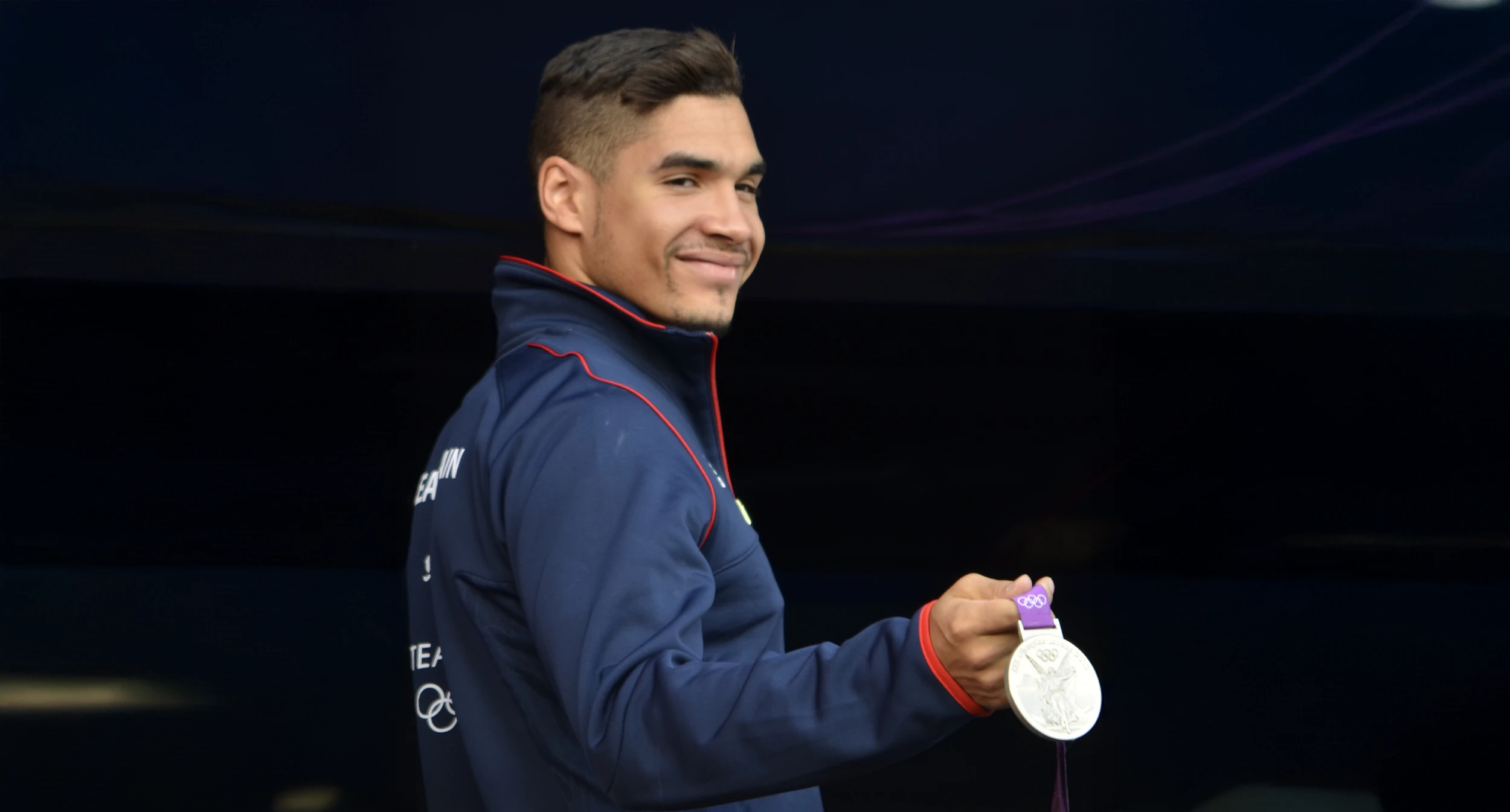
Peterborough-born Louis Smith MBE helped transform the fortunes and public profile of British men’s gymnastics, winning four Olympic medals and becoming one of the finest pommel horse specialists of his generation.
Life and career in dates
- 1989 Born in Peterborough on 22 April
- Age 4 Begins gymnastics in Peterborough
- 2004 Wins his first junior European pommel horse title
- 2006 Becomes Commonwealth pommel horse champion
- 2008 Wins historic Olympic bronze in Beijing
- 2012 Wins Olympic team bronze and pommel silver in London
- 2013 Appointed MBE for services to gymnastics
- 2015 Becomes European pommel horse champion
- 2016 Takes a second Olympic pommel silver in Rio
- 2018 Retires from competitive gymnastics
- 2021 Wins the first series of The Masked Dancer
- 2026 Tours the UK in the stage show Jukebox Idols
Growing up in Eye
Louis Antoine Smith was born in Peterborough on 22 April 1989 and grew up in the nearby village of Eye. He began gymnastics at the age of four after following his older brother into the sport.
Smith was diagnosed with attention deficit hyperactivity disorder, or ADHD, during childhood. His mother, Elaine, encouraged him to try different sports as a constructive outlet for his energy, but it was gymnastics that captured his attention and gave him the discipline on which his later career was built.
At seven, he began training at Huntingdon Gymnastics Club. Reaching the club required long journeys from Peterborough, initially made with his mother on public transport. There he came under the guidance of coach Paul Hall, beginning a partnership that would carry Smith from junior competition to the Olympic podium.
Smith attended Arthur Mellows Village College in Glinton. As his gymnastics developed, the demands of elite training increasingly shaped his education and social life. By his mid-teens, that commitment was producing results at international level.
A historic breakthrough
Smith became junior European pommel horse champion in 2004, aged 15, and successfully reclaimed the title in 2006. Later that year, representing England at the Commonwealth Games in Melbourne, he won pommel horse gold and contributed to a team bronze.
His arrival among the world’s leading senior gymnasts was confirmed at the 2007 World Championships in Stuttgart, where he won pommel horse bronze. The following year he was selected for his first Olympic Games in Beijing.
On 17 August 2008, Smith produced a score of 15.725 in the pommel horse final and won the bronze medal. He became the first British man to win an individual Olympic gymnastics medal since Walter Tysall took silver in 1908, ending a century-long wait.
The achievement was also Britain’s first Olympic gymnastics medal of any kind since the women’s team won bronze in 1928. Smith was just 19, but his success immediately made him one of the leading public faces of Britain’s rapidly improving gymnastics programme.
Further senior medals followed. He won European pommel horse silver in 2009, European team and apparatus silver medals in 2010 and World Championship pommel silver later that year. A difficult routine with one costly error still brought him World Championship bronze in 2011.
London 2012
Expectations surrounding Smith grew as Britain prepared to host the 2012 Olympic Games. Earlier that year, he captained Great Britain to its first European men’s team title and added another European silver medal on the pommel horse.
At London 2012, Smith’s first medal came in the men’s team final. Alongside Max Whitlock, Kristian Thomas, Daniel Purvis and Sam Oldham, he helped Great Britain win bronze: the country’s first Olympic men’s gymnastics team medal for exactly 100 years.
Six days later, Smith competed in the pommel horse final. Performing last, he matched Hungary’s Krisztián Berki with a score of 16.066. The gold medal was decided by the execution component of the score, on which Berki held the narrow advantage, leaving Smith with silver.
Although he had missed gold by the smallest of margins, Smith had delivered the highest-scoring major routine of his career under extraordinary pressure. His two London medals brought his Olympic total to three and helped establish men’s gymnastics as a prominent British spectator sport.
Later in 2012, Smith exchanged the pommel horse for the ballroom. Partnered with Flavia Cacace, he won the tenth series of BBC One’s Strictly Come Dancing, completing an exceptional year in both sport and popular entertainment.
A successful comeback
Smith stepped away from competition after London but returned to full-time training in 2014. His immediate target was another Commonwealth Games, held that summer in Glasgow.
Representing England, he helped win the men’s team title and took bronze on the pommel horse. The comeback gathered further momentum in 2015 when he won the individual European pommel horse title in Montpellier, his first senior European apparatus gold.
At the 2015 World Championships in Glasgow, Smith claimed two silver medals. Great Britain finished second in the men’s team competition, while Smith was runner-up to Max Whitlock in the pommel horse final. It was his fourth individual World Championship medal on the apparatus.
Rio and public responsibility
Smith represented Great Britain at his third Olympic Games in Rio de Janeiro in 2016. He scored 15.833 in the pommel horse final to win silver behind teammate Max Whitlock, producing a memorable British first-and-second finish.
The result made Smith the first British gymnast to win medals at three consecutive Olympic Games. His career record now stood at two Olympic silver medals and two bronzes, three of them earned individually on the pommel horse.
Later in 2016, Smith faced widespread criticism after footage emerged in which he appeared to mock Islamic prayer. British Gymnastics found his actions to be a breach of its standards of conduct and suspended him for two months. Smith apologised, acknowledged that his actions had been wrong and subsequently visited mosques to speak with and learn from members of Muslim communities.
Life beyond competition
Smith formally retired from competitive gymnastics in November 2018. His contribution to the sport had already been recognised through appointment as a Member of the Order of the British Empire in the 2013 New Year Honours for services to gymnastics.
Anglia Ruskin University also awarded him an honorary Doctor of Health Sciences degree in 2013 in recognition of his contribution to British sport.
Television, dance and live performance have formed an important second career. In addition to winning Strictly Come Dancing, Smith served as a judge on the BBC gymnastics programme Tumble, finished as runner-up on The Jump and performed in the stage productions Rip It Up.
In 2021, he won the first series of ITV’s The Masked Dancer, performing inside the elaborate Carwash costume. He has also worked in photography and other creative ventures.
During June and July 2026, Smith returned to theatres across the country in Jukebox Idols, a 29-date music and dance production featuring Strictly professional Nadiya Bychkova and vocal group The Overtones.
A Peterborough sporting legacy
Smith’s Olympic breakthrough arrived before Great Britain had become one of the established powers of men’s artistic gymnastics. His Beijing medal demonstrated that British gymnasts could challenge the world’s best, while the London team medal helped announce the arrival of an exceptional generation.
His success also gave Peterborough a visible place in one of the defining sporting stories of the London 2012 era. From his childhood in Eye and daily journeys to Huntingdon Gymnastics Club, Smith progressed to Olympic, world, European and Commonwealth podiums while retaining a strong connection with his home city.
Louis Smith’s legacy lies not only in four Olympic medals, but in helping make British men’s gymnastics visible, ambitious and successful. His career showed a generation of young athletes that a journey beginning in Peterborough could lead to the world’s greatest sporting stage.