



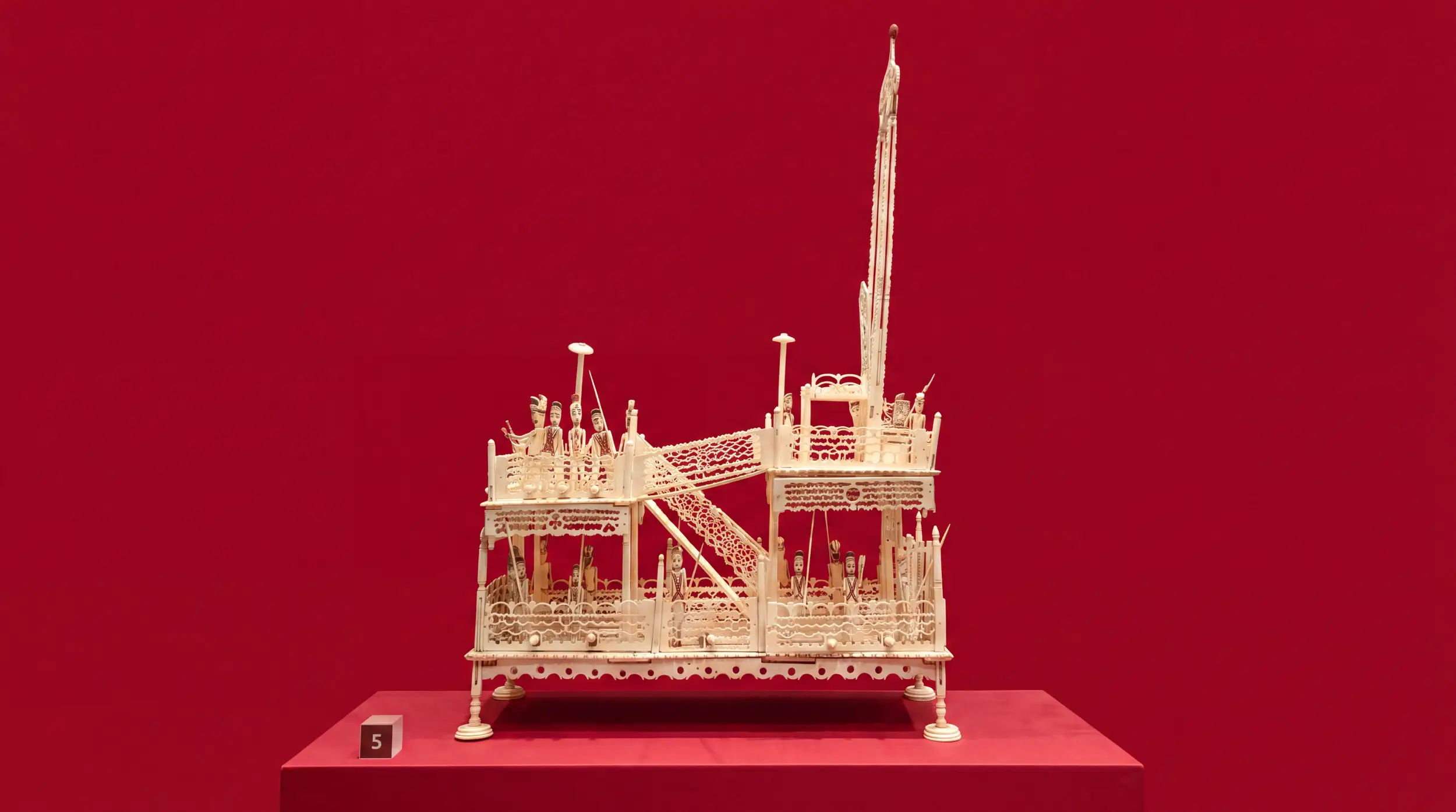
At first glance it is macabre: a miniature execution machine complete with victim, executioner and armed guards. Look closer and something else emerges. Every stair, railing and tiny figure was painstakingly fashioned by a prisoner held at Norman Cross more than two centuries ago. This little guillotine is not simply an image of death. It is evidence of extraordinary skill, ingenuity and enterprise inside the world’s first purpose-built prisoner-of-war camp.
CRAFTSMAN.
TRADER.
Captivity restricted where a prisoner could go. It did not prevent him from making, selling, designing or creating.
A machine made in captivity
Some objects tell us about institutions. This one brings us unusually close to the hands of a person inside one.
The model belongs to the remarkable collection of objects made by prisoners held at Norman Cross Prison Depot, just south of Peterborough.
It is a miniature guillotine.
But miniature does not mean simple.
The structure rises across two decorated decks.
Stairs connect the different levels.
Bone railings and filigree create an almost architectural delicacy.
A condemned figure waits beside the machine.
An executioner attends it.
Soldiers stand guard with muskets.
Red, black and blue paint pick out details.
And at the centre of everything is a blade made not from bone, but from tortoiseshell.
A prisoner took the remains of an animal ration and transformed them into one of the most elaborate objects in Peterborough Museum.
Look closely
The Museum catalogue describes this particular object with unusual precision.
Raised platforms sit at either end, joined by miniature stairs.
The principal structure and figures are painstakingly carved from animal bone.
Open, decorative bonework turns a functional scaffold into something almost ornamental.
A contrasting material was chosen for the guillotine's most recognisable component.
The drama is populated, making this a scene rather than merely an architectural model.
Uniformed figures painted red and blue stand around the execution platform.
That combination is what makes the object so arresting.
Its subject is brutal.
Its workmanship is delicate.
Violence has been rendered in filigree.
This was not simply a sculpture
Peterborough Museum catalogues PETMG:E184 as a mechanical model and specifically as a working model.
That matters because Norman Cross prisoners did not restrict themselves to static ornaments.
The surviving collection contains automata and mechanically animated objects alongside ships, boxes, games, figures and decorative work.
Technical understanding and artistic skill often occupied the same object.
The guillotine therefore belongs as much to a history of miniature engineering as it does to a history of carving.
From ration bone to extraordinary craft
Perhaps the most remarkable thing about the model is its principal material.
Bone.
Animal bone was readily available through the food supplied to prisoners.
Instead of becoming waste, it could be cleaned, cut, scraped, polished, pierced and assembled into intricate objects.
Animal bone enters the Depot as part of food provision.
Usable pieces are retained and prepared for working.
Bone is cut, shaped, pierced, polished and assembled.
The finished object can be sold to someone outside the prison.
Thomas James Walker, writing his great history of Norman Cross in 1913, marvelled at the bone workers represented in Peterborough Museum's collection.
He described craftsmen cutting, scraping, polishing and fitting pieces together, and singled out elaborate models of guillotines crowded with tiny soldiers, victims and executioners.
The work demanded something prison life supplied in abundance, but under the worst possible circumstances.
Time.
The prison controlled the maker's movement. It could not control what he was capable of making.
Behind the object was an extraordinary lost town
Norman Cross was established in 1796 and received its first prisoners in 1797.
It was the first known purpose-built prisoner-of-war camp of its kind.
Instead of adapting a castle, fortress or prison hulk, the British state created a new institution specifically to confine captured enemy servicemen.
At any one time thousands of men could live inside its compounds.
There were barrack blocks, airing grounds, fences, guards, hospitals, kitchens, markets and workshops improvised within the spaces available.
Captured men arrived from conflicts spanning Europe and the seas beyond it.
Some had been soldiers.
Many were sailors.
Some were boys.
And their imprisonment could last years.
The whole story can be explored in Norman Cross Prison Depot: The World's First Purpose-Built Prisoner-of-War Camp.
The prison also had a market
The most important thing to understand about objects like this guillotine is that prisoner craft was not simply occupational therapy.
It was an economy.
Prisoners were permitted to manufacture goods and sell them.
A market operated at the east gate of Norman Cross, bringing the captive population into direct commercial contact with local people and traders.
Skill, labour and available materials are turned into an object.
Goods enter a supervised trading system.
A local resident, dealer or visitor takes the object away.
Earnings could buy food, clothing, tobacco and other comforts.
Peterborough Museum describes prisoners tailoring high-status and desirable goods to the British market.
That changes the way we should look at the guillotine.
It is not only an expression of its maker.
It is also a product.
Somebody outside the wire may once have wanted to buy it.
Why make a guillotine?
It is the obvious question.
Why would a prisoner spend so much time making a miniature execution machine?
The honest answer is that we do not know what the maker of this particular object thought about it.
But the subject would have been instantly recognisable.
The guillotine had become one of the defining images of the French Revolution.
It was used to execute Louis XVI and Marie Antoinette, and during the Reign of Terror it became internationally synonymous with revolutionary violence.
By the time Norman Cross opened, miniature guillotines already belonged to a wider culture of revolutionary imagery, spectacle and novelty.
For a British buyer, a working miniature would have combined several attractions.
But we should resist turning possibility into certainty.
We do not know whether the maker viewed the guillotine with fascination, horror, pride, irony or simply commercial calculation.
We do not know who first bought this model.
And the Museum does not identify its miniature victim.
It may look like a miniature history painting, but the thoughts of the person who made it have not survived with the object.
We do not know the maker's name
This is an important part of the story.
The Museum catalogue identifies the maker simply as:
Name unknown · nationality unrecorded
Norman Cross craft is often described collectively as the work of French prisoners, and Frenchmen certainly formed a major part of the population.
But the Depot also held prisoners of other nationalities.
Without documentary evidence attached to this particular model, it would be wrong to invent a more precise identity.
That anonymity is poignant.
The maker's name disappeared.
His workmanship did not.
From prisoner-made souvenir to museum object
The guillotine is catalogued by Peterborough Museum as PETMG:E184.
The online record also preserves an older reference:
The Museum's online catalogue does not give a complete acquisition history for this individual model, so we should not invent one.
But the Dack number places the object within the older cataloguing history of a collection closely associated with Charles Dack, an important early curator and collector of Norman Cross material.
The wider collection expanded dramatically through nineteenth-century local interest.
In 1897, a centenary exhibition prompted an appeal for Peterborough families to search attics and cupboards for prisoner-made objects bought by earlier generations.
Many emerged.
Many were eventually donated.
Objects originally created for a market at the gates of a prison became historical evidence preserved by the city.
Peterborough now holds one of the great collections of prisoner craft
The Norman Cross story did not disappear when the Depot closed.
It survived in hundreds of extraordinary things.
objects in the Norman Cross collection
Peterborough Museum describes the collection as probably the finest of its kind on public display anywhere.
That is enormously important for Peterborough.
The prison itself was largely dismantled after closure.
Its wooden barracks vanished.
Its compounds became archaeology.
But objects like this one preserve the human scale of life inside it.
You can explore the Norman Cross display through Peterborough Museum's galleries.
The place where it was made has not disappeared either
Norman Cross survives today as a Scheduled Monument beside the route of the Great North Road, south of Peterborough.
Much of what once stood above ground has gone.
But the geometry of the Depot survives archaeologically beneath the fields.
Thousands of prisoners, guards, barracks, markets and workshops.
The prisoners leave as the Napoleonic conflict reaches its end.
Buildings and materials are sold and the wooden complex disappears.
Earthworks, archaeology and memorials preserve the footprint of the Depot.
Discover the surviving landscape in the full Norman Cross history.
Why this is a Peterborough object
The model is easy to remember because of its subject.
But the guillotine itself is only part of what makes it important.
It was made inside a pioneering institution built specifically to confine prisoners of war.
An ordinary material is transformed through patience, precision and technical skill.
Craft could create income and a degree of economic agency within captivity.
Global warfare brought people, ideas and revolutionary imagery into the local landscape.
There is also something uncomfortable about it.
A man deprived of his liberty created an exquisitely delicate model of a machine designed to deprive somebody of life.
Then somebody outside the prison bought or acquired it.
Two centuries later, we look at it through museum glass.
The meanings have changed at every stage.
The guillotine is the subject. The prisoner who made it is the story.
That is why this object belongs in Peterborough's history.
It transforms Norman Cross from an institutional plan, a field and a set of statistics into something intensely human.
Somebody sat inside that prison.
Somebody cut the bone.
Somebody pierced the tiny railings.
Somebody painted the uniforms.
Somebody assembled the stairs.
We no longer know his name.
But his hands are still visible everywhere.