


Peterborough Guildhall at a glance
- What
- Peterborough’s historic civic and market hall
- Where
- Cathedral Square, Peterborough, PE1 1XH
- Completed
- 1671
- Architect
- John Lovin
- Heritage
- Grade II* listed
- Look out for
- Open market arches, carved stonework and the Royal Arms of Charles II
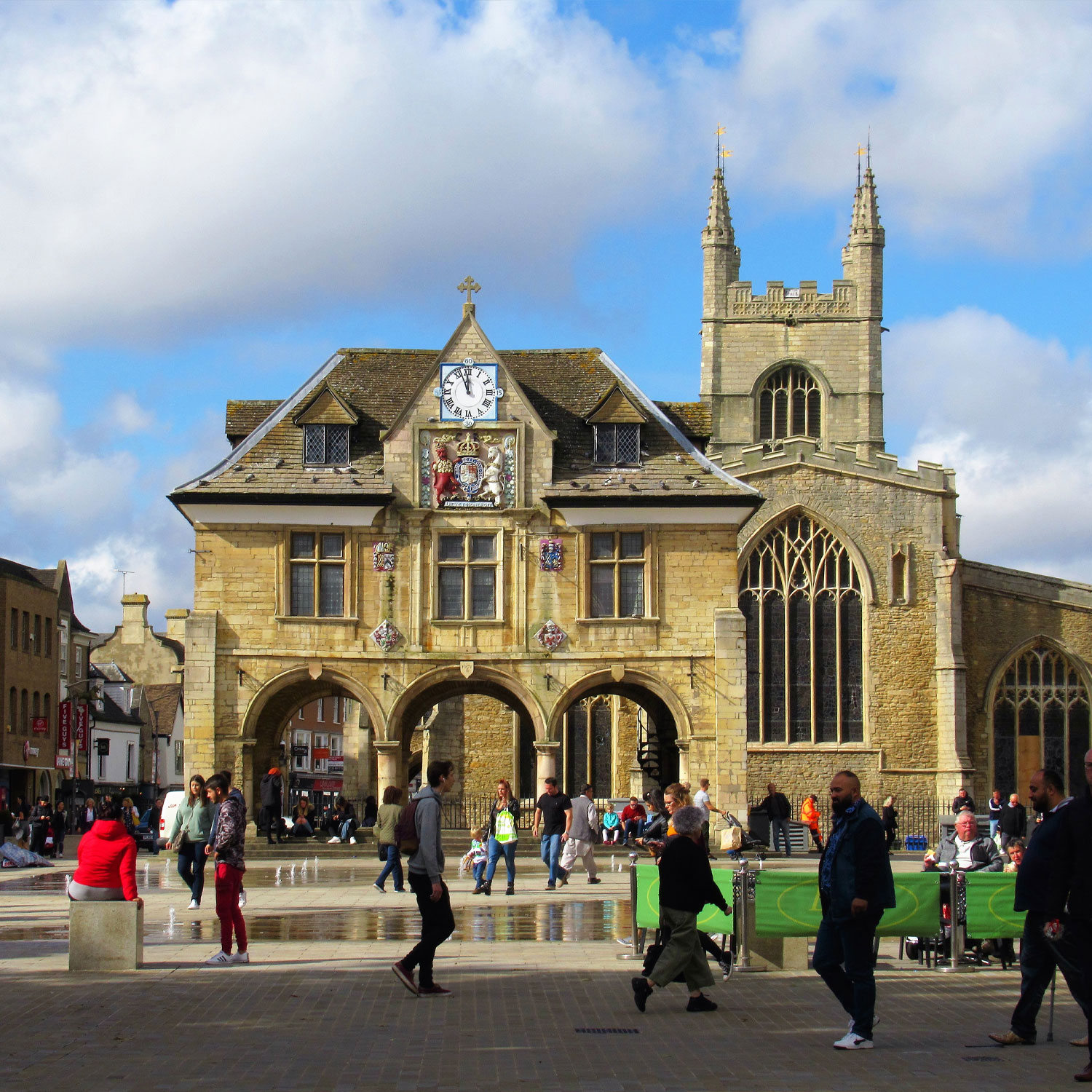
Stand in Cathedral Square and Peterborough’s civic history is right in front of you: a compact 17th-century building raised above the market, with the monarchy on its walls and centuries of city life passing beneath its arches.
Peterborough Guildhall has stood at the centre of the city since 1671. Small enough to walk around in moments but important enough to define an entire public space, it brought commerce, administration and civic ceremony together beneath one roof.
The arrangement is wonderfully direct. Traders occupied the open ground floor while meetings and civic business took place in the chamber above. The architecture itself therefore explains how Peterborough worked: trade below, authority above, all taking place in the heart of the market town.
Today the building remains one of Cathedral Square’s great visual anchors. The city around it has changed enormously, but the Guildhall still occupies the position from which generations of Peterborians would have recognised the centre of town.
A new civic landmark for a restored monarchy
The Guildhall belongs to the world of Restoration England. Its royal heraldry, classical proportions and formal civic chamber expressed both loyalty to Charles II and Peterborough’s own sense of importance.
What to look for
The Guildhall rewards a slow circuit. Walk all the way around it and look upwards as well as through the arches.
The open market arcades
Round-headed arches keep the ground floor open to the square, preserving the building’s original relationship with market trading.
The civic chamber
The upper room provided a formal place for administration, meetings and, later, municipal government.
The Royal Arms
The arms of Charles II prominently proclaim the political world into which the Guildhall was built.
Classical symmetry
Columns, arches, mullioned windows and carefully balanced proportions give a remarkably small building real civic dignity.
The Butter Cross
The site was associated with the dairy market, and the open space beneath the Guildhall remained closely linked with market trading.
The square around it
The building makes most sense as part of Cathedral Square, surrounded by the parish church, shops, streets and the route towards the Cathedral.
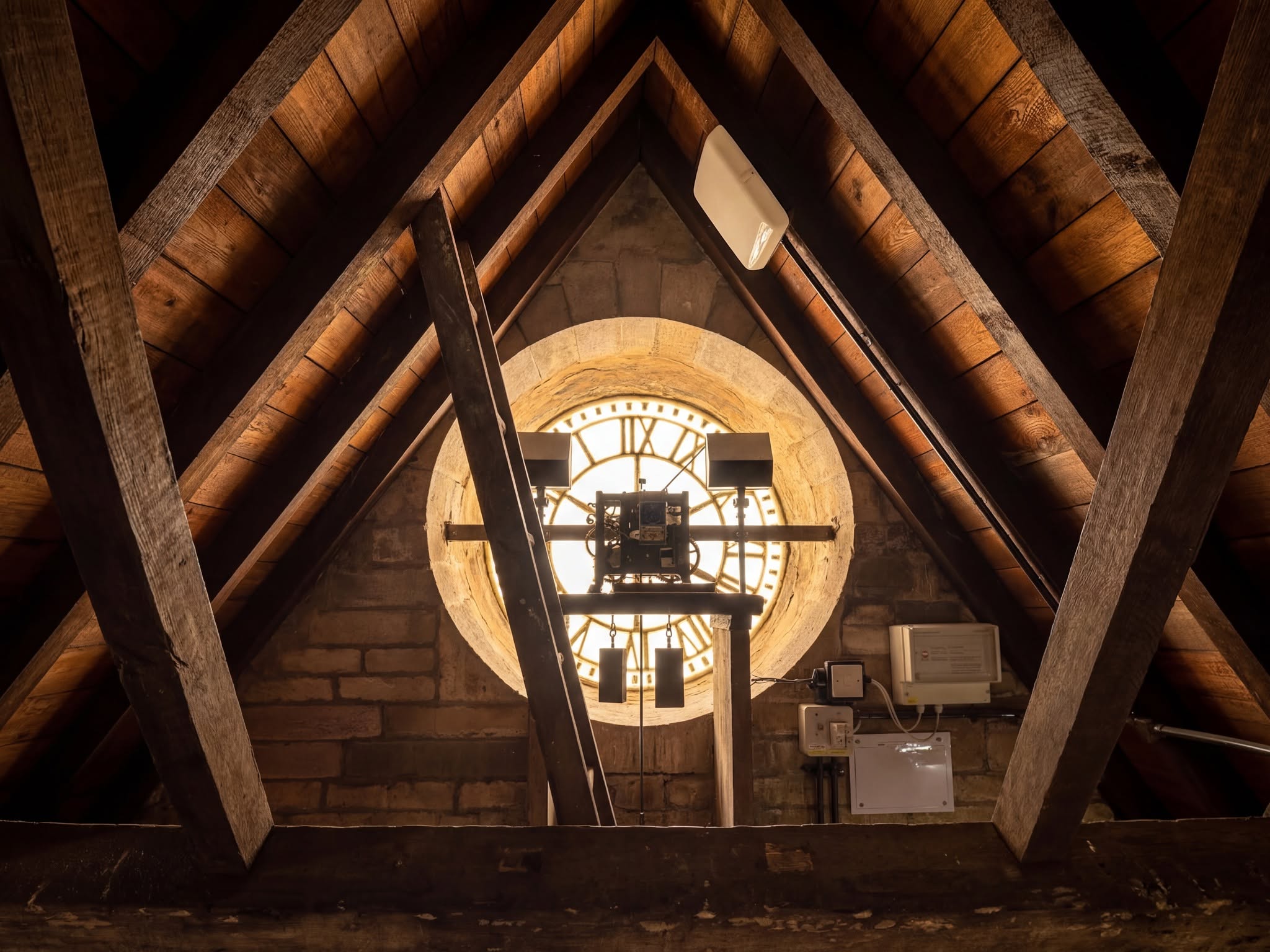
A tiny building with a very big job.
The Guildhall had to do several things at once.
It needed to preserve trading space in the busy market below. It needed to provide a dignified meeting chamber above. And it needed to announce that Peterborough possessed civic confidence and authority.
John Lovin solved that challenge by lifting the formal part of the building above a series of open arches.
The result is almost pavilion-like: light at ground level, substantial above, and visible from every side of the square.
Before the Guildhall: Peterborough’s market place
The Guildhall did not create the importance of this space. It inherited it.
Peterborough had long been a market town gathered around the great Abbey. An earlier medieval guildhall stood nearby, while the site of the present building was associated with the covered Butter Cross and dairy market.
That helps explain the open ground floor. The new civic building did not simply occupy valuable trading space. It allowed the market to continue beneath it.
For generations, butter, dairy produce and poultry were associated with this part of the market place. Commerce was literally built into Peterborough’s civic architecture.
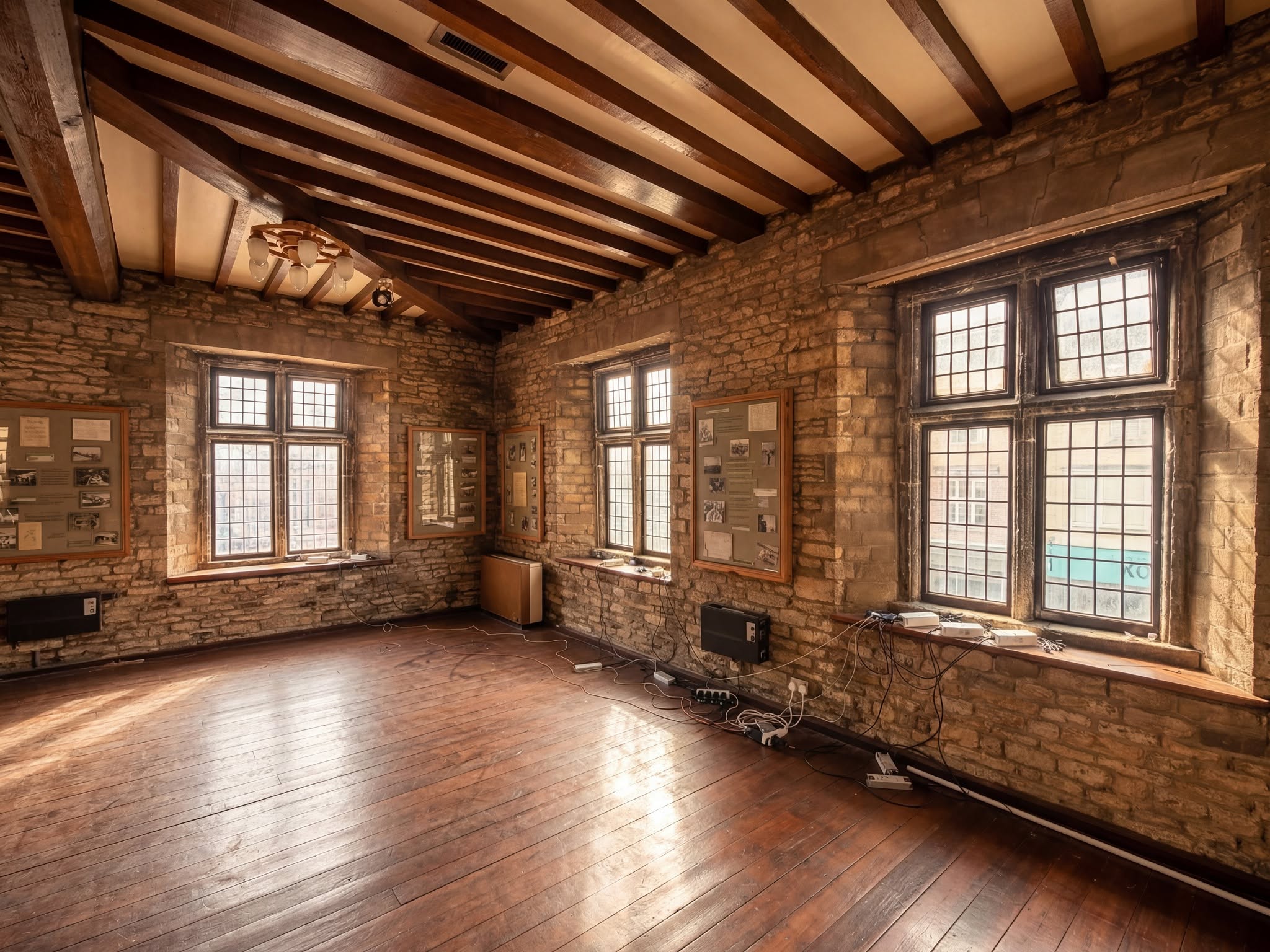
Built for the square
The Guildhall is best understood from different angles, where its symmetry and open ground floor become much more apparent.
Stone, arches and civic theatre
The building’s detailing gives monumental presence to a structure that is actually remarkably compact.
Why is a king staring down at the market?
The Guildhall was completed barely a decade after the monarchy returned to England, and its heraldry makes that political moment impossible to miss.
The Restoration
Charles II returned to the throne after the republican Commonwealth, bringing monarchy back to the centre of national political life.
Peterborough responds
The new Guildhall was completed within this Restoration world, giving the market place a consciously formal civic landmark.
The Royal Arms
Prominent heraldry connected local government, public space and civic identity with the restored Crown.
Loyalty and status
The Guildhall was practical architecture, but it was also political theatre. Peterborough was stating who governed and where civic authority belonged.
The building gradually became the formal home of civic government.
Peterborough’s municipal role changed dramatically during the nineteenth century.
Following the incorporation of the municipal borough in 1874, the upper chamber became associated with the new Corporation and its civic business.
For decades, councillors debated the affairs of a rapidly expanding industrial and railway city inside a building designed when Peterborough was still a much smaller market town.
Eventually the city simply outgrew it.

1933: civic government moves on
By the early twentieth century, Peterborough was no longer the compact town for which the Guildhall had been designed.
Railways, engineering, brickmaking and population growth had transformed the scale of the city. A larger municipal headquarters was required.
That arrived with Peterborough Town Hall, which opened in 1933 on Bridge Street.
The transfer created a fascinating architectural pair. The Guildhall represents the civic confidence of Restoration Peterborough. The Town Hall represents the ambitions of the twentieth-century city.
Two buildings, separated by little more than a short walk, tell the story of how much Peterborough changed.
Cathedral Square: Peterborough in miniature
Few places explain the city more efficiently than the few hundred metres around the Guildhall.
On one side stands St John the Baptist, the medieval parish church of the townspeople.
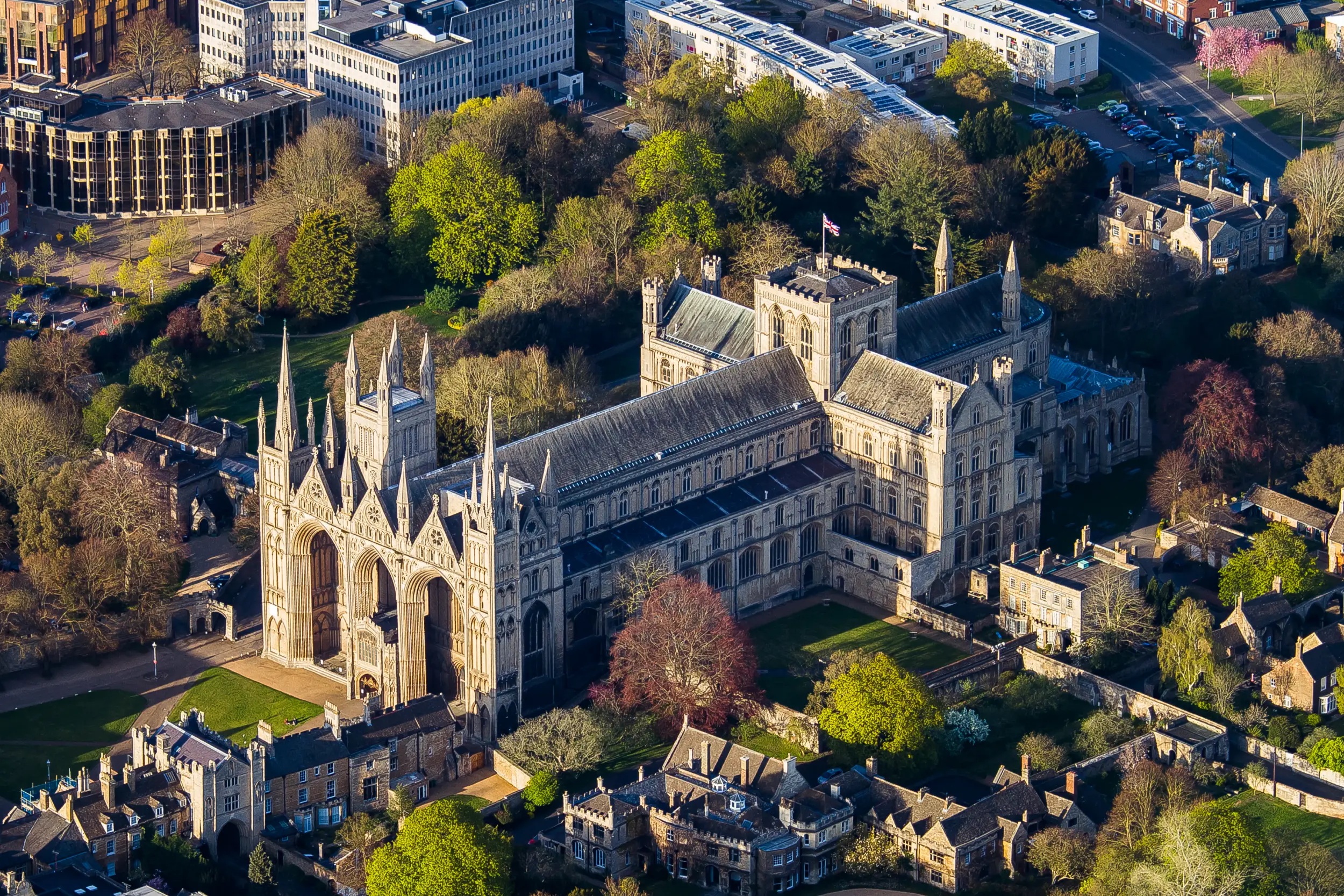
Beyond the square lies Peterborough Cathedral, descended from the great Abbey that dominated the town for centuries.
Between them stands the Guildhall, representing market trading, civic administration and the growth of an increasingly independent town.
Church, market, government and Abbey are therefore all visible within one compact urban landscape.
A landmark built for people to pass through
One of the loveliest things about the Guildhall is that it has never felt detached from everyday city life.
You can walk beneath it, meet beside it, photograph it, sit nearby or simply pass it on the way between the Cathedral and the shops.
That is remarkably close to its original purpose. The building was designed to place civic authority directly inside the life of the market place rather than behind gates or within a private enclosure.
More than three and a half centuries later, the city still flows around and beneath it.
Planning your visit
- Where to find the Guildhall
- The Guildhall stands in Cathedral Square, Peterborough, PE1 1XH, at the heart of the pedestrianised city centre.
- Best way to experience it
- Walk completely around the building. Each elevation reveals different stonework, windows, arches and heraldic details.
- Interior access
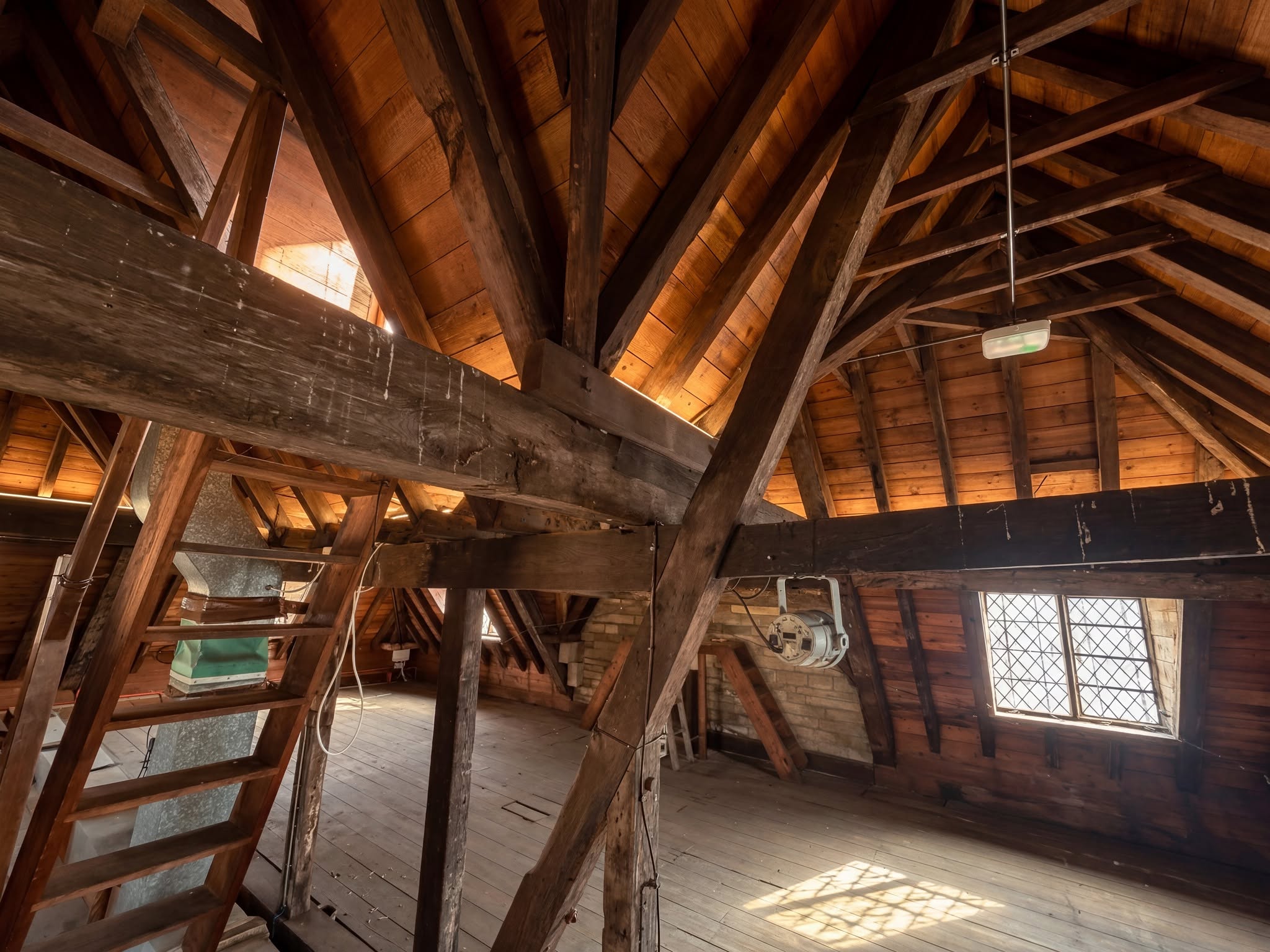
- The upper chamber is not generally operated as a regular visitor attraction. If interior access is important to your visit, check current arrangements before travelling.
- Accessibility
- The exterior is approached across the level paved surface of Cathedral Square. Historic interior access has different considerations.
- Arriving by train
- Peterborough railway station is within walking distance through the city centre.
- Historic England
- Read the official Grade II* list entry for the architectural description and designation record.
Discover Peterborough tip: stand beneath the arches and look across at St John the Baptist Church before turning towards the Cathedral. In a few seconds you can physically place yourself between three forces that shaped historic Peterborough: the town, the market and the Abbey.
Continue exploring Peterborough
The Guildhall is an ideal starting point for exploring Peterborough’s historic centre on foot.
St John the Baptist
Step across Cathedral Square into Peterborough’s medieval parish church and look for its remarkable roof angels.
Explore St John’sPeterborough Cathedral
Walk through the historic gateway into one of England’s great medieval buildings and more than a millennium of Peterborough history.
Explore the CathedralPeterborough Museum & Art Gallery
Continue to Priestgate for Jurassic fossils, archaeology, Norman Cross, social history and art.
Explore the MuseumPeterborough History
Place the Guildhall within the much larger story of the people, industries and events that created the modern city.
Explore the historyPeterborough Timeline
Travel chronologically from deep prehistory through the medieval town, Restoration Peterborough and the modern city.
Travel through timeArts, Culture & Heritage
Find more historic buildings, museums, churches, galleries and cultural attractions across Peterborough.
Discover more heritagePeterborough in Objects
Explore the artefacts, artworks, documents and extraordinary objects through which the city’s history survives.
Explore the objectsMore things to do
Find more attractions, family experiences, heritage, culture and memorable places across Peterborough.
Find more experiencesStop beneath the arches of the Guildhall
Walk around the building, look up at the royal heraldry and then continue into the Cathedral, parish church, Museum and historic streets surrounding Cathedral Square.