



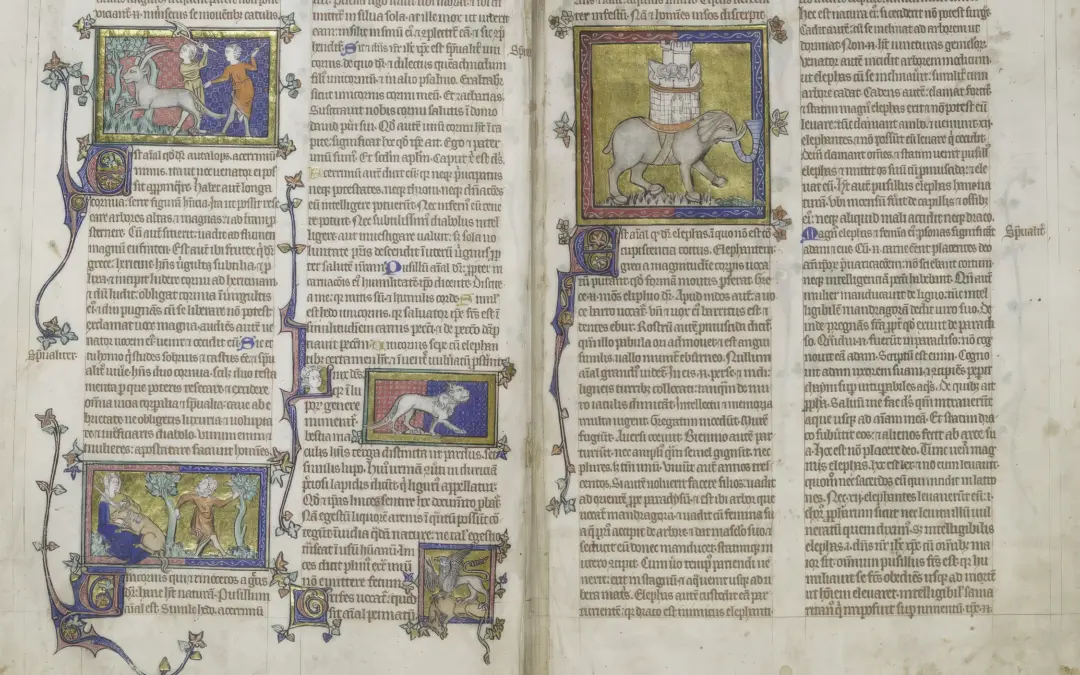
Imagine an encyclopaedia of the natural world — lions, camels, serpents, dolphins, dragons and unicorns — painted in brilliant colours, shimmering with gold leaf, and imbued with moral lessons drawn from every creature it portrays. Created in Peterborough around 1300–1310, the Peterborough Bestiary is one of the finest illuminated manuscripts ever made in England, and it bears our city’s name.
What is a Bestiary?
Long before the age of natural history museums or wildlife documentaries, people turned to bestiaries to understand the animal kingdom. A bestiary — from the Latin bestiarum vocabulum — was a lavishly illustrated book describing the appearance, behaviour, and symbolic meaning of real and imaginary creatures. Each animal entry offered not just natural history, but a moral or theological lesson: the pelican that feeds its young with its own blood became a symbol of Christ’s sacrifice; the cunning fox, a warning against deception.
The tradition drew on ancient sources, chiefly a Greek text from the second century called the Physiologus (“The Naturalist”) and the encyclopaedic Etymologiae of the Spanish bishop Isidore of Seville, who died in 636 AD. Medieval scribes wove these together into richly illustrated volumes, and the results were among the most beautiful books of the Middle Ages.
“The scribe noted the word spiritualiter — ‘spiritually’ — in the margins to flag each moral lesson, making the book a practical tool for teaching and preaching.”
The Peterborough Connection
The Peterborough Bestiary takes its name from its association with Peterborough Abbey — the great Benedictine monastery at the heart of the city, which is now our magnificent Cathedral. It was almost certainly made for a senior clergyman: its pages are unusually large and formal, its script is Gothic Textura Quadrata (the most prestigious of medieval writing styles), and the whole production radiates the kind of stately grandeur that speaks of an important commission.
At some point the bestiary was bound together with a psalter from Peterborough itself, and this pairing gave the manuscript its enduring nickname. How the two were united, and exactly where the bestiary was first made and used, remains a delicious historical puzzle.
Miniature Illustrations
Decorated & inhabited initials
Date of creation
Folios in the bestiary
A Book Alive with Gold and Colour
What truly sets the Peterborough Bestiary apart is its extraordinary illumination. Its more than 100 miniatures — many spanning the full width of a column — are painted in rich, jewel-bright colours with generous use of gold leaf. Backgrounds are either burnished gold or diapered in repeating geometric patterns. The decorated initials spiral with leafy tendrils and sprout human heads, their sinuous extenders enlivening virtually every page.
The anonymous artist was a master of their craft. Scholars have identified the same hand in the De Lisle Hours, now held at the Morgan Library in New York — suggesting a painter of considerable reputation working across multiple prestigious commissions.
The illustrations fall into two distinct modes. Entries drawn from Isidore of Seville tend towards clean, elegant profile portraits of their subjects. Those from the Physiologus, by contrast, are richer narratives — showing creatures in their habitats, sometimes alongside human figures. On folio 196r, for instance, two men strain to load a sack onto a camel’s back: a moment of everyday medieval life captured in miniature.
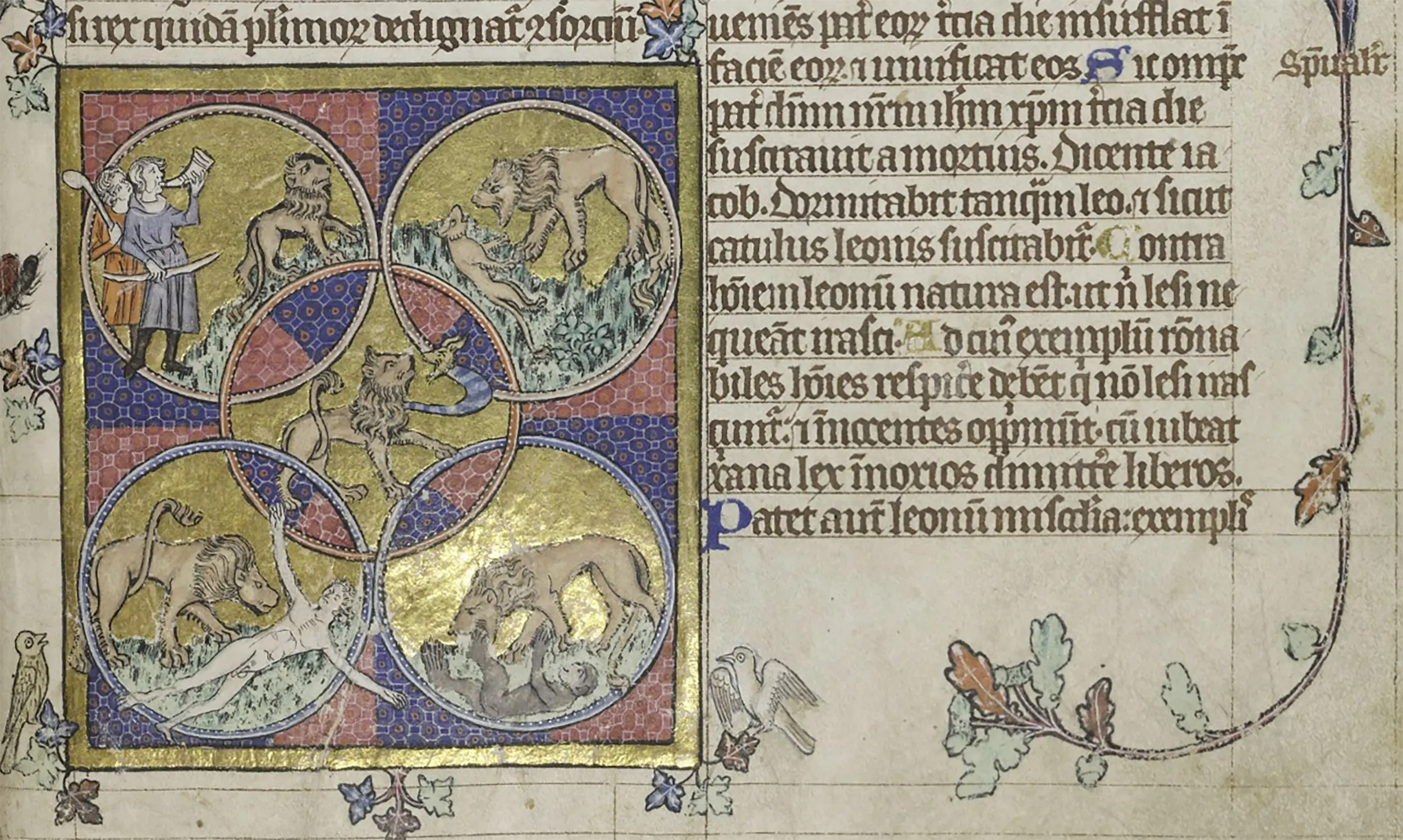
The opening miniature of the lion, composed of five interlocking circular fields — Cambridge, Corpus Christi College, MS 53, fol. 189r.
The King of Beasts — and the Page that Stops You in Your Tracks
The book opens with its most spectacular image: a full treatment of the lion, king of beasts. Rather than a single scene, the illuminator devised a remarkable composition of five interlocking circular fields, each illustrating a different characteristic attributed to the lion in the text. One shows the beast using its tail to wipe away its own tracks; another depicts the extraordinary medieval belief that a lion could cure itself of illness by eating an ape. It is one of the most inventive page designs in all of English Gothic illumination.
How It Survived the Reformation
The story of how the Peterborough Bestiary came down to us is almost as extraordinary as the manuscript itself. When Henry VIII dissolved the English monasteries between 1536 and 1540, countless medieval manuscripts were lost, destroyed, or scattered to the winds. The Peterborough Bestiary was one of the lucky survivors.
It came into the hands of Matthew Parker (1504–1575), Archbishop of Canterbury and one of the greatest book collectors of the Elizabethan age. Parker was passionately committed to preserving England’s manuscript heritage at a time when it was under serious threat. He acquired hundreds of volumes from dissolved monasteries and, crucially, bequeathed his entire collection to Corpus Christi College, Cambridge — where the bestiary has been carefully kept ever since, in the college’s celebrated Parker Library.
The Peterborough Bestiary has been fully digitised and is freely available to browse online through the Parker Library on the Web at Stanford University. Every page, every miniature, every gilded initial — viewable in extraordinary detail from anywhere in the world.
What the Bestiary Tells Us About Medieval Peterborough
A book this grand and costly tells us something important: Peterborough in 1300 was a place of serious wealth, learning, and cultural ambition. The abbey was one of England’s most powerful Benedictine houses, and its clergy were educated, well-connected, and deeply engaged with the intellectual currents of their day. The bestiary was almost certainly made for someone who would use it in teaching or in preparing sermons — the word spiritualiter noted in the margins beside each moral lesson confirms this practical purpose behind the beauty.
In short, the Peterborough Bestiary isn’t just a stunning object. It’s a window into the minds of the people who created medieval Peterborough — their view of the natural world, their faith, their learning, and their extraordinary artistic ambition.
The Peterborough Bestiary is held at the Parker Library, Corpus Christi College, Cambridge (MS 53, fols. 189–210). It can be explored online via the Parker Library on the Web. A facsimile edition was published by Faksimile Verlag (2003), with commentary by Christopher de Hamel, Lucy Freeman Sandler, and Hans Zotter.