A metre-wide wooden wheel seems almost impossible in a village built above water. Yet beneath the mud at Must Farm, archaeologists found exactly that. The discovery revealed a Bronze Age community connected not only by river and boat, but by tracks, animals, vehicles and the dry land beyond the Fens.
The wheel in context
- c.1300 BC An earlier, incomplete wooden wheel is associated with the Bronze Age landscape at nearby Flag Fen.
- c.850 BC The extraordinary pile-dwelling settlement at Must Farm is constructed above a slow-moving freshwater channel.
- 9–12 months The settlement appears to have been occupied for less than a year before catastrophe struck.
- c.850 BC Fire destroys the settlement and its structures and possessions collapse into water and soft sediment.
- 2011 Earlier Must Farm investigations reveal an extraordinary sequence of prehistoric river archaeology including nine logboats.
- 2016 The famous complete wheel emerges from river sediments during excavation of the pile-dwelling settlement.
- 2024 The definitive Must Farm research volumes bring together years of specialist analysis of the settlement and its material world.
What is a wheel doing in the middle of a river?
Must Farm is one of the last places most of us would expect to find evidence for a wheeled vehicle.
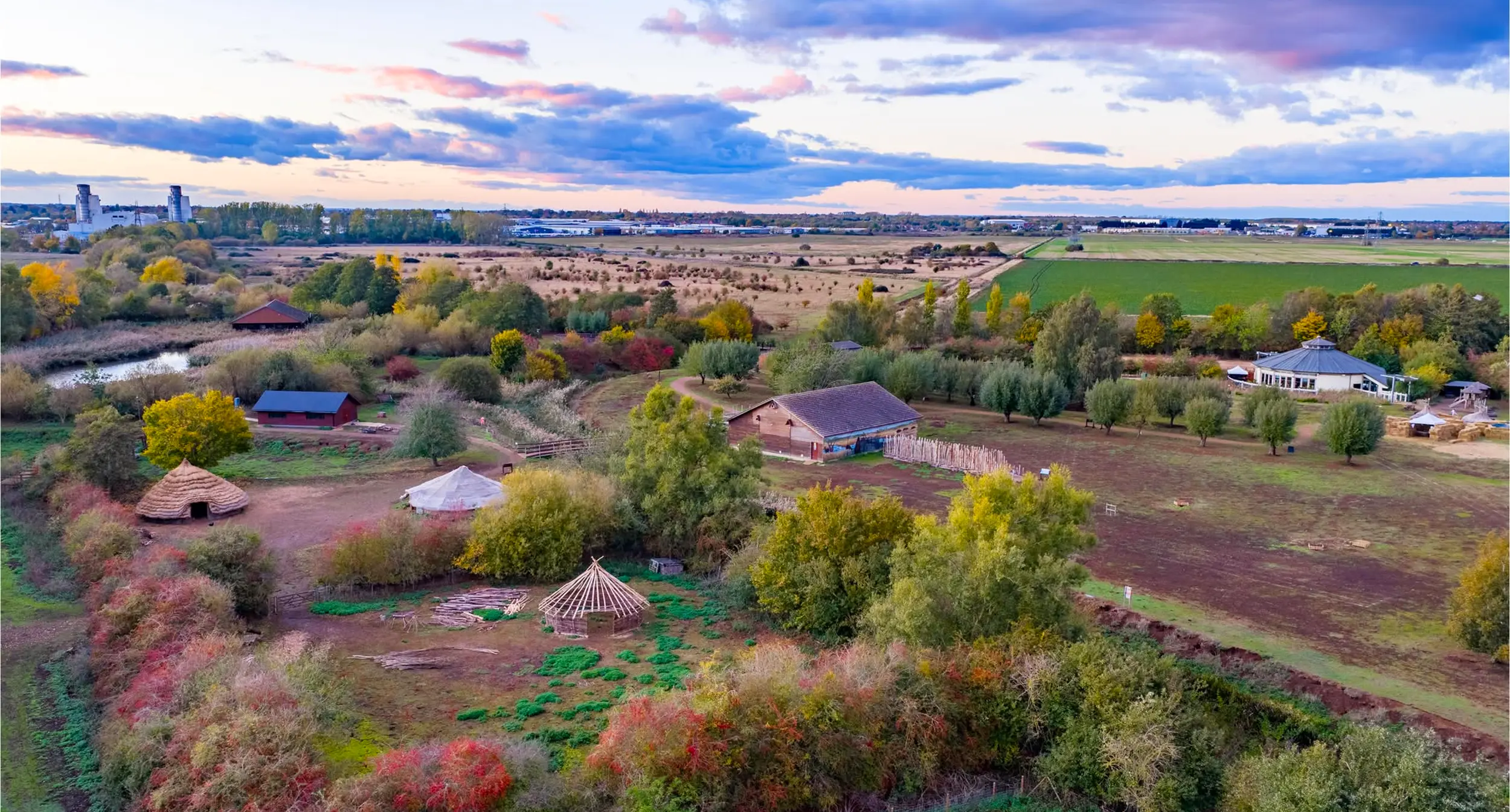
The Late Bronze Age settlement stood above a freshwater channel within the Flag Fen Basin. Its roundhouses were raised on timber piles around two metres above the riverbed. Walkways connected parts of the settlement. Water flowed beneath the homes.
Elsewhere in the same prehistoric channel system, archaeologists found logboats, fish traps and fish weirs.
Everything appears to point towards a life built around water.
Then came the wheel.
A wooden wheel in a settlement above a river forces us to imagine a much bigger Bronze Age landscape.
It is one of the most striking discoveries from Must Farm: Britain’s Bronze Age Time Capsule, an archaeological site whose preservation has transformed our understanding of everyday prehistoric life.
The moment a piece of timber became a wheel
The discovery came during the great 2015–16 excavation of the Must Farm pile-dwelling settlement by Cambridge Archaeological Unit.
Archaeologists were working in the western part of the site, an area where the preservation of timber was slightly poorer than in the centre.
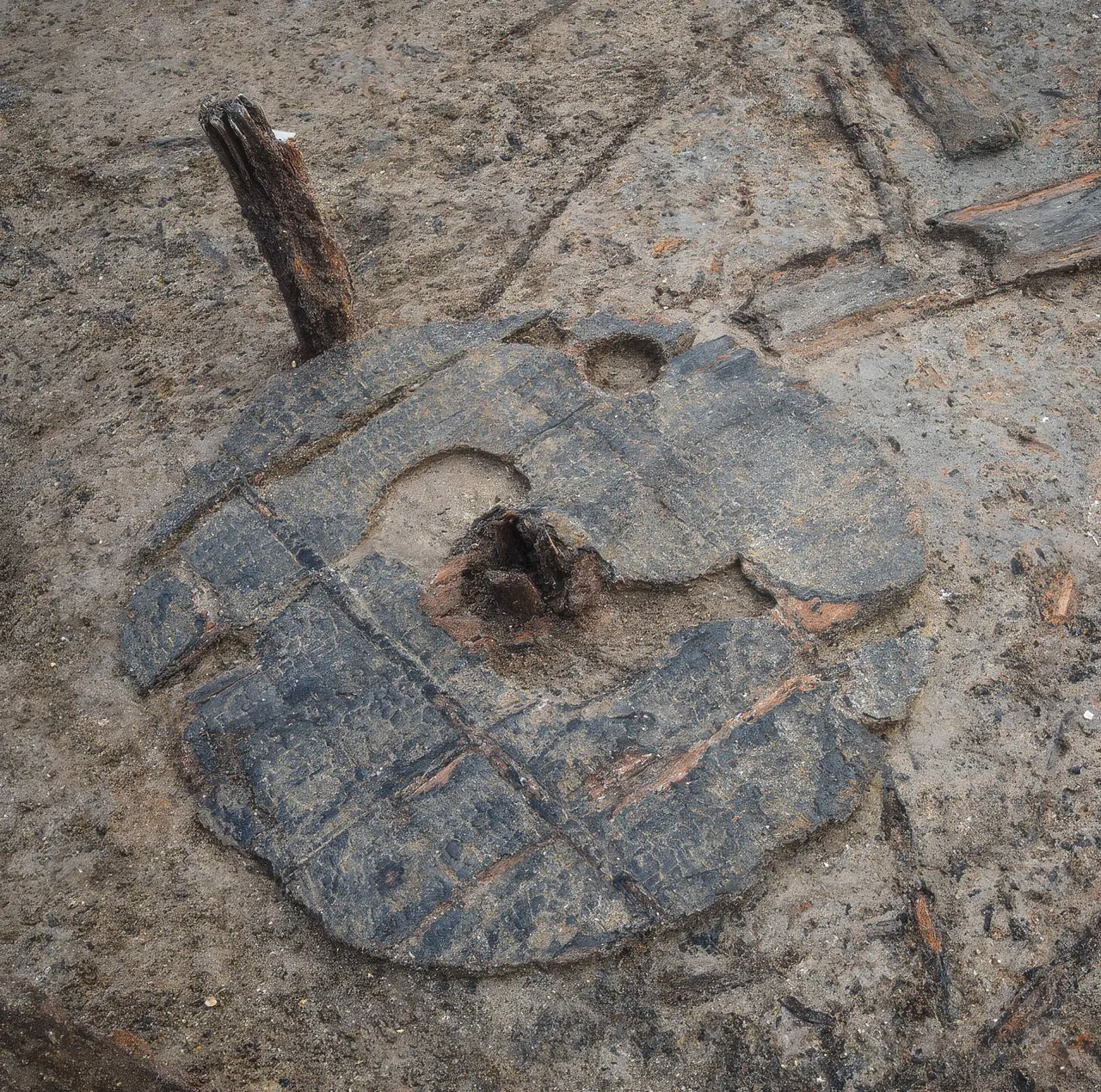
As layers of river sediment were removed, an unusual wooden object began to emerge.
At first it was simply timber.
Then its edge appeared.
Then the centre.
It became clear that the team was uncovering a complete wooden wheel.
The object was the first complete Bronze Age wheel of its kind discovered in Britain and one of the most remarkable surviving pieces of prehistoric woodworking ever recovered here.
Historic England described the discovery at the time as unprecedented in Britain for its combination of size and completeness.
Three boards. Two braces. One wheel.
The most extraordinary thing about the Must Farm wheel is not simply that it survived.
It survived well enough for archaeologists to understand how it was made.
This was not a spoked wheel like a bicycle or modern cart wheel.
It was a solid tripartite wheel.
The boards were joined into a single circular structure and strengthened by timber braces fitted across the wheel.
The braces were not crudely nailed in position.
They were fixed using dovetail joints, shaped connections familiar to woodworkers thousands of years later.
The surviving wood had lost some of its original thickness, but excavators estimated that the wheel was probably around 3–4 centimetres thick when it was in use.
The central axle component was identified as oak.
Why does the wheel have two holes?
On either side of the centre are two distinctive crescent-shaped openings.
Archaeologists describe them as lunate holes.
Similar openings occur on other European prehistoric wheels. They may have helped with the construction, joining or securing of the wheel.
The same design language places Must Farm within a much wider European technological tradition.
Its inhabitants were living at the edge of the Fens, but their technology was not isolated.
Was there a Bronze Age cart at Must Farm?
A wheel usually implies a vehicle.
But archaeology rarely gives us the whole object.
No complete Must Farm cart rolled out of the river mud beside it.
The excavators therefore had to ask a series of questions.
The wheel could have become separated from a cart before entering the river sediment.
It may have been brought to the settlement because something had gone wrong with the vehicle.
A valuable piece of worked timber could potentially have acquired another purpose once its travelling life ended.
The preservation of one wheel does not mean every wooden component belonging to its vehicle survived or lay within the excavation area.
The safest interpretation is therefore that it represents wheeled transport, without pretending we can reconstruct the precise vehicle or explain exactly why its wheel ended up beside the settlement.
Horse remains were also recovered at Must Farm, providing another tantalising connection with terrestrial movement, although the precise relationship between those animals and the wheels cannot be proved.
Must Farm was not an island
The wheel helped overturn one of the simplest assumptions about the settlement.
It would be easy to imagine Must Farm as a self-contained village marooned in marshland.
The archaeology says otherwise.
Life at Must Farm was intimately connected with freshwater channels and wetland resources.
Much of the settlement’s economy depended on managed landscapes beyond the water.
Must Farm produced bones from sheep, cattle and deer. Timber came from managed woodland. Plants and agricultural products connected the households to cultivated land.
The wheels belong to the same story.
The people of Must Farm lived over water. Their world extended far beyond it.
The final Cambridge research now records two rare, well-preserved tripartite wheels from Must Farm, strengthening the evidence that wheeled transport was a meaningful part of the community’s wider landscape.
Wheel and boat belonged to the same world
One of the greatest mistakes we can make with prehistoric transport is to ask whether people used roads or rivers.
At Must Farm, the answer appears to be both.
Investigations of the prehistoric watercourse upstream revealed nine logboats, some complete and some fragmentary, dating across the Bronze and into the Iron Age.
Fish traps and weirs show people actively managing the waterways.
Yet wheels show terrestrial transport at the same time.
Travel along channels through the Fenland landscape.
Movement across the dry ground surrounding the basin.
Must Farm therefore starts to look less like an isolated settlement and more like a transport node inside a complex network.
Channels, paths, tracks, causeways and dry land connected people to neighbouring communities and, ultimately, much further away.
Another wheel had already appeared at Flag Fen
The Must Farm wheel was spectacular, but it was not the first Bronze Age wheel found in this landscape.
An incomplete wooden wheel had already been discovered at nearby Flag Fen.
That example dates to around 1300 BC, making it older than the famous complete Must Farm wheel, but it survives only partially and is smaller, at about 0.8 metres across.
Most importantly, the construction is strikingly similar.
Earlier, incomplete tripartite wooden wheel.
About 0.8 m diameterExceptionally complete tripartite wooden wheel.
About 1 m diameterThe connection matters.
Flag Fen and Must Farm are not two unrelated spectacular archaeological sites that happen to lie near Peterborough.
They are parts of the same changing Bronze Age landscape.
Explore that relationship in Flag Fen: Peterborough’s Extraordinary Bronze Age Landscape and Must Farm: Britain’s Bronze Age Time Capsule.
The fire reached the wheel too
The wheel carries traces of the catastrophe that made Must Farm famous.
Its surface shows signs of radiant charring.
That is different from wood being consumed directly by flames.
It suggests that the wheel was close enough to intense fire to be scorched by heat.
The settlement itself had existed for only around nine months to a year.
Its houses were still startlingly new when fire tore through them.
Floors and roofs collapsed. Pots, tools, textiles, food, jewellery and household possessions fell into the water beneath.
Soft river sediment covered them.
The event destroyed the homes but created the archaeological time capsule that survived for almost three millennia.
That is why Must Farm can reveal details that usually disappear completely from prehistoric sites, including wooden wheels.
Where is the wheel now?
The Must Farm material was lifted from the waterlogged deposits for specialist recording, analysis and conservation.
The settlement archive now forms one of the most important archaeological collections associated with Peterborough Museum.
In 2025, Peterborough Museum received £250,000 from the National Lottery Heritage Fund for the My Must Farm project, a two-year programme that will culminate in a permanent prehistory display and expanded interpretation of the internationally important collection.
Peterborough Museum & Art Gallery
The Must Farm archive includes the wheels alongside extraordinary textiles, pottery, metalwork, tools, beads and other objects from the settlement. Displays can change while conservation and the My Must Farm project continue, so check current Museum information if you are hoping to see a particular artefact.
Why this is a Peterborough object
The Must Farm wheel matters because it is rare.
Wood normally rots.
We know prehistoric communities possessed wheeled transport partly through tracks, representations and fragmentary finds, but complete wooden wheels almost never survive.
Here, the Fenland mud kept one.
Yet rarity alone is not what makes the wheel powerful.
Its real importance is what it does to our picture of the people who lived here.
They were not a simple “wetland people” cut off from everything beyond the reeds.
They travelled by boat and by land.
They managed animals and woodland.
They cultivated crops.
They possessed sophisticated woodworking skills.
They lived inside networks that connected the river channel beneath their houses with dry land, neighbouring communities and distant exchange routes.
The wheel does not take us away from the Fens. It shows us how connected the Fens really were.
Seen alongside a Peterborough Ware vessel, the wheel also demonstrates just how deep the technological history of this landscape runs.
Seen beside Flag Fen, it belongs to generations of people building, travelling and adapting around an increasingly wet environment.
And seen within the extraordinary household remains of Must Farm, it becomes something even more immediate.
It was not ceremonial archaeology.
It was technology.
It moved.