

More than five thousand years ago, people living beside the Nene pressed cord, bone, sticks and their own fingertips into wet clay. Thousands of years later, pottery discovered at Fengate gave archaeologists a name for an entire prehistoric tradition: Peterborough Ware.
Peterborough Ware in context
- c.4000 BC Farming and new forms of pottery become established in Britain during the earlier Neolithic.
- c.3400 BC The decorated pottery tradition now called Peterborough Ware is in use.
- 3400–2800 BC Peterborough Ware becomes one of the characteristic ceramic traditions of Middle Neolithic southern Britain.
- c.3000 BC Communities continue to use the lower Nene landscape around Fengate, Etton and the fen edge.
- Early 1900s George Wyman Abbott recovers highly decorated Neolithic pottery from gravel workings at Fengate.
- 1910 Abbott publishes his discoveries from prehistoric pits at Peterborough.
- Today Peterborough Ware is recognised at archaeological sites across Britain, while important local examples remain in Peterborough Museum.
Peterborough gave an entire pottery tradition its name
There are not many archaeological artefacts that carry the name of a modern British city wherever they are found.
Peterborough Ware does.
A decorated Neolithic bowl might be excavated hundreds of miles from the city and still be described by an archaeologist as Peterborough Ware.
The name comes from discoveries made at Fengate, on the eastern side of modern Peterborough, during the first years of the twentieth century.
At the time, gravel extraction was cutting into an extraordinary prehistoric landscape stretching along the fen edge.
An amateur archaeologist was watching.
Long before Flag Fen made Peterborough famous for archaeology, Fengate had already put the city’s name into the vocabulary of British prehistory.
George Wyman Abbott watches the gravel pits
The man was George Wyman Abbott.
In the early 1900s Abbott observed gravel being extracted around Fengate and recognised prehistoric material emerging from the workings.
Among his discoveries were pits containing flintwork, animal remains and distinctive pieces of thick, heavily decorated pottery.
Abbott published his discoveries in 1910 under the title The Discovery of Prehistoric Pits at Peterborough.
The importance of the pottery gradually became clear.
Similar vessels were being recognised elsewhere, but the Peterborough discoveries became one of the defining assemblages through which the tradition was classified.
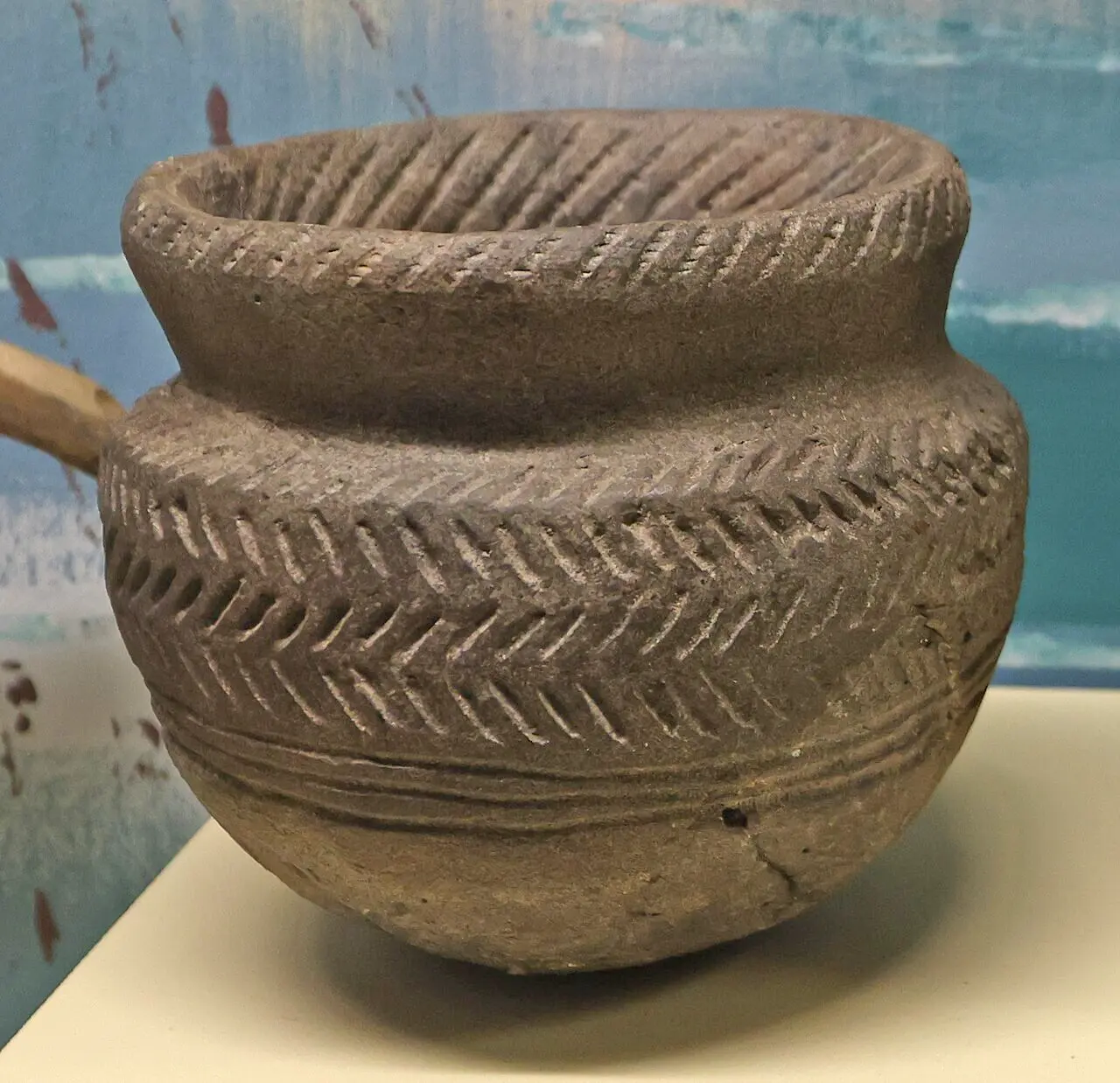
Peterborough Museum’s prehistoric collection today includes a Mortlake-style Peterborough Ware bowl found at Fengate, preserving that connection between archaeological terminology and the place where the story began.
What does Peterborough Ware look like?
Peterborough Ware is difficult to mistake once you learn to recognise it.
The pots are generally substantial bowls, often with thickened or expanded rims and surfaces covered with dense impressed decoration.
They are not smooth, restrained objects.
They demand to be touched.
Many vessels have strongly thickened, expanded or collared rims that create a distinctive silhouette.
Decoration can spread over rims, necks, shoulders and bodies rather than being restricted to a single band.
Cord, sticks, bone, fingernails and fingertips could all be pressed into the wet clay.
Materials such as crushed flint, shell or sand could be mixed with the clay to change its working and firing properties.
The result is pottery in which the act of making remains startlingly visible.
Fingerprints in five-thousand-year-old clay
Peterborough Museum describes the decoration as being made with twisted cord, bird bones, sticks and fingernails.
That list is extraordinary because it lets us imagine the moment of manufacture.
Pressed or rolled against soft clay to create repeated textured impressions.
The ends of bones could produce small repeated oval or angular impressions.
Lines, grooves, chevrons and other patterns could be incised directly into the surface.
The maker’s own body became a decorating tool, leaving repeated impressions around the vessel.
The decoration is not painted onto the surface. It is physically pressed into it.
That makes Peterborough Ware unusually intimate.
A fingertip impression is not simply a pattern. It is the point at which somebody living five thousand years ago physically touched the object we can still see today.
Made by hand, not by machine
There was no potter’s wheel in Neolithic Peterborough.
Vessels were made by hand from prepared clay.
Different techniques could be used, including building up the body from coils or pieces of clay and then working the surfaces together.
Suitable clay and tempering materials are collected.
The vessel is formed by hand rather than thrown on a wheel.
Patterns are impressed while the clay is still workable.
Heat transforms fragile clay into durable pottery.
Control of temperature and atmosphere was far less precise than in a modern kiln. Different parts of a vessel could therefore emerge brown, reddish, grey or almost black.
Crushed flint, shell, sand and other material mixed into the clay helped create workable ceramic fabrics suited to local resources and traditions.
Every pot was simultaneously a container, a piece of technology and an object shaped by somebody’s hands.
Ebbsfleet. Mortlake. Fengate.
Archaeologists traditionally divide Peterborough Ware into three principal sub-styles.
Often relatively restrained in form and decoration compared with the more heavily ornamented vessels.
The local Peterborough Museum example from Fengate is identified as a Mortlake-style bowl.
This sub-style takes its name directly from Fengate, the Peterborough landscape central to the early study of the pottery tradition.
This is also why a Mortlake-style bowl can perfectly well have been found at Fengate. Fengate is both a real place in Peterborough and the archaeological name later given to one particular Peterborough Ware sub-style.
Who owned a Peterborough Ware bowl?
No names survive.
We are more than three thousand years earlier than Sennianus writing his name on a Roman mortarium and more than four thousand years earlier than Peterborough’s medieval chroniclers writing on parchment.
With Peterborough Ware, people survive through materials rather than words.
These communities combined farming with hunting, gathering and exploitation of river and wetland resources.
They moved through a landscape of gravel terraces, river channels, woodland and increasingly important cleared spaces.
Pottery meant that substances could be stored, carried, prepared and served in durable containers.
But Peterborough Ware was more than purely functional.
Why spend time covering a useful container in elaborate repeated patterns if appearance carried no meaning?
Decoration may have expressed identity, tradition, relationships, occasion or simply ideas about how a proper vessel should look. Without written evidence, we cannot recover its exact social language.
What archaeology can show is that the patterns were shared.
Vessels recognisably belonging to the same broad tradition appear across large parts of Britain.
Peterborough, found far beyond Peterborough
This is one of the most intriguing things about the name.
Peterborough Ware was not manufactured only in Peterborough and exported across the country.
It is the archaeological name for a shared pottery tradition whose vessels were made in many different places.
Examples have been recovered across southern and eastern Britain and well beyond the lower Nene.
From Fengate to archaeological reports across Britain
Analysis of Peterborough Ware from different sites demonstrates that pots could be made from different regional clays and tempers.
So what spread was not simply the finished pottery.
Ideas spread.
Ideas about shape. Decoration. Craft. Perhaps food. Perhaps social identity.
People separated by considerable distances were participating in related ways of making and using pottery.
This was Peterborough before Flag Fen
The Fengate pottery belongs to a landscape much older than the prehistoric Peterborough most visitors know today.
Flag Fen was created largely after about 1300 BC.
The extraordinary settlement at Must Farm dates to around 850 BC.
Peterborough Ware takes us back another two thousand years.
Fengate was already attracting people thousands of years before the great timber causeway crossed the Flag Fen basin.
The Neolithic finds demonstrate repeated human activity on the gravel terraces beside what would later become the wet Fenland landscape.
By the Bronze Age, that relationship between dry ground and expanding wetland would become one of the defining features of prehistoric Peterborough.
Explore that later transformation through Flag Fen: Peterborough’s Extraordinary Bronze Age Landscape and Must Farm: Britain’s Bronze Age Time Capsule.
The story comes back to Peterborough Museum
Peterborough Museum holds major archaeological collections from Fengate and the wider Peterborough area.
Its First People displays include a Neolithic Peterborough Ware bowl of Mortlake style found at Fengate.
That makes it an especially fitting object for this collection.
It is not simply an example of a pottery type carrying the city’s name.
It comes from the place that helped create the name in the first place.
Peterborough Museum & Art Gallery
The Museum preserves an important archaeological collection from prehistoric Fengate and the wider Peterborough landscape, including Peterborough Ware and material spanning human occupation from the Palaeolithic onwards.
Why this is a Peterborough object
Peterborough Ware is important locally for an unusual reason.
The city did not simply produce the object.
It helped name the category.
A century of archaeological research has carried the word Peterborough into reports, museum catalogues, university departments and excavations across Britain.
An archaeologist can excavate a decorated pot in Wiltshire, Hampshire, Norfolk or London and describe it using the name of this city.
Yet its significance runs deeper than civic naming rights.
The pottery proves that the lower Nene was already an active human landscape more than five thousand years ago.
People made things here. They decorated them. They shared traditions with communities living far away. They used the river, the gravel terraces and the fen edge generations before the landscape we now associate with Bronze Age Peterborough had developed.
Before Peterborough had a Cathedral, before it had Roman roads, before it even had a name, people here were already making objects distinctive enough to be recognised five thousand years later.
The progression is extraordinary.
Peterborough Ware gives us Neolithic makers.
Flag Fen gives us Bronze Age builders and ritual.
Must Farm gives us Bronze Age homes and possessions.
Later objects such as the Sennianus Mortarium and Water Newton Treasure begin to give us named individuals, industry, religion and written words.
Together they reveal a Peterborough landscape occupied, organised and reimagined over millennia.